Key facts
- Dates
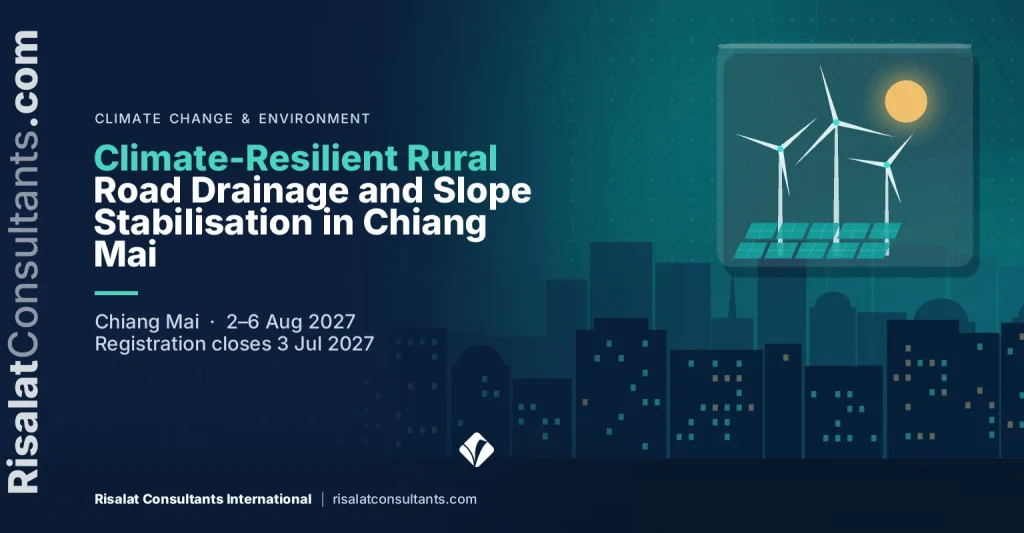
- 2–6 Aug 2027 (5 days)
- Where
- Chiang Mai, Thailand
- Fee per participant
- £3,750 (GBP)
- Payment
- By invoice and bank transfer
- Registration closes
- 3 Jul 2027
- Certificate
- Certificate of completion
- In-house option
- Run it for your team, on your dates
On this page 13 sections
Programme Overview
Climate change continues to escalate the frequency and severity of extreme rainfall events across Southeast Asia, placing rural transport networks under unprecedented hydrological stress. Unpaved and low-volume paved roads frequently suffer from severe culvert washouts, edge scouring, surface deterioration, and widespread slope failures during monsoon seasons. This course delivers rigorous technical guidance to design, construct, and maintain resilient rural road infrastructure capable of withstanding acute flash flooding, extended inundation, and progressive soil instability.
Hosted in Chiang Mai, Thailand, this five-day practical programme focuses on the application of sound engineering and hydraulic criteria for flood-resilient pavements and bio-engineered slope protection. Participants work through geotechnical assessments, hydrological modelling parameters, and catchment-level drainage planning aligned with international transport standards. The curriculum bridges the gap between high-level disaster risk management policies and day-to-day site execution, ensuring that rural accessibility is maintained even during extreme hydrological shocks.
Through applied design exercises, structural failure analyses, and practical drainage sizing simulations, infrastructure practitioners examine real-world vulnerabilities common to rural road corridors. Special attention is directed towards cost-effective intervention strategies, combining civil structures with nature-based solutions. Road authorities and project implementation teams gain the technical competencies necessary to implement climate-resilient engineering specifications, modernise maintenance operations, and safeguard critical rural mobility against recurring climate disasters.
Rural road networks across the region face regular disruption from intense monsoonal precipitation and compounding geotechnical hazards, isolating vulnerable rural communities and undermining economic connectivity. Significant capital investments funded through major initiatives, including the Cambodia Southeast Asia Disaster Risk Management Project 2 and the Cambodia Road Connectivity Improvement project, require project implementation units and highway engineers to integrate climate resilience directly into road asset lifecycles. Strengthening institutional capacity in flood-proofing standards, catchment drainage diagnostics, and emergency asset preservation is vital to protect capital investments and ensure uninterrupted all-weather access.
Delivered by Risalat Consultants International in Chiang Mai, Thailand, it combines expert-led sessions, real cases and group work, so that participants can apply what they learn in their own institution.
The Programme Strengthens Institutional Capability
- Regional climate trends, monsoonal impacts, and rural road vulnerability profiling
- Hydrological assessment methods: Rational Method and regional flood frequency curves
- Determination of design storms, return periods, and runoff coefficients for rural terrains
- Catchment delineation, flow path identification, and cross-drainage spacing criteria
- Practical exercise: Calculating peak discharge for rural cross-drainage structures
- Hydraulic capacity calculations for single and multi-cell pipe and box culverts
- Inlet and outlet control regimes, scour protection, and energy dissipators
- Longitudinal drainage: Trapezoidal, lined, and unlined side drain hydraulics
- Climate and environmental risk assessment
- Adaptation and mitigation planning
- Sector strategies for energy, water and land
- Project design for climate and environmental goals
It is designed for road design engineers and civil engineers from national road authorities, project Implementation Unit (PIU) directors, managers, and technical coordinators, ministry of Public Works and Transport technical officers and regional inspectors and others who want practical, current skills in climate, environment and natural resources.
The Growing Importance of Climate-Resilient Rural Road Drainage and Slope Stabilisation in Chiang Mai
Climate change, environmental pressure and resource management now shape national plans, budgets and investment decisions. Financiers increasingly expect climate and environmental considerations to be built into projects from the start.
Institutions that can plan for climate risks, manage natural resources well and prepare sound proposals are better placed to protect services and to access the funding available for this work.
Organisations increasingly require professionals capable of:
- Assess climate and environmental risks to their services and assets
- Design projects that meet climate and environmental goals
- Prepare proposals that financiers can approve
- Measure and report results credibly
- Work with communities and partners across sectors
Strong climate, environment and natural resources systems help organisations:
- Protect services and infrastructure from climate risks
- Access climate and environmental finance
- Meet national and international commitments
- Use natural resources sustainably
This Climate-Resilient Rural Road Drainage and Slope Stabilisation in Chiang Mai programme brings these elements together in a practical format, so that participants understand not only what good practice looks like but also how to introduce it in their own setting, with the people and resources they have.
Who Should Attend This Climate-Resilient Rural Road Drainage and Slope Stabilisation in Chiang Mai Training?
This programme is designed for:
- Road design engineers and civil engineers from national road authorities
- Project Implementation Unit (PIU) directors, managers, and technical coordinators
- Ministry of Public Works and Transport technical officers and regional inspectors
- Provincial and rural infrastructure development department engineers
- Hydraulic engineers and drainage infrastructure specialists
- Geotechnical and slope stabilisation field supervisors
- Disaster risk management and climate adaptation infrastructure advisors
- Resident engineers and site supervisors working on donor-financed transport projects
- Procurement and contract management specialists overseeing rural road works
- Climate change and environment officers
- Energy, water and agriculture sector staff
- Planning and policy officers
The programme suits experienced professionals as well as those moving into new responsibilities. Groups that mix institutions and countries are encouraged, because participants learn a great deal from each other’s experience.
Tick what your team needs to be able to do.
Climate-Resilient Rural Road Drainage and Slope Stabilisation in Chiang Mai Training Objectives
Upon successful completion of this Climate-Resilient Rural Road Drainage and Slope Stabilisation in Chiang Mai Training, participants will be able to:
- Analyse catchment hydrology and extreme rainfall intensity data to determine design discharge for rural drainage assets
- Apply hydraulic and geotechnical design criteria to size culverts, side drains, and outfall structures for flood conditions
- Design robust slope stabilisation solutions integrating bio-engineering techniques with conventional geotechnical retaining systems
- Evaluate pavement foundation materials and subgrade stabilisation options for roads subjected to high water tables and inundation
- Conduct field-level vulnerability assessments and structural failure forensics on rural road corridors
- Formulate post-disaster rapid damage assessments and emergency rehabilitation schedules within asset management systems
- Prepare climate-resilient technical specifications and bill of quantities aligned with multilateral donor procurement frameworks
- Explain the main climate and environmental challenges for their sector
- Assess climate and environmental risks to services and assets
- Plan adaptation and mitigation measures
Each objective is practised during the programme through exercises, cases or group work, so that participants leave able to do it, not only to describe it.
Programme Contents and Structure
- Regional climate trends, monsoonal impacts, and rural road vulnerability profiling
- Hydrological assessment methods: Rational Method and regional flood frequency curves
- Determination of design storms, return periods, and runoff coefficients for rural terrains
- Catchment delineation, flow path identification, and cross-drainage spacing criteria
- Practical exercise: Calculating peak discharge for rural cross-drainage structures
- Hydraulic capacity calculations for single and multi-cell pipe and box culverts
- Inlet and outlet control regimes, scour protection, and energy dissipators
- Longitudinal drainage: Trapezoidal, lined, and unlined side drain hydraulics
- Design of ford crossings, vented causeways, and submersible bridge alternatives
- Simulation workshop: Optimising culvert sizing to prevent embankment overtopping
- Mechanisms of rural road slope failures, shallow slips, and embankment erosion
- Soil mechanics, pore water pressure dynamics, and cut-and-fill slope design
- Gravity structures, gabion mattresses, riprap, and geosynthetic-reinforced soil systems
- Bio-engineering techniques: Vetiver grass systems, brush layering, and live fascines
- Design workshop: Integrated geotechnical and vegetative slope stabilisation plans
- Behaviour of low-volume rural pavements under saturated and flooded conditions
- Subgrade improvement: Lime, cement, and chemical stabilisation techniques
- Drainage layers, permeable aggregate bases, and sub-surface water management
- Surface treatment resilience: Double Bituminous Surface Treatment (DBST) versus concrete paving
- Pavement lifecycle costing and material selection for recurring flood zones
- Rapid post-flood structural damage inspection protocols and scoring matrices
- Emergency road opening priorities versus planned climate adaptation retrofits
- Integrating resilience metrics into routine, periodic, and emergency maintenance programmes
- Developing donor-compliant technical specifications and quality assurance procedures
- Action planning: Formulating corridor-level climate adaptation investment proposals
Full day-by-day contents
The programme runs over 5 days. Each day combines expert input, practical work and a closing workshop or case study:
- First Day: Hydrological Analysis and Catchment-Level Drainage Design
- Second Day: Hydraulic Design of Cross-Drainage and Longitudinal Structures
- Third Day: Geotechnical Stability, Embankment Design, and Slope Protection
- Fourth Day: Flood-Resilient Pavement Design and Subgrade Protection
- Fifth Day: Post-Disaster Asset Management, Inspection, and Project Implementation
Full day-by-day contents
First Day | Hydrological Analysis and Catchment-Level Drainage Design
- Regional climate trends, monsoonal impacts, and rural road vulnerability profiling
- Hydrological assessment methods: Rational Method and regional flood frequency curves
- Determination of design storms, return periods, and runoff coefficients for rural terrains
- Catchment delineation, flow path identification, and cross-drainage spacing criteria
- Practical exercise: Calculating peak discharge for rural cross-drainage structures
Workshop: Hydrological Analysis and Catchment-Level Drainage Design: Applying It to Your Institution
Working in small groups, participants apply the day's methods to examples from their own institutions and agree practical next steps.
Second Day | Hydraulic Design of Cross-Drainage and Longitudinal Structures
- Hydraulic capacity calculations for single and multi-cell pipe and box culverts
- Inlet and outlet control regimes, scour protection, and energy dissipators
- Longitudinal drainage: Trapezoidal, lined, and unlined side drain hydraulics
- Design of ford crossings, vented causeways, and submersible bridge alternatives
- Simulation workshop: Optimising culvert sizing to prevent embankment overtopping
Workshop: Hydraulic Design of Cross-Drainage and Longitudinal Structures: Applying It to Your Institution
Working in small groups, participants apply the day's methods to examples from their own institutions and agree practical next steps.
Third Day | Geotechnical Stability, Embankment Design, and Slope Protection
- Mechanisms of rural road slope failures, shallow slips, and embankment erosion
- Soil mechanics, pore water pressure dynamics, and cut-and-fill slope design
- Gravity structures, gabion mattresses, riprap, and geosynthetic-reinforced soil systems
- Bio-engineering techniques: Vetiver grass systems, brush layering, and live fascines
- Design workshop: Integrated geotechnical and vegetative slope stabilisation plans
Case Study: Geotechnical Stability, Embankment Design, and Slope Protection in Practice
Participants analyse a realistic case, compare the choices made with good practice and draw lessons they can use in their own setting.
Fourth Day | Flood-Resilient Pavement Design and Subgrade Protection
- Behaviour of low-volume rural pavements under saturated and flooded conditions
- Subgrade improvement: Lime, cement, and chemical stabilisation techniques
- Drainage layers, permeable aggregate bases, and sub-surface water management
- Surface treatment resilience: Double Bituminous Surface Treatment (DBST) versus concrete paving
- Pavement lifecycle costing and material selection for recurring flood zones
Workshop: Flood-Resilient Pavement Design and Subgrade Protection: Applying It to Your Institution
Working in small groups, participants apply the day's methods to examples from their own institutions and agree practical next steps.
Fifth Day | Post-Disaster Asset Management, Inspection, and Project Implementation
- Rapid post-flood structural damage inspection protocols and scoring matrices
- Emergency road opening priorities versus planned climate adaptation retrofits
- Integrating resilience metrics into routine, periodic, and emergency maintenance programmes
- Developing donor-compliant technical specifications and quality assurance procedures
- Action planning: Formulating corridor-level climate adaptation investment proposals
Capstone Exercise: Climate-Resilient Rural Road Drainage and Slope Stabilisation in Chiang Mai Action Plan for Your Institution
Participants bring the week together in an action plan for their own institution, with priorities, owners and first steps, and present it for feedback from peers and facilitators.
Climate-Resilient Rural Road Drainage and Slope Stabilisation in Chiang Mai Training Methodology
The training employs an applied, engineering-focused adult learning methodology combining technical lectures with interactive design exercises. Participants examine real rural transport case studies, conduct manual and spreadsheet-based hydraulic calculations, and evaluate geotechnical failure scenarios. Daily group exercises require multi-disciplinary teams to resolve practical site constraints using field simulation data. Peer review sessions and plenary discussions ensure participants can directly translate structural and hydrological standards into project execution workflows.
The programme combines:
- Expert-led sessions on current practice
- Regional and international case studies
- Group work and practical exercises
- Simulations and role plays where relevant
- Discussion of participants' own challenges
- Peer learning across institutions and countries
- Practical tools and templates to take back to work
- Daily reflection and action planning
Before the programme, a short pre-assessment helps the facilitators understand each participant’s role and priorities, so that examples and exercises can be adjusted to the group. Each day ends with a short reflection in which participants note what they will apply at work.
- Funds
- Entity
- Project
- Results
- MRV
Expected Outcomes
Upon completion of this Climate-Resilient Rural Road Drainage and Slope Stabilisation in Chiang Mai Training, participants will be able to:
- Select appropriate hydrological return periods and design discharge values for rural road structures
- Produce hydraulic designs for culverts, side drains, and energy dissipators that resist scouring and siltation
- Deploy integrated mechanical and bio-engineered slope stabilization solutions on vulnerable cut-and-fill slopes
- Specify pavement layers and subgrade treatments that maintain structural capacity during saturation
- Execute systematic post-flood damage assessments to inform rapid repairs and capital investment planning
- Draft climate-resilient construction guidelines and terms of reference for infrastructure implementation units
- Assess climate and environmental risks
- Plan adaptation and mitigation measures
Participants leave with a personal action plan and practical tools they can use in their institution from the first week back. Institutions that send several participants can use the programme to agree shared methods and templates across teams, which makes improvements easier to sustain.
£3,750 per participant · invoice and bank transfer · groups of 5 or more receive a discount
Five or more from one organisation: ask for the group rate on the invoice request.
Ten or more: an in-house version for your institution may cost less per person. Ask for an in-house quote.
Registration closes in 238 days (3 Jul 2027)
Institutional Application of Climate-Resilient Rural Road Drainage and Slope Stabilisation in Chiang Mai Training
This programme supports organisations in strengthening:
- Climate and environmental planning
- Project design
- Access to finance
- Results measurement
- Stakeholder involvement
Participants return with practical tools to improve:
- Risk assessments
- Concept notes
- Results frameworks
- Monitoring systems
- Partnership arrangements
The programme is built so that learning moves from the classroom into the institution. Participants work on their own processes and documents where possible, and leave with an action plan that their managers can review and support.
Regional Relevance & Application
Europe
European institutions apply climate, environment and natural resources within detailed regulatory frameworks and reform agendas. Participants from Europe can compare their practice with colleagues from other regions and test how established methods work under different conditions.
Africa
Across Africa, ministries, agencies and project teams working in climate, environment and natural resources increasingly operate alongside donor-financed programmes that expect clear systems and evidence. The programme helps participants adapt good practice to the institutions and resources they work with.
Middle East
In the Middle East, national development strategies and diversification plans place growing demands on climate, environment and natural resources. Participants explore how to build the capability these plans need inside public bodies and companies.
Asia
Institutions across Asia combine rapid growth with ambitious modernisation programmes. Participants from Asia can share their experience of scaling systems quickly and learn from approaches used elsewhere.
Pacific
Small island and Pacific states face particular constraints of size, distance and capacity. The programme highlights practical, proportionate approaches to climate, environment and natural resources that suit smaller institutions.
Holding the programme in Chiang Mai, Thailand brings participants together away from their daily pressures, so they can compare how climate, environment and natural resources is handled in different settings. The same programme can also be delivered in-house for one institution, in its own country or online, with cases taken from its current work.
Host Country Profile – Thailand
Training programmes and study tours in Chiang Mai suit professionals working in public administration, community development, environmental resource management, and regional tourism planning.
Studying away from their own country gives participants time to focus, a fresh view of their own institution and the chance to build a network with colleagues from other countries.
Climate-Resilient Rural Road Drainage and Slope Stabilisation in Chiang Mai Training Deliverables
Participants receive support before, during and after the programme, so that preparation, learning and follow-up form one continuous experience.
Before the Programme
- Participant Pre-Assessment
- Climate-Resilient Rural Road Drainage and Slope Stabilisation in Chiang Mai Readiness Assessment
- Climate-Resilient Rural Road Drainage and Slope Stabilisation in Chiang Mai Resource Pack
- Preparatory Reading Materials
- Complimentary Visa Support & Advisory
During the Programme
- Airport Pickup & Welcome Assistance
- Accommodation with Breakfast
- Welcome Networking Dinner
- Risalat Training Kit (Bag, Bottle, Mug, T-Shirt, Cap, Passport Cover, Pens, Notebook, Magnet & Keychain)
- Comprehensive Climate-Resilient Rural Road Drainage and Slope Stabilisation in Chiang Mai Training Manual
- Climate Risk Screening Checklist
- Options Appraisal Template
- Concept Note Template
- Results Measurement Template
- Practical Workshops & Simulations
- Group Discussions & Peer Learning
- Daily Lunch and Refreshments
- Full Access to Training Venue Facilities
- Mini Pad / Tablet with Digital Learning Materials
- Field Visit (where applicable)
- Entertaining City Tour
After the Programme
- Certificate of Completion
- Risalat Programme Participation Recognition Award
- Post-Training Reference Materials
- Funding Readiness Checklist
- Monitoring and Reporting Template
- Post-Training Support & Follow-Up Guidance
- Programme Report
Institutions can also request a tailored in-house version of this programme, delivered at their premises or online. Request a proposal.
Common Challenges in Climate-Resilient Rural Road Drainage and Slope Stabilisation in Chiang Mai, And How This Training Helps
How can institutions assess climate and environmental risks to their services and assets?
The programme addresses this directly on the first day (Hydrological Analysis and Catchment-Level Drainage Design), where participants practise the methods involved and adapt them to their own institution, then build it into their action plan.
How can institutions design projects that meet climate and environmental goals?
The programme addresses this directly on the second day (Hydraulic Design of Cross-Drainage and Longitudinal Structures), where participants practise the methods involved and adapt them to their own institution, then build it into their action plan.
How can institutions prepare proposals that financiers can approve?
The programme addresses this directly on the third day (Geotechnical Stability, Embankment Design, and Slope Protection), where participants practise the methods involved and adapt them to their own institution, then build it into their action plan.
How can institutions measure and report results credibly?
The programme addresses this directly on the fourth day (Flood-Resilient Pavement Design and Subgrade Protection), where participants practise the methods involved and adapt them to their own institution, then build it into their action plan.
How can institutions work with communities and partners across sectors?
The programme addresses this directly on the fifth day (Post-Disaster Asset Management, Inspection, and Project Implementation), where participants practise the methods involved and adapt them to their own institution, then build it into their action plan.
Frequently Asked Questions
When and where does the Climate-Resilient Rural Road Drainage and Slope Stabilisation in Chiang Mai programme take place?
It runs from 2 Aug 2027 to 6 Aug 2027, in Chiang Mai, Thailand. The registration deadline is shown at the top of this page.
Who should attend?
The programme is designed for road design engineers and civil engineers from national road authorities, project Implementation Unit (PIU) directors, managers, and technical coordinators, ministry of Public Works and Transport technical officers and regional inspectors, provincial and rural infrastructure development department engineers, and others who want practical skills in climate, environment and natural resources.
Will I receive a certificate?
Yes. Participants who complete the programme receive a Certificate of Completion from Risalat Consultants International.
Can this programme be delivered for our institution only?
Yes. We can deliver a tailored in-house version at your premises, in another city or online, built around your own cases. Use the proposal request on this page.
Do I need prior experience in climate, environment and natural resources?
No specialist background is required beyond experience in a related role. A short pre-assessment helps the facilitators adapt the sessions to the group.
Training courses in Chiang MaiClimate Change & Environment training courses
Why Chiang Mai for this programme
Chiang Mai is an established educational and development centre in northern Thailand, home to Chiang Mai University and regional research institutes. Visiting officials can examine local community-based tourism, royal agricultural development projects, and sustainable environmental initiatives. Chiang Mai International Airport offers straightforward flight connections to Bangkok and major transport hubs across Asia.
The Climate-Resilient Rural Road Drainage and Slope Stabilisation in Chiang Mai programme in August 2027 brings together officials and professionals from across the Asia region and beyond. Sessions combine short inputs, case studies and group work on participants' own files, and the city's institutions can be added as a study visit on request.
Getting there: Chiang Mai International Airport (CNX).
Check whether you need a visa with the free Visa Checker, and ask for an invitation letter once you are registered.
The same topic in other cities
Other programmes in Chiang Mai
- Maternal and Child Health Social Behaviour Change Design in Chiang Mai
- Community-Based Stunting and Child Growth Monitoring in Chiang Mai
- Agri-Enterprise Incubation & Producer Commercialisation Schemes in Chiang Mai
- Agricultural Extension Modernisation & Climate-Smart Practices in Chiang Mai
Related: Climate finance and energy programmes · free Climate Finance Proposal Readiness · all programmes
- United Nations Framework Convention on Climate Change UNFCCC
- UN Office for Disaster Risk Reduction UNDRR
- Adaptation Fund Adaptation Fund
More training courses in Thailand · All programmes in Asia · Full training calendar