Key facts
- Dates
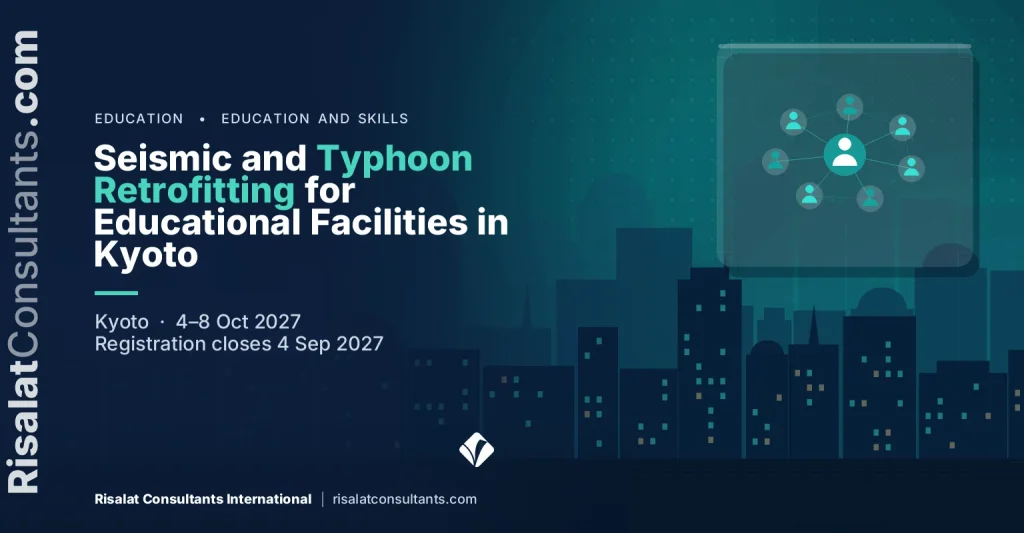
- 4–8 Oct 2027 (5 days)
- Where
- Kyoto, Japan
- Fee per participant
- £3,250 (GBP)
- Payment
- By invoice and bank transfer
- Registration closes
- 4 Sep 2027
- Certificate
- Certificate of completion
- In-house option
- Run it for your team, on your dates
On this page 13 sections
Programme Overview
Educational infrastructure across hazard-prone regions faces severe risks from high-magnitude earthquakes and extreme wind loads. This five-day executive course in Kyoto provides public sector technical specialists with advanced competencies in structural diagnosis, retrofit design, and construction supervision. Drawing upon rigorous Japanese engineering methodologies and international best practice, the curriculum addresses the unique vulnerabilities of masonry and prefabricated learning facilities. Participants explore evidence-based technical solutions designed to preserve asset integrity and ensure life safety during catastrophic natural hazard occurrences.
The programme focuses on the end-to-end engineering cycle required for upgrading public school structures. Participants examine multi-hazard vulnerability assessments, code-mandated design benchmarks, and structural diagnostic techniques. Through applied technical sessions, attendees evaluate performance-based retrofitting measures, load path continuity, and connection detailing tailored for non-engineered masonry, reinforced concrete frames, and light-gauge steel classrooms. Instruction emphasises practical compliance with international standards and national building regulations, equipping technical officers to critically evaluate retrofitting designs prepared by third-party engineering consultants.
Delivered through a combination of engineering analysis and simulated operational reviews, the training bridges design principles and site-level enforcement. Attendees review structural health monitoring data, assess material testing protocols, and establish rigorous quality surveillance frameworks for public works execution. The course also addresses contractor monitoring, structural site inspections, and practical verification methodologies. By completing this programme, government engineers and technical reviewers gain the direct capabilities required to supervise large-scale rehabilitation projects and eliminate systemic construction flaws in vulnerable school estates.
Educational networks across the Asia-Pacific region face recurring devastation from overlapping geophysical and hydro-meteorological shocks. Massive international development portfolios, including large-scale interventions such as the multi-million dollar Infrastructure for Safer and Resilient Schools project, require immediate technical execution capacity across government agencies. Public works authorities and education ministries need specialised structural competence to oversee procurement, appraise multi-hazard engineering interventions, and maintain quality assurance. Ensuring structural resilience protects development capital, avoids continuous reconstruction cycles, and safeguards vulnerable school communities against projected seismic events and intensified tropical cyclones.
Delivered by Risalat Consultants International in Kyoto, Japan, it combines expert-led sessions, real cases and group work, so that participants can apply what they learn in their own institution.
The Programme Strengthens Institutional Capability
- Multi-hazard vulnerability dynamics: Concurrent seismic ground motion and typhoon wind pressures
- Performance benchmarks for educational infrastructure: Life safety versus immediate occupancy limits
- Diagnostic protocols for unreinforced masonry, confined masonry, and reinforced concrete school typologies
- Structural pathology of prefabricated and transitional learning spaces under cyclic lateral loading
- Non-destructive testing methods: Rebound hammer, ultrasonic pulse velocity, and rebar detection
- Seismic vulnerability calculations under the National Structural Code of the Philippines and international codes
- Load-bearing wall strengthening: Ferro-cement jackets, reinforced plaster overlays, and carbon-fibre composites
- Reinforced concrete frame enhancement: Column jacketing, beam-column joint confining, and shear wall integration
- Service planning and management
- Quality improvement and standards
- Human resources and workforce planning
- Financing and budgeting for services
It is designed for department of Education project engineers and technical unit specialists, school Infrastructure Unit directors, coordinators, and facility supervisors, department of Public Works and Highways structural plan reviewers and design evaluators and others who want practical, current skills in health, education and social services.
The Growing Importance of Seismic and Typhoon Retrofitting for Educational Facilities in Kyoto
Health, education and social services reach people directly, and their quality depends on planning, management and the use of evidence. Governments and partners expect better results from limited budgets.
Leaders and managers in these sectors face rising demand, staff shortages and new technologies. Strong management skills help institutions plan services, use resources well and show results.
Organisations increasingly require professionals capable of:
- Plan and manage services to meet demand
- Improve quality against standards
- Manage staff and resources effectively
- Use data to guide decisions
- Work with communities and partners
Strong health, education and social services systems help organisations:
- Deliver better services to more people
- Use budgets and staff efficiently
- Meet quality standards
- Show results to government and partners
This Seismic and Typhoon Retrofitting for Educational Facilities in Kyoto programme brings these elements together in a practical format, so that participants understand not only what good practice looks like but also how to introduce it in their own setting, with the people and resources they have.
Who Should Attend This Seismic and Typhoon Retrofitting for Educational Facilities in Kyoto Training?
This programme is designed for:
- Department of Education project engineers and technical unit specialists
- School Infrastructure Unit directors, coordinators, and facility supervisors
- Department of Public Works and Highways structural plan reviewers and design evaluators
- Municipal and provincial building officials responsible for public infrastructure safety
- Structural engineers managing donor-financed education recovery and resilience portfolios
- Procurement and contract managers supervising educational civil works frameworks
- Quality assurance and civil works inspection engineers in public ministries
- Disaster risk reduction and infrastructure resilience programme specialists
- Consulting structural engineers contracted for school vulnerability assessments
- Civil works monitors executing multilateral development bank educational upgrades
- Service managers and administrators
- Directors and senior officials
The programme suits experienced professionals as well as those moving into new responsibilities. Groups that mix institutions and countries are encouraged, because participants learn a great deal from each other’s experience.
Tick what your team needs to be able to do.
Seismic and Typhoon Retrofitting for Educational Facilities in Kyoto Training Objectives
Upon successful completion of this Seismic and Typhoon Retrofitting for Educational Facilities in Kyoto Training, participants will be able to:
- Appraise multi-hazard structural vulnerability assessments for masonry and prefabricated educational assets
- Evaluate structural compliance against the National Structural Code of the Philippines and relevant Japanese seismic codes
- Design cost-effective retrofit interventions to mitigate seismic shear failure and typhoon roof uplift
- Formulate robust quality assurance protocols for structural steel, concrete strengthening, and masonry stitching
- Simulate structural site supervision routines to verify contractor compliance with detailed engineering designs
- Analyse structural performance limits using standard non-destructive testing and material investigation results
- Establish rigorous civil works acceptance and sign-off criteria for donor-funded school rehabilitation schemes
- Explain the main challenges facing their sector
- Plan services that match demand and resources
- Apply quality improvement methods
Each objective is practised during the programme through exercises, cases or group work, so that participants leave able to do it, not only to describe it.
Programme Contents and Structure
- Multi-hazard vulnerability dynamics: Concurrent seismic ground motion and typhoon wind pressures
- Performance benchmarks for educational infrastructure: Life safety versus immediate occupancy limits
- Diagnostic protocols for unreinforced masonry, confined masonry, and reinforced concrete school typologies
- Structural pathology of prefabricated and transitional learning spaces under cyclic lateral loading
- Non-destructive testing methods: Rebound hammer, ultrasonic pulse velocity, and rebar detection
- Seismic vulnerability calculations under the National Structural Code of the Philippines and international codes
- Load-bearing wall strengthening: Ferro-cement jackets, reinforced plaster overlays, and carbon-fibre composites
- Reinforced concrete frame enhancement: Column jacketing, beam-column joint confining, and shear wall integration
- Diaphragm stiffening and ring-beam construction to establish complete lateral load paths
- Case review of Japanese seismic retrofit technologies for historic and institutional educational buildings
- Extreme wind action on low-rise institutional structures: ASCE 7 and local code wind load provisions
- Roof envelope vulnerability: Uplift pressures, purlin connections, and structural truss anchorage systems
- Retrofitting timber and light-gauge steel trusses using engineered gussets, hurricane clips, and tie-down straps
- Window protection, opening reinforcement, and preventing internal pressurisation failures in classroom blocks
- Design and detailing of wind-resistant school roofing assemblies and continuous structural load continuity
- Quality control frameworks for donor-funded civil works: World Bank, ADB, and international benchmarks
- Material testing standards: Concrete core extraction, compressive testing, and reinforcing steel tensile evaluation
- Structural steel fabrication, welding inspection, and anchor bolt torque verification protocols
- Assessing structural repair materials: Non-shrink grouts, epoxy injection resins, and shotcrete mixes
- Developing risk-based inspection checklists and hold-point schedules for educational construction sites
- Site supervisory routines: Resolving non-compliance, material deviations, and contractor execution defects
- Structural audit simulation: Evaluating contractor submittals, bar bending schedules, and shop drawings
- Environmental safeguards, worker safety, and operational continuity management in functioning school sites
- Structural verification criteria for practical completion, defect liability monitoring, and asset handover
- Participant presentations: Developing a school-specific multi-hazard structural retrofitting strategy
Full day-by-day contents
The programme runs over 5 days. Each day combines expert input, practical work and a closing workshop or case study:
- First Day: Day 1: Structural Hazard Profiling and School Vulnerability Diagnostics
- Second Day: Day 2: Seismic Retrofitting Methodologies and Code Compliance
- Third Day: Day 3: Typhoon Wind Engineering and Structural Envelope Retrofitting
- Fourth Day: Day 4: Quality Surveillance, Material Standards, and Laboratory Verification
- Fifth Day: Day 5: Construction Supervision Simulation and Contractual Close-out
Full day-by-day contents
First Day | Day 1: Structural Hazard Profiling and School Vulnerability Diagnostics
- Multi-hazard vulnerability dynamics: Concurrent seismic ground motion and typhoon wind pressures
- Performance benchmarks for educational infrastructure: Life safety versus immediate occupancy limits
- Diagnostic protocols for unreinforced masonry, confined masonry, and reinforced concrete school typologies
- Structural pathology of prefabricated and transitional learning spaces under cyclic lateral loading
- Non-destructive testing methods: Rebound hammer, ultrasonic pulse velocity, and rebar detection
Workshop: Day 1: Structural Hazard Profiling and School Vulnerability Diagnostics: Applying It to Your Institution
Working in small groups, participants apply the day's methods to examples from their own institutions and agree practical next steps.
Second Day | Day 2: Seismic Retrofitting Methodologies and Code Compliance
- Seismic vulnerability calculations under the National Structural Code of the Philippines and international codes
- Load-bearing wall strengthening: Ferro-cement jackets, reinforced plaster overlays, and carbon-fibre composites
- Reinforced concrete frame enhancement: Column jacketing, beam-column joint confining, and shear wall integration
- Diaphragm stiffening and ring-beam construction to establish complete lateral load paths
- Case review of Japanese seismic retrofit technologies for historic and institutional educational buildings
Workshop: Day 2: Seismic Retrofitting Methodologies and Code Compliance: Applying It to Your Institution
Working in small groups, participants apply the day's methods to examples from their own institutions and agree practical next steps.
Third Day | Day 3: Typhoon Wind Engineering and Structural Envelope Retrofitting
- Extreme wind action on low-rise institutional structures: ASCE 7 and local code wind load provisions
- Roof envelope vulnerability: Uplift pressures, purlin connections, and structural truss anchorage systems
- Retrofitting timber and light-gauge steel trusses using engineered gussets, hurricane clips, and tie-down straps
- Window protection, opening reinforcement, and preventing internal pressurisation failures in classroom blocks
- Design and detailing of wind-resistant school roofing assemblies and continuous structural load continuity
Case Study: Day 3: Typhoon Wind Engineering and Structural Envelope Retrofitting in Practice
Participants analyse a realistic case, compare the choices made with good practice and draw lessons they can use in their own setting.
Fourth Day | Day 4: Quality Surveillance, Material Standards, and Laboratory Verification
- Quality control frameworks for donor-funded civil works: World Bank, ADB, and international benchmarks
- Material testing standards: Concrete core extraction, compressive testing, and reinforcing steel tensile evaluation
- Structural steel fabrication, welding inspection, and anchor bolt torque verification protocols
- Assessing structural repair materials: Non-shrink grouts, epoxy injection resins, and shotcrete mixes
- Developing risk-based inspection checklists and hold-point schedules for educational construction sites
Workshop: Day 4: Quality Surveillance, Material Standards, and Laboratory Verification: Applying It to Your Institution
Working in small groups, participants apply the day's methods to examples from their own institutions and agree practical next steps.
Fifth Day | Day 5: Construction Supervision Simulation and Contractual Close-out
- Site supervisory routines: Resolving non-compliance, material deviations, and contractor execution defects
- Structural audit simulation: Evaluating contractor submittals, bar bending schedules, and shop drawings
- Environmental safeguards, worker safety, and operational continuity management in functioning school sites
- Structural verification criteria for practical completion, defect liability monitoring, and asset handover
- Participant presentations: Developing a school-specific multi-hazard structural retrofitting strategy
Capstone Exercise: Seismic and Typhoon Retrofitting for Educational Facilities in Kyoto Action Plan for Your Institution
Participants bring the week together in an action plan for their own institution, with priorities, owners and first steps, and present it for feedback from peers and facilitators.
- Transaction
- Record
- Control
- Evidence
- Opinion
Seismic and Typhoon Retrofitting for Educational Facilities in Kyoto Training Methodology
The training employs a participatory, engineering-led instructional methodology combining analytical lectures, design problem-solving, and practical technical exercises. Participants work with real structural drawings, diagnostic inspection data, and material testing results to evaluate real failure modes. Peer working groups execute simulated structural reviews, non-compliance investigations, and site supervisory exercises mirroring multilateral donor project governance. Technical exchanges integrate local Japanese structural mitigation experience with the practical administrative and procurement frameworks governing public educational works in developing member countries.
The programme combines:
- Expert-led sessions on current practice
- Regional and international case studies
- Group work and practical exercises
- Simulations and role plays where relevant
- Discussion of participants' own challenges
- Peer learning across institutions and countries
- Practical tools and templates to take back to work
- Daily reflection and action planning
Before the programme, a short pre-assessment helps the facilitators understand each participant’s role and priorities, so that examples and exercises can be adjusted to the group. Each day ends with a short reflection in which participants note what they will apply at work.
Expected Outcomes
Upon completion of this Seismic and Typhoon Retrofitting for Educational Facilities in Kyoto Training, participants will be able to:
- Demonstrated capability to evaluate vulnerability assessment reports and select appropriate school retrofit systems
- Competence in verifying structural calculations against international wind and earthquake engineering standards
- Proficiency in detailing seismic and typhoon retrofit connections for concrete, masonry, and steel classrooms
- Ability to enforce site quality control regimes, non-destructive testing protocols, and material compliance audits
- Operational readiness to conduct structured civil works inspections and manage defect remediation cycles
- Formulation of standard technical evaluation rubrics for donor-funded school rehabilitation project pipelines
- Plan services to meet demand
- Improve quality against standards
Participants leave with a personal action plan and practical tools they can use in their institution from the first week back. Institutions that send several participants can use the programme to agree shared methods and templates across teams, which makes improvements easier to sustain.
£3,250 per participant · invoice and bank transfer · groups of 5 or more receive a discount
Five or more from one organisation: ask for the group rate on the invoice request.
Ten or more: an in-house version for your institution may cost less per person. Ask for an in-house quote.
Registration closes in 300 days (4 Sep 2027)
Institutional Application of Seismic and Typhoon Retrofitting for Educational Facilities in Kyoto Training
This programme supports organisations in strengthening:
- Service planning
- Quality management
- Workforce management
- Data use
- Partnerships
Participants return with practical tools to improve:
- Service plans
- Quality reviews
- Workforce plans
- Performance reports
- Supply planning
The programme is built so that learning moves from the classroom into the institution. Participants work on their own processes and documents where possible, and leave with an action plan that their managers can review and support.
Regional Relevance & Application
Europe
European institutions apply health, education and social services within detailed regulatory frameworks and reform agendas. Participants from Europe can compare their practice with colleagues from other regions and test how established methods work under different conditions.
Africa
Across Africa, ministries, agencies and project teams working in health, education and social services increasingly operate alongside donor-financed programmes that expect clear systems and evidence. The programme helps participants adapt good practice to the institutions and resources they work with.
Middle East
In the Middle East, national development strategies and diversification plans place growing demands on health, education and social services. Participants explore how to build the capability these plans need inside public bodies and companies.
Asia
Institutions across Asia combine rapid growth with ambitious modernisation programmes. Participants from Asia can share their experience of scaling systems quickly and learn from approaches used elsewhere.
Pacific
Small island and Pacific states face particular constraints of size, distance and capacity. The programme highlights practical, proportionate approaches to health, education and social services that suit smaller institutions.
Holding the programme in Kyoto, Japan brings participants together away from their daily pressures, so they can compare how health, education and social services is handled in different settings. The same programme can also be delivered in-house for one institution, in its own country or online, with cases taken from its current work.
Host Country Profile – Japan
Risalat Consultants International runs open-enrolment training programmes in Kyoto, Japan for officials, project teams and professionals from across the region. Dates, fees and what each programme covers are listed above, and any programme can also be delivered in-house for your institution.
Studying away from their own country gives participants time to focus, a fresh view of their own institution and the chance to build a network with colleagues from other countries.
Seismic and Typhoon Retrofitting for Educational Facilities in Kyoto Training Deliverables
Participants receive support before, during and after the programme, so that preparation, learning and follow-up form one continuous experience.
Before the Programme
- Participant Pre-Assessment
- Seismic and Typhoon Retrofitting for Educational Facilities in Kyoto Readiness Assessment
- Seismic and Typhoon Retrofitting for Educational Facilities in Kyoto Resource Pack
- Preparatory Reading Materials
- Complimentary Visa Support & Advisory
During the Programme
- Airport Pickup & Welcome Assistance
- Accommodation with Breakfast
- Welcome Networking Dinner
- Risalat Training Kit (Bag, Bottle, Mug, T-Shirt, Cap, Passport Cover, Pens, Notebook, Magnet & Keychain)
- Comprehensive Seismic and Typhoon Retrofitting for Educational Facilities in Kyoto Training Manual
- Service Planning Template
- Quality Improvement Plan Template
- Workforce Planning Template
- Performance Dashboard Template
- Practical Workshops & Simulations
- Group Discussions & Peer Learning
- Daily Lunch and Refreshments
- Full Access to Training Venue Facilities
- Mini Pad / Tablet with Digital Learning Materials
- Field Visit (where applicable)
- Entertaining City Tour
After the Programme
- Certificate of Completion
- Risalat Programme Participation Recognition Award
- Post-Training Reference Materials
- Service Review Checklist
- Improvement Tracking Sheet
- Post-Training Support & Follow-Up Guidance
- Programme Report
Institutions can also request a tailored in-house version of this programme, delivered at their premises or online. Request a proposal.
Common Challenges in Seismic and Typhoon Retrofitting for Educational Facilities in Kyoto, And How This Training Helps
How can institutions plan and manage services to meet demand?
The programme addresses this directly on the first day (Day 1: Structural Hazard Profiling and School Vulnerability Diagnostics), where participants practise the methods involved and adapt them to their own institution, then build it into their action plan.
How can institutions improve quality against standards?
The programme addresses this directly on the second day (Day 2: Seismic Retrofitting Methodologies and Code Compliance), where participants practise the methods involved and adapt them to their own institution, then build it into their action plan.
How can institutions manage staff and resources effectively?
The programme addresses this directly on the third day (Day 3: Typhoon Wind Engineering and Structural Envelope Retrofitting), where participants practise the methods involved and adapt them to their own institution, then build it into their action plan.
How can institutions use data to guide decisions?
The programme addresses this directly on the fourth day (Day 4: Quality Surveillance, Material Standards, and Laboratory Verification), where participants practise the methods involved and adapt them to their own institution, then build it into their action plan.
How can institutions work with communities and partners?
The programme addresses this directly on the fifth day (Day 5: Construction Supervision Simulation and Contractual Close-out), where participants practise the methods involved and adapt them to their own institution, then build it into their action plan.
Frequently Asked Questions
When and where does the Seismic and Typhoon Retrofitting for Educational Facilities in Kyoto programme take place?
It runs from 4 Oct 2027 to 8 Oct 2027, in Kyoto, Japan. The registration deadline is shown at the top of this page.
Who should attend?
The programme is designed for department of Education project engineers and technical unit specialists, school Infrastructure Unit directors, coordinators, and facility supervisors, department of Public Works and Highways structural plan reviewers and design evaluators, municipal and provincial building officials responsible for public infrastructure safety, and others who want practical skills in health, education and social services.
Will I receive a certificate?
Yes. Participants who complete the programme receive a Certificate of Completion from Risalat Consultants International.
Can this programme be delivered for our institution only?
Yes. We can deliver a tailored in-house version at your premises, in another city or online, built around your own cases. Use the proposal request on this page.
Do I need prior experience in health, education and social services?
No specialist background is required beyond experience in a related role. A short pre-assessment helps the facilitators adapt the sessions to the group.
Training courses in KyotoEducation training courses
Why Kyoto for this programme
Kyoto is home to leading academic bodies such as Kyoto University and established research centres. Visiting delegations can examine sustainable urban planning, heritage management at historic cultural sites, and advanced environmental technologies. The city is easily reachable by rail from major international transport hubs across the Kansai region.
The Seismic and Typhoon Retrofitting for Educational Facilities in Kyoto programme in October 2027 brings together officials and professionals from across the Asia region and beyond. Sessions combine short inputs, case studies and group work on participants' own files, and the city's institutions can be added as a study visit on request.
Getting there: Kansai International Airport (KIX).
Check whether you need a visa with the free Visa Checker, and ask for an invitation letter once you are registered.
Other programmes in Kyoto
More training courses in Japan · All programmes in Asia · Full training calendar
Plan this programme in a roadmap: why it matters, why to approve it, the dates to plan and the career it builds.