Datos clave
- Fechas
- 15–19 feb 2027 (5 días)
- Dónde
- HF Fénix Lisboa, Praça Marquês de Pombal, Lisbon, Portugal
- Tarifa por participante
- 3.910 £ (GBP)
- Pago
- Mediante factura y transferencia bancaria
- Cierre de inscripciones
- 31 dic 2026
- A quién va dirigido
- The programme is specifically designed for officials and professionals responsible for designing, managing, modernizing, financing or implementing…
- Certificado
- Certificado de finalización
- Opción interna
- Impártalo para su equipo, en sus fechas
Descripción del programa
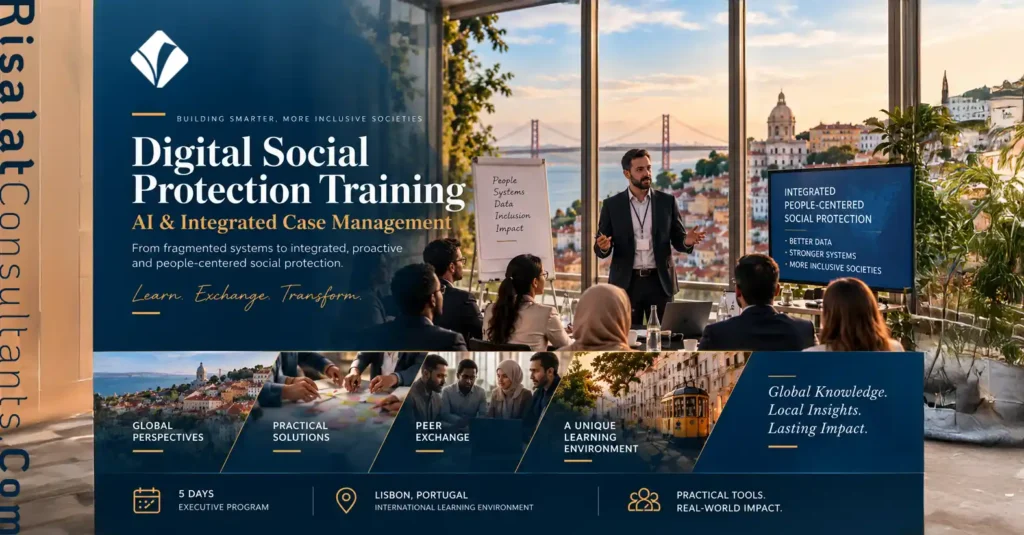
Digital Social Protection Training in Lisbon designed for government institutions and development projects ready to modernize how social protection is delivered. Bring your system. Diagnose its bottlenecks. Redesign the delivery architecture. Test integrated case management. Examine where AI should, and should not, be used. Benchmark international approaches. Leave Lisbon with a practical 90-day institutional transformation roadmap.
Social protection systems are undergoing a fundamental transformation. Governments are moving beyond fragmented benefit administration and stand-alone databases toward integrated digital ecosystems capable of identifying vulnerability, coordinating services, managing complex cases, responding to shocks, and connecting individuals and households with the support they need.
Artificial intelligence, digital public infrastructure, dynamic social registries, interoperable government databases, digital identity, automated eligibility mechanisms and advanced analytics are creating real opportunities to make social protection more proactive, responsive, efficient and inclusive. But technology alone does not create an effective social protection system. Successful transformation requires governments to integrate policy, institutions, people, processes, data, technology, case management, safeguards and frontline service delivery around the needs of citizens.
This programme is built for government institutions and development projects that are modernizing social protection delivery and want to move from fragmented, reactive systems toward integrated, proactive, data-driven and people-centered models. It goes beyond the classroom: participants examine their own institutional systems, diagnose delivery bottlenecks, work through complex beneficiary cases, explore interoperable system architecture, assess the opportunities and risks of AI, benchmark international approaches, and leave with practical institutional transformation priorities they can implement immediately.
Lisbon provides a highly relevant international learning environment. Portugal is advancing integrated, people-centered digital public services, proactive service delivery, digital identity, omnichannel citizen services and AI-enabled public administration. Its Digital Mobile Key already provides a common authentication mechanism for accessing multiple public and private portals, while social-security services continue to operate through digital, video, telephone and physical channels side by side.
What This Digital Social Protection Training Strengthens:
- Social protection delivery systems
- Integrated case management
- Dynamic social registries
- Digital public infrastructure (DPI)
- Digital identity & government interoperability
- Digital payments
- Grievance redress & appeals
- AI & advanced analytics in public service delivery
- Data governance, privacy & accountability
- Gender equality & social inclusion (GESI)
- Disability inclusion
- Adaptive & shock-responsive social protection
- Frontline service delivery & caseworker practice
- Institutional change management
- Economic inclusion pathways
What Your Institution Takes Back?
- Digital Social Protection Readiness Diagnostic
- Social Protection Delivery & Bottleneck Map
- Integrated Case Management & Referral Model
- Digital Social Protection Architecture Blueprint
- Responsible AI Governance Matrix
- 90-Day Institutional Transformation Roadmap
- Clínica de seguimiento de la implementación a 30 días
- Recopilar
- Depurar
- Almacenar
- Analizar
- Decidir
Why Digital Social Protection Training – Why Now?
Across many countries, governments have invested significantly in social registries, management information systems, digital payments, social assistance programmes, employment services, disability services and digital government platforms. Important implementation challenges remain.
Social protection systems may still operate through disconnected databases and institutions. Vulnerable households may repeatedly provide the same information to different agencies. Caseworkers may lack an integrated view of household needs. Referral mechanisms between social protection, employment, health, education and disability services may remain weak. Digitalization itself can create new forms of exclusion when systems are designed without sufficient attention to accessibility, digital literacy, gender, disability, connectivity, privacy or human oversight.
Meanwhile, AI introduces a new generation of opportunities, and risks. Governments are beginning to explore AI-supported vulnerability analysis, fraud and error detection, beneficiary communication, case prioritization, forecasting, service personalization and decision support.
The World Bank is currently scaling digital social-protection delivery through ID, social registries, payment platforms and management systems; as of January 2026, its Social Protection Response programme reported 14 grants across 11 country teams supporting the digital transformation of social protection systems.
The central question is no longer simply: “How do we digitize social protection?”
It is increasingly: “How do we build an integrated, proactive and trustworthy social protection system in which digital technology and AI improve human decision-making without excluding the people the system exists to protect?”
What Makes This Programme Different?
This is not an introductory course in social protection, case management or digital transformation. Online programmes, including well-established options such as the ILO/ITCILO and ISSA courses on social-security digitalization, strategy and big data, already give practitioners access to the underlying concepts. Participants are not expected to spend five days in Lisbon simply listening to material they could obtain through a report, a webinar or an AI tool.
This programme is built around institutional application. Participants work with real-world social protection challenges, ideally their own, and develop practical responses through guided transformation labs, simulations, comparative case analysis, peer exchange and institutional action planning.
Institutional Diagnostic → 5 Transformation Labs → Complex Case Simulation → Lisbon Benchmarking → 90-Day Roadmap → 30-Day Implementation Clinic
An online course teaches concepts. This programme produces six institutional work-products, a readiness diagnostic, delivery map, integrated case management model, digital architecture blueprint, responsible AI governance matrix and 90-day transformation roadmap, developed against participants’ own institutional systems and stress-tested through international practice and peer exchange.
RCI Digital Social Protection Transformation Framework
Participants use this framework throughout the five days to examine their own institutional environment. It is structured around six interconnected functions:
IDENTIFY
Understand vulnerability dynamically through outreach, registration, social registries, administrative data and appropriate analytics.
INTEGRATE
Connect institutions, databases, digital identity, payments, employment services, health, education, disability services and other relevant systems.
EVALUAR
Move beyond benefit eligibility toward multidimensional assessment of individual and household needs.
RESPOND
Coordinate benefits, services, referrals and case interventions through integrated delivery mechanisms.
SUPERVISAR
Track beneficiary journeys, case progress, service quality, grievances, outcomes and system performance.
ADAPT
Use evidence, emerging technologies, feedback and changing vulnerability patterns to continuously improve the system and respond to shocks.
Valor para la aprobación institucional
For nominating institutions, the programme is structured as an implementation engagement rather than a study visit. Each delegation works on a live institutional challenge and returns with six usable outputs, a 90-day roadmap, and a 30-day follow-up clinic. This strengthens the business case for participation by linking international exposure directly to institutional reform priorities, project implementation and measurable next steps.
Who Should Attend This Digital Social Protection Training?
The programme is specifically designed for officials and professionals responsible for designing, managing, modernizing, financing or implementing social protection and related public-service systems.
It is particularly relevant for:
- Directors and Senior Officials of Social Protection
- Social Assistance Programme Managers
- Social Registry Managers
- Integrated Case Management Leads
- Social Service Directors
- Directores de transformación digital
- MIS and ICT Managers
- Digital Government Specialists
- Social Workers and Case Management Supervisors
- Employment Service Managers
- Disability and Inclusion Specialists
- Gender and Social Inclusion Officers
- M&E and Data Specialists
- Adaptive Social Protection Specialists
- Government Data and Interoperability Teams
- PIU/PMU Managers and Specialists
- World Bank, ADB, EU, UN and other development-project personnel
- Provincial and Regional Social Service Managers
- Policy and Planning Officials
The programme is particularly valuable when institutions nominate multidisciplinary teams, enabling policy, programme, digital, M&E and service-delivery personnel to work together on a shared institutional challenge.
Marque lo que su equipo necesita ser capaz de hacer.
Digital Social Protection Training Objectives
Al final del programa, los participantes serán capaces de:
- Assess the maturity of existing social protection delivery systems.
- Identify institutional, operational, digital and data-related bottlenecks.
- Design more integrated and people-centered social protection delivery models.
- Strengthen integrated case management and referral mechanisms.
- Understand the strategic role of dynamic social registries.
- Examine interoperability between social protection and other government systems.
- Assess the role of Digital Public Infrastructure in social protection.
- Evaluate appropriate applications of AI and advanced analytics, and establish appropriate human oversight for AI-supported decisions.
- Strengthen data governance, privacy, security and accountability.
- Reduce risks of digital exclusion and improve grievance and appeals mechanisms.
- Integrate GESI, disability inclusion and vulnerable-population considerations.
- Strengthen adaptive and shock-responsive social protection.
- Develop practical institutional transformation priorities and a 90-day implementation roadmap.
Diagnóstico institucional previo al programa
One of the distinctive components of the programme begins before participants arrive in Lisbon. Participants are invited to complete a structured Digital Social Protection Readiness Diagnostic, examining institutional maturity across:
Governance • Delivery Chain • Social Registry • Case Management • Interoperability • Digital Identity • Payments • Grievance Redress • Inclusion • Data Governance • AI Readiness • Adaptive Capacity • Workforce Capability
The diagnostic helps participants identify strengths and weaknesses in their current environment and provides a practical baseline for the work undertaken during the programme. Participants are encouraged to bring a real institutional challenge to Lisbon.
Contenido y estructura del programa
- From Programmes to People-Centered Delivery
- Dynamic Social Registries
- Transformation Lab I | Participants map their current Outreach → Registration → Assessment → Eligibility → Enrollment → Service/Payment → Case Management → Referral → Grievance → Monitoring pathway and identify critical bottlenecks.
- Evolution of modern social protection delivery
- From fragmented programmes to integrated systems
- The social protection delivery chain: outreach and communication, registration and intake, assessment and eligibility, enrollment, benefit and service delivery, case management, referral, grievance and appeals, monitoring and outcomes
- Static versus dynamic registries; social registries versus beneficiary registries
- Moving From Benefits to Whole-Person Support
- Breaking Institutional Silos
- Social Protection ↔ Employment ↔ Health ↔ Education ↔ Disability ↔ Housing ↔ Child Protection ↔ GBV Services ↔ Local Government
- Frontline Workforce
- Principles of integrated case management; person- and family-centered approaches
- Needs assessment, case planning and referral pathways
- Multi-agency coordination and case conferencing
- Building the Digital Backbone
- Infraestructura pública digital
- Gobernanza de datos
- Social protection MIS, social registries and beneficiary management
- Digital identity and digital payments
- Data exchange, API-based integration and government data platforms
- Case management platforms and grievance systems
- Moving From Reactive to Proactive Social Protection
- AI Applications in Social Protection
- Responsible AI
- Traditional: citizen experiences problem → applies → government assesses → assistance provided
- Digital: citizen applies digitally → databases verify → eligibility established → assistance provided
- Proactive: life event / data signal → potential need identified → appropriate outreach → assessment → coordinated service response
- Vulnerability analysis, forecasting and predictive analytics
- Designing Systems That Do Not Leave People Behind
- Digital Exclusion
- Adaptive & Shock-Responsive Social Protection
- Capstone Exercise: 90-Day Digital Social Protection Transformation Roadmap. Each participant or delegation develops a practical roadmap covering:
- Gender-responsive social protection and disability inclusion
- Older persons, children and families
- Refugees, displaced populations and remote communities
Contenido completo día a día
First Day | Diagnosing the Social Protection Delivery System
From Programmes to People-Centered Delivery
- Evolution of modern social protection delivery
- From fragmented programmes to integrated systems
- The social protection delivery chain: outreach and communication, registration and intake, assessment and eligibility, enrollment, benefit and service delivery, case management, referral, grievance and appeals, monitoring and outcomes
Dynamic Social Registries
- Static versus dynamic registries; social registries versus beneficiary registries
- Continuous updating and administrative data integration
- Inclusion and exclusion errors; vulnerability profiling
- Registries as gateways to multiple public services
- Linking social protection with employment and economic inclusion
Social registries are increasingly cross-sector digital platforms rather than simple targeting databases. The World Bank reports that 62 countries had operationalized social registries as of 2024, covering approximately 1.1 billion people, with growing use across employment, health, education and other services.
Transformation Lab I | Participants map their current Outreach → Registration → Assessment → Eligibility → Enrollment → Service/Payment → Case Management → Referral → Grievance → Monitoring pathway and identify critical bottlenecks.
Day 1 Output: Institutional Social Protection Delivery Map & Bottleneck Diagnostic
Second Day | Integrated Case Management & Coordinated Service Delivery
Moving From Benefits to Whole-Person Support
- Principles of integrated case management; person- and family-centered approaches
- Needs assessment, case planning and referral pathways
- Multi-agency coordination and case conferencing
- Service tracking, follow-up, case closure and outcome measurement
Breaking Institutional Silos
Social Protection ↔ Employment ↔ Health ↔ Education ↔ Disability ↔ Housing ↔ Child Protection ↔ GBV Services ↔ Local Government
Complex Case Simulation – Participants work with a simulated vulnerable household facing interconnected challenges, unemployment, disability, childcare, elderly dependency, housing insecurity, financial vulnerability, health needs and protection risks, assuming different institutional roles and developing a coordinated response.
Frontline Workforce
- The role of social workers and digital tools for caseworkers
- Caseload management, supervisory systems and professional judgment
- Workload and burnout; mobile case management and escalation protocols
- Human-centered service delivery
Day 2 Output: Integrated Case Management & Referral Model
Third Day | Digital Architecture, DPI & Interoperability
Building the Digital Backbone
- Social protection MIS, social registries and beneficiary management
- Digital identity and digital payments
- Data exchange, API-based integration and government data platforms
- Case management platforms and grievance systems
Infraestructura pública digital
Understanding how reusable digital foundations – Digital ID + Payments + Trusted Data Exchange, can support multiple social programmes. The World Bank increasingly treats interoperable digital ID, payments and data-sharing infrastructure as reusable foundations that can enable services across social protection, health, finance and other sectors.
Architecture Lab – Participants construct a conceptual architecture connecting Citizen/Household → Digital Identity → Dynamic Social Registry → Eligibility & Assessment → Integrated Case Management → Employment / Health / Education / Disability / Local Government → Benefits, Services & Payments → Grievance & Feedback → Monitoring & Analytics.
Gobernanza de datos
- Data ownership, minimization and consent; privacy and access controls
- Ciberseguridad, data-sharing agreements and accountability
- Audit trails, data quality and the ethical use of sensitive information
Day 3 Output: Digital Social Protection Architecture Blueprint
Fourth Day | AI, Proactive Services & Responsible Automation
Moving From Reactive to Proactive Social Protection
- Traditional: citizen experiences problem → applies → government assesses → assistance provided
- Digital: citizen applies digitally → databases verify → eligibility established → assistance provided
- Proactive: life event / data signal → potential need identified → appropriate outreach → assessment → coordinated service response
AI Applications in Social Protection
- Vulnerability analysis, forecasting and predictive analytics
- Case prioritization and resource allocation
- Fraud and error detection
- Service personalization and beneficiary communication
- Document processing, pattern recognition and caseworker decision support
Responsible AI
- Algorithmic bias, discrimination and explainability
- Privacy, data quality and automated decision risks
- Human-in-the-loop requirements, accountability and appeals
- Transparency, procurement of AI systems, vendor governance and ethical safeguards
The critical question: What should AI decide, and what must remain a human decision?
AI Governance Lab – Participants analyze real-world scenarios involving eligibility, vulnerability, fraud alerts, case prioritization and service recommendations, and classify each decision into: Automate | AI-Assisted | Human Decision Required | Prohibited / High-Risk.
Day 4 Output: Responsible AI Use-Case & Governance Matrix
Fifth Day | Inclusion, Resilience & Institutional Transformation
Designing Systems That Do Not Leave People Behind
- Gender-responsive social protection and disability inclusion
- Older persons, children and families
- Refugees, displaced populations and remote communities
- Informal workers, digitally excluded and low-literacy populations
Digital Exclusion
- Connectivity, device access and digital literacy
- Language and disability accessibility; authentication problems
- Assisted digital services, offline alternatives and omnichannel delivery
Portugal itself combines online, video, telephone and physical channels for accessing social-security services, illustrating why digitalization does not necessarily mean eliminating human or assisted channels.
Adaptive & Shock-Responsive Social Protection
- Climate shocks, economic crises, pandemics and displacement
- Dynamic registries and rapid enrollment
- Emergency payments and data-driven early response
- Scalability and resilience
Institutional Transformation Clinic – Participants return to the diagnostic completed before the programme and determine: What should we STOP? What should we REDESIGN? What should we INTEGRATE? What should we DIGITIZE? Where should we use AI? What must remain human? What can we implement within 90 days?
Capstone Exercise: 90-Day Digital Social Protection Transformation Roadmap. Each participant or delegation develops a practical roadmap covering:
- Priority institutional reform and process redesign
- Case management improvement
- Digital / interoperability action
- AI opportunity or governance requirement
- Inclusion action and data-governance requirement
- Capacity-development priority and immediate next steps
- Responsible institution / unit and initial performance indicators
Day 5 Output: 90-Day Digital Social Protection Transformation Roadmap
Metodología de formación
The programme applies an executive, practice-oriented methodology combining:
- Expert-led technical sessions and international case studies
- Institutional diagnostics and system mapping
- Complex case simulations and architecture design exercises
- AI governance exercises and scenario analysis
- Peer-country exchange and group problem-solving
- International benchmarking and institutional action planning
- Retroalimentación de expertos y coaching para la implementación
The emphasis throughout is on application rather than passive instruction.
Lo que los participantes llevarán de vuelta a sus instituciones
Unlike conventional programmes where the principal output is a certificate, participants leave Lisbon with a portfolio of practical institutional products developed during the programme:
- Digital Social Protection Readiness Diagnostic – A structured assessment of their existing institutional environment.
- Social Protection Delivery Map – An end-to-end visualization of the existing delivery chain and identified bottlenecks.
- Integrated Case Management Model – A practical framework for assessment, referral, coordination and follow-up.
- Digital Social Protection Architecture Blueprint – A conceptual model for connecting registries, identity, case management, payments and other government systems.
- Responsible AI Governance Matrix – A framework identifying appropriate AI use cases, risks, human oversight and safeguards.
- 90-Day Transformation Roadmap – A practical implementation plan participants take back to their institutions.
Together, these outputs give nominating institutions practical value beyond attendance: participants return with tools that can support internal planning, coordination and implementation.
3.910 £ por participante · factura y transferencia bancaria · descuento para grupos de 5 o más personas
Cinco o más personas de una misma organización: solicite la tarifa de grupo al pedir la factura.
Ten or more: an in-house version for your institution may cost less per person. Ask for an in-house quote.
Registration closes in 59 days (31 Dec 2026)
Institutional Application of Digital Social Protection Training
Los participantes regresan con herramientas prácticas para mejorar:
- Delivery-chain design and case management practice
- Registry dynamism and interoperability with other government systems
- Responsible, well-governed use of AI and analytics
- Grievance handling and digital-exclusion safeguards
- GESI and disability inclusion in service design
- Shock-responsiveness and institutional coordination
Participants will leave the programme with practical tools, internationally recognized approaches and implementation strategies to strengthen social protection delivery, institutional coordination, digital inclusion and people-centered public services.
Pertinencia y aplicación regionales
- Europe & Central Asia – supporting registry modernization, pension and social-insurance digitalization, interoperability with EU frameworks, and case management for displacement and refugee caseloads.
- Africa – strengthening social registry expansion, shock-responsive social protection for climate and drought response, cash-transfer digitalization and mobile-money payment delivery.
- Middle East – supporting digital ID and biometric registration, humanitarian–development nexus case management, and modernization of national social-welfare systems.
- Asia – strengthening large-scale social registries, digital-ID-linked benefit delivery, disaster-responsive social protection and AI-enabled service-delivery pilots.
- Latin America & the Caribbean – modernizing long-standing conditional cash transfer systems, single-registry (registro único) architectures, and cross-ministry interoperability.
- Pacific – strengthening shock-responsive systems for small island states, climate-displacement response and last-mile digital service delivery.
Across these regions, governments and development partners increasingly require professionals capable of building integrated, proactive and trustworthy social protection systems, not simply digitizing existing bureaucracy.
Host Country Profile – Portugal
Portugal is advancing one of Europe’s more integrated approaches to people-centered digital public services. Its current Digital Strategy targets public services that are integrated, efficient and people-centered, alongside an inclusive digital transition of public administration, including a National Artificial Intelligence Agenda and a drive toward streamlined public services.
Portugal operates the Chave Móvel Digital (Digital Mobile Key), a common digital authentication mechanism for accessing public and private portals that can also support legally recognized digital signatures. Its government-services strategy explicitly goes beyond putting existing procedures online, aiming instead for proactive, simplified and integrated service experiences that anticipate citizen and business needs.
Social-security services in Portugal continue to operate through digital, video, telephone and physical channels side by side, a practical illustration of omnichannel delivery that keeps assisted and offline routes open even as digital channels expand.
Lisbon therefore offers a highly relevant, currently-in-motion example of a government moving from fragmented to integrated, from reactive to proactive, and from digitalization to intelligent service delivery, exactly the transition this programme is designed around.
Why Lisbon?
This makes Lisbon particularly appropriate for Digital Social Protection Training, giving participants an international environment for examining how governments can move:
- From fragmented → integrated
- From reactive → proactive
- From programme-centered → people-centered
- From databases → interoperable ecosystems
- From digitalization → intelligent service delivery
Lisbon International Benchmarking Component
Lisbon is incorporated into the learning proposition rather than serving merely as the venue. Participants examine relevant Portuguese and European experience in:
- Digital government and people-centered public services
- Digital identity and the Digital Mobile Key
- Omnichannel service delivery and proactive public services
- Public-sector interoperability and AI governance
- Privacy and data protection; inclusive digital transformation
Where feasible, the programme may include an institutional briefing, technical exchange, expert presentation or relevant public-service exposure activity. Any specific institutional visit is subject to confirmation and the availability of the host institution.
Cross-Country Social Protection Innovation Exchange
Participants share current reforms and implementation challenges from their respective countries. Rather than generic presentations, country exchanges focus on:
- What has already been digitized, and what remains fragmented?
- What is preventing interoperability?
- Where is case management failing, and what is creating exclusion?
- Where could AI realistically add value?
- Which reforms have produced measurable improvements?
- What would participants do differently if redesigning their systems today?
This creates a benefit that cannot be replicated through self-paced online learning.
Estudios de casos internacionales
Comparative examples may be drawn from relevant international experience including Portugal, Estonia, Türkiye, Kazakhstan, Uzbekistan, Brazil, Rwanda, South Korea, Singapore, selected EU systems, and World Bank-supported social protection modernization programmes. Cases are selected according to participant composition and current reform priorities.
Special Focus: From Social Protection to Economic Inclusion
Modern social protection should not operate as an isolated benefit system. The programme examines how social registries and integrated case management can support pathways from assistance toward greater economic resilience:
Social Protection → Employment Services → Skills → Financial Inclusion → Entrepreneurship → Economic Participation
The World Bank increasingly promotes this type of integration, including links between registries, public employment services, skills programmes, financial inclusion, health and education.
Clínica de implementación posterior al programa
The learning process does not end when participants leave Lisbon. Participating institutions are invited to a 30-Day Implementation Follow-Up Clinic, a virtual session that reviews:
- Progress on the 90-Day Roadmap
- Early implementation challenges and institutional resistance
- Technical bottlenecks
- Lessons emerging after participants return to their organizations
This turns the programme from a one-time training event into an implementation-oriented capacity development engagement.
Opción de participación institucional
Government institutions and development projects are encouraged to nominate small multidisciplinary delegations. A particularly effective delegation combines representatives from:
Policy + Social Protection Programme + Digital/MIS + Case Management/Social Services + M&E/Data
This enables the institution to work collectively on its own transformation challenge during the programme. Customized institutional clinics may also be incorporated for participating groups.
Digital Social Protection Training for Development-Partner-Funded Projects
The programme is particularly relevant to government institutions and PIUs/PMUs implementing reforms supported by the World Bank, Asian Development Bank, European Union, UNICEF, ILO, UNDP, bilateral development partners and other international development institutions. Relevant project areas include Social Protection Modernization, Digital Government, Human Capital Development, Social Registries, Economic Inclusion, Employment Services, Disability Inclusion, Social Service Reform, Adaptive Social Protection, Digital Payments, Government Interoperability, Institutional Strengthening, and Social Protection Information Systems.
This is a statement of relevance to the types of reforms these institutions finance, not a claim of donor endorsement, partnership or sponsorship.
Entregables de la formación
Los participantes disfrutarán de un servicio integral que cubre todo lo necesario antes, durante y después del programa.
Antes del programa
- Digital Social Protection Readiness Diagnostic
- Institutional briefing and preparatory reading materials
- Social protection reference resources and reading list
- Apoyo y asesoramiento gratuitos para el visado
- Coordinación previa a la llegada y orientación para el viaje
Durante el programa
- Recogida en el aeropuerto y asistencia de bienvenida
- Alojamiento con desayuno diario
- Cena de bienvenida y networking
- Kit de formación ejecutiva de Risalat (bolsa, botella de agua, taza, camiseta, gorra, funda de pasaporte, bolígrafos, cuaderno, imán y llavero)
- Comprehensive training manual and Digital Social Protection Toolkit
- Case Management & Referral Planning templates
- Digital Architecture Blueprint template
- Responsible AI Governance Matrix template
- 90-Day Transformation Roadmap template
- International case studies and comparative reference material
- Interactive transformation labs, complex case simulation and group exercises
- Executive peer-learning sessions
- Almuerzo y refrigerios diarios
- Acceso completo a las instalaciones de la sede de formación
- Materiales de aprendizaje digitales en una tableta (los participantes se quedan con el dispositivo)
- Institutional briefing / technical exposure activity, where confirmed
- Visita guiada entretenida por la ciudad
- Certificado de finalización y Reconocimiento a la participación en programas de Risalat
Después del programa
- Electronic training materials and editable Digital Social Protection Toolkit
- Institutional Action Planning framework
- Recomendaciones prácticas para la aplicación institucional
- Clínica de seguimiento de la implementación a 30 días
- Tres (3) meses de apoyo técnico tras la formación
- Informe del programa
- Acceso a recursos de aprendizaje actualizados, cuando estén disponibles
Common Challenges in Digital Social Protection, and How This Programme Helps
How can we move from fragmented databases to an integrated delivery system?
Participants build a conceptual architecture connecting digital identity, social registries, case management, payments and other government systems, using their own institutional context as the working example, not a generic template.
How do we make our social registry dynamic rather than static?
Day 1 examines continuous updating, administrative data integration, inclusion/exclusion error management, and how registries function as gateways to multiple public services rather than single-programme targeting databases.
How do we strengthen case management across agencies that don’t currently talk to each other?
The Day 2 complex case simulation puts participants in different institutional roles around one simulated household, forcing exactly the multi-agency coordination that referral mechanisms are meant to achieve on paper.
Where should AI actually be used in our system, and where is it too risky?
The Day 4 AI Governance Lab has participants classify real decision types into Automate / AI-Assisted / Human Decision Required / Prohibited, producing a governance matrix they can defend to oversight bodies and procurement teams.
How do we digitize without excluding people who lack connectivity, devices or digital literacy?
Day 5 addresses digital exclusion directly, using Portugal’s own multichannel model, digital, video, telephone and physical, as a live example of keeping assisted and offline channels open.
How do we protect privacy and keep data governance accountable as systems become more connected?
Day 3 covers data ownership, minimization, consent, access controls, cybersecurity, data-sharing agreements and audit trails as integration expands across agencies.
How do we prepare our system for climate shocks, economic crises or displacement?
Adaptive and shock-responsive social protection is addressed directly on Day 5, dynamic registries, rapid enrollment, emergency payments and data-driven early response.
How does social protection connect to jobs and economic inclusion, not just benefits?
A dedicated session examines the pathway from registries and case management through employment services, skills, financial inclusion and entrepreneurship.
Why come to Lisbon instead of taking an online course on social protection digitalization?
An online course teaches concepts. This programme produces six institutional work-products, a diagnostic, a delivery map, a case management model, an architecture blueprint, an AI governance matrix, built against your own system and stress-tested against international practice and peer critique.
Certificación
Participants who successfully complete the programme receive the Professional Certificate in AI-Enabled Social Protection & Integrated Case Management, issued by Risalat Consultants International. The certificate recognizes completion of the executive implementation programme, transformation labs, international benchmarking activities and institutional action-planning exercises.
¿Por qué Risalat Consultants International?
Risalat Consultants International (RCI) brings together the multidisciplinary expertise required to deliver Digital Social Protection Training for government institutions, public agencies and development projects:
- Social Protection & Inclusive Development
- Digital Transformation & Artificial Intelligence
- Fortalecimiento institucional y desarrollo de capacidades gubernamentales
- Environmental & Social Safeguards (ESS)
- MAS del Banco Mundial, Normas de Desempeño de la IFC y salvaguardas para el desarrollo
- Cambio climático, sostenibilidad y gestión ambiental
- Resettlement, Livelihood Restoration & Social Risk Management
- Monitoring, Evaluation, Accountability & Learning (MEAL)
- Gender Equality, Disability & Social Inclusion (GEDSI)
- Community Engagement & Stakeholder Engagement
- Social & Behavior Change Communication (SBCC)
- Gestión de proyectos y programas
- Gestión de las finanzas públicas y gobernanza
- Procurement, Contract Management & Supply Chain
- Datos, investigación y toma de decisiones basada en evidencia
- Employment, Skills & Workforce Development
- Organizational Transformation & Change Management
- Public Sector Reform & Service Delivery Modernization
- Digital Government, Data Governance & Interoperability
- Acción humanitaria y desarrollo comunitario
- Health Systems & Public Health Capacity Development
- Economic Inclusion & Livelihood Development
- Ejecución de proyectos de desarrollo y asistencia técnica
- Desarrollo de capacidades de proyectos financiados por donantes y de UEP/UGP
Rather than treating technology, institutional reform and human service delivery as separate subjects, RCI’s approach examines how they interact within complex government systems. The programme is built around one central objective: helping institutions translate digital innovation into better outcomes for people.
Todos los programas en LisboaMás programas de Desarrollo comunitario
Por qué Lisboa para este programa
Lisboa es una sede natural para las delegaciones lusófonas de África y Brasil.
The Digital Social Protection Training: AI-Enabled Social Protection & Integrated Case Management programme in February 2027 brings together officials and professionals from across Europe, Africa, the Middle East and Asia. Sessions combine short inputs, case studies and group work on participants' own files, and the city's institutions can be added as a study visit on request.
Cómo llegar: Aeropuerto Humberto Delgado de Lisboa (LIS).
Compruebe si necesita visado con el Verificador de visados gratuito y solicite una carta de invitación una vez inscrito.
Otros programas en Lisboa
Relacionado: Gobernanza de la IA para instituciones públicas · Preparación para la gobernanza de la IA gratuita · todos los programas
Más cursos de formación en Portugal · Todos los programas en Europa · Calendario de formación completo