Datos clave
- Fechas
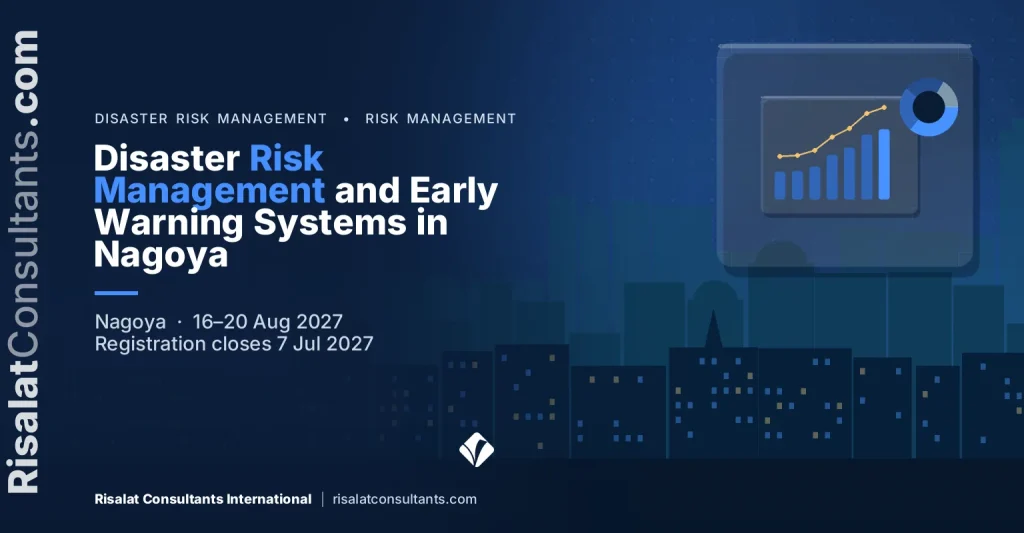
- 16-20 ago 2027 (5 días)
- Dónde
- Nagoya, Japan
- Tarifa por participante
- 2.600 £ (GBP)
- Pago
- Mediante factura y transferencia bancaria
- Cierre de inscripciones
- 7 Jul 2027
- Formato
- 5-day short course: a practical capacity-building programme for government, NGO and project teams in Nagoya
- Opción interna
- Impártalo para su equipo, en sus fechas
En esta página 10 secciones
Disaster Risk Management and Early Warning Systems in Nagoya
Descripción del programa
This five-day professional training programme provides public officials and development practitioners with advanced knowledge to design, implement, and monitor robust disaster risk management strategies and early warning systems. Delivered in Nagoya, Japan, the course draws upon internationally recognised disaster risk reduction methodologies, Japanese flood and seismic protection engineering, and community-based resilience models. Participants examine institutional, infrastructural, and technological interventions that safeguard vulnerable communities and protect critical public assets against climate-induced hazards and geophysical events.
Free self-check: the governance self-audit gives a quick check of governance, controls and accountability, in about 10 minutes.
The curriculum aligns with the Sendai Framework for Disaster Risk Reduction 2015-2030 and the Early Warnings for All initiative led by the United Nations. Participants review international financing mechanisms, including disaster risk management requirements of the World Bank, Asian Development Bank, European Union, and United Nations agencies. The course emphasizes integrated catchment management, multi-hazard risk assessment, institutional coordination, and cross-sectoral disaster risk finance. Practical exercises explore urban resilience and structural countermeasures demonstrated by Japanese municipal and prefectural authorities.
Through applied case studies, technical presentations, and collaborative planning exercises, delegates evaluate the four pillars of effective end-to-end early warning systems: risk knowledge, monitoring and forecasting, dissemination and communication, and preparedness to respond. Delivered by Risalat Consultants International in Nagoya, Japan, the programme supports public bodies and donor-funded project delivery teams in modernising national policies, upgrading hazard warning infrastructure, and executing sustainable disaster mitigation projects that comply with rigorous international social and environmental standards.
El programa fortalece la capacidad institucional en:
- International frameworks: Sendai Framework targets, Paris Agreement synergies, and Sustainable Development Goals
- Understanding risk: Multi-hazard identification, vulnerability metrics, and exposure analysis
- Governance and institutional arrangements: National platforms, legislative frameworks, and line agency coordination
- Japanese disaster risk management evolution: The Nagoya metropolitan flood control and earthquake defence experience
- Practical workshop: Mapping institutional responsibilities and gap analysis for national risk reduction
- Architecture of modern early warning systems: The four core pillars of the EW4All global agenda
- Hydrological and meteorological monitoring: Hydro-met network design, radar integration, and real-time data flows
- Forecasting and threshold setting: Impact-based forecasting techniques and risk triggers
- Evaluación de riesgos climáticos y ambientales
- Planificación de la adaptación y la mitigación
- Estrategias sectoriales para la energía, el agua y la tierra
- Diseño de proyectos para objetivos climáticos y ambientales
Why this matters now
Las organizaciones necesitan cada vez más profesionales capaces de:
- Evaluar los riesgos climáticos y ambientales para sus servicios y activos
- Diseñar proyectos que cumplan los objetivos climáticos y ambientales
- Preparar propuestas que los financiadores puedan aprobar
- Medir e informar los resultados de forma creíble
- Trabajar con comunidades y socios de distintos sectores
Unos sistemas sólidos de clima, medio ambiente y recursos naturales ayudan a las organizaciones a:
- Proteger los servicios y las infraestructuras frente a los riesgos climáticos
- Acceder a la financiación climática y ambiental
- Cumplir los compromisos nacionales e internacionales
- Utilizar los recursos naturales de forma sostenible
- Insumos
- Actividades
- Productos
- Efectos
- Impacto
Quién debería asistir
Este programa está dirigido a:
- Disaster risk reduction and emergency management officials from national, provincial, and local government agencies
- Project directors and procurement officers managing World Bank, ADB, EU, and UN-funded resilience programmes
- Engineers and technical specialists from ministries of public works, water resources, environment, and urban planning
- Meteorological and hydrological agency professionals responsible for hazard monitoring, forecasting, and data dissemination
- Urban resilience and spatial planners tasked with land-use zoning and community-level hazard mitigation
- Climate change adaptation coordinators within national ministries of finance, economy, and national planning
- Civil defence and public safety officers responsible for municipal evacuation planning and crisis operations
- Monitoring and evaluation specialists overseeing disaster risk governance and emergency response indicators
- Non-governmental organisation programme leads and development consultants executing regional disaster mitigation initiatives
- Responsables de cambio climático y medio ambiente
- Personal de los sectores de energía, agua y agricultura
- Responsables de planificación y políticas
Marque lo que su equipo necesita ser capaz de hacer.
Objetivos del programa
Al final de este programa, los participantes serán capaces de:
- Analyse national disaster management frameworks against the priorities and targets of the Sendai Framework for Disaster Risk Reduction 2015-2030
- Design end-to-end multi-hazard early warning systems conforming to the four pillars of the Early Warnings for All initiative
- Integrate nature-based solutions and structural mitigation measures into infrastructure projects financed by multilateral development banks
- Evaluate multi-hazard risk assessments using standard hazard identification, vulnerability assessment, and exposure analysis methodologies
- Formulate institutional standard operating procedures for crisis communication, cross-agency emergency response, and community-level evacuation
- Structure disaster risk financing instruments and contingency planning mechanisms to support post-disaster recovery and fiscal resilience
- Develop practical monitoring, evaluation, and learning frameworks for donor-supported disaster risk management investment portfolios
- Explicar los principales desafíos climáticos y ambientales de su sector
- Evaluar los riesgos climáticos y ambientales para los servicios y los activos
- Planificar medidas de adaptación y mitigación
Training Structure & Contents
- International frameworks: Sendai Framework targets, Paris Agreement synergies, and Sustainable Development Goals
- Understanding risk: Multi-hazard identification, vulnerability metrics, and exposure analysis
- Governance and institutional arrangements: National platforms, legislative frameworks, and line agency coordination
- Japanese disaster risk management evolution: The Nagoya metropolitan flood control and earthquake defence experience
- Practical workshop: Mapping institutional responsibilities and gap analysis for national risk reduction
- Workshop: Applying Foundations of Disaster Risk Management and the Sendai Framework to your institution
- Architecture of modern early warning systems: The four core pillars of the EW4All global agenda
- Hydrological and meteorological monitoring: Hydro-met network design, radar integration, and real-time data flows
- Forecasting and threshold setting: Impact-based forecasting techniques and risk triggers
- Communication protocols: Last-mile connectivity, Common Alerting Protocol standards, and telecom partnerships
- Practical exercise: Designing a river basin flash-flood and typhoon early warning workflow
- Workshop: Applying Multi-Hazard Early Warning Systems and the EW4All Initiative to your institution
- Mainstreaming disaster risk reduction into capital planning and public investment programmes
- Structural versus non-structural countermeasures: Lessons from Japanese underground flood retention systems
- Nature-based solutions: Coastal mangrove protection, slope bio-engineering, and urban sustainable drainage
- Land-use regulation and spatial zoning: Restricting development in high-risk zones and floodplains
- Simulation clinic: Evaluating resilient design options for vulnerable coastal and riverine settlements
- Case study: Resilient Infrastructure, Urban Planning, and Countermeasures in practice
- Community-based disaster risk management: Inclusive participation of women, elderly, and vulnerable groups
- Local contingency planning: Hazard mapping, safe shelter designation, and evacuation route engineering
- Standard operating procedures for emergency response and crisis operations
- Institutional coordination for community-level evacuation planning
- Practical review of public safety and civil defence protocols
- Disaster risk financing instruments and contingency planning mechanisms
- Post-disaster recovery and fiscal resilience planning
- Monitoring, evaluation, and learning frameworks for donor-supported portfolios
- Compliance with multilateral development bank social and environmental standards
- Final action planning and institutional roadmaps
Contenido completo día a día
First Day | Foundations of Disaster Risk Management and the Sendai Framework
- International frameworks: Sendai Framework targets, Paris Agreement synergies, and Sustainable Development Goals
- Understanding risk: Multi-hazard identification, vulnerability metrics, and exposure analysis
- Governance and institutional arrangements: National platforms, legislative frameworks, and line agency coordination
- Japanese disaster risk management evolution: The Nagoya metropolitan flood control and earthquake defence experience
- Practical workshop: Mapping institutional responsibilities and gap analysis for national risk reduction
- Workshop: Applying Foundations of Disaster Risk Management and the Sendai Framework to your institution
Second Day | Multi-Hazard Early Warning Systems and the EW4All Initiative
- Architecture of modern early warning systems: The four core pillars of the EW4All global agenda
- Hydrological and meteorological monitoring: Hydro-met network design, radar integration, and real-time data flows
- Forecasting and threshold setting: Impact-based forecasting techniques and risk triggers
- Communication protocols: Last-mile connectivity, Common Alerting Protocol standards, and telecom partnerships
- Practical exercise: Designing a river basin flash-flood and typhoon early warning workflow
- Workshop: Applying Multi-Hazard Early Warning Systems and the EW4All Initiative to your institution
Third Day | Resilient Infrastructure, Urban Planning, and Countermeasures
- Mainstreaming disaster risk reduction into capital planning and public investment programmes
- Structural versus non-structural countermeasures: Lessons from Japanese underground flood retention systems
- Nature-based solutions: Coastal mangrove protection, slope bio-engineering, and urban sustainable drainage
- Land-use regulation and spatial zoning: Restricting development in high-risk zones and floodplains
- Simulation clinic: Evaluating resilient design options for vulnerable coastal and riverine settlements
- Case study: Resilient Infrastructure, Urban Planning, and Countermeasures in practice
Fourth Day | Community-Based Disaster Risk Preparedness and Evacuation Planning
- Community-based disaster risk management: Inclusive participation of women, elderly, and vulnerable groups
- Local contingency planning: Hazard mapping, safe shelter designation, and evacuation route engineering
- Standard operating procedures for emergency response and crisis operations
- Institutional coordination for community-level evacuation planning
- Practical review of public safety and civil defence protocols
Fifth Day | Disaster Risk Finance, Project Governance, and Action Planning
- Disaster risk financing instruments and contingency planning mechanisms
- Post-disaster recovery and fiscal resilience planning
- Monitoring, evaluation, and learning frameworks for donor-supported portfolios
- Compliance with multilateral development bank social and environmental standards
- Final action planning and institutional roadmaps
Metodología de formación
The programme combines expert-led sessions, real cases, and group work, so that participants can apply what they learn in their own institution. Each day combines expert input, practical work, and a closing workshop or case study:
- Small-group workshops applying methods to examples from participants’ own institutions
- Applied case study analysis comparing practical choices with established good practice
- Simulation clinics and design exercises for resilient interventions
- Practical workflow mapping and gap analysis exercises
Resultados esperados
- Ability to introduce good practice in disaster risk management within home organisations using available people and resources
- Acquisition of practical, current skills in climate, environment, and natural resources management
- Capability to design projects and prepare funding proposals that financiers can approve
- Clear practical next steps and institutional action plans agreed through peer collaboration
2.600 £ por participante · factura y transferencia bancaria · descuento para grupos de 5 o más personas
Cinco o más personas de una misma organización: solicite la tarifa de grupo al pedir la factura.
Ten or more: an in-house version for your institution may cost less per person. Ask for an in-house quote.
La inscripción se cierra en 227 días (7 Jul 2027)
Pertinencia y aplicación regionales
Southeast Asian and Pacific Island nations face accelerating disaster vulnerabilities, ranging from devastating typhoons and riverine floods to coastal surges, droughts, and seismic shocks. Countries such as the Philippines, Vietnam, Indonesia, Cambodia, Lao PDR, and Fiji are experiencing heightened exposure of critical infrastructure and local communities. Modernising multi-hazard early warning systems and mainstreaming disaster resilience into national investment pipelines has become urgent to protect hard-won development gains, meet Sendai Framework commitments, and satisfy the stringent climate resilience criteria of major multilateral development banks.
Who Will Deliver This Programme
Each date is delivered by a team assigned from Risalat's expert network for this subject. For this programme we assign:
How we choose them: Experience in the region of the participants or comparable settings; Command of the financier rules that apply (World Bank, ADB, AfDB, EU, UN) where relevant; Delivery in English; other languages on request for in-house groups; No conflict of interest with participants' institutions.
Training courses in NagoyaClimate Change & Environment training courses
Why Nagoya for this programme
Nagoya is a major industrial and manufacturing hub, home to major enterprises such as the Toyota Motor Corporation in the wider prefecture. Visiting officials can study advanced production methods, technology, and transport infrastructure at facilities like the SCMaglev and Railway Park. The city is easily accessible via direct rail links and its nearby international airport.
The Disaster Risk Management and Early Warning Systems in Nagoya programme in August 2027 brings together officials and professionals from across the Asia region and beyond. Sessions combine short inputs, case studies and group work on participants' own files, and the city's institutions can be added as a study visit on request.
Getting there: Chubu Centrair International Airport (NGO).
Compruebe si necesita visado con el Verificador de visados gratuito y solicite una carta de invitación una vez inscrito.
El mismo tema en otras ciudades
- Disaster Risk Management and Early Warning Systems in Sapporo (Sapporo)
- Disaster Risk Management and Early Warning Systems in Fukuoka (Fukuoka)
- Disaster Risk Management and Early Warning Systems in Hiroshima (Hiroshima)
- Disaster Risk Management and Early Warning Systems in Sendai (Sendai)
- Disaster Risk Management and Early Warning Systems in Kobe (Kobe)
- Disaster Risk Management and Early Warning Systems in Osaka (Osaka)
Free roadmap: Disaster Insurance on the Lookout of Modern Disaster Risk Management: a 12-month plan for your team
- Oficina de las Naciones Unidas para la Reducción del Riesgo de Desastres UNDRR
- Fondo de Adaptación Fondo de Adaptación
Is there disaster risk management training for government officials in Nagoya in August 2027?
Can "Disaster Risk Management and Early Warning Systems in Nagoya" be delivered in-house for one organisation?
¿Qué otros programas de gestión del riesgo de desastres imparte Risalat?
¿Cómo se inscriben y pagan las organizaciones?
For teams and institutions
Bring your team
Teams that learn together apply more at work. Tell us how many people and how you would like to take part: we reply with a group quote within two working days.
Watch: this programme in short


Otras fechas y ciudades para este tema: Cursos de capacitación en gestión de riesgos de desastres y respuesta a emergencias (83 próximas fechas).
Más cursos de formación en Japón · Todos los programas en Asia · Calendario de formación completo
Planificar este programa en una hoja de ruta: por qué es importante, por qué aprobarlo, las fechas a planificar y la carrera que construye.