关键信息
- 日期
- 2027年8月16日至20日(5天)
- 地点
- Nagoya, Japan
- 每位学员费用
- £2,600(英镑)
- 付款
- 通过发票和银行转账付款
- 报名截止
- 7 Jul 2027
- 形式
- 5-day short course: a practical capacity-building programme for government, NGO and project teams in Nagoya
- 内训选项
- 按您的日期,为您的团队专场举办
本页内容10个部分
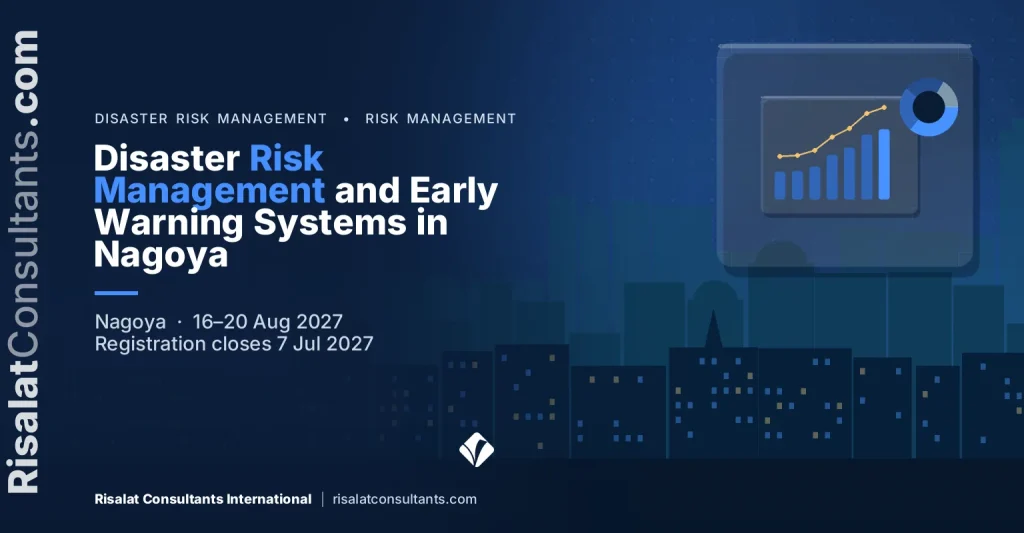
Disaster Risk Management and Early Warning Systems in Nagoya
培训项目概述
This five-day professional training programme provides public officials and development practitioners with advanced knowledge to design, implement, and monitor robust disaster risk management strategies and early warning systems. Delivered in Nagoya, Japan, the course draws upon internationally recognised disaster risk reduction methodologies, Japanese flood and seismic protection engineering, and community-based resilience models. Participants examine institutional, infrastructural, and technological interventions that safeguard vulnerable communities and protect critical public assets against climate-induced hazards and geophysical events.
Free self-check: the governance self-audit gives a quick check of governance, controls and accountability, in about 10 minutes.
The curriculum aligns with the Sendai Framework for Disaster Risk Reduction 2015-2030 and the Early Warnings for All initiative led by the United Nations. Participants review international financing mechanisms, including disaster risk management requirements of the World Bank, Asian Development Bank, European Union, and United Nations agencies. The course emphasizes integrated catchment management, multi-hazard risk assessment, institutional coordination, and cross-sectoral disaster risk finance. Practical exercises explore urban resilience and structural countermeasures demonstrated by Japanese municipal and prefectural authorities.
Through applied case studies, technical presentations, and collaborative planning exercises, delegates evaluate the four pillars of effective end-to-end early warning systems: risk knowledge, monitoring and forecasting, dissemination and communication, and preparedness to respond. Delivered by Risalat Consultants International in Nagoya, Japan, the programme supports public bodies and donor-funded project delivery teams in modernising national policies, upgrading hazard warning infrastructure, and executing sustainable disaster mitigation projects that comply with rigorous international social and environmental standards.
本培训项目可在以下方面加强机构能力:
- International frameworks: Sendai Framework targets, Paris Agreement synergies, and Sustainable Development Goals
- Understanding risk: Multi-hazard identification, vulnerability metrics, and exposure analysis
- Governance and institutional arrangements: National platforms, legislative frameworks, and line agency coordination
- Japanese disaster risk management evolution: The Nagoya metropolitan flood control and earthquake defence experience
- Practical workshop: Mapping institutional responsibilities and gap analysis for national risk reduction
- Architecture of modern early warning systems: The four core pillars of the EW4All global agenda
- Hydrological and meteorological monitoring: Hydro-met network design, radar integration, and real-time data flows
- Forecasting and threshold setting: Impact-based forecasting techniques and risk triggers
- 气候与环境风险评估
- 适应与减缓规划
- 能源、水和土地领域的行业战略
- 面向气候与环境目标的项目设计
Why this matters now
各机构日益需要具备以下能力的专业人员:
- 评估其服务和资产面临的气候与环境风险
- 设计符合气候与环境目标的项目
- 编制出资方能够批准的提案
- 可信地衡量和报告成果
- 与社区及跨部门合作伙伴协同工作
健全的气候、环境与自然资源体系有助于机构:
- 保护服务和基础设施免受气候风险影响
- 获取气候与环境资金
- 履行国家及国际承诺
- 可持续地利用自然资源
- 投入
- 活动
- 产出
- 成果
- 影响
哪些人员应参加
本培训项目适合:
- Disaster risk reduction and emergency management officials from national, provincial, and local government agencies
- Project directors and procurement officers managing World Bank, ADB, EU, and UN-funded resilience programmes
- Engineers and technical specialists from ministries of public works, water resources, environment, and urban planning
- Meteorological and hydrological agency professionals responsible for hazard monitoring, forecasting, and data dissemination
- Urban resilience and spatial planners tasked with land-use zoning and community-level hazard mitigation
- Climate change adaptation coordinators within national ministries of finance, economy, and national planning
- Civil defence and public safety officers responsible for municipal evacuation planning and crisis operations
- Monitoring and evaluation specialists overseeing disaster risk governance and emergency response indicators
- Non-governmental organisation programme leads and development consultants executing regional disaster mitigation initiatives
- 气候变化与环境官员
- 能源、水和农业部门工作人员
- 规划与政策官员
勾选您的团队需要具备的能力。
培训项目目标
完成本培训项目后,学员将能够:
- Analyse national disaster management frameworks against the priorities and targets of the Sendai Framework for Disaster Risk Reduction 2015-2030
- Design end-to-end multi-hazard early warning systems conforming to the four pillars of the Early Warnings for All initiative
- Integrate nature-based solutions and structural mitigation measures into infrastructure projects financed by multilateral development banks
- Evaluate multi-hazard risk assessments using standard hazard identification, vulnerability assessment, and exposure analysis methodologies
- Formulate institutional standard operating procedures for crisis communication, cross-agency emergency response, and community-level evacuation
- Structure disaster risk financing instruments and contingency planning mechanisms to support post-disaster recovery and fiscal resilience
- Develop practical monitoring, evaluation, and learning frameworks for donor-supported disaster risk management investment portfolios
- 阐述本行业面临的主要气候与环境挑战
- 评估服务和资产面临的气候与环境风险
- 规划适应与减缓措施
Training Structure & Contents
- International frameworks: Sendai Framework targets, Paris Agreement synergies, and Sustainable Development Goals
- Understanding risk: Multi-hazard identification, vulnerability metrics, and exposure analysis
- Governance and institutional arrangements: National platforms, legislative frameworks, and line agency coordination
- Japanese disaster risk management evolution: The Nagoya metropolitan flood control and earthquake defence experience
- Practical workshop: Mapping institutional responsibilities and gap analysis for national risk reduction
- Workshop: Applying Foundations of Disaster Risk Management and the Sendai Framework to your institution
- Architecture of modern early warning systems: The four core pillars of the EW4All global agenda
- Hydrological and meteorological monitoring: Hydro-met network design, radar integration, and real-time data flows
- Forecasting and threshold setting: Impact-based forecasting techniques and risk triggers
- Communication protocols: Last-mile connectivity, Common Alerting Protocol standards, and telecom partnerships
- Practical exercise: Designing a river basin flash-flood and typhoon early warning workflow
- Workshop: Applying Multi-Hazard Early Warning Systems and the EW4All Initiative to your institution
- Mainstreaming disaster risk reduction into capital planning and public investment programmes
- Structural versus non-structural countermeasures: Lessons from Japanese underground flood retention systems
- Nature-based solutions: Coastal mangrove protection, slope bio-engineering, and urban sustainable drainage
- Land-use regulation and spatial zoning: Restricting development in high-risk zones and floodplains
- Simulation clinic: Evaluating resilient design options for vulnerable coastal and riverine settlements
- Case study: Resilient Infrastructure, Urban Planning, and Countermeasures in practice
- Community-based disaster risk management: Inclusive participation of women, elderly, and vulnerable groups
- Local contingency planning: Hazard mapping, safe shelter designation, and evacuation route engineering
- Standard operating procedures for emergency response and crisis operations
- Institutional coordination for community-level evacuation planning
- Practical review of public safety and civil defence protocols
- Disaster risk financing instruments and contingency planning mechanisms
- Post-disaster recovery and fiscal resilience planning
- Monitoring, evaluation, and learning frameworks for donor-supported portfolios
- Compliance with multilateral development bank social and environmental standards
- Final action planning and institutional roadmaps
完整的每日课程内容
First Day | Foundations of Disaster Risk Management and the Sendai Framework
- International frameworks: Sendai Framework targets, Paris Agreement synergies, and Sustainable Development Goals
- Understanding risk: Multi-hazard identification, vulnerability metrics, and exposure analysis
- Governance and institutional arrangements: National platforms, legislative frameworks, and line agency coordination
- Japanese disaster risk management evolution: The Nagoya metropolitan flood control and earthquake defence experience
- Practical workshop: Mapping institutional responsibilities and gap analysis for national risk reduction
- Workshop: Applying Foundations of Disaster Risk Management and the Sendai Framework to your institution
Second Day | Multi-Hazard Early Warning Systems and the EW4All Initiative
- Architecture of modern early warning systems: The four core pillars of the EW4All global agenda
- Hydrological and meteorological monitoring: Hydro-met network design, radar integration, and real-time data flows
- Forecasting and threshold setting: Impact-based forecasting techniques and risk triggers
- Communication protocols: Last-mile connectivity, Common Alerting Protocol standards, and telecom partnerships
- Practical exercise: Designing a river basin flash-flood and typhoon early warning workflow
- Workshop: Applying Multi-Hazard Early Warning Systems and the EW4All Initiative to your institution
Third Day | Resilient Infrastructure, Urban Planning, and Countermeasures
- Mainstreaming disaster risk reduction into capital planning and public investment programmes
- Structural versus non-structural countermeasures: Lessons from Japanese underground flood retention systems
- Nature-based solutions: Coastal mangrove protection, slope bio-engineering, and urban sustainable drainage
- Land-use regulation and spatial zoning: Restricting development in high-risk zones and floodplains
- Simulation clinic: Evaluating resilient design options for vulnerable coastal and riverine settlements
- Case study: Resilient Infrastructure, Urban Planning, and Countermeasures in practice
Fourth Day | Community-Based Disaster Risk Preparedness and Evacuation Planning
- Community-based disaster risk management: Inclusive participation of women, elderly, and vulnerable groups
- Local contingency planning: Hazard mapping, safe shelter designation, and evacuation route engineering
- Standard operating procedures for emergency response and crisis operations
- Institutional coordination for community-level evacuation planning
- Practical review of public safety and civil defence protocols
Fifth Day | Disaster Risk Finance, Project Governance, and Action Planning
- Disaster risk financing instruments and contingency planning mechanisms
- Post-disaster recovery and fiscal resilience planning
- Monitoring, evaluation, and learning frameworks for donor-supported portfolios
- Compliance with multilateral development bank social and environmental standards
- Final action planning and institutional roadmaps
培训方法
The programme combines expert-led sessions, real cases, and group work, so that participants can apply what they learn in their own institution. Each day combines expert input, practical work, and a closing workshop or case study:
- Small-group workshops applying methods to examples from participants’ own institutions
- Applied case study analysis comparing practical choices with established good practice
- Simulation clinics and design exercises for resilient interventions
- Practical workflow mapping and gap analysis exercises
预期成果
- Ability to introduce good practice in disaster risk management within home organisations using available people and resources
- Acquisition of practical, current skills in climate, environment, and natural resources management
- Capability to design projects and prepare funding proposals that financiers can approve
- Clear practical next steps and institutional action plans agreed through peer collaboration
每位学员£2,600 · 通过发票和银行转账付款 · 5人及以上团体报名可享优惠
同一机构五人及以上:请在申请发票时索取团体价。
Ten or more: an in-house version for your institution may cost less per person. Ask for an in-house quote.
距离报名截止还有 227天(2027年7月7日)
区域相关性与应用
Southeast Asian and Pacific Island nations face accelerating disaster vulnerabilities, ranging from devastating typhoons and riverine floods to coastal surges, droughts, and seismic shocks. Countries such as the Philippines, Vietnam, Indonesia, Cambodia, Lao PDR, and Fiji are experiencing heightened exposure of critical infrastructure and local communities. Modernising multi-hazard early warning systems and mainstreaming disaster resilience into national investment pipelines has become urgent to protect hard-won development gains, meet Sendai Framework commitments, and satisfy the stringent climate resilience criteria of major multilateral development banks.
Who Will Deliver This Programme
Each date is delivered by a team assigned from Risalat's expert network for this subject. For this programme we assign:
How we choose them: Experience in the region of the participants or comparable settings; Command of the financier rules that apply (World Bank, ADB, AfDB, EU, UN) where relevant; Delivery in English; other languages on request for in-house groups; No conflict of interest with participants' institutions.
Training courses in NagoyaClimate Change & Environment training courses
Why Nagoya for this programme
Nagoya is a major industrial and manufacturing hub, home to major enterprises such as the Toyota Motor Corporation in the wider prefecture. Visiting officials can study advanced production methods, technology, and transport infrastructure at facilities like the SCMaglev and Railway Park. The city is easily accessible via direct rail links and its nearby international airport.
The Disaster Risk Management and Early Warning Systems in Nagoya programme in August 2027 brings together officials and professionals from across the Asia region and beyond. Sessions combine short inputs, case studies and group work on participants' own files, and the city's institutions can be added as a study visit on request.
Getting there: Chubu Centrair International Airport (NGO).
使用免费的签证查询工具确认您是否需要签证,完成报名后即可申请邀请函。
其他城市的同主题培训
- Disaster Risk Management and Early Warning Systems in Sapporo (Sapporo)
- Disaster Risk Management and Early Warning Systems in Fukuoka (Fukuoka)
- Disaster Risk Management and Early Warning Systems in Hiroshima (Hiroshima)
- Disaster Risk Management and Early Warning Systems in Sendai (Sendai)
- Disaster Risk Management and Early Warning Systems in Kobe (Kobe)
- Disaster Risk Management and Early Warning Systems in Osaka (Osaka)
Free roadmap: Disaster Insurance on the Lookout of Modern Disaster Risk Management: a 12-month plan for your team
- 联合国减少灾害风险办公室 UNDRR
- 适应基金 适应基金
Is there disaster risk management training for government officials in Nagoya in August 2027?
Can "Disaster Risk Management and Early Warning Systems in Nagoya" be delivered in-house for one organisation?
Risalat还举办哪些灾害风险管理培训项目?
机构如何报名和付款?
For teams and institutions
Bring your team
Teams that learn together apply more at work. Tell us how many people and how you would like to take part: we reply with a group quote within two working days.
Watch: this programme in short


该主题的其他日期和城市:灾害风险管理与应急响应培训课程(83个即将到来的日期)。
在路线图中规划此项目:为什么重要、为什么要批准它、要计划的日期以及它所构建的职业生涯。