Points clés
- Dates
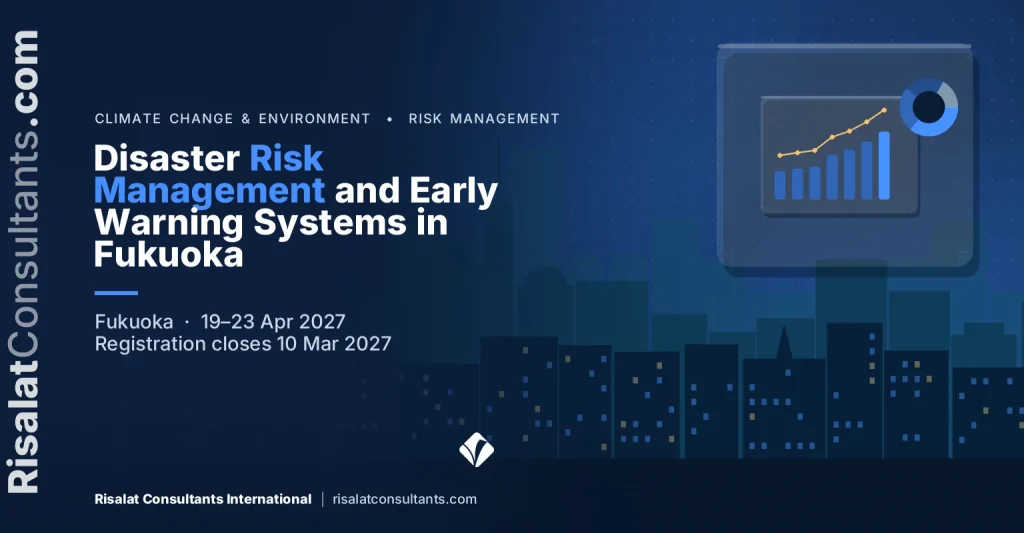
- 19–23 avr. 2027 (5 jours)
- Lieu
- Fukuoka, Japan
- Frais par participant
- 2 600 £ (GBP)
- Paiement
- Sur facture et par virement bancaire
- Clôture des inscriptions
- 10 Mar 2027
- Format
- 5-day short course: a practical capacity-building programme for government, NGO and project teams in Fukuoka
- Option intra
- Organisez-le pour votre équipe, à vos dates
Sur cette page 9 sections
Disaster Risk Management and Early Warning Systems in Fukuoka
Présentation du programme
Fukuoka provides an exceptional environment for studying comprehensive disaster risk management and modern early warning systems. Situated in a region historically exposed to typhoons, seismic hazards, and intense rainfall events, the city demonstrates advanced urban resilience, river basin management, and multi-hazard response protocols. Participants examine institutional arrangements, legal frameworks, and practical operations that bridge national directives with municipality-level civil protection. The curriculum investigates how public institutions organise resources, maintain continuous monitoring, and coordinate public warnings to protect vulnerable populations and safeguard critical infrastructure.
Free self-check: the governance self-audit gives a quick check of governance, controls and accountability, in about 10 minutes.
This intensive five-day programme links core operational principles to real-world public sector challenges encountered across the Asia-Pacific region. Professionals review disaster risk financing, community-based risk reduction, structural mitigation measures, and data integration platforms used for emergency preparedness. Guided analysis focuses on international benchmarks, including the Sendai Framework for Disaster Risk Reduction 2015-2030, aligning project proposals with financing criteria from the World Bank, Asian Development Bank, European Union, and United Nations agencies. Practical sessions dissect coordination challenges, procurement necessities, and asset maintenance required for enduring resilience.
Delivered through practical modules, peer review, and Japanese disaster management case material, the course equips public officials to upgrade existing operational standard operating procedures. Attendees explore end-to-end early warning architectures, ensuring threat detection translates into decisive, inclusive community action. By assessing Fukuoka’s hazard mapping, shelter management systems, and cross-departmental incident commands, participants return with actionable strategies to design, implement, and monitor robust disaster risk management components within sector programmes, regional development portfolios, and donor-financed investments across their home jurisdictions.
Le programme renforce les capacités institutionnelles en matière de :
- Global mandates: Sendai Framework priorities and integration with national development policies
- Japanese disaster risk management legislation: Central government roles versus municipal responsibilities
- Multilateral development bank safeguards and disaster risk management funding mechanisms
- Institutional coordination: Overcoming jurisdictional overlap and data silos in government
- Strategic planning: Formulating comprehensive national and subnational disaster management master plans
- Data collection methodologies for multi-hazard risk assessment and hazard profiling
- Application of GIS, remote sensing, and spatial data in municipal flood and landslide mapping
- Exposure and vulnerability assessment methodologies: Physical, social, and economic indicators
- Évaluation des risques climatiques et environnementaux
- Planification de l'adaptation et de l'atténuation
- Stratégies sectorielles pour l'énergie, l'eau et les terres
- Conception de projets pour les objectifs climatiques et environnementaux
Why this matters now
Les organisations ont de plus en plus besoin de professionnels capables de :
- Évaluer les risques climatiques et environnementaux pesant sur leurs services et leurs actifs
- Concevoir des projets qui répondent aux objectifs climatiques et environnementaux
- Préparer des propositions que les bailleurs peuvent approuver
- Mesurer les résultats et en rendre compte de manière crédible
- Travailler avec les communautés et les partenaires de différents secteurs
Des systèmes solides en matière de climat, d'environnement et de ressources naturelles aident les organisations à :
- Protéger les services et les infrastructures contre les risques climatiques
- Accéder aux financements climatiques et environnementaux
- Respecter les engagements nationaux et internationaux
- Utiliser durablement les ressources naturelles
- Collecter
- Nettoyer
- Stocker
- Analyser
- Décider
Public concerné
Ce programme s'adresse à :
- Officials from national disaster management authorities and civil defence agencies
- Project directors and technical specialists from World Bank, ADB, and UN-financed project implementation units
- Engineers and urban planners from municipal councils and public works ministries
- Hydrological and meteorological service professionals managing warning infrastructure
- Policy specialists from ministries of finance, planning, and national development
- Environmental, social, and resilience focal points within line ministries
- Emergency response coordinators and civil protection operations managers
- Public infrastructure managers responsible for transport, water, and energy assets
- Community-based disaster risk reduction leads from non-governmental and regional bodies
- Chargés du changement climatique et de l'environnement
- Personnel des secteurs de l'énergie, de l'eau et de l'agriculture
- Chargés de planification et de politiques
Cochez ce que votre équipe doit être capable de faire.
Objectifs du programme
À l'issue de ce programme, les participants seront en mesure de :
- Examine comprehensive disaster risk management governance aligned with the Sendai Framework for Disaster Risk Reduction 2015-2030
- Evaluate multi-hazard early warning systems (MHEWS) from observation networks and forecasting to institutional dissemination
- Formulate institutional standard operating procedures that translate technical hazard alerts into prompt public action
- Analyse structural and non-structural risk mitigation investments integrated into donor-funded development projects
- Develop hazard, exposure, and vulnerability assessment methodologies to inform subnational physical master planning
- Structure emergency operations centre protocols for inter-agency coordination, crisis logistics, and multi-channel communication
- Design monitoring and verification frameworks to evaluate disaster risk reduction investments funded through multilateral mechanisms
- Expliquer les principaux enjeux climatiques et environnementaux de leur secteur
- Évaluer les risques climatiques et environnementaux pesant sur les services et les actifs
- Planifier des mesures d'adaptation et d'atténuation
Training Structure & Contents
- Global mandates: Sendai Framework priorities and integration with national development policies
- Japanese disaster risk management legislation: Central government roles versus municipal responsibilities
- Multilateral development bank safeguards and disaster risk management funding mechanisms
- Institutional coordination: Overcoming jurisdictional overlap and data silos in government
- Strategic planning: Formulating comprehensive national and subnational disaster management master plans
- Workshop: Applying disaster risk governance frameworks and institutional mandates to participant institutions
- Data collection methodologies for multi-hazard risk assessment and hazard profiling
- Application of GIS, remote sensing, and spatial data in municipal flood and landslide mapping
- Exposure and vulnerability assessment methodologies: Physical, social, and economic indicators
- Analysing Fukuoka’s hazard atlas: Practical integration into urban zoning and spatial planning
- Exercise: Designing a project-level vulnerability baseline for donor investment approval
- Workshop: Applying risk assessment and hazard mapping methods to participant institutions
- Components of people-centred MHEWS: Detection, risk analysis, warning dissemination, and response capability
- Hydrological and meteorological monitoring technologies and automated sensor networks
- Last-mile communication systems: Common Alerting Protocol, siren networks, and cell broadcast options
- Inclusive warning protocols: Addressing language barriers, disabilities, and vulnerable rural populations
- Operational readiness: Verifying alert delivery times and establishing public feedback mechanisms
- Case Study: End-to-End Multi-Hazard Early Warning Systems (MHEWS) in practice
- Structural engineering interventions: Retention basins, sea defence, and slope stabilisation techniques
- Non-structural mitigation: Ecosystem-based disaster risk reduction and catchment conservation
- Critical infrastructure protection: Maintaining hospital, water, and power functionality during hazards
- Evacuation shelter design and logistics: Operation, registration, public health, and dignity standards
- Fukuoka case review: Urban flood diversion networks and municipal flood barrier operations
- Workshop: Applying structural mitigation and evacuation planning methods to participant institutions
- Emergency operations centre design, multi-agency incident command, and standard operating procedures
- Disaster risk financing mechanisms, contingency budgets, and post-disaster recovery planning
- Data integration platforms and multi-channel emergency communication systems
- Project design alignment with World Bank, ADB, and UN climate adaptation criteria
- Monitoring and verification frameworks for donor-funded disaster risk reduction investments
- Participant action planning for institutional disaster risk management implementation
Contenu détaillé jour par jour
First Day | Disaster Risk Governance, Frameworks, and Institutional Mandates
- Global mandates: Sendai Framework priorities and integration with national development policies
- Japanese disaster risk management legislation: Central government roles versus municipal responsibilities
- Multilateral development bank safeguards and disaster risk management funding mechanisms
- Institutional coordination: Overcoming jurisdictional overlap and data silos in government
- Strategic planning: Formulating comprehensive national and subnational disaster management master plans
- Workshop: Applying disaster risk governance frameworks and institutional mandates to participant institutions
Second Day | Risk Assessment, Hazard Mapping, and Vulnerability Analysis
- Data collection methodologies for multi-hazard risk assessment and hazard profiling
- Application of GIS, remote sensing, and spatial data in municipal flood and landslide mapping
- Exposure and vulnerability assessment methodologies: Physical, social, and economic indicators
- Analysing Fukuoka’s hazard atlas: Practical integration into urban zoning and spatial planning
- Exercise: Designing a project-level vulnerability baseline for donor investment approval
- Workshop: Applying risk assessment and hazard mapping methods to participant institutions
Third Day | End-to-End Multi-Hazard Early Warning Systems (MHEWS)
- Components of people-centred MHEWS: Detection, risk analysis, warning dissemination, and response capability
- Hydrological and meteorological monitoring technologies and automated sensor networks
- Last-mile communication systems: Common Alerting Protocol, siren networks, and cell broadcast options
- Inclusive warning protocols: Addressing language barriers, disabilities, and vulnerable rural populations
- Operational readiness: Verifying alert delivery times and establishing public feedback mechanisms
- Case Study: End-to-End Multi-Hazard Early Warning Systems (MHEWS) in practice
Fourth Day | Structural Mitigation, Infrastructure Resilience, and Evacuation Planning
- Structural engineering interventions: Retention basins, sea defence, and slope stabilisation techniques
- Non-structural mitigation: Ecosystem-based disaster risk reduction and catchment conservation
- Critical infrastructure protection: Maintaining hospital, water, and power functionality during hazards
- Evacuation shelter design and logistics: Operation, registration, public health, and dignity standards
- Fukuoka case review: Urban flood diversion networks and municipal flood barrier operations
- Workshop: Applying structural mitigation and evacuation planning methods to participant institutions
Fifth Day | Emergency Response Operations and Investment Action Planning
- Emergency operations centre design, multi-agency incident command, and standard operating procedures
- Disaster risk financing mechanisms, contingency budgets, and post-disaster recovery planning
- Data integration platforms and multi-channel emergency communication systems
- Project design alignment with World Bank, ADB, and UN climate adaptation criteria
- Monitoring and verification frameworks for donor-funded disaster risk reduction investments
- Participant action planning for institutional disaster risk management implementation
Méthodologie de formation
Delivered by Risalat Consultants International in Fukuoka, Japan, the course combines expert-led sessions, real cases and group work, so that participants can apply what they learn in their own institution. Each objective is practised during the programme through exercises, cases or group work, so that participants leave able to execute techniques in their home jurisdictions.
- Expert-led instructional modules and analytical presentations
- Case material review of Japanese and Fukuoka disaster management models
- Hands-on technical exercises including baseline vulnerability design
- Small-group workshops focused on institutional application
- Peer review and cross-country experience sharing
Résultats attendus
- Strengthened institutional capacity to align national policies with the Sendai Framework
- Operational capability to design and evaluate people-centred, multi-hazard early warning systems
- Competence in applying spatial data, GIS, and risk assessments to municipal zoning and planning
- Practical strategies for implementing structural and ecosystem-based mitigation interventions
- Preparedness to formulate robust project proposals meeting international donor financing standards
- Actionable standard operating procedures for emergency coordination, shelter logistics, and response
2 600 £ par participant · facture et virement bancaire · remise pour les groupes de 5 personnes ou plus
Cinq personnes ou plus d'une même organisation : demandez le tarif de groupe lors de votre demande de facture.
Ten or more: an in-house version for your institution may cost less per person. Ask for an in-house quote.
Registration closes in 108 days (10 Mar 2027)
Who Will Deliver This Programme
Each date is delivered by a team assigned from Risalat's expert network for this subject. For this programme we assign:
How we choose them: Experience in the region of the participants or comparable settings; Command of the financier rules that apply (World Bank, ADB, AfDB, EU, UN) where relevant; Delivery in English; other languages on request for in-house groups; No conflict of interest with participants' institutions.
Training courses in FukuokaClimate Change & Environment training courses
Why Fukuoka for this programme
Fukuoka is a prominent regional hub known for municipal innovation, environmental initiatives and urban planning. Visiting officials can examine local governance models, startup support centres and waste management facilities such as the Seibu Environmental Plant. The city is straightforward to reach, served directly by a centrally located international airport.
The Disaster Risk Management and Early Warning Systems in Fukuoka programme in April 2027 brings together officials and professionals from across the Asia region and beyond. Sessions combine short inputs, case studies and group work on participants' own files, and the city's institutions can be added as a study visit on request.
Getting there: Fukuoka Airport (FUK).
Vérifiez si vous avez besoin d'un visa avec le vérificateur de visa gratuit, et demandez une lettre d'invitation une fois inscrit.
Le même thème dans d'autres villes
- Disaster Risk Management and Early Warning Systems in Nagoya (Nagoya)
- Disaster Risk Management and Early Warning Systems in Sapporo (Sapporo)
- Disaster Risk Management and Early Warning Systems in Hiroshima (Hiroshima)
- Disaster Risk Management and Early Warning Systems in Sendai (Sendai)
- Disaster Risk Management and Early Warning Systems in Kobe (Kobe)
- Disaster Risk Management and Early Warning Systems in Osaka (Osaka)
Free roadmap: Disaster Insurance on the Lookout of Modern Disaster Risk Management: a 12-month plan for your team
- Bureau des Nations Unies pour la réduction des risques de catastrophe UNDRR
- Fonds pour l'adaptation Fonds pour l'adaptation
Is there disaster risk management training for government officials in Fukuoka in April 2027?
Can "Disaster Risk Management and Early Warning Systems in Fukuoka" be delivered in-house for one organisation?
Quels autres programmes Risalat propose-t-il en gestion des risques de catastrophe ?
Comment les organisations s'inscrivent-elles et paient-elles ?
Pour les équipes et les institutions
Bring your team
Teams that learn together apply more at work. Tell us how many people and how you would like to take part: we reply with a group quote within two working days.
Watch: this programme in short



Other dates and cities for this subject: Disaster Risk Management and Emergency Response training courses (83 upcoming dates).
Plus de formations au Japon · Tous les programmes en Asie · Calendrier complet des formations
Plan this programme in a roadmap: why it matters, why to approve it, the dates to plan and the career it builds.