Points clés
- Dates
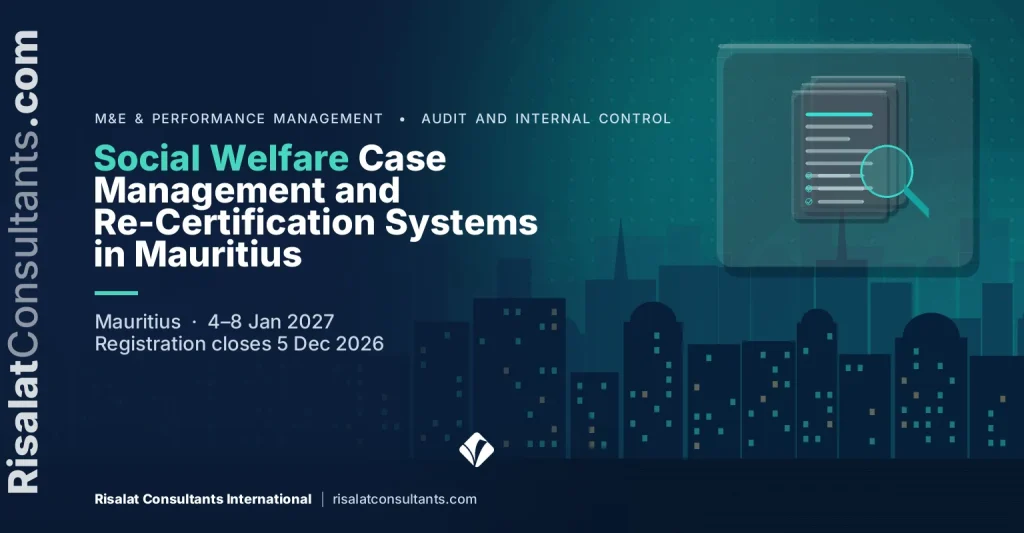
- 4–8 janv. 2027 (5 jours)
- Lieu
- Mauritius, Mauritius
- Frais par participant
- 3 150 £ (GBP)
- Paiement
- Sur facture et par virement bancaire
- Clôture des inscriptions
- 5 déc. 2026
- Certificat
- Certificat de participation
- Option intra
- Organisez-le pour votre équipe, à vos dates
Sur cette page 15 sections
Présentation du programme
This five-day professional training programme provides social protection practitioners with the operational competencies required to run rigorous social welfare case management and re-certification systems. Delivered in Mauritius, the course focuses on practical administrative workflows, evidence-based intake assessments, and structured means-testing protocols. Participants examine institutional processes that uphold transparency, reduce targeting errors, and maintain comprehensive beneficiary records across national social assistance schemes, aligning administrative practices with international standards established by major multilateral development institutions.
The curriculum addresses the practical challenges of processing dynamic household vulnerabilities, managing high caseloads, and preventing systemic leakages. Delegates engage with standardized eligibility determination models, interoperable beneficiary registry functions, and scheduled re-certification mechanisms. Through hands-on exercises, attendees examine how to conduct objective home visits, evaluate formal and informal household income sources, and handle complex grievance redressal procedures, ensuring that social protection funds are directed exclusively to eligible households through verifiable, legally robust administrative pipelines.
Special emphasis is placed on case auditing techniques, workflow re-engineering, and the continuous oversight required for institutional integrity. Participants explore practical frameworks for cross-referencing administrative data across civil registries, tax databases, and social security records. By auditing simulated case files and mapping workflow bottlenecks, social programme managers acquire the technical tools to eliminate inclusion and exclusion errors, modernise frontline service delivery, and preserve public trust in statutory social welfare operations.
Public welfare institutions face growing fiscal constraints alongside heightened demands for administrative accountability and transparent targeting. Across island states and developing administrations, modernising legacy social assistance schemes requires a shift toward automated data verification, auditable case review cycles, and objective means-testing frameworks. This training directly addresses the operational modernisation priorities highlighted under social protection system strengthening initiatives supported by international lenders. Strengthening caseworker assessment skills, formalising recertification schedules, and eliminating manual data vulnerabilities ensures that social protection systems maintain targeting integrity and adapt efficiently to real household welfare fluctuations.
Delivered by Risalat Consultants International in Mauritius, it combines expert-led sessions, real cases and group work, so that participants can apply what they learn in their own institution.
The Programme Strengthens Institutional Capability
- Principles of administrative targeting integrity in social assistance programmes
- Standardised intake protocols: client registration, household profiling, and consent frameworks
- Standard operating procedures for primary evidence collection and identity verification
- Conducting structured household interviews and objective home visit assessments
- Managing vulnerable populations: intake pathways for persons with disabilities, elderly, and orphans
- Direct means-testing versus proxy means-testing: design principles and operational limits
- Methodologies for capturing informal economy earnings, agricultural yields, and in-kind income
- Multi-source data verification: cross-checking civil registration, tax, and property data
- Réflexion stratégique et définition d'une orientation
- Diriger et faire progresser les équipes
- Prise de décision et résolution de problèmes
- Communication et influence
It is designed for social welfare officers handling frontline case intake and household assessments, case review specialists and social protection eligibility auditors, social programme managers and directors from national ministries and others who want practical, current skills in leadership, management and communication.
The Growing Importance of Social Welfare Case Management and Re-Certification Systems in Mauritius
Les institutions évoluent plus vite que jamais : nouvelles politiques, nouvelles technologies et nouvelles attentes des citoyens et des partenaires. Les dirigeants et managers capables de fixer un cap, de constituer des équipes et de gérer le changement font la différence entre les plans et les résultats.
Un bon leadership repose sur des compétences pratiques : décider, communiquer, négocier, faire progresser les personnes et conduire le changement. Ces compétences s'acquièrent et s'améliorent par la pratique et le retour d'expérience.
Les organisations ont de plus en plus besoin de professionnels capables de :
- Fixer une orientation et des priorités claires
- Diriger et motiver les équipes dans le changement
- Communiquer et négocier efficacement
- Gérer la performance de manière équitable
- Prendre de bonnes décisions sous pression
Des systèmes solides de leadership, de management et de communication aident les organisations à :
- Transformer les stratégies en résultats
- Constituer des équipes motivées et compétentes
- Gérer le changement en limitant les résistances
- Améliorer les relations avec les partenaires et les parties prenantes
This Social Welfare Case Management and Re-Certification Systems in Mauritius programme brings these elements together in a practical format, so that participants understand not only what good practice looks like but also how to introduce it in their own setting, with the people and resources they have.
3 150 £ par participant · facture et virement bancaire · remise pour les groupes de 5 personnes ou plus
Cinq personnes ou plus d'une même organisation : demandez le tarif de groupe lors de votre demande de facture.
À partir de dix participants, une version intra pour votre institution peut revenir moins cher par personne. Demander un devis intra.
Clôture des inscriptions dans 22 jours (5 déc. 2026)
Who Should Attend This Social Welfare Case Management and Re-Certification Systems in Mauritius Training?
Ce programme s'adresse à :
- Social welfare officers handling frontline case intake and household assessments
- Case review specialists and social protection eligibility auditors
- Social programme managers and directors from national ministries
- Social assistance administrators and district welfare supervisors, especially from Seychelles
- Monitoring and evaluation specialists attached to donor-financed social protection programmes
- Data management officers overseeing national social registries and beneficiary databases
- Policy analysts responsible for social safety net targeting and re-certification design
- Grievance redressal officers and appeals committee secretariats
- Public sector reform specialists working on social welfare administrative modernisation
- Directeurs et cadres supérieurs
- Chefs de département et d'unité
- Cadres intermédiaires et chefs d'équipe
Le programme convient aussi bien aux professionnels expérimentés qu’à ceux qui prennent de nouvelles responsabilités. Les groupes réunissant plusieurs institutions et pays sont encouragés, car les participants apprennent beaucoup de l’expérience des autres.
Cochez ce que votre équipe doit être capable de faire.
Social Welfare Case Management and Re-Certification Systems in Mauritius Training Objectives
Upon successful completion of this Social Welfare Case Management and Re-Certification Systems in Mauritius Training, participants will be able to:
- Master standardised intake, registration, and documentation protocols for national social welfare programmes
- Apply proxy means testing and verified means-testing audit mechanisms to validate household eligibility
- Design and implement structured, risk-based re-certification workflows to reduce inclusion and exclusion errors
- Re-engineer frontline case management processes to eliminate processing bottlenecks and administrative delays
- Conduct comprehensive case audits to identify fraudulent claims, documentation inconsistencies, and compliance failures
- Establish transparent grievance redressal mechanisms and structured appeals workflows for disputed welfare determinations
- Develop standard operating procedures for secure data exchange between social registries and external administrative databases
- Expliquer les approches actuelles du leadership dans les institutions publiques et privées
- Fixer l'orientation et les priorités de leur équipe
- Diriger, motiver et faire progresser les personnes
Chaque objectif est mis en pratique pendant le programme à travers des exercices, des études de cas ou des travaux de groupe, afin que les participants repartent capables de le faire, et pas seulement de le décrire.
Contenu et structure du programme
- Principles of administrative targeting integrity in social assistance programmes
- Standardised intake protocols: client registration, household profiling, and consent frameworks
- Standard operating procedures for primary evidence collection and identity verification
- Conducting structured household interviews and objective home visit assessments
- Managing vulnerable populations: intake pathways for persons with disabilities, elderly, and orphans
- Direct means-testing versus proxy means-testing: design principles and operational limits
- Methodologies for capturing informal economy earnings, agricultural yields, and in-kind income
- Multi-source data verification: cross-checking civil registration, tax, and property data
- Detecting document falsification, shadow assets, and undeclared household composition shifts
- Practical laboratory: calculating household dependency ratios and composite vulnerability scores
- Designing periodic and trigger-based re-certification cycles for social transfer schemes
- Operational workflows: notification, documentation submission, re-assessment, and transition out
- Managing graduation pathways: handling temporary shocks versus chronic poverty cohorts
- Interoperability between social registries and integrated beneficiary management systems
- Simulation exercise: mapping an end-to-end re-certification workflow to eliminate administrative drop-offs
- Methodologies for internal case auditing: sampling strategies, spot checks, and error metrics
- Detecting, investigating, and documenting administrative error, client fraud, and collusion
- Establishing independent, accessible grievance redressal mechanisms and tracking registers
- Due process and administrative justice: protocols for benefit suspension, reduction, and exit appeals
- Practical audit clinic: reviewing flagged case files to identify compliance failures
- Process mapping: diagnosing bottlenecks, duplication, and paperwork burdens in welfare offices
- Drafting robust Standard Operating Procedures (SOPs) for frontline caseworkers
- Data protection, privacy protocols, and ethical records retention in social registry management
- Key performance indicators for case turnaround time, targeting accuracy, and audit compliance
- Participant action plan presentation: modernising national re-certification and intake systems
Contenu détaillé jour par jour
Le programme se déroule sur 5 jours. Chaque journée associe apports d'experts, travail pratique et un atelier ou une étude de cas de clôture :
- First Day: Day 1: Foundations of Social Welfare Intake and Standardised Assessment
- Second Day: Day 2: Means-Testing Methodologies, Verification, and Targeting Integrity
- Third Day: Day 3: Re-Certification Workflows and Dynamic Case Management
- Fourth Day: Day 4: Case Auditing, Fraud Prevention, and Grievance Systems
- Fifth Day: Day 5: Administrative Workflow Re-Engineering and System Implementation
Contenu détaillé jour par jour
First Day | Day 1: Foundations of Social Welfare Intake and Standardised Assessment
- Principles of administrative targeting integrity in social assistance programmes
- Standardised intake protocols: client registration, household profiling, and consent frameworks
- Standard operating procedures for primary evidence collection and identity verification
- Conducting structured household interviews and objective home visit assessments
- Managing vulnerable populations: intake pathways for persons with disabilities, elderly, and orphans
Workshop: Day 1: Foundations of Social Welfare Intake and Standardised Assessment: Applying It to Your Institution
En petits groupes, les participants appliquent les méthodes du jour à des exemples tirés de leurs institutions et conviennent d'étapes concrètes pour la suite.
Second Day | Day 2: Means-Testing Methodologies, Verification, and Targeting Integrity
- Direct means-testing versus proxy means-testing: design principles and operational limits
- Methodologies for capturing informal economy earnings, agricultural yields, and in-kind income
- Multi-source data verification: cross-checking civil registration, tax, and property data
- Detecting document falsification, shadow assets, and undeclared household composition shifts
- Practical laboratory: calculating household dependency ratios and composite vulnerability scores
Workshop: Day 2: Means-Testing Methodologies, Verification, and Targeting Integrity: Applying It to Your Institution
En petits groupes, les participants appliquent les méthodes du jour à des exemples tirés de leurs institutions et conviennent d'étapes concrètes pour la suite.
Third Day | Day 3: Re-Certification Workflows and Dynamic Case Management
- Designing periodic and trigger-based re-certification cycles for social transfer schemes
- Operational workflows: notification, documentation submission, re-assessment, and transition out
- Managing graduation pathways: handling temporary shocks versus chronic poverty cohorts
- Interoperability between social registries and integrated beneficiary management systems
- Simulation exercise: mapping an end-to-end re-certification workflow to eliminate administrative drop-offs
Case Study: Day 3: Re-Certification Workflows and Dynamic Case Management in Practice
Les participants analysent un cas réaliste, comparent les choix effectués aux bonnes pratiques et en tirent des enseignements applicables à leur propre contexte.
Fourth Day | Day 4: Case Auditing, Fraud Prevention, and Grievance Systems
- Methodologies for internal case auditing: sampling strategies, spot checks, and error metrics
- Detecting, investigating, and documenting administrative error, client fraud, and collusion
- Establishing independent, accessible grievance redressal mechanisms and tracking registers
- Due process and administrative justice: protocols for benefit suspension, reduction, and exit appeals
- Practical audit clinic: reviewing flagged case files to identify compliance failures
Workshop: Day 4: Case Auditing, Fraud Prevention, and Grievance Systems: Applying It to Your Institution
En petits groupes, les participants appliquent les méthodes du jour à des exemples tirés de leurs institutions et conviennent d'étapes concrètes pour la suite.
Fifth Day | Day 5: Administrative Workflow Re-Engineering and System Implementation
- Process mapping: diagnosing bottlenecks, duplication, and paperwork burdens in welfare offices
- Drafting robust Standard Operating Procedures (SOPs) for frontline caseworkers
- Data protection, privacy protocols, and ethical records retention in social registry management
- Key performance indicators for case turnaround time, targeting accuracy, and audit compliance
- Participant action plan presentation: modernising national re-certification and intake systems
Capstone Exercise: Social Welfare Case Management and Re-Certification Systems in Mauritius Action Plan for Your Institution
Les participants synthétisent la semaine dans un plan d'action pour leur institution, avec des priorités, des responsables et des premières étapes, puis le présentent à leurs pairs et aux animateurs pour recueillir leurs retours.
Social Welfare Case Management and Re-Certification Systems in Mauritius Training Methodology
The training employs an adult-learning approach focused on operational execution within public welfare institutions. Training sessions combine technical presentations, regulatory analyses, and workflow process mapping with rigorous practical exercises. Delegates work through anonymised social assistance case files to evaluate eligibility, apply means-testing formulas, and run forensic compliance audits. Small-group breakout sessions allow participants to map institutional bottlenecks, review standard operating procedures, and simulate grievance hearings, ensuring practical transferability to their home institutions.
Le programme associe :
- Sessions animées par des experts sur les pratiques actuelles
- Études de cas régionales et internationales
- Travaux de groupe et exercices pratiques
- Simulations et jeux de rôle le cas échéant
- Discussion des défis rencontrés par les participants dans l'exercice de leurs fonctions
- Apprentissage entre pairs, d'institutions et de pays différents
- Des outils et modèles pratiques à réutiliser au travail
- Réflexion quotidienne et plan d'action
Avant le programme, une courte pré-évaluation aide les animateurs à comprendre le rôle et les priorités de chaque participant, afin d’adapter les exemples et les exercices au groupe. Chaque journée se termine par une brève réflexion au cours de laquelle les participants notent ce qu’ils appliqueront dans leur travail.
- Opération
- Enregistrement
- Contrôle
- Données probantes
- Opinion
Préparation à la certification et à l'examen
Lorsque le programme prépare les participants à un certificat ou à un examen professionnel, les séances suivent le référentiel de connaissances et le format d'examen publiés par l'organisme certificateur. Les participants s'entraînent sur des questions de type examen, revoient leurs points faibles avec les animateurs et repartent avec un plan d'étude personnel pour les semaines précédant l'examen.
- Présentation de la certification, de ses exigences et du format de l'examen
- Revue structurée du référentiel de connaissances
- Questions d'entraînement de type examen, avec explications
- Gestion du temps et technique d'examen
- Plan d'étude personnel et lectures recommandées
Résultats attendus
Upon completion of this Social Welfare Case Management and Re-Certification Systems in Mauritius Training, participants will be able to:
- Ability to execute standardized social welfare intake protocols in full compliance with administrative guidelines
- Proficiency in auditing means-testing calculations and identifying discrepancies in reported household income
- Capability to establish and manage structured re-certification cycles that update beneficiary rosters accurately
- Practical skill in designing case review workflows that reduce turnaround times and administrative bottlenecks
- Capacity to run structured case audits and implement preventative measures against targeting fraud and error
- Competency to formulate operational standard operating procedures for appeals management and inter-agency data sharing
- Fixer une orientation et des priorités claires
- Diriger et faire progresser les équipes
Les participants repartent avec un plan d'action personnel et des outils pratiques utilisables dans leur institution dès la première semaine de retour. Les institutions qui envoient plusieurs participants peuvent s'appuyer sur le programme pour convenir de méthodes et de modèles communs entre équipes, ce qui facilite la pérennité des améliorations.
Institutional Application of Social Welfare Case Management and Re-Certification Systems in Mauritius Training
Ce programme aide les organisations à renforcer :
- Leadership et management
- Développement d'équipe
- Gestion du changement
- Communication
- Gestion de la performance
Les participants repartent avec des outils pratiques pour améliorer :
- Plans d'équipe
- Coaching
- Plans de changement
- Communication avec les parties prenantes
- Entretiens d'évaluation
Le programme est conçu pour que l'apprentissage passe de la salle de formation à l'institution. Les participants travaillent, dans la mesure du possible, sur leurs propres processus et documents, et repartent avec un plan d'action que leurs responsables peuvent examiner et soutenir.
Pertinence régionale & mise en application
Europe
Les institutions européennes exercent le leadership, le management et la communication dans le cadre de réglementations détaillées et de programmes de réforme. Les participants venus d'Europe peuvent comparer leurs pratiques avec celles de collègues d'autres régions et vérifier comment des méthodes éprouvées fonctionnent dans d'autres conditions.
Afrique
En Afrique, les ministères, agences et équipes de projet œuvrant dans le leadership, le management et la communication travaillent de plus en plus aux côtés de programmes financés par les bailleurs qui exigent des systèmes clairs et des données probantes. Le programme aide les participants à adapter les bonnes pratiques aux institutions et aux ressources avec lesquelles ils travaillent.
Moyen-Orient
Au Moyen-Orient, les stratégies nationales de développement et les plans de diversification sollicitent de plus en plus le leadership, le management et la communication. Les participants examinent comment bâtir, au sein des organismes publics et des entreprises, les capacités dont ces plans ont besoin.
Asie
Les institutions asiatiques conjuguent croissance rapide et programmes de modernisation ambitieux. Les participants venus d'Asie peuvent partager leur expérience du déploiement rapide de systèmes à grande échelle et découvrir les approches adoptées ailleurs.
Pacifique
Les petits États insulaires et du Pacifique font face à des contraintes particulières de taille, de distance et de capacités. Le programme met en avant des approches pratiques et proportionnées du leadership, du management et de la communication, adaptées aux institutions de petite taille.
Holding the programme in Mauritius brings participants together away from their daily pressures, so they can compare how leadership, management and communication is handled in different settings. The same programme can also be delivered in-house for one institution, in its own country or online, with cases taken from its current work.
Host Country Profile – Mauritius
Risalat Consultants International runs open-enrolment training programmes in Mauritius, Mauritius for officials, project teams and professionals from across the region. Dates, fees and what each programme covers are listed above, and any programme can also be delivered in-house for your institution.
Se former hors de son pays permet aux participants de se concentrer, de porter un regard neuf sur leur propre institution et de constituer un réseau avec des collègues d'autres pays.
Social Welfare Case Management and Re-Certification Systems in Mauritius Training Deliverables
Les participants sont accompagnés avant, pendant et après le programme, afin que la préparation, l'apprentissage et le suivi forment une expérience continue.
Avant le programme
- Pré-évaluation des participants
- Social Welfare Case Management and Re-Certification Systems in Mauritius Readiness Assessment
- Social Welfare Case Management and Re-Certification Systems in Mauritius Resource Pack
- Lectures préparatoires
- Aide et conseils gratuits pour le visa
Pendant le programme
- Accueil à l'aéroport & assistance à l'arrivée
- Hébergement avec petit-déjeuner
- Dîner de bienvenue et de réseautage
- Kit de formation Risalat (sac, gourde, mug, t-shirt, casquette, protège-passeport, stylos, carnet, magnet & porte-clés)
- Comprehensive Social Welfare Case Management and Re-Certification Systems in Mauritius Training Manual
- Autoévaluation du leadership
- Modèle de plan de développement d'équipe
- Modèle de plan de changement
- Fiche de préparation à la négociation
- Ateliers pratiques & simulations
- Discussions de groupe & apprentissage entre pairs
- Déjeuner et pauses-café quotidiens
- Accès complet aux installations du lieu de formation
- Mini tablette avec supports pédagogiques numériques
- Visite de terrain (le cas échéant)
- Visite récréative de la ville
Après le programme
- Certificat de participation
- Distinction Risalat de participation au programme
- Documents de référence après la formation
- Modèle de plan de développement personnel
- Guide d'entretien de coaching
- Accompagnement après la formation & conseils de suivi
- Rapport du programme
Les institutions peuvent aussi demander une version intra sur mesure de ce programme, dispensée dans leurs locaux ou en ligne. Demander une proposition.
Common Challenges in Social Welfare Case Management and Re-Certification Systems in Mauritius, And How This Training Helps
Comment les institutions peuvent-elles fixer une orientation et des priorités claires ?
The programme addresses this directly on the first day (Day 1: Foundations of Social Welfare Intake and Standardised Assessment), where participants practise the methods involved and adapt them to their own institution, then build it into their action plan.
Comment les institutions peuvent-elles diriger et motiver les équipes dans le changement ?
The programme addresses this directly on the second day (Day 2: Means-Testing Methodologies, Verification, and Targeting Integrity), where participants practise the methods involved and adapt them to their own institution, then build it into their action plan.
Comment les institutions peuvent-elles communiquer et négocier efficacement ?
The programme addresses this directly on the third day (Day 3: Re-Certification Workflows and Dynamic Case Management), where participants practise the methods involved and adapt them to their own institution, then build it into their action plan.
Comment les institutions peuvent-elles gérer la performance de manière équitable ?
The programme addresses this directly on the fourth day (Day 4: Case Auditing, Fraud Prevention, and Grievance Systems), where participants practise the methods involved and adapt them to their own institution, then build it into their action plan.
Comment les institutions peuvent-elles prendre de bonnes décisions sous pression ?
The programme addresses this directly on the fifth day (Day 5: Administrative Workflow Re-Engineering and System Implementation), where participants practise the methods involved and adapt them to their own institution, then build it into their action plan.
Questions fréquentes
When and where does the Social Welfare Case Management and Re-Certification Systems in Mauritius programme take place?
It runs from 4 Jan 2027 to 8 Jan 2027, in Mauritius. The registration deadline is shown at the top of this page.
Qui devrait participer ?
The programme is designed for social welfare officers handling frontline case intake and household assessments, case review specialists and social protection eligibility auditors, social programme managers and directors from national ministries, social assistance administrators and district welfare supervisors, especially from Seychelles, and others who want practical skills in leadership, management and communication.
Recevrai-je un certificat ?
Oui. Les participants qui terminent le programme reçoivent un certificat de participation délivré par Risalat Consultants International.
Ce programme peut-il être dispensé pour notre seule institution ?
Oui. Nous pouvons proposer une version intra sur mesure dans vos locaux, dans une autre ville ou en ligne, construite autour de vos propres cas. Utilisez la demande de proposition sur cette page.
Faut-il une expérience préalable en leadership, management et communication ?
Aucune formation spécialisée n'est requise au-delà d'une expérience dans une fonction similaire. Une courte pré-évaluation aide les animateurs à adapter les sessions au groupe.
Who Will Deliver This Programme
Each date is delivered by a team assigned from Risalat's expert network for this subject. For this programme we assign:
How we choose them: Experience in the region of the participants or comparable settings; Command of the financier rules that apply (World Bank, ADB, AfDB, EU, UN) where relevant; Delivery in English; other languages on request for in-house groups; No conflict of interest with participants' institutions.
Names and short CVs of the assigned experts are shared with registered participants and sponsoring organisations before the programme, on request. Are you an expert in this subject? Join our expert network.
Training courses in MauritiusRetirement and Social Insurance training courses
Why Mauritius for this programme
Mauritius combines strong public institutions with a retreat setting.
The Social Welfare Case Management and Re-Certification Systems in Mauritius programme in January 2027 brings together officials and professionals from across the Africa region and beyond. Sessions combine short inputs, case studies and group work on participants' own files, and the city's institutions can be added as a study visit on request.
Getting there: Sir Seewoosagur Ramgoolam (MRU).
Vérifiez si vous avez besoin d'un visa avec le vérificateur de visa gratuit, et demandez une lettre d'invitation une fois inscrit.
Other programmes in Mauritius
- Private Sector Regulatory Impact Assessment and Business Licensing in Mauritius
- Island Waste Segregation and Circular Material Recovery Models in Mauritius
- Payment System Interoperability and Retail Financial Infrastructure in Mauritius
- Port Infrastructure Rehabilitation and Interisland Terminal Works in Mauritius
- Cyclone-Resilient Housing Reconstruction and Building Standards in Mauritius
For teams and institutions
Bring your team
Teams that learn together apply more at work. Tell us how many people and how you would like to take part: we reply with a group quote within two working days.
More training courses in Mauritius · Tous les programmes en Afrique · Calendrier complet des formations
Plan this programme in a roadmap: why it matters, why to approve it, the dates to plan and the career it builds.