Factos essenciais
- Datas
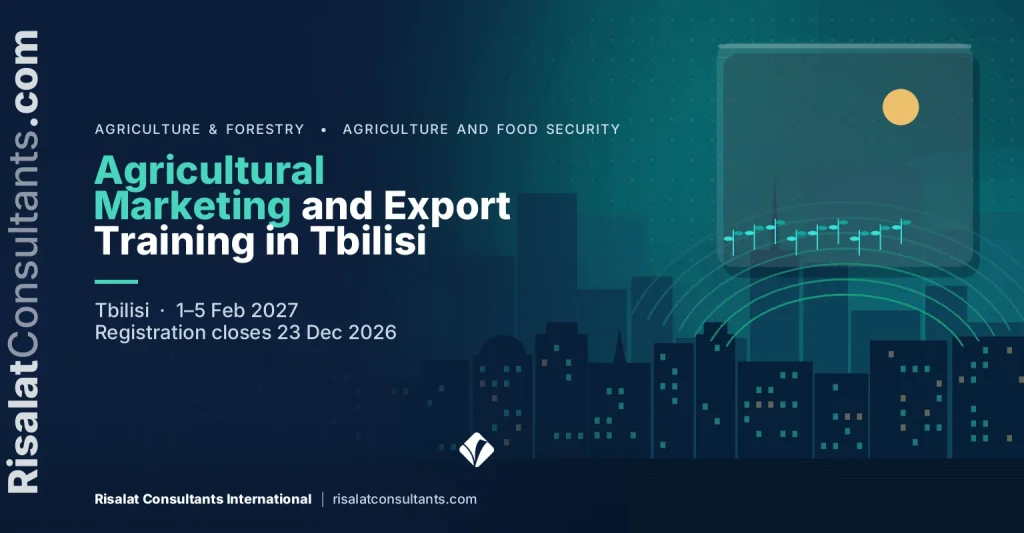
- 1–5 fev. 2027 (5 dias)
- Local
- A definir, Tbilissi, Geórgia
- Preço por participante
- £2.760 (GBP)
- Pagamento
- Por fatura e transferência bancária
- Encerramento das inscrições
- 23 dez. 2026
- Formato
- 5-day short course: a practical capacity-building programme for government, NGO and project teams in Tbilisi
- Certificado
- Certificado de conclusão
- Opção interna
- Realize-o para a sua equipa, nas datas que preferir
Nesta página 16 secções
Visão geral do programa
Producing a good crop is only half the task; selling it at a fair price, to the right buyer, in a form that buyer wants is the other half. This five-day programme in Tbilisi covers the practical side of agricultural marketing: market research, segmentation, pricing, channels, branding, export requirements and the marketing plan that brings them together.
Georgia offers a working example of a small agricultural economy repositioning itself through markets. Agriculture’s share of GDP fell from 7.6% in 2022 to a preliminary 5.9% in 2025 according to Geostat, even though output kept growing, because services and trade grew faster. For producers and agencies, the response has been to compete on value rather than volume: origin products, processing, quality and new export markets.
Wine is the clearest case. The National Wine Agency reports that Georgia exported 82.3 million litres of wine worth about USD 245 million to 70 countries in January to November 2025, while the average export price rose to USD 2.98 per litre. In strategic markets such as the United States, Japan and the United Kingdom, average prices were well above USD 5 per litre, showing how positioning and branding change returns.
O apoio público e de doadores tem acompanhado este foco de mercado. A Estratégia de Desenvolvimento Agrícola e Rural 2021-2027 do governo visa a competitividade, a utilização sustentável dos recursos e a segurança alimentar; o programa ENPARD da UE tem apoiado o desenvolvimento rural desde 2013; e os esquemas estatais, como o projeto Agrocrédito Preferencial, ajudam os produtores e transformadores a investir. Estes fornecem o material de estudo para a semana.
Risalat works with ministries, agencies, cooperatives and agribusinesses to turn market evidence into marketing decisions. Participants leave with a tested marketing plan for a product they work with, plus templates for research, pricing and promotion.
The Programme Strengthens Institutional Capability
- Agricultural market research and demand analysis
- Customer segmentation and target market selection
- Proposta de valor e posicionamento de produto
- Pricing strategy and margin management
- Distribution channels and wholesale, retail and export routes
- Branding, packaging and origin labelling
- Geographical indications and quality schemes
- Export market entry and buyer requirements
- Food safety and standards as marketing assets
- Marketing digital e comércio eletrónico para produtos agrícolas
- Cooperative and group marketing
- Promotional campaign planning and budgeting
- Trade fair and buyer meeting preparation
- Market information systems and price monitoring
- Farm and enterprise marketing plans
- Monitoring sales and marketing performance
The programme suits both public bodies that support producers and enterprises that sell directly, and it is taught from the basics up so mixed teams can follow.
The Growing Importance of Agricultural Marketing
Market access now decides the success of many agricultural investments. Georgia’s Association Agreement with the European Union, including a Deep and Comprehensive Free Trade Area, opened a large market but also brought EU-aligned food safety and quality rules. The head of the National Food Agency has stated that up to 150 EU-aligned legal acts were approximated between 2015 and 2020, and producers still need help to meet buyer and regulatory expectations.
Georgian origin names are protected in the EU through the geographical indications provisions of the Association Agreement, and an EU twinning project with Sakpatenti, the national intellectual property centre, worked on GI control from farm to retail. For marketers, a protected name is only valuable when quality is controlled and the story reaches buyers.
Finance is also tied to markets. The Ministry of Environmental Protection and Agriculture reports that the Preferential Agrocredit project supported over 50,000 beneficiaries with loans of up to GEL 8.2 billion between 2013 and 2025. Investments in processing and storage need marketing plans that secure buyers and prices.
As organizações precisam cada vez mais de profissionais capazes de:
- Researching demand, competitors and buyer preferences
- Segmenting customers and choosing target markets
- Setting prices that cover costs and match the market
- Selecting and managing distribution channels
- Building brands and packaging for origin products
- Utilização de indicações geográficas e rótulos de qualidade
- Preparing for export buyer audits and certification
- Planning promotions, trade fairs and buyer meetings
- Running digital and social media marketing
- Organising group marketing through cooperatives
- Elaboração e apuramento de custos de um plano de marketing
- Tracking sales, margins and market share
Strong agricultural marketing systems help organisations:
- Earn better prices for the same output
- Reduce dependence on one buyer or market
- Turn quality and origin into sales advantage
- Enter export markets with fewer rejections
- Planear a produção em torno da procura
- Make investments in processing and storage pay back
- Strengthen cooperatives’ bargaining position
- Show results to lenders and support programmes
The common lesson across these programmes is that support works best when producers and agencies understand the buyer. This training gives participants a structured way to do that.
Who Should Attend This Agricultural Marketing Training?
Este programa destina-se a:
- Marketing and sales managers of agribusinesses and food processors
- General managers and business development managers in agri-enterprises
- Cooperative and producer organisation leaders
- Wineries, orchard, nut and horticulture producers
- Export managers and trade promotion officers
- Officials of ministries of agriculture and economy
- Staff of rural and agricultural development agencies
- Food safety and quality assurance officers
- PIU staff of agriculture and rural development projects
- Value chain and market systems advisers
- Agricultural credit officers assessing market risk
- Pessoal de extensão e aconselhamento empresarial
- Técnicos de programas de ONG e de parceiros de desenvolvimento
- Graduates and new staff entering agri-marketing roles
No prior marketing qualification is needed. Organisations can use our free training needs assessment to match nominees to the sessions that fit them best.
Assinale o que a sua equipa precisa de ser capaz de fazer.
Agricultural Marketing Training Objectives
Upon successful completion of this Agricultural Marketing Training, participants will be able to:
- Explain the role of marketing in agricultural enterprises and value chains
- Realizar pesquisa de mercado prática para um produto agrícola
- Segment customers and select target markets
- Develop a value proposition and positioning for a product
- Set pricing objectives and choose pricing methods
- Conceber canais de distribuição para mercados nacionais e de exportação
- Use branding, packaging and origin labels effectively
- Apply food safety and quality requirements as part of the offer
- Plan promotional campaigns and buyer engagement
- Write, cost and monitor a farm or enterprise marketing plan
- Coordinate group marketing through cooperatives and associations
Cada objetivo é praticado em exemplos reais georgianos e regionais, sendo depois aplicado a um produto escolhido por cada equipe participante.
Conteúdo e estrutura do programa
- The role and concepts of agricultural marketing
- Actors and functions in agri-food marketing systems
- Supply, demand and price behaviour for farm products
- Georgia’s agri-food sector in numbers
- Sources of market information and price data
- Designing simple buyer and consumer surveys
- Competitor and substitute analysis
- Customer values, attitudes and buying behaviour
- Market segmentation methods for agri-products
- Selecting target markets and estimating their size
- Building a value proposition
- Positioning and image
- Product range, grading and value addition
- Market penetration and market development options
- Pricing objectives and cost-based pricing
- Precificação baseada no mercado e baseada no valor
- Price risk and seasonal price patterns
- Canais grossistas, retalhistas, de serviços de alimentação e diretos
- Contracts with supermarkets and exporters
- Market coverage and channel selection
- Physical handling, storage and cold chain
- Logos, packaging, labelling and brand identity
- Origin stories and geographical indications
- Publicidade, venda pessoal e promoção de vendas
- Marketing digital e nas redes sociais
- Trade fairs and buyer meetings
- Food safety and quality systems as selling points
- EU market rules under the DCFTA
- Estrutura de um plano de marketing agrícola ou empresarial
- Linking marketing objectives to strategies
- Market retention and balancing strategies
- Comercialização em grupo através de cooperativas
- Lessons from EU-supported rural development in Georgia
- Budgeting and resourcing the plan
- Sales and marketing performance indicators
Conteúdo completo, dia a dia
Os cinco dias progridem desde a compreensão dos mercados até à conceção da oferta, alcance dos compradores e, finalmente, elaboração de um plano de marketing completo.
- Day 1: Agricultural marketing systems and market research
- Day 2: Segmentation, positioning and product strategy
- Day 3: Pricing, channels and physical distribution
- Dia 4: Imagem de marca, promoção, qualidade e acesso à exportação
- Day 5: The marketing plan and its management
Conteúdo completo, dia a dia
First Day | Agricultural Marketing Systems and Market Research
- The role and concepts of agricultural marketing
- Actors and functions in agri-food marketing systems
- Supply, demand and price behaviour for farm products
- Georgia’s agri-food sector in numbers
- Sources of market information and price data
- Designing simple buyer and consumer surveys
- Competitor and substitute analysis
- Reviewing the business’s current market situation
- Setting the week’s team product
Workshop: Market Scan for a Georgian Product
Teams choose a product such as wine, hazelnuts, fruit or dairy and build a quick market scan using published statistics and buyer information. They identify current buyers, competitors and price ranges, and agree three questions their market research must answer before the business invests further.
Second Day | Segmentation, Positioning and Product Strategy
- Customer values, attitudes and buying behaviour
- Market segmentation methods for agri-products
- Selecting target markets and estimating their size
- Building a value proposition
- Positioning and image
- Product range, grading and value addition
- Market penetration and market development options
- Geographical indications as a positioning tool
- Setting marketing objectives
Case Study: Positioning Georgian Wine in Strategic Markets
Utilizando dados da Agência Nacional do Vinho sobre preços médios de exportação por mercado, os participantes comparam como o vinho georgiano está posicionado nos Estados Unidos, Japão, Alemanha, China e Polónia. Os grupos explicam as diferenças de preço e, em seguida, redigem uma declaração de posicionamento e um segmento-alvo para o seu próprio produto.
Third Day | Pricing, Channels and Physical Distribution
- Pricing objectives and cost-based pricing
- Precificação baseada no mercado e baseada no valor
- Price risk and seasonal price patterns
- Canais grossistas, retalhistas, de serviços de alimentação e diretos
- Contracts with supermarkets and exporters
- Market coverage and channel selection
- Physical handling, storage and cold chain
- Logistics costs and delivery reliability
- Using credit programmes to finance market investments
Workshop: Channel and Price Model
Teams compare two routes to market for their product, for example a supermarket contract and an export distributor. They calculate the margin taken at each stage, the price needed to cover costs, and the volume and quality the channel demands, then recommend one route with reasons.
Fourth Day | Branding, Promotion, Quality and Export Access
- Logos, packaging, labelling and brand identity
- Origin stories and geographical indications
- Publicidade, venda pessoal e promoção de vendas
- Marketing digital e nas redes sociais
- Trade fairs and buyer meetings
- Food safety and quality systems as selling points
- EU market rules under the DCFTA
- Export documentation and buyer audits
- Creating customer awareness on a limited budget
Workshop: Promotional Campaign Plan
Each team designs a twelve-month promotional campaign for its product, covering brand message, channels, trade events and digital activity. Teams set a budget, a calendar and measures of success, and check that every claim on the label and in promotion can be supported by their quality controls.
Fifth Day | The Marketing Plan and Its Management
- Estrutura de um plano de marketing agrícola ou empresarial
- Linking marketing objectives to strategies
- Market retention and balancing strategies
- Comercialização em grupo através de cooperativas
- Lessons from EU-supported rural development in Georgia
- Budgeting and resourcing the plan
- Sales and marketing performance indicators
- Managing and reviewing the plan
- Team presentations and peer review
Capstone Exercise: Complete Marketing Plan
Teams bring together their research, positioning, price and channel model and promotional campaign into a complete marketing plan. They present it to a panel playing buyers and lenders, respond to questions on assumptions and risks, and finalise the plan with responsibilities and review dates.
Agricultural Marketing Training Methodology
The programme is interactive and built on adult learning principles. Short inputs lead into case analysis, calculation exercises and team work on a product each group knows well.
O programa combina:
- Facilitator-led sessions on marketing concepts and tools
- Case studies from Georgia’s wine, horticulture and dairy sectors
- Analysis of real export and price data
- Market research and survey design exercises
- Workshops de segmentação e posicionamento
- Price and margin calculations in spreadsheets
- Channel comparison simulations
- Branding and packaging critique sessions
- Promotional campaign design
- Team project carried through all five days
- Revisão por pares e apresentações em painel
- Templates ready for use at work
As sessões são adaptadas à coorte, com maior foco na exportação para grupos orientados para o comércio e mais marketing cooperativo para grupos que trabalham com pequenos agricultores.
Resultados esperados
Upon completion of this Agricultural Marketing Training, participants will be able to:
- Run practical market research before investing
- Choose target markets with clear reasons
- Position products to earn better prices
- Set prices using costs, competition and value
- Select channels that match volume and quality
- Build brands and use origin labels effectively
- Planear e orçamentar campanhas promocionais
- Prepare for export buyer and regulatory requirements
- Manage and review a written marketing plan
Together, these outcomes help producers and agencies move from selling whatever is harvested to producing what buyers will pay for.
£2.760 por participante · fatura e transferência bancária · desconto para grupos de 5 ou mais pessoas
Cinco ou mais participantes da mesma organização: peça a tarifa de grupo no pedido de fatura.
Ten or more: an in-house version for your institution may cost less per person. Ask for an in-house quote.
As inscrições encerram em 30 dias (23 dez 2026)
Institutional Application of Agricultural Marketing Training
Este programa ajuda as organizações a reforçar:
- Market intelligence and price monitoring
- Export promotion and buyer linkage services
- Apoio ao marketing cooperativo e de grupo
- Branding and origin product programmes
- Quality and food safety communication
- Assessment of market risk in grants and loans
- Marketing advice in extension services
- Trade fair and promotion planning
- Value chain programme design
- Monitorização de vendas e resultados de mercado
Os participantes regressam com ferramentas práticas para melhorar:
- Market scan and survey templates
- Fichas de trabalho de segmentação e posicionamento
- Price and margin calculators
- Channel comparison model
- Promotional campaign planner
- Marketing plan template
- Folha de indicadores de vendas e marketing
- Export readiness checklist
Agencies reviewing how well their teams are organised to support producers can pair this training with our institutional capacity assessment.
Relevância regional e aplicação
Europa
The EU’s Deep and Comprehensive Free Trade Areas with Eastern Partnership countries link market access to food safety and quality rules. Georgia’s experience with approximation, geographical indications and EU-funded rural development is directly useful for agencies and exporters in neighbouring partner countries.
Ásia
Central Asian and Caucasus producers are diversifying export markets and adding value through processing. Georgia’s positioning of wine in Japan, South Korea and China shows how origin products can reach distant Asian buyers, a lesson relevant to exporters of fruit, nuts and specialty foods.
Médio Oriente
Importing countries in the region demand reliable volumes, clear labelling and halal or other certification. Exporters and trade agencies from the region gain from understanding how supplying countries organise channels, quality and promotion.
África
Many African agriculture programmes now focus on market linkages, cooperatives and branding of origin products. The research, pricing and group marketing tools used in the week apply directly to value chain projects financed by multilateral partners.
Mixed regional teams compare markets and constraints, which helps every participant test their own assumptions against other experiences.
Fonte: Geostat, conforme divulgado pelo Georgia Today (2025 preliminar)
1. What was the average export price of Georgian wine in 2025?
The National Wine Agency reported an average export price of USD 2.98 per litre in 2025, up from USD 2.91 in 2024.
2. Which of these is one of the three priorities of Georgia's 2024–2027 agriculture action plan?
The government approved an action plan of 88 activities with competitiveness, sustainable resources and food safety, veterinary and plant protection as its priorities.
3. Roughly how many beneficiaries has Georgia's Preferential Agrocredit project supported since 2013?
The Ministry of Environmental Protection and Agriculture reported over 50,000 beneficiaries and loans of up to GEL 8.2 billion between 2013 and 2025.
Perfil do país anfitrião – Geórgia
Georgia sits between the Black Sea and the Caucasus mountains, with a farming tradition built around vineyards, orchards, nuts, dairy and livestock. Tbilisi, the capital, hosts the ministry, its agencies, development partners and many agribusiness head offices, making it a convenient base for a programme on marketing farm products.
The country is a useful benchmark because it combines an EU trade agreement, protected origin names, a national agriculture strategy with a 2024–2027 action plan of 88 activities, and long-running support through ENPARD, the World Bank’s Georgia Resilient Agriculture, Irrigation and Land Project and IFAD’s dairy modernisation work. Participants can see how policy, finance and marketing interact in a small, open economy.
Tbilisi está ligada por voos diretos à Europa, Médio Oriente, Turquia e Ásia Central. Muitas nacionalidades podem entrar na Geórgia sem visto, e outras podem candidatar-se online, mas as regras diferem consoante o passaporte, pelo que os participantes devem verificar os requisitos atuais atempadamente. A Risalat presta apoio com o visto e recolha no aeroporto, e quaisquer visitas de estudo são confirmadas com as organizações de acolhimento.
Agricultural Marketing Training Deliverables
Risalat provides a full package so participants can concentrate on learning and applying it.
Antes do programa
- Avaliação prévia dos participantes
- Agricultural Marketing Readiness Assessment
- Agricultural Marketing Resource Pack
- Materiais de leitura preparatória
- Apoio e aconselhamento gratuitos em matéria de vistos
Durante o programa
- Recolha no aeroporto e apoio de boas-vindas
- Accommodation with breakfast: 6 nights, check-in Sunday 31 January 2027, check-out Saturday 6 February 2027 (one night before and one night after the programme)
- Jantar de boas-vindas e networking
- Kit de formação Risalat (saco, garrafa, caneca, t-shirt, boné, capa de passaporte, canetas, bloco de notas, íman e porta-chaves)
- Comprehensive Agricultural Marketing Training Manual
- Market Scan and Survey Template
- Ficha de trabalho de segmentação e posicionamento
- Calculadora de Preço e Margem
- Channel Comparison Model
- Promotional Campaign Planner
- Export Readiness Checklist
- Workshops práticos e simulações
- Discussões de grupo e aprendizagem entre pares
- Almoço e pausas para café diários
- Acesso total às instalações do local de formação
- Mini tablet com materiais de aprendizagem digitais
- Visita de campo (quando aplicável)
- Passeio recreativo pela cidade
Depois do programa
- Certificado de Conclusão
- Prémio Risalat de Reconhecimento da Participação no Programa
- Materiais de referência pós-formação
- Team Marketing Plan
- Sales and Marketing Indicator Sheet
- Apoio pós-formação e orientação de acompanhamento
- Relatório do programa
Ministérios, agências, cooperativas e empresas também podem solicitar uma proposta personalizada para uma versão interna construída em torno dos seus próprios produtos e mercados.
Desafios Comuns no Marketing Agrícola e Como Esta Formação Ajuda
How can producers find out what buyers really want?
Many investments are made before demand is checked. The First Day market research sessions show low-cost ways to collect buyer, price and competitor information before committing money.
How can small producers escape low prices for undifferentiated products?
Vender como mercadoria deixa pouca margem. As sessões de posicionamento do segundo dia e o estudo de caso do vinho mostram como a classificação, a valorização e a origem podem apoiar melhores preços.
How can prices be set when costs and markets keep changing?
Pricing by habit often loses money. The Third Day pricing sessions combine cost, competition and value methods and build a simple calculator participants can update.
How can a business choose between local and export channels?
Each channel has different volume, quality and payment terms. The Third Day channel model compares routes side by side so the choice is based on margins and risk.
De que forma podem os nomes de origem e os rótulos de qualidade acrescentar valor real?
A protected name helps only if quality is controlled and buyers know the story. The Fourth Day covers geographical indications, labelling and the quality controls behind marketing claims.
How can exporters meet EU and other buyer requirements?
Rejeições e auditorias falhadas danificam a reputação. As sessões do quarto dia sobre segurança alimentar, regras da DCFTA e documentação de exportação ajudam as equipas a prepararem-se antes de abordarem os compradores.
How can marketing plans be kept alive after they are written?
Plans are often filed and forgotten. The Fifth Day covers budgeting, indicators and review routines that make the plan a working management tool.
Perguntas frequentes
Who should attend the Agricultural Marketing Training in Tbilisi?
Marketing, sales and general managers of agribusinesses, cooperative leaders, exporters, and officials and project staff who support producers in reaching markets.
Is previous marketing experience required?
Não. O programa começa do básico e evolui para o marketing de exportação e um plano de marketing completo, permitindo a participação de equipas mistas.
Que exemplos georgianos são utilizados?
Sessions use National Wine Agency export and price data, Georgia's geographical indications experience under the EU Association Agreement, and rural development support such as ENPARD.
Will participants produce something they can use at work?
Yes. Each team leaves with a market scan, price and channel model, promotional campaign and complete marketing plan for a product of its choice.
O programa pode ser realizado internamente?
Sim. As instituições podem solicitar uma versão personalizada focada nos seus próprios produtos, mercados e pessoal.
Who Will Deliver This Programme
Each date is delivered by a team assigned from Risalat's expert network for this subject. For this programme we assign:
How we choose them: Experience in the region of the participants or comparable settings; Command of the financier rules that apply (World Bank, ADB, AfDB, EU, UN) where relevant; Delivery in English; other languages on request for in-house groups; No conflict of interest with participants' institutions.
Training courses in TbilisiAgriculture & Forestry training courses
Porquê Tbilissi para este programa
Tbilissi é conhecida pelos seus balcões únicos de serviços públicos e pelas reformas anticorrupção, e oferece vistos fáceis para muitos países.
The Agricultural Marketing and Export Training in Tbilisi programme in February 2027 brings together officials and professionals from across the Caucasus region and beyond. Sessions combine short inputs, case studies and group work on participants' own files, and the city's institutions can be added as a study visit on request.
Como chegar: Aeroporto Internacional de Tbilissi (TBS).
Verifique se precisa de visto com o Verificador de Vistos gratuito e peça uma carta-convite depois de se inscrever.
O mesmo tema noutras cidades
- Pastoral Rangeland Management and Livestock Value Chain Resilience in Nairobi (Nairobi)
- Inovação Agroalimentar e Sistemas pecuários inteligentes face ao clima em Casablanca (Casablanca)
- Agro-Logistics Hub Infrastructure and Regional Value Chain Linkages in Tbilisi (Tbilisi)
- Agribusiness Incubator Design and Smallholder Market Linkages in Nadi (Nadi)
- Post-Harvest Handling, Cold Chain Logistics & Export Standards in Kuala Lumpur (Kuala Lumpur)
- Formação em Gestão de Marketing em Catmandu (Catmandu)
Outros programas em Tbilissi
- Performance Management in Government in Tbilisi
- Mountain Highway Slope Protection and Mudflow Barrier Engineering in Tbilisi
- Hydro Plant Electro-Mechanical Refurbishment and Turbine Rehab in Tbilisi
- Modern Irrigation Scheme Modernisation and Water Conveyance Systems in Tbilisi
- Secondary Road Rehabilitation and Climate-Proof Pavement Design in Tbilisi
Relacionado: Programas de desenvolvimento empresarial e de PME · Avaliação de Necessidades de Formação gratuita · todos os programas
Teams often travel here from Azerbaijan, Georgia, Armenia, Ukraine, Moldova, Albania, Serbia, North Macedonia. Funding, visa letters and group rates are explained on each country page.
For teams and institutions
Bring your team
Teams that learn together apply more at work. Tell us how many people and how you would like to take part: we reply with a group quote within two working days.
Outras datas e cidades para este tema: Cursos de formação em Agricultura, Cadeias de Valor e Segurança Alimentar (96 datas futuras).
Mais cursos de formação na Geórgia · Todos os programas na Ásia · Calendário de formação completo
Planear este programa num roteiro: porque importa, porque o aprovar, as datas a planear e a carreira que constrói.