

概览
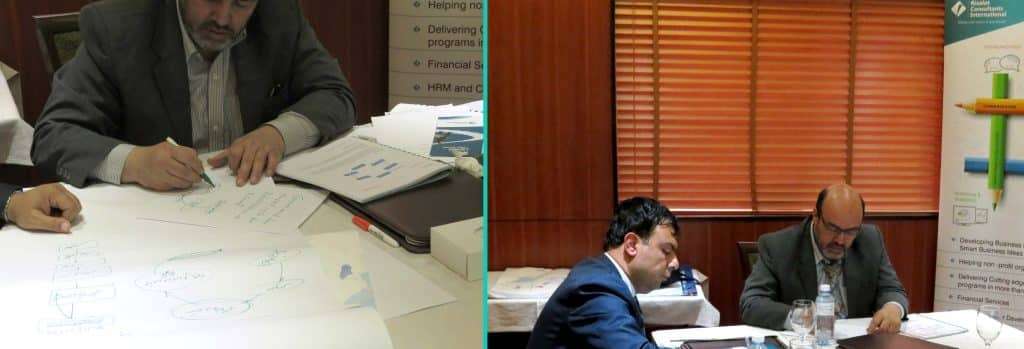
This assignment comprised a Project Cycle Management Workshop and Coaching programme delivered for international development organisations. The sessions provided comprehensive training on managing development projects across their entire life cycle, from initial policy setting and formulation through to evaluation and closure.
The training was organised for personnel from development agencies, strengthening their capabilities in project design methodology, stakeholder analysis, and donor procedures for successful project proposal preparation.
Client and context
The participants attending the workshop and coaching programme were from the United Nations Development Programme (UNDP) and the Deutsche Gesellschaft für Internationale Zusammenarbeit (GIZ). The programme addressed the procedures applied by donor agencies to identify, formulate, and manage development initiatives.
Objectives
- Understand Project Cycle Management, its principles, and its limitations.
- Apply the Logical Framework Approach (LFA) to project design, monitoring, and evaluation.
- Familiarise participants with donor agency procedures to identify, formulate, and manage development projects.
- Enable participants to prepare successful project proposals.
- Develop and integrate appropriate strategies and exit plans into project proposal development.
- Create monitoring and follow-up tools for the execution of disengagement plans of action.
- Establish a fast-track approach involving all key stakeholders for interventions that need to conclude within a very short timeframe.
What we delivered
- Understanding Project Cycle Management, limitations, instruments, and procedures.
- Coverage of the project cycle phases: policy setting, identification, formulation, appraisal, contracting, commitment, implementation, monitoring, mid-term evaluation, and final evaluation.
- Stakeholder analysis, problem analysis, analysis of objectives, and strategy analysis.
- Intervention logic, assumptions, preconditions, and factors ensuring sustainability.
- Procedures for developing and applying the logical framework.
- A project design methodology in 10 steps.
- Application of Objectively Verifiable Indicators (OVIs) and Sources of Verification (SOVs).
- Instruction on indicators as a management tool, covering monitoring, performance, reaction, direct, indirect, evaluation, and indicator formulation.
- Activity and resource schedules, plus assumptions and sustainability assessments.
- Preparation of terms of reference and the quality assessment tool.
- Designing a monitoring system, reviewing implementation procedures, and project evaluation and reporting.
Approach
The assignment combined structured workshop sessions with targeted coaching, taking participants systematically through a 10-step project design methodology and the practical application of the Logical Framework Approach.
- Interactive review of each phase within the project cycle.
- Step-by-step guidance on analytical tools, from problem and stakeholder analysis through to objective trees and strategy selection.
- Hands-on instruction on drafting and structuring terms of reference for feasibility studies.
- Practical focus on the development of exit strategies and fast-track stakeholder engagement plans.
Results and outputs
- Participants learned the role of the project cycle and key activities required at each stage.
- Participants mastered the principles of Project Cycle Management and the Logical Framework Approach (LFA).
- Participants learned how to use the LFA to assess project documents and identify information requirements for feasibility studies.
- Participants learned how to structure terms of reference for feasibility studies.
- Participants gained an understanding of the role of the logframe in project monitoring and evaluation.
- Participants acquired an understanding of the integrated approach and the basic PCM format.
- Participants gained familiarity with donor agency procedures for project identification, formulation, and management to support successful proposal preparation.
- Participants learned to design monitoring and follow-up tools for disengagement plans and apply fast-track closure approaches with main stakeholders.
At a glance
| 客户类型 | International development organisations (UNDP, GIZ) |
|---|---|
| 国家 | 阿拉伯联合酋长国 |
| Location | 迪拜 |
| 年份 | 2015 |
| 形式 | Workshop and coaching |
| 时长 | 3 days (24-26 October 2015) |
| 学员 | Personnel from UNDP and GIZ |