Key facts
- Dates
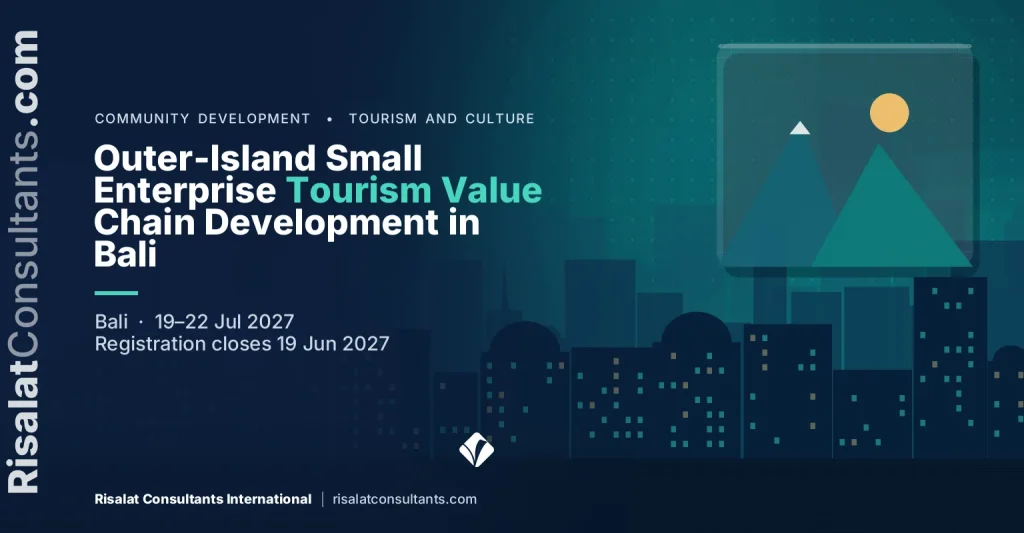
- 19–22 Jul 2027 (4 days)
- Where
- Bali, Indonesia
- Fee per participant
- £2,350 (GBP)
- Payment
- By invoice and bank transfer
- Registration closes
- 19 Jun 2027
- Certificate
- Certificate of completion
- In-house option
- Run it for your team, on your dates
On this page 13 sections
Programme Overview
Outer-island and remote provincial economies frequently struggle to retain economic value generated by mainstream tourism activities. While coastal resorts and urban hubs attract significant visitor spending, secondary and tertiary suppliers in rural geographies often face logistical isolation, fragmented markets, and limited commercial compliance. This four-day training programme in Bali addresses structural gaps in remote destination development. It delivers practical methodologies for integrating provincial micro, small, and medium enterprises into commercial hospitality procurement networks and visitor itineraries.
Delegates examine applied value chain approaches tailored specifically to remote island contexts. Drawing on practical lessons from island economic planning in the Asia-Pacific region, the curriculum provides technical tools to diagnose economic leakages and identify high-potential linkages across agriculture, artisanal production, creative industries, and maritime transport. Focus is placed on structuring actionable enterprise development interventions that align grassroots productive capacities with the quality, safety, and reliability standards demanded by commercial tour operators and hotel chains.
The programme equips policy specialists, commercial development officers, and regional planners to design targeted support frameworks for outer-island enterprises. Participants analyse administrative instruments including tailored micro-grant delivery mechanisms, cluster governance models, and local quality verification schemes. By shifting from ad hoc assistance to integrated value chain facilitation, public institutions can systematically strengthen the commercial resilience of provincial businesses, expand local employment, and foster sustainable trade linkages between remote communities and established hospitality markets.
Remote island provinces require resilient economic diversification to counter geographic vulnerability and distribute economic benefits beyond primary gateways. This training directly underpins public sector efforts to deliver sustainable infrastructure, commercial development, and trade administration aligned with multi-phase initiatives such as the Fiji Tourism Development Programme in Vanua Levu. Public officers must move beyond basic community livelihood models by establishing formal market systems, reliable supply linkages, and compliant business standards capable of sustaining long-term private sector investment across remote provincial territories.
Delivered by Risalat Consultants International in Bali, Indonesia, it combines expert-led sessions, real cases and group work, so that participants can apply what they learn in their own institution.
The Programme Strengthens Institutional Capability
- Applying the UN Tourism and International Trade Centre value chain analysis methodologies to island destinations
- Diagnostic mapping of provincial hospitality supply flows: Identifying economic leakage and retention points
- Assessing outer-island transport, cold-chain, and logistics constraints affecting commercial viability
- Market readiness assessments: Evaluating small enterprise capacity against resort procurement criteria
- Exercise: Constructing an end-to-end value chain map for an outer-island destination sub-sector
- Integrating local agricultural and artisanal suppliers into resort food, beverage, and retail operations
- Structuring cooperative aggregation mechanisms to overcome supply volume and consistency constraints
- Developing rural creative and culinary cultural assets into commercially viable visitor experiences
- Destination planning and management
- Sustainable tourism principles
- Heritage conservation and management
- Marketing and visitor experience
It is designed for enterprise development specialists from Ministries of Commerce, Trade, and Industry, tourism planning officers and regional economic development specialists, trade administration officials managing provincial small enterprise portfolios and others who want practical, current skills in tourism, culture and heritage.
The Growing Importance of Outer-Island Small Enterprise Tourism Value Chain Development in Bali
Tourism, culture and heritage support jobs, local businesses and national identity. To grow sustainably, destinations need planning that balances visitors, communities and the environment.
Public bodies, operators and communities increasingly work together on destination management, marketing and heritage protection. Teams with these skills help places benefit from tourism without losing what makes them valuable.
Organisations increasingly require professionals capable of:
- Plan destinations that balance visitors and communities
- Protect and manage heritage
- Market destinations and improve visitor experience
- Involve communities and share benefits
- Monitor tourism performance and impacts
Strong tourism, culture and heritage systems help organisations:
- Grow tourism sustainably
- Protect heritage and the environment
- Create local jobs and businesses
- Attract investment and partners
This Outer-Island Small Enterprise Tourism Value Chain Development in Bali programme brings these elements together in a practical format, so that participants understand not only what good practice looks like but also how to introduce it in their own setting, with the people and resources they have.
Who Should Attend This Outer-Island Small Enterprise Tourism Value Chain Development in Bali Training?
This programme is designed for:
- Enterprise development specialists from Ministries of Commerce, Trade, and Industry
- Tourism planning officers and regional economic development specialists
- Trade administration officials managing provincial small enterprise portfolios
- Directors and technical leads of national and regional tourism associations
- Provincial administrators and local government economic planners
- Chamber of Commerce representatives supporting outer-island business clusters
- Project implementation unit managers overseeing multilateral-financed private sector projects
- Microfinance and rural enterprise coordinators in public development agencies
- Maritime transport and local logistics regulators supporting provincial tourism routes
- Tourism ministry and agency staff
- Destination managers
- Heritage and culture officials
The programme suits experienced professionals as well as those moving into new responsibilities. Groups that mix institutions and countries are encouraged, because participants learn a great deal from each other’s experience.
Tick what your team needs to be able to do.
Outer-Island Small Enterprise Tourism Value Chain Development in Bali Training Objectives
Upon successful completion of this Outer-Island Small Enterprise Tourism Value Chain Development in Bali Training, participants will be able to:
- Analyse outer-island tourism supply ecosystems to identify market failures, structural bottlenecks, and economic leakages
- Map local artisanal, maritime transport, and culinary linkages into established commercial hospitality supply networks
- Design targeted micro-grant allocation mechanisms that incorporate sound fiduciary controls and technical milestones
- Develop provincial quality assurance and certification criteria aligned with standard food safety and hospitality requirements
- Formulate cluster governance frameworks that enable smallholders and micro-enterprises to aggregate supply reliably
- Structure business development service interventions tailored to the commercial realities of remote island enterprises
- Establish monitoring and evaluation frameworks using standard trade and enterprise indicators to track local value retention
- Explain the principles of sustainable tourism
- Plan and manage a destination with stakeholders
- Apply heritage conservation and management practices
Each objective is practised during the programme through exercises, cases or group work, so that participants leave able to do it, not only to describe it.
Programme Contents and Structure
- Applying the UN Tourism and International Trade Centre value chain analysis methodologies to island destinations
- Diagnostic mapping of provincial hospitality supply flows: Identifying economic leakage and retention points
- Assessing outer-island transport, cold-chain, and logistics constraints affecting commercial viability
- Market readiness assessments: Evaluating small enterprise capacity against resort procurement criteria
- Exercise: Constructing an end-to-end value chain map for an outer-island destination sub-sector
- Integrating local agricultural and artisanal suppliers into resort food, beverage, and retail operations
- Structuring cooperative aggregation mechanisms to overcome supply volume and consistency constraints
- Developing rural creative and culinary cultural assets into commercially viable visitor experiences
- Contracting models: Designing equitable forward-purchase agreements between hotels and micro-enterprises
- Field review of Bali agro-tourism and artisan cluster integration models in provincial supply networks
- Translating standard hospitality expectations into tiered provincial quality verification schemes
- Establishing baseline hygiene, sanitation, and safety compliance for rural food producers and boat operators
- Designing low-burden traceability and authenticity certification frameworks for island-origin goods
- Developing peer-to-peer mentoring and technical extension models for rural micro-enterprises
- Workshop: Formulating a provincial enterprise certification framework and compliance checklist
- Structuring targeted micro-grant and matching-grant windows within donor-funded project frameworks
- Establishing transparent appraisal, disbursement, and milestone verification procedures for grant schemes
- Designing sustainable business development services without creating permanent subsidy dependencies
- Public-private destination governance: Facilitating regional tourism and business associations
- Action planning: Drafting provincial enterprise value chain interventions for national implementation
Full day-by-day contents
The programme runs over 4 days. Each day combines expert input, practical work and a closing workshop or case study:
- First Day: Day 1: Tourism Value Chain Diagnostics for Outer-Island Economies
- Second Day: Day 2: Supplier Linkages, Aggregation Models, and Local Sourcing
- Third Day: Day 3: Quality Standards, Certification, and Compliance Systems
- Fourth Day: Day 4: Public Support Instruments, Micro-Grants, and Sustainability
Full day-by-day contents
First Day | Day 1: Tourism Value Chain Diagnostics for Outer-Island Economies
- Applying the UN Tourism and International Trade Centre value chain analysis methodologies to island destinations
- Diagnostic mapping of provincial hospitality supply flows: Identifying economic leakage and retention points
- Assessing outer-island transport, cold-chain, and logistics constraints affecting commercial viability
- Market readiness assessments: Evaluating small enterprise capacity against resort procurement criteria
- Exercise: Constructing an end-to-end value chain map for an outer-island destination sub-sector
Workshop: Day 1: Tourism Value Chain Diagnostics for Outer-Island Economies: Applying It to Your Institution
Working in small groups, participants apply the day's methods to examples from their own institutions and agree practical next steps.
Second Day | Day 2: Supplier Linkages, Aggregation Models, and Local Sourcing
- Integrating local agricultural and artisanal suppliers into resort food, beverage, and retail operations
- Structuring cooperative aggregation mechanisms to overcome supply volume and consistency constraints
- Developing rural creative and culinary cultural assets into commercially viable visitor experiences
- Contracting models: Designing equitable forward-purchase agreements between hotels and micro-enterprises
- Field review of Bali agro-tourism and artisan cluster integration models in provincial supply networks
Workshop: Day 2: Supplier Linkages, Aggregation Models, and Local Sourcing: Applying It to Your Institution
Working in small groups, participants apply the day's methods to examples from their own institutions and agree practical next steps.
Third Day | Day 3: Quality Standards, Certification, and Compliance Systems
- Translating standard hospitality expectations into tiered provincial quality verification schemes
- Establishing baseline hygiene, sanitation, and safety compliance for rural food producers and boat operators
- Designing low-burden traceability and authenticity certification frameworks for island-origin goods
- Developing peer-to-peer mentoring and technical extension models for rural micro-enterprises
- Workshop: Formulating a provincial enterprise certification framework and compliance checklist
Case Study: Day 3: Quality Standards, Certification, and Compliance Systems in Practice
Participants analyse a realistic case, compare the choices made with good practice and draw lessons they can use in their own setting.
Fourth Day | Day 4: Public Support Instruments, Micro-Grants, and Sustainability
- Structuring targeted micro-grant and matching-grant windows within donor-funded project frameworks
- Establishing transparent appraisal, disbursement, and milestone verification procedures for grant schemes
- Designing sustainable business development services without creating permanent subsidy dependencies
- Public-private destination governance: Facilitating regional tourism and business associations
- Action planning: Drafting provincial enterprise value chain interventions for national implementation
Capstone Exercise: Outer-Island Small Enterprise Tourism Value Chain Development in Bali Action Plan for Your Institution
Participants bring the week together in an action plan for their own institution, with priorities, owners and first steps, and present it for feedback from peers and facilitators.
Outer-Island Small Enterprise Tourism Value Chain Development in Bali Training Methodology
The training applies an adult-learning approach focused on operational tools, practical exercises, and comparative analysis of island economic environments. Participants evaluate real-world case material, conduct value chain diagnostics, and critique regulatory instruments. Facilitators lead technical workshops where delegates draft operational frameworks, matching-grant criteria, and certification systems directly applicable to their home institutions. Plenary discussions encourage structured peer exchange between public officials and project specialists managing outer-island trade and tourism portfolios.
The programme combines:
- Expert-led sessions on current practice
- Regional and international case studies
- Group work and practical exercises
- Simulations and role plays where relevant
- Discussion of participants' own challenges
- Peer learning across institutions and countries
- Practical tools and templates to take back to work
- Daily reflection and action planning
Before the programme, a short pre-assessment helps the facilitators understand each participant’s role and priorities, so that examples and exercises can be adjusted to the group. Each day ends with a short reflection in which participants note what they will apply at work.
Expected Outcomes
Upon completion of this Outer-Island Small Enterprise Tourism Value Chain Development in Bali Training, participants will be able to:
- Technical competency to conduct end-to-end tourism value chain assessments in remote island geographies
- Practical capacity to design and manage transparent micro-grant schemes for rural micro-enterprises
- Ability to establish tiered provincial quality standards and certification schemes for local suppliers
- Skills to facilitate commercial linkages between remote producers and institutional hospitality buyers
- Frameworks to establish enterprise aggregation and cluster governance models that ensure consistent supply
- Readiness to execute value chain components of donor-funded regional trade and tourism projects
- Plan destinations sustainably
- Protect and manage heritage
Participants leave with a personal action plan and practical tools they can use in their institution from the first week back. Institutions that send several participants can use the programme to agree shared methods and templates across teams, which makes improvements easier to sustain.
£2,350 per participant · invoice and bank transfer · groups of 5 or more receive a discount
Five or more from one organisation: ask for the group rate on the invoice request.
Ten or more: an in-house version for your institution may cost less per person. Ask for an in-house quote.
Registration closes in 223 days (19 Jun 2027)
Institutional Application of Outer-Island Small Enterprise Tourism Value Chain Development in Bali Training
This programme supports organisations in strengthening:
- Destination management
- Heritage protection
- Marketing
- Community involvement
- Performance monitoring
Participants return with practical tools to improve:
- Destination plans
- Visitor management
- Marketing plans
- Partnership agreements
- Tourism statistics
The programme is built so that learning moves from the classroom into the institution. Participants work on their own processes and documents where possible, and leave with an action plan that their managers can review and support.
Regional Relevance & Application
Europe
European institutions apply tourism, culture and heritage within detailed regulatory frameworks and reform agendas. Participants from Europe can compare their practice with colleagues from other regions and test how established methods work under different conditions.
Africa
Across Africa, ministries, agencies and project teams working in tourism, culture and heritage increasingly operate alongside donor-financed programmes that expect clear systems and evidence. The programme helps participants adapt good practice to the institutions and resources they work with.
Middle East
In the Middle East, national development strategies and diversification plans place growing demands on tourism, culture and heritage. Participants explore how to build the capability these plans need inside public bodies and companies.
Asia
Institutions across Asia combine rapid growth with ambitious modernisation programmes. Participants from Asia can share their experience of scaling systems quickly and learn from approaches used elsewhere.
Pacific
Small island and Pacific states face particular constraints of size, distance and capacity. The programme highlights practical, proportionate approaches to tourism, culture and heritage that suit smaller institutions.
Holding the programme in Bali, Indonesia brings participants together away from their daily pressures, so they can compare how tourism, culture and heritage is handled in different settings. The same programme can also be delivered in-house for one institution, in its own country or online, with cases taken from its current work.
Host Country Profile – Indonesia
Programmes, Workshops, Exposures, Training Courses in Bali, Indonesia by Risalat Consultants International
Studying away from their own country gives participants time to focus, a fresh view of their own institution and the chance to build a network with colleagues from other countries.
Outer-Island Small Enterprise Tourism Value Chain Development in Bali Training Deliverables
Participants receive support before, during and after the programme, so that preparation, learning and follow-up form one continuous experience.
Before the Programme
- Participant Pre-Assessment
- Outer-Island Small Enterprise Tourism Value Chain Development in Bali Readiness Assessment
- Outer-Island Small Enterprise Tourism Value Chain Development in Bali Resource Pack
- Preparatory Reading Materials
- Complimentary Visa Support & Advisory
During the Programme
- Airport Pickup & Welcome Assistance
- Accommodation with Breakfast
- Welcome Networking Dinner
- Risalat Training Kit (Bag, Bottle, Mug, T-Shirt, Cap, Passport Cover, Pens, Notebook, Magnet & Keychain)
- Comprehensive Outer-Island Small Enterprise Tourism Value Chain Development in Bali Training Manual
- Destination Assessment Checklist
- Visitor Management Plan Template
- Marketing Plan Template
- Tourism Monitoring Template
- Practical Workshops & Simulations
- Group Discussions & Peer Learning
- Daily Lunch and Refreshments
- Full Access to Training Venue Facilities
- Mini Pad / Tablet with Digital Learning Materials
- Field Visit (where applicable)
- Entertaining City Tour
After the Programme
- Certificate of Completion
- Risalat Programme Participation Recognition Award
- Post-Training Reference Materials
- Heritage Site Management Checklist
- Community Benefit Plan Template
- Post-Training Support & Follow-Up Guidance
- Programme Report
Institutions can also request a tailored in-house version of this programme, delivered at their premises or online. Request a proposal.
Common Challenges in Outer-Island Small Enterprise Tourism Value Chain Development in Bali, And How This Training Helps
How can institutions plan destinations that balance visitors and communities?
The programme addresses this directly on the first day (Day 1: Tourism Value Chain Diagnostics for Outer-Island Economies), where participants practise the methods involved and adapt them to their own institution, then build it into their action plan.
How can institutions protect and manage heritage?
The programme addresses this directly on the second day (Day 2: Supplier Linkages, Aggregation Models, and Local Sourcing), where participants practise the methods involved and adapt them to their own institution, then build it into their action plan.
How can institutions market destinations and improve visitor experience?
The programme addresses this directly on the third day (Day 3: Quality Standards, Certification, and Compliance Systems), where participants practise the methods involved and adapt them to their own institution, then build it into their action plan.
How can institutions involve communities and share benefits?
The programme addresses this directly on the fourth day (Day 4: Public Support Instruments, Micro-Grants, and Sustainability), where participants practise the methods involved and adapt them to their own institution, then build it into their action plan.
How can institutions monitor tourism performance and impacts?
The programme addresses this directly on the first day (Day 1: Tourism Value Chain Diagnostics for Outer-Island Economies), where participants practise the methods involved and adapt them to their own institution, then build it into their action plan.
Frequently Asked Questions
When and where does the Outer-Island Small Enterprise Tourism Value Chain Development in Bali programme take place?
It runs from 19 Jul 2027 to 22 Jul 2027, in Bali, Indonesia. The registration deadline is shown at the top of this page.
Who should attend?
The programme is designed for enterprise development specialists from Ministries of Commerce, Trade, and Industry, tourism planning officers and regional economic development specialists, trade administration officials managing provincial small enterprise portfolios, directors and technical leads of national and regional tourism associations, and others who want practical skills in tourism, culture and heritage.
Will I receive a certificate?
Yes. Participants who complete the programme receive a Certificate of Completion from Risalat Consultants International.
Can this programme be delivered for our institution only?
Yes. We can deliver a tailored in-house version at your premises, in another city or online, built around your own cases. Use the proposal request on this page.
Do I need prior experience in tourism, culture and heritage?
No specialist background is required beyond experience in a related role. A short pre-assessment helps the facilitators adapt the sessions to the group.
Training courses in BaliCommunity Development training courses
Why Bali for this programme
Bali offers a retreat setting for leadership and team programmes, with links to tourism and community development.
The Outer-Island Small Enterprise Tourism Value Chain Development in Bali programme in July 2027 brings together officials and professionals from across the Asia region and beyond. Sessions combine short inputs, case studies and group work on participants' own files, and the city's institutions can be added as a study visit on request.
Getting there: Ngurah Rai (DPS).
Check whether you need a visa with the free Visa Checker, and ask for an invitation letter once you are registered.
Other programmes in Bali
- State Land Titling, Allocation and Community Livelihood Planning in Bali
- Forest Landscape Restoration & Protected Area Conservation Management in Bali
- Small Hydro Run-of-River Operation and Catchment Management in Bali
- Community-Based Routine Road Maintenance and Micro-Enterprise Contracting in Bali
- Sub-National Ward Development & Community Infrastructure Planning in Bali
Related: Tourism and destination management · free Exposure Visit Planner · all programmes
- Procurement Framework and Regulations for Projects World Bank
- MAPS: Methodology for Assessing Procurement Systems MAPS Initiative
- Open Contracting Partnership Open Contracting Partnership
More training courses in Indonesia · All programmes in Asia · Full training calendar
Plan this programme in a roadmap: why it matters, why to approve it, the dates to plan and the career it builds.