Key facts
- Dates
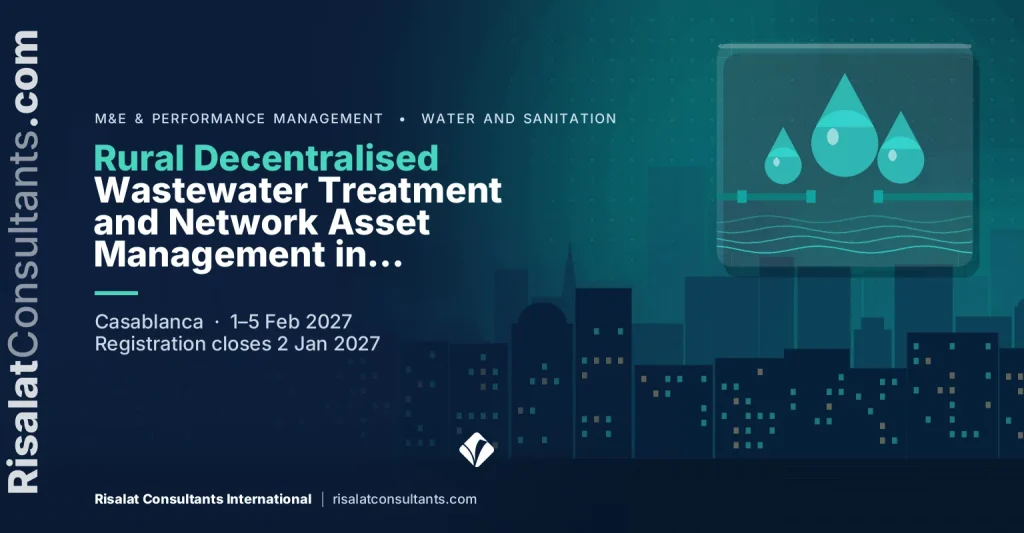
- 1–5 Feb 2027 (5 days)
- Where
- Casablanca, Morocco
- Fee per participant
- £2,500 (GBP)
- Payment
- By invoice and bank transfer
- Registration closes
- 2 Jan 2027
- Who it is for
- Sanitation project engineers from national water and wastewater utilities; Technical directors responsible for rural sanitation network management…
- Certificate
- Certificate of completion
- In-house option
- Run it for your team, on your dates
On this page 12 sections
Programme Overview
Rural sanitation programmes require robust technical solutions adapted to low-density settlements and challenging ground conditions. This five-day course equips technical specialists with the engineering and operational competencies required to plan, manage, and sustain decentralised wastewater infrastructure. Participants analyse appropriate treatment processes, small-bore and simplified sewer hydraulics, and reliable pumping arrangements suited to rural operational environments, ensuring that remote installations meet national effluent discharge regulations and protect local public health standards effectively.
Network asset management is vital for safeguarding capital investments in rural water and sanitation schemes. The curriculum focuses on whole-lifecycle asset governance, preventive maintenance programming, and asset condition grading frameworks suited to dispersed community schemes. Engineers and directors evaluate field assessment protocols, risk-based renewal prioritisation, and operational reliability metrics, enabling them to transition rural sanitation departments from reactive repairs to predictive maintenance models aligned with international utility standards.
Delivered in Casablanca, the programme draws upon regional infrastructure operational experiences and established international guidelines from development finance institutions. Through detailed technical case studies, design calculation reviews, and asset management frameworks, attendees develop institutional capacity to manage decentralised networks systematically. The course builds internal technical capability to conduct service-level benchmarking, control operational expenditures, and secure long-term system performance across small town and rural utility catchments.
Large-scale rural infrastructure initiatives, including investments aligned with the Sustainable Rural Sanitation Services Programme in Egypt, require decentralised sanitation assets to achieve lasting operational performance. Dispersed village networks frequently suffer from rapid asset deterioration, unmonitored pump station failure, and non-compliant treatment effluents when operational asset management is neglected. Public utilities and project implementation units must urgently establish systematic maintenance frameworks, asset registers, and performance benchmarking procedures to protect public capital, preserve environmental health, and sustain continuous service delivery across rural communities.
Delivered by Risalat Consultants International in Casablanca, Morocco, it combines expert-led sessions, real cases and group work, so that participants can apply what they learn in their own institution.
The Programme Strengthens Institutional Capability
- Rural wastewater flow profiles, organic loading variability, and design basis development
- Passive and nature-based treatment systems: constructed wetlands, waste stabilisation ponds, and reed beds
- Mechanised package plants: rotating biological contactors, moving bed biofilm reactors, and sequencing batch reactors
- Sludge production, stabilisation, handling, and safe disposal methods for village installations
- Process selection matrix balancing capital cost, energy reliability, and local operational capacity
- Hydraulic design of simplified sewerage and small-bore gravity collection networks
- Infiltration and inflow mitigation strategies in high groundwater and agricultural zones
- Design considerations, pump selection, and solids-handling requirements for rural lift stations
- Climate and environmental risk assessment
- Adaptation and mitigation planning
- Sector strategies for energy, water and land
- Project design for climate and environmental goals
It is designed for sanitation project engineers from national water and wastewater utilities, technical directors responsible for rural sanitation network management, rural water and wastewater utility branch managers and others who want practical, current skills in climate, environment and natural resources.
The Growing Importance of Rural Decentralised Wastewater Treatment and Network Asset Management in Casablanca
Climate change, environmental pressure and resource management now shape national plans, budgets and investment decisions. Financiers increasingly expect climate and environmental considerations to be built into projects from the start.
Institutions that can plan for climate risks, manage natural resources well and prepare sound proposals are better placed to protect services and to access the funding available for this work.
Organisations increasingly require professionals capable of:
- Assess climate and environmental risks to their services and assets
- Design projects that meet climate and environmental goals
- Prepare proposals that financiers can approve
- Measure and report results credibly
- Work with communities and partners across sectors
Strong climate, environment and natural resources systems help organisations:
- Protect services and infrastructure from climate risks
- Access climate and environmental finance
- Meet national and international commitments
- Use natural resources sustainably
This Rural Decentralised Wastewater Treatment and Network Asset Management in Casablanca programme brings these elements together in a practical format, so that participants understand not only what good practice looks like but also how to introduce it in their own setting, with the people and resources they have.
Who Should Attend This Rural Decentralised Wastewater Treatment and Network Asset Management in Casablanca Training?
This programme is designed for:
- Sanitation project engineers from national water and wastewater utilities
- Technical directors responsible for rural sanitation network management
- Rural water and wastewater utility branch managers
- Project Implementation Unit (PIU) engineers managing donor-funded sanitation loans
- Operations and maintenance managers overseeing village wastewater schemes
- Asset management specialists working within municipal infrastructure departments
- Design and planning engineers evaluating decentralised wastewater schemes
- Regulatory and compliance officers monitoring rural environmental standards
- Consulting engineers preparing detailed engineering designs for rural sewerage
- Climate change and environment officers
- Energy, water and agriculture sector staff
- Planning and policy officers
The programme suits experienced professionals as well as those moving into new responsibilities. Groups that mix institutions and countries are encouraged, because participants learn a great deal from each other’s experience.
Tick what your team needs to be able to do.
Rural Decentralised Wastewater Treatment and Network Asset Management in Casablanca Training Objectives
Upon successful completion of this Rural Decentralised Wastewater Treatment and Network Asset Management in Casablanca Training, participants will be able to:
- Evaluate decentralised wastewater treatment process options against rural influent characteristics and effluent discharge criteria
- Analyse hydraulic performance and design assumptions for simplified, small-bore, and conventional gravity rural sewerage systems
- Formulate operational monitoring and preventive maintenance procedures for rural wastewater pump stations and force mains
- Construct comprehensive asset registers and condition grading systems adapted to dispersed village sanitation infrastructure
- Apply asset lifecycle management frameworks to calculate total cost of ownership and schedule capital renewals
- Implement key performance indicators and service-level benchmarking for community-level wastewater service delivery
- Prepare corrective maintenance protocols and contingency responses to address common decentralised treatment process failures
- Explain the main climate and environmental challenges for their sector
- Assess climate and environmental risks to services and assets
- Plan adaptation and mitigation measures
Each objective is practised during the programme through exercises, cases or group work, so that participants leave able to do it, not only to describe it.
Programme Contents and Structure
- Rural wastewater flow profiles, organic loading variability, and design basis development
- Passive and nature-based treatment systems: constructed wetlands, waste stabilisation ponds, and reed beds
- Mechanised package plants: rotating biological contactors, moving bed biofilm reactors, and sequencing batch reactors
- Sludge production, stabilisation, handling, and safe disposal methods for village installations
- Process selection matrix balancing capital cost, energy reliability, and local operational capacity
- Hydraulic design of simplified sewerage and small-bore gravity collection networks
- Infiltration and inflow mitigation strategies in high groundwater and agricultural zones
- Design considerations, pump selection, and solids-handling requirements for rural lift stations
- Monitoring pump performance, wet well operating levels, and energy efficiency parameters
- Instrumentation, basic telemetry, and alarm systems for unstaffed rural pumping installations
- Asset hierarchy creation and spatial network mapping using GIS standards for rural catchments
- Visual inspection standards and closed-circuit television (CCTV) survey logging using standard condition codes
- Condition grading models: structural integrity, hydraulic capacity, and operational defect scoring
- Criticality analysis combining likelihood of failure and social, economic, and environmental consequences
- Development of dynamic asset failure risk registers for dispersed network components
- Structuring planned preventive maintenance schedules for civil, mechanical, and electrical assets
- Sewer cleansing programmes: jetting schedules, rodding intervals, and blockage root-cause tracking
- Supply chain management for critical spares, standby components, and emergency stock levels
- Service-level benchmarking applying IWA performance indicators to community sanitation schemes
- Establishing customer-facing and operational key performance indicators for rural operations
- Capital replacement planning and whole-lifecycle costing for rural wastewater infrastructure
- Structuring maintenance contracts: performance-based contracts versus direct labour schemes
- Environmental compliance verification, water quality sampling regimes, and reporting procedures
- Aligning asset management plans with multilateral development bank project covenants
- Participant group presentations: rural network asset management strategy and action plan
Full day-by-day contents
The programme runs over 5 days. Each day combines expert input, practical work and a closing workshop or case study:
- First Day: Decentralised Treatment Technologies and Rural Wastewater Characteristics
- Second Day: Decentralised Sewer Network Hydraulics and Rural Pump Stations
- Third Day: Network Asset Inventory, Condition Assessment, and Risk Profiling
- Fourth Day: Preventive Maintenance, Spares Logistics, and Service-Level Benchmarking
- Fifth Day: Asset Investment Planning, Governance, and Programme Delivery
Full day-by-day contents
First Day | Decentralised Treatment Technologies and Rural Wastewater Characteristics
- Rural wastewater flow profiles, organic loading variability, and design basis development
- Passive and nature-based treatment systems: constructed wetlands, waste stabilisation ponds, and reed beds
- Mechanised package plants: rotating biological contactors, moving bed biofilm reactors, and sequencing batch reactors
- Sludge production, stabilisation, handling, and safe disposal methods for village installations
- Process selection matrix balancing capital cost, energy reliability, and local operational capacity
Workshop: Decentralised Treatment Technologies and Rural Wastewater Characteristics: Applying It to Your Institution
Working in small groups, participants apply the day's methods to examples from their own institutions and agree practical next steps.
Second Day | Decentralised Sewer Network Hydraulics and Rural Pump Stations
- Hydraulic design of simplified sewerage and small-bore gravity collection networks
- Infiltration and inflow mitigation strategies in high groundwater and agricultural zones
- Design considerations, pump selection, and solids-handling requirements for rural lift stations
- Monitoring pump performance, wet well operating levels, and energy efficiency parameters
- Instrumentation, basic telemetry, and alarm systems for unstaffed rural pumping installations
Workshop: Decentralised Sewer Network Hydraulics and Rural Pump Stations: Applying It to Your Institution
Working in small groups, participants apply the day's methods to examples from their own institutions and agree practical next steps.
Third Day | Network Asset Inventory, Condition Assessment, and Risk Profiling
- Asset hierarchy creation and spatial network mapping using GIS standards for rural catchments
- Visual inspection standards and closed-circuit television (CCTV) survey logging using standard condition codes
- Condition grading models: structural integrity, hydraulic capacity, and operational defect scoring
- Criticality analysis combining likelihood of failure and social, economic, and environmental consequences
- Development of dynamic asset failure risk registers for dispersed network components
Case Study: Network Asset Inventory, Condition Assessment, and Risk Profiling in Practice
Participants analyse a realistic case, compare the choices made with good practice and draw lessons they can use in their own setting.
Fourth Day | Preventive Maintenance, Spares Logistics, and Service-Level Benchmarking
- Structuring planned preventive maintenance schedules for civil, mechanical, and electrical assets
- Sewer cleansing programmes: jetting schedules, rodding intervals, and blockage root-cause tracking
- Supply chain management for critical spares, standby components, and emergency stock levels
- Service-level benchmarking applying IWA performance indicators to community sanitation schemes
- Establishing customer-facing and operational key performance indicators for rural operations
Workshop: Preventive Maintenance, Spares Logistics, and Service-Level Benchmarking: Applying It to Your Institution
Working in small groups, participants apply the day's methods to examples from their own institutions and agree practical next steps.
Fifth Day | Asset Investment Planning, Governance, and Programme Delivery
- Capital replacement planning and whole-lifecycle costing for rural wastewater infrastructure
- Structuring maintenance contracts: performance-based contracts versus direct labour schemes
- Environmental compliance verification, water quality sampling regimes, and reporting procedures
- Aligning asset management plans with multilateral development bank project covenants
- Participant group presentations: rural network asset management strategy and action plan
Capstone Exercise: Rural Decentralised Wastewater Treatment and Network Asset Management in Casablanca Action Plan for Your Institution
Participants bring the week together in an action plan for their own institution, with priorities, owners and first steps, and present it for feedback from peers and facilitators.
- Funds
- Entity
- Project
- Results
- MRV
Rural Decentralised Wastewater Treatment and Network Asset Management in Casablanca Training Methodology
The programme utilises interactive technical sessions, step-by-step engineering calculation workshops, and practical asset data analysis exercises. Participants work with real-world case data from public utilities to develop maintenance schedules, asset condition grading sheets, and operational monitoring templates. Facilitators guide practical group discussions comparing technical challenges across rural regions, supported by standard templates and institutional reference frameworks from international development agencies.
The programme combines:
- Expert-led sessions on current practice
- Regional and international case studies
- Group work and practical exercises
- Simulations and role plays where relevant
- Discussion of participants' own challenges
- Peer learning across institutions and countries
- Practical tools and templates to take back to work
- Daily reflection and action planning
Before the programme, a short pre-assessment helps the facilitators understand each participant’s role and priorities, so that examples and exercises can be adjusted to the group. Each day ends with a short reflection in which participants note what they will apply at work.
Expected Outcomes
Upon completion of this Rural Decentralised Wastewater Treatment and Network Asset Management in Casablanca Training, participants will be able to:
- Select and size technically viable decentralised wastewater treatment processes for varied rural settlements
- Identify hydraulic defects and operational vulnerabilities in village sewerage networks and unstaffed pump stations
- Establish structured asset registers and standardised condition rating scores across dispersed sanitation assets
- Formulate predictive maintenance schedules that extend the service life of rural electromechanical plant
- Deploy international service-level benchmarking metrics to monitor operational reliability and effluent compliance
- Develop evidence-based capital renewal forecasts to justify sanitation asset rehabilitation budgets
- Assess climate and environmental risks
- Plan adaptation and mitigation measures
Participants leave with a personal action plan and practical tools they can use in their institution from the first week back. Institutions that send several participants can use the programme to agree shared methods and templates across teams, which makes improvements easier to sustain.
£2,500 per participant · invoice and bank transfer · groups of 5 or more receive a discount
Five or more from one organisation: ask for the group rate on the invoice request.
Ten or more: an in-house version for your institution may cost less per person. Ask for an in-house quote.
Registration closes in 55 days (2 Jan 2027)
Institutional Application of Rural Decentralised Wastewater Treatment and Network Asset Management in Casablanca Training
This programme supports organisations in strengthening:
- Climate and environmental planning
- Project design
- Access to finance
- Results measurement
- Stakeholder involvement
Participants return with practical tools to improve:
- Risk assessments
- Concept notes
- Results frameworks
- Monitoring systems
- Partnership arrangements
The programme is built so that learning moves from the classroom into the institution. Participants work on their own processes and documents where possible, and leave with an action plan that their managers can review and support.
Regional Relevance & Application
Europe
European institutions apply climate, environment and natural resources within detailed regulatory frameworks and reform agendas. Participants from Europe can compare their practice with colleagues from other regions and test how established methods work under different conditions.
Africa
Across Africa, ministries, agencies and project teams working in climate, environment and natural resources increasingly operate alongside donor-financed programmes that expect clear systems and evidence. The programme helps participants adapt good practice to the institutions and resources they work with.
Middle East
In the Middle East, national development strategies and diversification plans place growing demands on climate, environment and natural resources. Participants explore how to build the capability these plans need inside public bodies and companies.
Asia
Institutions across Asia combine rapid growth with ambitious modernisation programmes. Participants from Asia can share their experience of scaling systems quickly and learn from approaches used elsewhere.
Pacific
Small island and Pacific states face particular constraints of size, distance and capacity. The programme highlights practical, proportionate approaches to climate, environment and natural resources that suit smaller institutions.
Holding the programme in Casablanca, Morocco brings participants together away from their daily pressures, so they can compare how climate, environment and natural resources is handled in different settings. The same programme can also be delivered in-house for one institution, in its own country or online, with cases taken from its current work.
Host Country Profile – Morocco
Training programmes and study tours in Casablanca suit government officials, project teams and professionals focusing on international trade, maritime transport, banking and regional economic development.
Studying away from their own country gives participants time to focus, a fresh view of their own institution and the chance to build a network with colleagues from other countries.
Rural Decentralised Wastewater Treatment and Network Asset Management in Casablanca Training Deliverables
Participants receive support before, during and after the programme, so that preparation, learning and follow-up form one continuous experience.
Before the Programme
- Participant Pre-Assessment
- Rural Decentralised Wastewater Treatment and Network Asset Management in Casablanca Readiness Assessment
- Rural Decentralised Wastewater Treatment and Network Asset Management in Casablanca Resource Pack
- Preparatory Reading Materials
- Complimentary Visa Support & Advisory
During the Programme
- Airport Pickup & Welcome Assistance
- Accommodation with Breakfast
- Welcome Networking Dinner
- Risalat Training Kit (Bag, Bottle, Mug, T-Shirt, Cap, Passport Cover, Pens, Notebook, Magnet & Keychain)
- Comprehensive Rural Decentralised Wastewater Treatment and Network Asset Management in Casablanca Training Manual
- Climate Risk Screening Checklist
- Options Appraisal Template
- Concept Note Template
- Results Measurement Template
- Practical Workshops & Simulations
- Group Discussions & Peer Learning
- Daily Lunch and Refreshments
- Full Access to Training Venue Facilities
- Mini Pad / Tablet with Digital Learning Materials
- Field Visit (where applicable)
- Entertaining City Tour
After the Programme
- Certificate of Completion
- Risalat Programme Participation Recognition Award
- Post-Training Reference Materials
- Funding Readiness Checklist
- Monitoring and Reporting Template
- Post-Training Support & Follow-Up Guidance
- Programme Report
Institutions can also request a tailored in-house version of this programme, delivered at their premises or online. Request a proposal.
Common Challenges in Rural Decentralised Wastewater Treatment and Network Asset Management in Casablanca, And How This Training Helps
How can institutions assess climate and environmental risks to their services and assets?
The programme addresses this directly on the first day (Decentralised Treatment Technologies and Rural Wastewater Characteristics), where participants practise the methods involved and adapt them to their own institution, then build it into their action plan.
How can institutions design projects that meet climate and environmental goals?
The programme addresses this directly on the second day (Decentralised Sewer Network Hydraulics and Rural Pump Stations), where participants practise the methods involved and adapt them to their own institution, then build it into their action plan.
How can institutions prepare proposals that financiers can approve?
The programme addresses this directly on the third day (Network Asset Inventory, Condition Assessment, and Risk Profiling), where participants practise the methods involved and adapt them to their own institution, then build it into their action plan.
How can institutions measure and report results credibly?
The programme addresses this directly on the fourth day (Preventive Maintenance, Spares Logistics, and Service-Level Benchmarking), where participants practise the methods involved and adapt them to their own institution, then build it into their action plan.
How can institutions work with communities and partners across sectors?
The programme addresses this directly on the fifth day (Asset Investment Planning, Governance, and Programme Delivery), where participants practise the methods involved and adapt them to their own institution, then build it into their action plan.
Frequently Asked Questions
When and where does the Rural Decentralised Wastewater Treatment and Network Asset Management in Casablanca programme take place?
It runs from 1 Feb 2027 to 5 Feb 2027, in Casablanca, Morocco. The registration deadline is shown at the top of this page.
Who should attend?
The programme is designed for sanitation project engineers from national water and wastewater utilities, technical directors responsible for rural sanitation network management, rural water and wastewater utility branch managers, project Implementation Unit (PIU) engineers managing donor-funded sanitation loans, and others who want practical skills in climate, environment and natural resources.
Will I receive a certificate?
Yes. Participants who complete the programme receive a Certificate of Completion from Risalat Consultants International.
Can this programme be delivered for our institution only?
Yes. We can deliver a tailored in-house version at your premises, in another city or online, built around your own cases. Use the proposal request on this page.
Do I need prior experience in climate, environment and natural resources?
No specialist background is required beyond experience in a related role. A short pre-assessment helps the facilitators adapt the sessions to the group.
Training courses in CasablancaM&E & Performance Management training courses
Why Casablanca for this programme
Casablanca links French- and Arabic-speaking Africa with Europe.
The Rural Decentralised Wastewater Treatment and Network Asset Management in Casablanca programme in February 2027 brings together officials and professionals from across the Africa region and beyond. Sessions combine short inputs, case studies and group work on participants' own files, and the city's institutions can be added as a study visit on request.
Getting there: Mohammed V (CMN).
Check whether you need a visa with the free Visa Checker, and ask for an invitation letter once you are registered.
The same topic in other cities
- Rural Water Quality Monitoring and Sanitation Scheme Upgrades in Bangkok (Bangkok)
- Faecal Sludge Management and Rural Sanitation Expansion in Kuala Lumpur (Kuala Lumpur)
- Eco-Tourism Infrastructure Planning and Siting for Vanua Levu in Nadi (Nadi)
- Rural Community Sanitation Systems & Hygiene Behaviour Change in Bali (Bali)
Other programmes in Casablanca
- Intergovernmental Fiscal Transfers and Recurrent Cost Verification in Casablanca
- Community Grievance Redress and Accountability to Affected Ppl in Casablanca
- Community-Based Needs Identification and Local Service Mapping in Casablanca
- Grievance Redress and Accountability in Vulnerable Communities in Casablanca
- Infection Prevention and Clinical Quality Standards for Public Hospitals in Casablanca
More training courses in Morocco · All programmes in Africa · Full training calendar
Plan this programme in a roadmap: why it matters, why to approve it, the dates to plan and the career it builds.