Key facts
- Dates
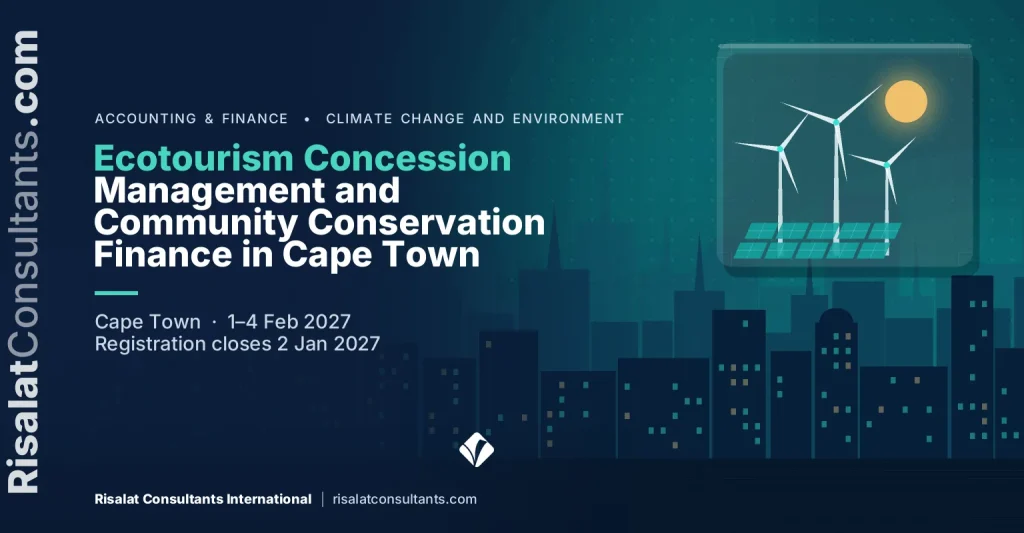
- 1–4 Feb 2027 (4 days)
- Where
- Cape Town, South Africa
- Fee per participant
- £2,200 (GBP)
- Payment
- By invoice and bank transfer
- Registration closes
- 2 Jan 2027
- Who it is for
- Tourism development officers from national ministries and regional boards; Park wardens and commercial directors from national wildlife management…
- Certificate
- Certificate of completion
- In-house option
- Run it for your team, on your dates
On this page 12 sections
Programme Overview
Ecotourism concessions offer public wildlife authorities and local communities structured pathways to commercialise protected area assets sustainably. This four-day intensive programme equips public sector officers to structure, tender, and manage long-term tourism partnerships that attract responsible private capital. Delegates analyse public-private partnership models, risk allocations, and performance-based contracting to ensure state conservation agencies retain regulatory oversight while private operators drive operational delivery, visitor management, and infrastructure development within ecologically sensitive zones.
Sustainable financing mechanisms form the operational backbone of durable conservation. Participants examine revenue-sharing structures, community-based natural resource management compacts, and blended finance interventions that channel commercial proceeds directly into host communities. The course links capital mobilisation with conservation outcomes, interrogating payment for ecosystem services, biodiversity credits, and concession fee formulas. Delegates review real-world commercial arrangements to balance investor returns, municipal fiscal needs, and rural poverty reduction priorities.
Hosted in Cape Town, a premier hub for nature-based tourism and innovative municipal conservation finance, the course integrates empirical case studies with global standards. Designed principally for tourism officers, park management authorities, and investment promotion teams, particularly from Zambia and neighbouring southern African states, the curriculum addresses the full lifecycle of protected area business planning. Participants depart prepared to prepare, negotiate, and oversee bankable destination concession plans that protect critical ecosystems.
Public conservation agencies across southern Africa face mounting pressure to bridge the financing gap between statutory conservation allocations and the actual costs of protecting biodiversity. Large-scale development initiatives, such as the US$100m Green, Resilient and Transformational Tourism Development Project (GREAT-TDP), require heightened institutional capacity to mobilise private capital and direct revenues to community livelihoods. Navigating transparent procurement, bankable concession structuring, and genuine revenue sharing is essential to ensure that protected areas generate sustainable economic returns without degrading the natural capital upon which vulnerable rural communities depend.
Delivered by Risalat Consultants International in Cape Town, South Africa, it combines expert-led sessions, real cases and group work, so that participants can apply what they learn in their own institution.
The Programme Strengthens Institutional Capability
- Typologies of protected area commercialisation: leases, concessions, and joint ventures
- Statutory frameworks, land tenure rights, and community title verification in conservation areas
- Concession lifecycle management: from pre-feasibility appraisal to contract handover
- Institutional roles: separating state regulatory mandates from commercial tourism operations
- Case review of southern African legal regimes governing commercial wildlife and tourism concessions
- Determining ecological carrying capacity and development footprints using IUCN guidelines
- Financial modelling for eco-lodges: turnover-based fees, fixed ground rentals, and bed levies
- IFC Performance Standards: environmental and social due diligence in sensitive landscapes
- Budget preparation and execution
- Financial reporting and accounting standards
- Cash and treasury management
- Internal control over payments and assets
It is designed for tourism development officers from national ministries and regional boards, park wardens and commercial directors from national wildlife management authorities, community conservation directors and conservancy trust managers and others who want practical, current skills in public financial management and finance.
The Growing Importance of Ecotourism Concession Management and Community Conservation Finance in Cape Town
Sound financial management is the basis for credible budgets, timely payments and clean audits. Governments and financiers expect accurate reporting, disciplined budget execution and transparent use of funds.
Changes in reporting standards, digital payment systems and financier requirements mean finance teams must keep their skills current. Strong financial management also frees time and money for the services that matter.
Organisations increasingly require professionals capable of:
- Prepare and execute budgets in line with plans
- Produce accurate, timely financial reports
- Apply controls over payments and assets
- Meet financier financial management requirements
- Use financial information to support decisions
Strong public financial management and finance systems help organisations:
- Improve budget credibility and execution
- Produce reliable reports and clean audits
- Reduce payment delays and errors
- Build trust with financiers and oversight bodies
This Ecotourism Concession Management and Community Conservation Finance in Cape Town programme brings these elements together in a practical format, so that participants understand not only what good practice looks like but also how to introduce it in their own setting, with the people and resources they have.
Who Should Attend This Ecotourism Concession Management and Community Conservation Finance in Cape Town Training?
This programme is designed for:
- Tourism development officers from national ministries and regional boards
- Park wardens and commercial directors from national wildlife management authorities
- Community conservation directors and conservancy trust managers
- Investment promotion agency analysts handling hospitality and eco-concessions
- Project implementation unit specialists managing donor-funded tourism and conservation loans
- Municipal planning officers managing peri-urban protected areas and nature reserves
- Public-private partnership transaction advisors focusing on natural asset commercialisation
- Environmental and social safeguards officers working in protected landscape programmes
- Community-based natural resource management (CBNRM) liaison professionals
- Finance managers and accountants
- Budget officers and analysts
- Treasury and cash management staff
The programme suits experienced professionals as well as those moving into new responsibilities. Groups that mix institutions and countries are encouraged, because participants learn a great deal from each other’s experience.
Tick what your team needs to be able to do.
Ecotourism Concession Management and Community Conservation Finance in Cape Town Training Objectives
Upon successful completion of this Ecotourism Concession Management and Community Conservation Finance in Cape Town Training, participants will be able to:
- Evaluate diverse public-private partnership models applied to protected area infrastructure and operations
- Structure bankable eco-lodge and activity concession agreements aligned with international standards
- Design equitable revenue-sharing formulas and trust structures for natural asset host communities
- Apply the IFC Performance Standards to ecotourism infrastructure planning and environmental risk mitigation
- Formulate competitive, transparent concession tendering and contract monitoring frameworks
- Develop destination marketing and commercial promotion plans that preserve community ecological integrity
- Negotiate risk allocation schedules and dispute resolution mechanisms for public-private conservation contracts
- Explain the budget cycle and the role of each actor
- Prepare and monitor budgets linked to plans
- Apply the main principles of the relevant reporting standards
Each objective is practised during the programme through exercises, cases or group work, so that participants leave able to do it, not only to describe it.
Programme Contents and Structure
- Typologies of protected area commercialisation: leases, concessions, and joint ventures
- Statutory frameworks, land tenure rights, and community title verification in conservation areas
- Concession lifecycle management: from pre-feasibility appraisal to contract handover
- Institutional roles: separating state regulatory mandates from commercial tourism operations
- Case review of southern African legal regimes governing commercial wildlife and tourism concessions
- Determining ecological carrying capacity and development footprints using IUCN guidelines
- Financial modelling for eco-lodges: turnover-based fees, fixed ground rentals, and bed levies
- IFC Performance Standards: environmental and social due diligence in sensitive landscapes
- Structuring bid packages: investor prospectuses, minimum operational criteria, and site disclosure
- Risk allocation matrices: handling demand volatility, infrastructure failures, and political risks
- Community-based natural resource management: governance of collective conservation assets
- Designing transparent revenue collection, distribution, and auditing mechanisms for local trusts
- Conservation enterprise models: equity shares, resource harvesting rights, and employment quotas
- Blended finance and biodiversity credit mechanisms linked to conservation performance targets
- Analysing local economic empowerment provisions in South African and Zambian conservation compacts
- Competitive bidding processes: tender evaluation, anti-corruption safeguards, and contract award
- Key performance indicators: monitoring environmental compliance, community employment, and asset condition
- Dispute avoidance, renegotiation protocols, and contract termination remedies
- Building bankable, community-led destination promotion and natural asset marketing strategies
- Simulation exercise: evaluating competing commercial bids and structuring community benefit flows
Full day-by-day contents
The programme runs over 4 days. Each day combines expert input, practical work and a closing workshop or case study:
- First Day: Legal Frameworks and Public-Private Partnership Models in Protected Areas
- Second Day: Eco-Lodge Concession Design, Financial Structuring, and Bankability
- Third Day: Community Conservation Finance and Revenue-Sharing Architecture
- Fourth Day: Concession Procurement, Performance Monitoring, and Destination Promotion
Full day-by-day contents
First Day | Legal Frameworks and Public-Private Partnership Models in Protected Areas
- Typologies of protected area commercialisation: leases, concessions, and joint ventures
- Statutory frameworks, land tenure rights, and community title verification in conservation areas
- Concession lifecycle management: from pre-feasibility appraisal to contract handover
- Institutional roles: separating state regulatory mandates from commercial tourism operations
- Case review of southern African legal regimes governing commercial wildlife and tourism concessions
Workshop: Legal Frameworks and Public-Private Partnership Models in Protected Areas: Applying It to Your Institution
Working in small groups, participants apply the day's methods to examples from their own institutions and agree practical next steps.
Second Day | Eco-Lodge Concession Design, Financial Structuring, and Bankability
- Determining ecological carrying capacity and development footprints using IUCN guidelines
- Financial modelling for eco-lodges: turnover-based fees, fixed ground rentals, and bed levies
- IFC Performance Standards: environmental and social due diligence in sensitive landscapes
- Structuring bid packages: investor prospectuses, minimum operational criteria, and site disclosure
- Risk allocation matrices: handling demand volatility, infrastructure failures, and political risks
Workshop: Eco-Lodge Concession Design, Financial Structuring, and Bankability: Applying It to Your Institution
Working in small groups, participants apply the day's methods to examples from their own institutions and agree practical next steps.
Third Day | Community Conservation Finance and Revenue-Sharing Architecture
- Community-based natural resource management: governance of collective conservation assets
- Designing transparent revenue collection, distribution, and auditing mechanisms for local trusts
- Conservation enterprise models: equity shares, resource harvesting rights, and employment quotas
- Blended finance and biodiversity credit mechanisms linked to conservation performance targets
- Analysing local economic empowerment provisions in South African and Zambian conservation compacts
Case Study: Community Conservation Finance and Revenue-Sharing Architecture in Practice
Participants analyse a realistic case, compare the choices made with good practice and draw lessons they can use in their own setting.
Fourth Day | Concession Procurement, Performance Monitoring, and Destination Promotion
- Competitive bidding processes: tender evaluation, anti-corruption safeguards, and contract award
- Key performance indicators: monitoring environmental compliance, community employment, and asset condition
- Dispute avoidance, renegotiation protocols, and contract termination remedies
- Building bankable, community-led destination promotion and natural asset marketing strategies
- Simulation exercise: evaluating competing commercial bids and structuring community benefit flows
Capstone Exercise: Ecotourism Concession Management and Community Conservation Finance in Cape Town Action Plan for Your Institution
Participants bring the week together in an action plan for their own institution, with priorities, owners and first steps, and present it for feedback from peers and facilitators.
Ecotourism Concession Management and Community Conservation Finance in Cape Town Training Methodology
The training employs an applied, analytical learning approach focused on the operational realities of public authorities and donor programmes. Facilitators combine technical presentations with deep-dive scrutiny of non-confidential concession agreements, procurement documents, and financial models. Participants work through guided syndicate exercises, evaluating sample bids, drafting contract covenants, and structuring community revenue accounts. Peer review sessions enable cross-jurisdictional learning between Zambian delegates and regional counterparts, using empirical examples of concession successes and contractual failures from across Africa.
The programme combines:
- Expert-led sessions on current practice
- Regional and international case studies
- Group work and practical exercises
- Simulations and role plays where relevant
- Discussion of participants' own challenges
- Peer learning across institutions and countries
- Practical tools and templates to take back to work
- Daily reflection and action planning
Before the programme, a short pre-assessment helps the facilitators understand each participant’s role and priorities, so that examples and exercises can be adjusted to the group. Each day ends with a short reflection in which participants note what they will apply at work.
Expected Outcomes
Upon completion of this Ecotourism Concession Management and Community Conservation Finance in Cape Town Training, participants will be able to:
- Ability to select appropriate public-private partnership instruments for varied protected area assets
- Competence in drafting concession fee schedules that balance state revenue with commercial viability
- Mastery of institutional procedures for transparent, competitive ecotourism tender management
- Practical skill in embedding local community trusts into concession governance and cash distribution
- Capability to supervise environmental and social safeguards compliance during the concession lifecycle
- Readiness to contribute directly to institutional objectives under major donor-financed tourism programmes
- Prepare and monitor budgets linked to plans
- Produce accurate financial reports
Participants leave with a personal action plan and practical tools they can use in their institution from the first week back. Institutions that send several participants can use the programme to agree shared methods and templates across teams, which makes improvements easier to sustain.
£2,200 per participant · invoice and bank transfer · groups of 5 or more receive a discount
Five or more from one organisation: ask for the group rate on the invoice request.
Ten or more: an in-house version for your institution may cost less per person. Ask for an in-house quote.
Registration closes in 54 days (2 Jan 2027)
Institutional Application of Ecotourism Concession Management and Community Conservation Finance in Cape Town Training
This programme supports organisations in strengthening:
- Budget preparation and execution
- Financial reporting
- Payment and cash controls
- Donor financial management
- Audit readiness
Participants return with practical tools to improve:
- Budget monitoring
- Interim financial reports
- Reconciliations
- Asset management
- Audit follow-up
The programme is built so that learning moves from the classroom into the institution. Participants work on their own processes and documents where possible, and leave with an action plan that their managers can review and support.
Regional Relevance & Application
Europe
European institutions apply public financial management and finance within detailed regulatory frameworks and reform agendas. Participants from Europe can compare their practice with colleagues from other regions and test how established methods work under different conditions.
Africa
Across Africa, ministries, agencies and project teams working in public financial management and finance increasingly operate alongside donor-financed programmes that expect clear systems and evidence. The programme helps participants adapt good practice to the institutions and resources they work with.
Middle East
In the Middle East, national development strategies and diversification plans place growing demands on public financial management and finance. Participants explore how to build the capability these plans need inside public bodies and companies.
Asia
Institutions across Asia combine rapid growth with ambitious modernisation programmes. Participants from Asia can share their experience of scaling systems quickly and learn from approaches used elsewhere.
Pacific
Small island and Pacific states face particular constraints of size, distance and capacity. The programme highlights practical, proportionate approaches to public financial management and finance that suit smaller institutions.
Holding the programme in Cape Town, South Africa brings participants together away from their daily pressures, so they can compare how public financial management and finance is handled in different settings. The same programme can also be delivered in-house for one institution, in its own country or online, with cases taken from its current work.
Host Country Profile – South Africa
Programmes in Cape Town suit government officials, project teams and professionals focusing on public policy, parliamentary governance, infrastructure administration and urban management.
Studying away from their own country gives participants time to focus, a fresh view of their own institution and the chance to build a network with colleagues from other countries.
Ecotourism Concession Management and Community Conservation Finance in Cape Town Training Deliverables
Participants receive support before, during and after the programme, so that preparation, learning and follow-up form one continuous experience.
Before the Programme
- Participant Pre-Assessment
- Ecotourism Concession Management and Community Conservation Finance in Cape Town Readiness Assessment
- Ecotourism Concession Management and Community Conservation Finance in Cape Town Resource Pack
- Preparatory Reading Materials
- Complimentary Visa Support & Advisory
During the Programme
- Airport Pickup & Welcome Assistance
- Accommodation with Breakfast
- Welcome Networking Dinner
- Risalat Training Kit (Bag, Bottle, Mug, T-Shirt, Cap, Passport Cover, Pens, Notebook, Magnet & Keychain)
- Comprehensive Ecotourism Concession Management and Community Conservation Finance in Cape Town Training Manual
- Budget Monitoring Template
- Interim Financial Report Template
- Reconciliation Checklist
- Audit Preparation Checklist
- Practical Workshops & Simulations
- Group Discussions & Peer Learning
- Daily Lunch and Refreshments
- Full Access to Training Venue Facilities
- Mini Pad / Tablet with Digital Learning Materials
- Field Visit (where applicable)
- Entertaining City Tour
After the Programme
- Certificate of Completion
- Risalat Programme Participation Recognition Award
- Post-Training Reference Materials
- Financial Management Self-Assessment
- Payment Control Checklist
- Post-Training Support & Follow-Up Guidance
- Programme Report
Institutions can also request a tailored in-house version of this programme, delivered at their premises or online. Request a proposal.
Common Challenges in Ecotourism Concession Management and Community Conservation Finance in Cape Town, And How This Training Helps
How can institutions prepare and execute budgets in line with plans?
The programme addresses this directly on the first day (Legal Frameworks and Public-Private Partnership Models in Protected Areas), where participants practise the methods involved and adapt them to their own institution, then build it into their action plan.
How can institutions produce accurate, timely financial reports?
The programme addresses this directly on the second day (Eco-Lodge Concession Design, Financial Structuring, and Bankability), where participants practise the methods involved and adapt them to their own institution, then build it into their action plan.
How can institutions apply controls over payments and assets?
The programme addresses this directly on the third day (Community Conservation Finance and Revenue-Sharing Architecture), where participants practise the methods involved and adapt them to their own institution, then build it into their action plan.
How can institutions meet financier financial management requirements?
The programme addresses this directly on the fourth day (Concession Procurement, Performance Monitoring, and Destination Promotion), where participants practise the methods involved and adapt them to their own institution, then build it into their action plan.
How can institutions use financial information to support decisions?
The programme addresses this directly on the first day (Legal Frameworks and Public-Private Partnership Models in Protected Areas), where participants practise the methods involved and adapt them to their own institution, then build it into their action plan.
Frequently Asked Questions
When and where does the Ecotourism Concession Management and Community Conservation Finance in Cape Town programme take place?
It runs from 1 Feb 2027 to 4 Feb 2027, in Cape Town, South Africa. The registration deadline is shown at the top of this page.
Who should attend?
The programme is designed for tourism development officers from national ministries and regional boards, park wardens and commercial directors from national wildlife management authorities, community conservation directors and conservancy trust managers, investment promotion agency analysts handling hospitality and eco-concessions, and others who want practical skills in public financial management and finance.
Will I receive a certificate?
Yes. Participants who complete the programme receive a Certificate of Completion from Risalat Consultants International.
Can this programme be delivered for our institution only?
Yes. We can deliver a tailored in-house version at your premises, in another city or online, built around your own cases. Use the proposal request on this page.
Do I need prior experience in public financial management and finance?
No specialist background is required beyond experience in a related role. A short pre-assessment helps the facilitators adapt the sessions to the group.
Training courses in Cape TownAccounting & Finance training courses
Why Cape Town for this programme
Cape Town offers examples of water resilience and tourism, in a setting participants remember.
The Ecotourism Concession Management and Community Conservation Finance in Cape Town programme in February 2027 brings together officials and professionals from across the Africa region and beyond. Sessions combine short inputs, case studies and group work on participants' own files, and the city's institutions can be added as a study visit on request.
Getting there: Cape Town International (CPT).
Check whether you need a visa with the free Visa Checker, and ask for an invitation letter once you are registered.
The same topic in other cities
- Protected Area Governance and Community Forestry Management in Cape Town (Cape Town)
- Forest Landscape Restoration & Protected Area Conservation Management in Bali (Bali)
- Ecotourism Development and Protected Area Concessions in Baku (Baku)
Other programmes in Cape Town
- Smallholder Pressurised Irrigation & Solar Water Pumping Scheme Design in Cape Town
- Artisanal Fisheries Management, Post-Harvest Cold Chains and Quality in Cape Town
- Urban Bus Rapid Transit Operations and Corridor Traffic Integration in Cape Town
- Off-Grid Solar Mini-Grid Engineering and Rural Concession Models in Cape Town
- Public Health Crisis Communication and Risk Engagement in Cape Town
Related: Tourism and destination management · free Exposure Visit Planner · all programmes
- Procurement Framework and Regulations for Projects World Bank
- MAPS: Methodology for Assessing Procurement Systems MAPS Initiative
- Open Contracting Partnership Open Contracting Partnership
More training courses in South Africa · All programmes in Africa · Full training calendar
Plan this programme in a roadmap: why it matters, why to approve it, the dates to plan and the career it builds.