Key facts
- Dates
- 13–16 Sep 2027 (4 days)
- Where
- Istanbul, Türkiye
- Fee per participant
- £3,560 (GBP)
- Payment
- By invoice and bank transfer
- Registration closes
- 4 Aug 2027
- Format
- 4-day short course: a practical capacity-building programme for government, NGO and project teams in Istanbul
- Groups
- Teams of 3 or more qualify for a group discount, offered case by case: ask for a group quote.
- In-house option
- Run it for your team, on your dates
On this page 10 sections
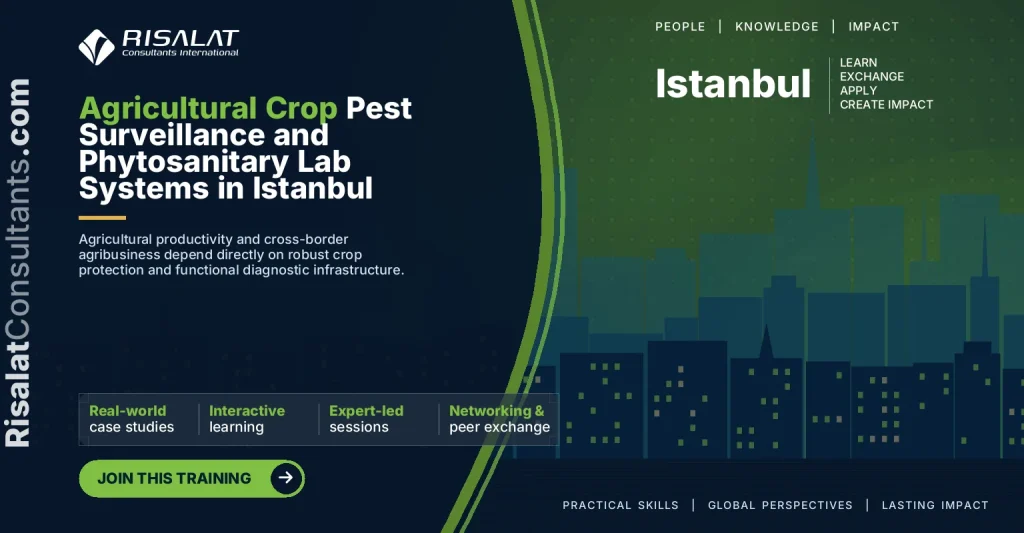
Agricultural Crop Pest Surveillance and Phytosanitary Lab Systems in Istanbul
Programme Overview
Agricultural productivity and cross-border agribusiness depend directly on robust crop protection and functional diagnostic infrastructure. This four-day professional course in Istanbul addresses critical gaps in pest surveillance, border control, and phytosanitary laboratory management. Participants examine practical approaches to protecting domestic agricultural production against quarantine organisms whilst simultaneously meeting the stringent sanitary and phytosanitary conditions demanded by high-value international trade corridors. The curriculum emphasises alignment with international agreements and modern laboratory standards.
The programme delivers comprehensive guidance on establishing structured field surveillance systems, risk-based border inspection protocols, and accredited laboratory workflows. Participants will evaluate diagnostic techniques for detecting regulated plant pests, pathogens, and invasive species using both traditional entomological or mycological methods and modern molecular assays. Operational sessions focus on sample chain of custody, biosafety, diagnostic validation, and national reporting systems to ensure phytosanitary authorities function transparently and effectively under International Plant Protection Convention guidelines.
By bridging the operational space between field inspections, quarantine checkpoints, and diagnostic testing centres, this course equips public sector agricultural specialists to implement integrated pest management and early warning protocols. Attendees will explore structural upgrades required to modernise laboratory equipment and quality management systems. The course prepares national plant protection organisations to lower border rejection rates, contain pest incursions quickly, and support resilient farming systems capable of sustaining rural livelihoods. Delivered by Risalat Consultants International in Istanbul, Turkey, it combines expert-led sessions, real cases and group work, so that participants can apply what they learn in their own institution.
The programme strengthens institutional capability in:
- International Plant Protection Convention (IPPC) mandates and relevant ISPM standards (ISPM 6, ISPM 8, and ISPM 9)
- Methodologies for conducting general surveillance versus specific pest surveys across commercial and subsistence farming systems
- Pest Risk Analysis (PRA) fundamentals: identifying quarantine pests and setting appropriate phytosanitary measures
- Establishing Pest Free Areas (PFAs) and areas of low pest prevalence to maintain international export integrity
- Case exercise: Developing a targeted seasonal surveillance plan for high-priority transboundary crop pests
- Risk-based border inspection procedures for imported and exported agricultural commodities (ISPM 20 and ISPM 31)
- Sampling regimes for consignments: calculating statistically valid sample sizes for latent and visible pests
- Consignment verification, documentation checks, and electronic phytosanitary certification (ePhyto) workflows
- Climate and environmental risk assessment
- Adaptation and mitigation planning
- Sector strategies for energy, water and land
- Project design for climate and environmental goals
Why this matters now
Organisations increasingly require professionals capable of:
- Assess climate and environmental risks to their services and assets
- Design projects that meet climate and environmental goals
- Prepare proposals that financiers can approve
- Measure and report results credibly
- Work with communities and partners across sectors
Strong climate, environment and natural resources systems help organisations:
- Protect services and infrastructure from climate risks
- Access climate and environmental finance
- Meet national and international commitments
- Use natural resources sustainably
Who Should Attend
This programme is designed for:
- National Plant Protection Organisation inspection officials
- Agricultural diagnostic laboratory technicians and managers
- Crop protection department directors and technical advisors
- Border quarantine officers and trade facilitation specialists
- Public agronomists responsible for pest monitoring and reporting
- Project implementation unit specialists from agricultural resilience projects
- Agronomic extension officers overseeing field pest surveillance
- Research institute scientists working on plant pathology and entomology
- Ministry of Agriculture biosecurity and trade compliance officers
- Climate change and environment officers
- Energy, water and agriculture sector staff
- Planning and policy officers
Tick what your team needs to be able to do.
Programme Objectives
By the end of this programme participants will be able to:
- Design risk-based national agricultural crop pest surveillance frameworks in line with International Standards for Phytosanitary Measures (ISPMs)
- Establish border phytosanitary inspection protocols to intercept quarantine plant pests and regulate commercial consignments
- Implement international laboratory quality management workflows aligned with ISO/IEC 17025 technical requirements for diagnostic facilities
- Standardise sample collection, packaging, transport, and chain-of-custody tracking from agricultural fields and border posts to laboratories
- Apply practical integrated pest management and emergency response protocols for sudden outbreaks of regulated and invasive plant pests
- Formulate national pest reporting mechanisms, pest free area documentation, and official pest status determinations
- Upgrade laboratory biosafety, equipment maintenance schedules, and reagent inventory controls within public diagnostic systems
- Explain the main climate and environmental challenges for their sector
- Assess climate and environmental risks to services and assets
- Plan adaptation and mitigation measures
Training Structure & Contents
- International Plant Protection Convention (IPPC) mandates and relevant ISPM standards (ISPM 6, ISPM 8, and ISPM 9)
- Methodologies for conducting general surveillance versus specific pest surveys across commercial and subsistence farming systems
- Pest Risk Analysis (PRA) fundamentals: identifying quarantine pests and setting appropriate phytosanitary measures
- Establishing Pest Free Areas (PFAs) and areas of low pest prevalence to maintain international export integrity
- Case exercise: Developing a targeted seasonal surveillance plan for high-priority transboundary crop pests
- Workshop: International Phytosanitary Frameworks, Surveillance Design, and Pest Risk Analysis: Applying It to Your Institution
- Risk-based border inspection procedures for imported and exported agricultural commodities (ISPM 20 and ISPM 31)
- Sampling regimes for consignments: calculating statistically valid sample sizes for latent and visible pests
- Consignment verification, documentation checks, and electronic phytosanitary certification (ePhyto) workflows
- Interception handling, quarantine holding measures, phytosanitary treatment supervision, and rejection notices
- Chain of custody documentation and digital track-and-trace mechanisms for intercepted agricultural samples
- Workshop: Border Inspection Regimes, Quarantine Procedures, and Traceability Systems: Applying It to Your Institution
- Phytosanitary laboratory infrastructure: layout, biosecurity zoning, containment controls, and contamination prevention
- Diagnostic pipelines for plant pathogens: morphological identification, serological tests (ELISA), and molecular assays (PCR)
- Implementing ISO/IEC 17025 principles in national plant health labs: document control, standard operating procedures, and calibration
- Diagnostic validation, proficiency testing, inter-laboratory comparisons, and reference collection maintenance
- Practical design of internal quality audit checklists and reagent management systems for public diagnostic laboratories
- Case Study: Modern Phytosanitary Laboratory Systems, Diagnostic Protocols, and ISO/IEC 17025 in Practice
- Linking surveillance alerts to national Integrated Pest Management (IPM) implementation and chemical control stewardship
- Formulating official emergency response plans for sudden incursions of high-threat quarantine organisms
- Official pest status determinations, pest records management, and national notification obligations under IPPC
- Action planning: drafting institutional modernisation roadmaps for surveillance teams and diagnostic laboratories
- Final programme assessment, technical review of institutional roadmaps
- Review of international phytosanitary frameworks and national application priorities
- Consolidation of border quarantine and sampling inspection methodologies
- Synthesis of ISO/IEC 17025 laboratory management requirements and diagnostic workflows
- Finalisation of emergency outbreak response mechanisms and national reporting procedures
- Technical evaluation and feedback on participants’ institutional modernisation roadmaps
Full day-by-day contents
First Day | International Phytosanitary Frameworks, Surveillance Design, and Pest Risk Analysis
- International Plant Protection Convention (IPPC) mandates and relevant ISPM standards (ISPM 6, ISPM 8, and ISPM 9)
- Methodologies for conducting general surveillance versus specific pest surveys across commercial and subsistence farming systems
- Pest Risk Analysis (PRA) fundamentals: identifying quarantine pests and setting appropriate phytosanitary measures
- Establishing Pest Free Areas (PFAs) and areas of low pest prevalence to maintain international export integrity
- Case exercise: Developing a targeted seasonal surveillance plan for high-priority transboundary crop pests
- Workshop: International Phytosanitary Frameworks, Surveillance Design, and Pest Risk Analysis: Applying It to Your Institution
Second Day | Border Inspection Regimes, Quarantine Procedures, and Traceability Systems
- Risk-based border inspection procedures for imported and exported agricultural commodities (ISPM 20 and ISPM 31)
- Sampling regimes for consignments: calculating statistically valid sample sizes for latent and visible pests
- Consignment verification, documentation checks, and electronic phytosanitary certification (ePhyto) workflows
- Interception handling, quarantine holding measures, phytosanitary treatment supervision, and rejection notices
- Chain of custody documentation and digital track-and-trace mechanisms for intercepted agricultural samples
- Workshop: Border Inspection Regimes, Quarantine Procedures, and Traceability Systems: Applying It to Your Institution
Third Day | Modern Phytosanitary Laboratory Systems, Diagnostic Protocols, and ISO/IEC 17025
- Phytosanitary laboratory infrastructure: layout, biosecurity zoning, containment controls, and contamination prevention
- Diagnostic pipelines for plant pathogens: morphological identification, serological tests (ELISA), and molecular assays (PCR)
- Implementing ISO/IEC 17025 principles in national plant health labs: document control, standard operating procedures, and calibration
- Diagnostic validation, proficiency testing, inter-laboratory comparisons, and reference collection maintenance
- Practical design of internal quality audit checklists and reagent management systems for public diagnostic laboratories
- Case Study: Modern Phytosanitary Laboratory Systems, Diagnostic Protocols, and ISO/IEC 17025 in Practice
Fourth Day | Integrated Pest Management Integration, Emergency Outbreak Response, and Reporting
- Linking surveillance alerts to national Integrated Pest Management (IPM) implementation and chemical control stewardship
- Formulating official emergency response plans for sudden incursions of high-threat quarantine organisms
- Official pest status determinations, pest records management, and national notification obligations under IPPC
- Action planning: drafting institutional modernisation roadmaps for surveillance teams and diagnostic laboratories
- Final programme assessment, technical review of institutional roadmaps
Fifth Day | Institutional Action Planning, Review, and Programme Synthesis
- Review of international phytosanitary frameworks and national application priorities
- Consolidation of border quarantine and sampling inspection methodologies
- Synthesis of ISO/IEC 17025 laboratory management requirements and diagnostic workflows
- Finalisation of emergency outbreak response mechanisms and national reporting procedures
- Technical evaluation and feedback on participants’ institutional modernisation roadmaps
Training Methodology
Delivered by Risalat Consultants International in Istanbul, Turkey, the programme combines expert input, real cases, and practical exercises. Each day includes small-group collaborative tasks or case analyses so that participants can apply what they learn in their own institution.
- Expert-led instructional sessions on phytosanitary standards and laboratory systems
- Practical small-group workshop exercises applying daily methods to home institutions
- Case study analyses examining real scenarios against international good practice
- Interactive group discussions comparing institutional and national experiences
- Individual and group development of institutional modernisation roadmaps
- Funds
- Entity
- Project
- Results
- MRV
Expected Outcomes
- Strengthened institutional capability to establish risk-based national crop pest surveillance frameworks
- Improved operational proficiency in consignment verification, border sampling, and ePhyto certification
- Enhanced diagnostic workflows aligned with ISO/IEC 17025 technical standards
- Standardised sample collection, handling, and chain-of-custody tracking across borders and laboratories
- Operationalised emergency response plans and integrated pest management stewardship for quarantine incursions
- Completed institutional modernisation roadmaps for surveillance teams and diagnostic facilities
£3,560 per participant · invoice and bank transfer · groups of 5 or more receive a discount
Five or more from one organisation: ask for the group rate on the invoice request.
Ten or more: an in-house version for your institution may cost less per person. Ask for an in-house quote.
Registration closes in 248 days (4 Aug 2027)
Who Will Deliver This Programme
Each date is delivered by a team assigned from Risalat's expert network for this subject. For this programme we assign:
How we choose them: Experience in the region of the participants or comparable settings; Command of the financier rules that apply (World Bank, ADB, AfDB, EU, UN) where relevant; Delivery in English; other languages on request for in-house groups; No conflict of interest with participants' institutions.
Training courses in IstanbulAgriculture & Forestry training courses
Why Istanbul for this programme
Istanbul sits between Europe and Asia, with direct flights from most capitals and easy visas for many delegations.
The Agricultural Crop Pest Surveillance and Phytosanitary Lab Systems in Istanbul programme in September 2027 brings together officials and professionals from across the Europe and Asia region and beyond. Sessions combine short inputs, case studies and group work on participants' own files, and the city's institutions can be added as a study visit on request.
Getting there: Istanbul Airport (IST).
Check whether you need a visa with the free Visa Checker, and ask for an invitation letter once you are registered.
The same topic in other cities
- Perennial Crop Export Logistics and Phytosanitary Certification Systems in Brussels (Brussels)
- Seed Systems, Agronomic Extension and Climate-Resilient Cropping in Nairobi (Nairobi)
- Post-Harvest Handling, Cold Chain Logistics & Export Standards in Kuala Lumpur (Kuala Lumpur)
Other programmes in Istanbul
- Mini Degree in Environmental and Social Safeguards in Istanbul
- Risk-Based Internal Audit in the Public Sector in Istanbul
- AI for Public Procurement and Contract Management Training in Istanbul
- Seed Sector Modernisation and Climate-Smart Seed Certification in Istanbul
- Credit Guarantee Scheme Administration and MSME Risk Underwriting in Istanbul
Questions before you nominate your team? Book a 30-minute call with us, or ask for this programme in-house.
Teams often travel here from Pakistan, Mongolia, Kazakhstan, Uzbekistan, Kyrgyzstan, Tajikistan, Turkmenistan, Azerbaijan. Funding, visa letters and group rates are explained on each country page.
Is there agriculture and food security training for government officials in Istanbul in September 2027?
Can "Agricultural Crop Pest Surveillance and Phytosanitary Lab Systems in Istanbul" be delivered in-house for one organisation?
Which other agriculture and food security programmes does Risalat run?
How do organisations register and pay?
For teams and institutions
Bring your team
Teams that learn together apply more at work. Tell us how many people and how you would like to take part: we reply with a group quote within two working days.
Watch: this programme in short
Other dates and cities for this subject: Agriculture, Value Chains and Food Security training courses (97 upcoming dates).
More training courses in Türkiye · All programmes in Europe · Full training calendar
Plan this programme in a roadmap: why it matters, why to approve it, the dates to plan and the career it builds.