أبرز الخلاصات
- Beyond Training: What Actually Works in Capacity Building. Organizational capacity development requires more than just conducting training sessions and hoping everything works out.
- The importance of context and ownership. Country ownership plays a vital role in development effectiveness.
- Poor Follow-through and Application. Employees quickly go back to their old ways without proper reinforcement.
- Principles of effective organizational capacity development. Modern capacity development goes beyond usual training approaches.
- Application for public agencies and donor-funded projects. A strategic, country-led approach to results-focused capacity development strengthens local agents through knowledge and learning.
In short: Capacity building requires practical choices about resources, evidence and implementation. This guide explains the main opportunities and constraints, and how organisations can turn the underlying ideas into measurable decisions.
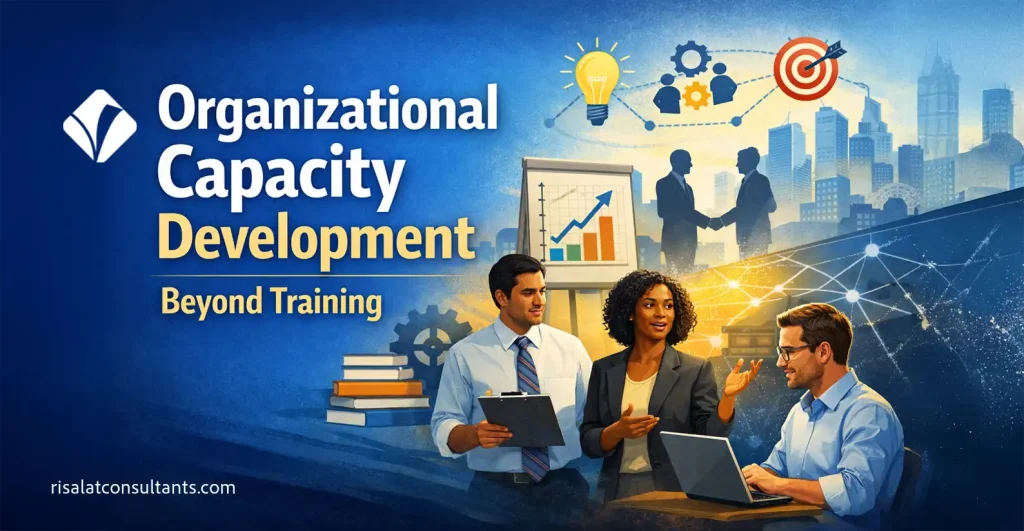
Beyond Training: What Actually Works in Capacity Building
Beyond Training: What Actually Works in Capacity Building
Organizational capacity development requires more than just conducting training sessions and hoping everything works out. Many organizations pour money into training programs, yet meaningful institutional change rarely happens. When knowledge is not applied in real work, the brain discards it, leading to wasted resources and missed opportunities.
Research shows that Bangladesh has over 2 million micro-merchants who handle transactions worth $18.42 billion each year. Traditional training methods don't deliver results because training is just one part of developing capacity. The focus needs to shift beyond workshops and seminars. A comprehensive development strategy should enable both people and institutions to grow. This piece will show why conventional training fails to create lasting impact and highlight the importance of organizational learning systems. You'll also find strategies that work in ground settings to build capacity and achieve results.
Understanding organizational capacity development beyond training
The difference between training and capacity development is fundamental but often goes unnoticed. Capacity development covers a wide range of activities that enable people and institutions to grow, while training focuses on specific skills. Real capacity development changes how people think and behave, not just how they perform tasks.
Why training capacity development
Training delivers specific technical skills through structured curricula. When well-aligned with organizational goals, advanced strategic training, such as advanced public financial management training can contribute effectively to broader institutional capacity development. Capacity development takes an integrated approach. A practitioner puts it well: "Training gives you skills. Capacity building gives you ownership". Traditional training programs become outdated faster in dynamic environments, especially in tech sectors where tools and frameworks keep changing. Capacity development creates lasting advantages by building continuous learning cultures and problem-solving mindsets.
For capacity building, a useful implementation plan should explicitly consider learning outcomes, institutional roles and the time available for implementation. A responsible decision starts by identifying who experiences the problem, who has authority to respond, and what information would change the proposed action. These questions help separate an attractive concept from a feasible intervention.
For example, an organisation considering a new initiative can document the existing process, consult the people who use it, select a manageable pilot and record its baseline. The pilot should have a named owner, a delivery timetable, a complaints route and a realistic operating budget. Progress should be judged against observed results rather than the number of meetings, workshops or announcements completed.
The importance of context and ownership
The importance of context and ownership
Country ownership plays a vital role in development effectiveness. True capacity development must grow from within a country, with donors supporting rather than leading. This means "valorizing, enhancing, and strengthening existing capacities, avoiding the temptation of building new institutions based on supposedly universal models".
A country's political leadership and governance systems shape capacity development outcomes. Research shows that sound policies, high commitment, participatory decision-making, effective coordination, and stable economic environments lead to success. Kenya's beverage manufacturing sector proved this point – capacity building worked best when adapted to specific local needs rather than using generic approaches.
From individual skills to institutional change
Long-term capacity development needs to go beyond individual skills to transform entire institutions. The World Bank describes institutional capacity development as "improving the effectiveness of country development by changing the formal and informal rules that structure interactions across multiple organizations".
Interest groups' deepening commitment shows a clear link to better outcomes in World Bank projects. This systems approach needs to think over all contextual elements and connections between them. It covers national, regional, and municipal levels among civil society, private and public organizations.
Lasting capacity development grows from within organizations. It encourages not just technical improvements but fundamental changes in organizational culture, strategic planning, and change management.
This shift from individual learning to systems change sits at the heart of effective organizational capacity development.
Why traditional training fails to build organizational capacity
Organizations worldwide spend nearly 400 million USD on employee training. Most see no real returns on this massive investment. Research shows 90% of learning never makes it to the job. These poor results come from three basic problems in traditional training methods.
Many programs fail because they skip a proper learning needs assessment, delivering generic training instead of addressing real performance gaps.
For capacity building, a useful implementation plan should explicitly consider costs, procurement options, stakeholder incentives and the risks of premature scaling. A responsible decision starts by identifying who experiences the problem, who has authority to respond, and what information would change the proposed action. These questions help separate an attractive concept from a feasible intervention.
For example, an organisation considering a new initiative can document the existing process, consult the people who use it, select a manageable pilot and record its baseline. The pilot should have a named owner, a delivery timetable, a complaints route and a realistic operating budget. Progress should be judged against observed results rather than the number of meetings, workshops or announcements completed.
Poor Follow-through and Application
Poor Follow-through and Application
Employees quickly go back to their old ways without proper reinforcement. This undermines even the best training programs. The Association for Talent Development shows that only 12% of learners use new skills without structured follow-up. Knowledge fades away even though participants feel excited right after training. The gap between learning and using new skills creates frustration. Employees spend time on training but see no real benefits in their daily work.
Broken Connection with Organization Systems
Training fails because it doesn't match broader company goals and systems. This mismatch wastes resources and hurts employee morale and performance. Even good programs fail when employees return to workplaces that don't support new skills. Many organizations expect training alone to fix complex performance gaps or systemic problems.
Weak Training Assessment and Feedback
Organizations only look at how learners react and what they learn. They don't measure real behavior changes or results. Many training professionals create and deliver programs before they think about measuring success. This approach guarantees minimal value. About 16% of professionals say better assessment would substantially improve training ROI.
This assessment gap keeps ineffective programs alive. Organizations keep investing in approaches that don't work because they lack clear success metrics. Building real capacity needs more than completion rates. It requires measuring true business results, including changes in how employees perform and how well they meet company goals.
For capacity building, a useful implementation plan should explicitly consider quality assurance, privacy or environmental safeguards where relevant, and transparent reporting. A responsible decision starts by identifying who experiences the problem, who has authority to respond, and what information would change the proposed action. These questions help separate an attractive concept from a feasible intervention.
For example, an organisation considering a new initiative can document the existing process, consult the people who use it, select a manageable pilot and record its baseline. The pilot should have a named owner, a delivery timetable, a complaints route and a realistic operating budget. Progress should be judged against observed results rather than the number of meetings, workshops or announcements completed.
Principles of effective organizational capacity development
Principles of effective organizational capacity development
Modern capacity development goes beyond usual training approaches. Companies that focus on leadership development are 84% more effective at improving leadership quality. They also see a 73% increase in employee retention. Building lasting capacity needs integration with core organizational functions.
Effective capacity development also strengthens organizational sustainability and resilience, ensuring institutions can adapt to shocks while maintaining performance.
Embed learning in real work
Learning works best when it's part of daily tasks, not separate activities. Small, repeatable learning actions create an environment where knowledge runs on success. This method connects learning opportunities to real-life challenges people face in their jobs. To cite an instance, companies that use weekly reflections and informal walkthroughs see better knowledge retention and application.
Ensure leadership and team alignment
The core team working together toward common goals improves organizational performance and adaptability. Teams that line up well create a clear direction that brings better clarity and participation across organizations. Clear vision, open communication, and continuous development make this possible. Collaborative platforms make smooth communication easier, improve alignment, and collect immediate feedback.
For capacity building, a useful implementation plan should explicitly consider the difference between a pilot that works once and a process that an institution can sustain. A responsible decision starts by identifying who experiences the problem, who has authority to respond, and what information would change the proposed action. These questions help separate an attractive concept from a feasible intervention.
For example, an organisation considering a new initiative can document the existing process, consult the people who use it, select a manageable pilot and record its baseline. The pilot should have a named owner, a delivery timetable, a complaints route and a realistic operating budget. Progress should be judged against observed results rather than the number of meetings, workshops or announcements completed.
Application for public agencies and donor-funded projects
Use results-based capacity building
A strategic, country-led approach to results-focused capacity development strengthens local agents through knowledge and learning. It goes beyond individuals and organizations to shared action across society. This organized process helps stakeholders plan capacity development from problem identification to change monitoring. It stays flexible enough for shared learning.
Move beyond training and build real institutional capacity. Drawing on these principles, organizations often benefit from integrated capacity building solutions that combine systems strengthening, leadership development, and performance alignment, as outlined in our capacity-building services. Explore Risalat's international capacity-building programs designed to turn learning into measurable performance and lasting change.
Support with coaching and peer learning
Peer coaching and mentoring give customized guidance in safe spaces where leaders can test new ideas and strategies. Skills spread across teams through this approach. It shows genuine interest in staff growth and helps long-term retention. Organizations using peer coaching report 80% of participants show improved self-confidence and performance.
Balance hard and soft skills
A good mix of technical expertise and people skills creates complete capacity. Hard skills give job-specific knowledge while soft skills help team interactions work better. Companies focusing
For capacity building, a useful implementation plan should explicitly consider the needs of implementing agencies, suppliers, community representatives and development partners. A responsible decision starts by identifying who experiences the problem, who has authority to respond, and what information would change the proposed action. These questions help separate an attractive concept from a feasible intervention.
For example, an organisation considering a new initiative can document the existing process, consult the people who use it, select a manageable pilot and record its baseline. The pilot should have a named owner, a delivery timetable, a complaints route and a realistic operating budget. Progress should be judged against observed results rather than the number of meetings, workshops or announcements completed.
For a ministry or project implementation unit, the practical sequence is to agree the public purpose, map responsibilities across agencies, identify procurement and safeguard requirements, and record the evidence needed for approval. Where a donor finances the work, the project team should use the applicable financing agreement, procurement framework and environmental and social commitments rather than assuming that one generic procedure applies to every project.
Consider a hypothetical donor-funded programme with a limited implementation period. The project manager could commission a baseline assessment, involve local stakeholders in defining service standards, test the proposed intervention in a small number of sites and evaluate performance before expansion. An independent review of expenditure and outcomes can reveal whether the programme is reaching intended beneficiaries and whether the implementing agency can maintain it after external financing ends.
Implementation checklist
- Define the decision and intended beneficiaries.
- Confirm legal, financial and operational constraints.
- Set a baseline and measurable indicators.
- Assign owners and establish stakeholder feedback.
- Pilot, evaluate and revise before scaling.
الأسئلة الشائعة
What is the main practical benefit?
It helps decision-makers connect the topic to defined needs, realistic resources and observable outcomes.
What should an organisation assess first?
Start with a baseline, stakeholder needs, delivery responsibilities and applicable legal requirements.
Which implementation risks deserve attention?
Pay attention to affordability, institutional capacity, inclusion, data quality and ongoing maintenance.
How can progress be measured?
Use a small set of baseline-linked indicators, user feedback and periodic independent review.
How does this apply to donor-funded projects?
Apply the project financing agreement and relevant procurement, safeguard, monitoring and reporting obligations.
هل تعرف أشخاصاً ينبغي أن يقرؤوا هذا؟ كن سفيراً لـ Risalat أو اكتب مقالاً مع Risalat باسمك الشخصي.
شركاء في نجاح المشاريع منذ 2011، نقدم التشخيص والدعم الاستشاري والتعلم التطبيقي للوزارات والهيئات العامة وفرق المشاريع.
هل تحتاج إلى مساعدة في تطبيق ذلك عملياً؟
ابدأ بتشخيص مجاني مدته 10 دقائق أو تحدث إلى خبرائنا.