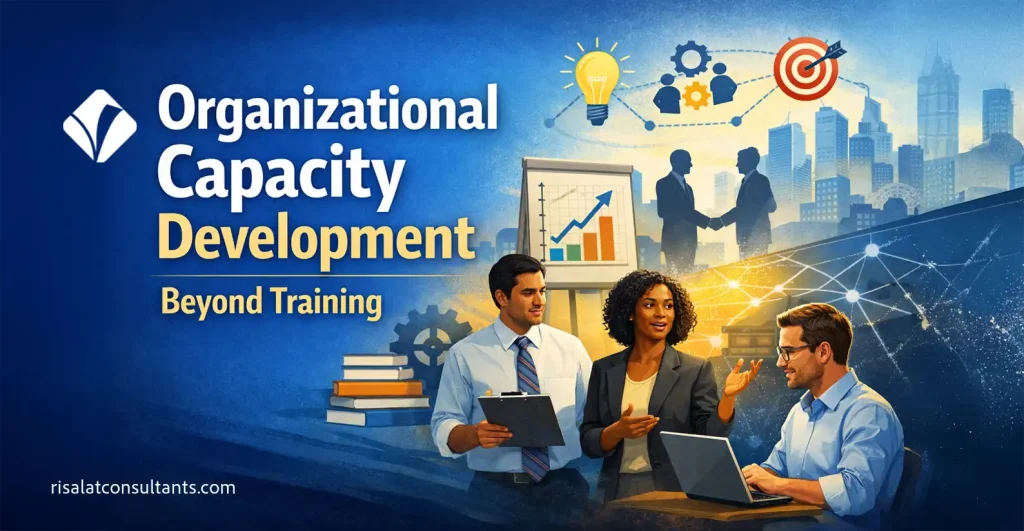
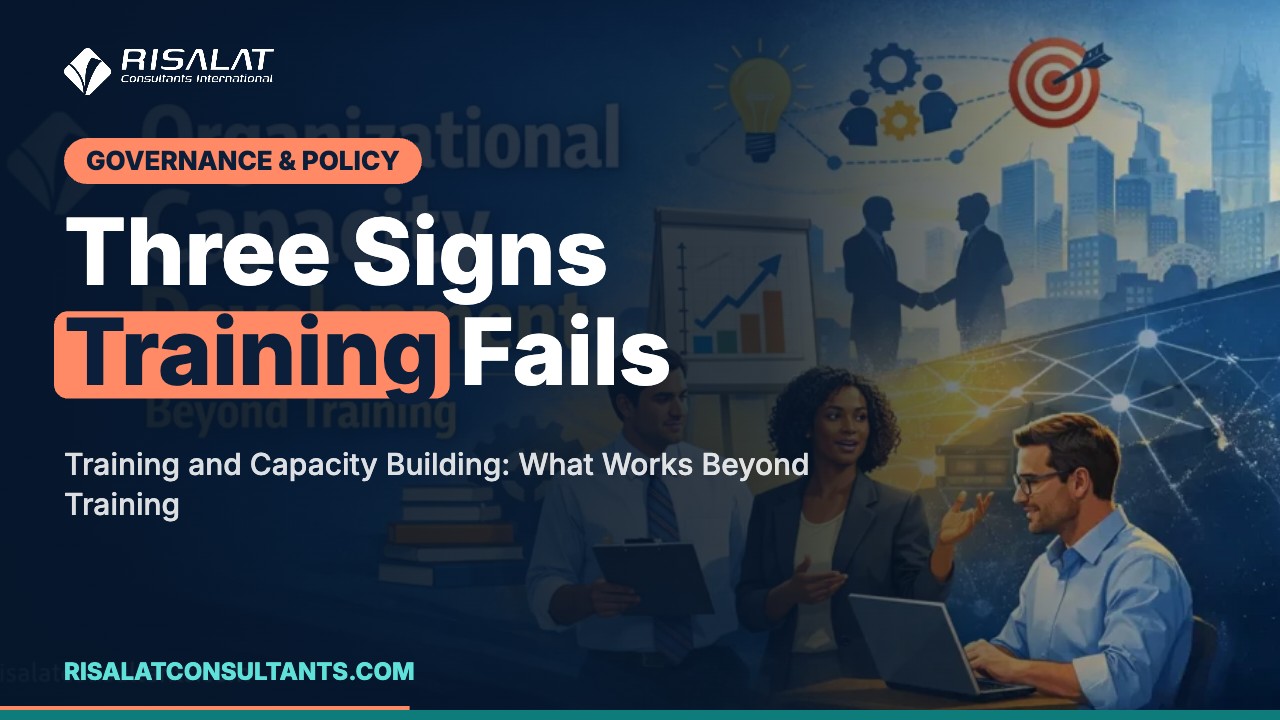
In short: Training and capacity building explained: why training alone rarely lasts, and how systems, leadership and follow-up turn capacity building into results.
Free self-check: the governance self-audit gives a quick check of governance, controls and accountability, in about 10 minutes.
Points essentiels
Training and capacity building are not the same thing: training builds individual skills, while capacity building changes what a whole organisation can deliver.
- Different levels – training works on individuals; capacity building works on people, systems, processes and leadership together.
- Training is one tool – it lasts only when procedures, incentives and management allow people to use new skills.
- Financiers pay for capacity – projects such as ADB’s early warning investment in Mongolia list capacity building as a planned output.
- Gaps are often institutional – ITU found capacity development is one of the weakest areas of national cybersecurity in most countries.
- Measure results, not attendance – agree performance indicators first and check them months later.
Introduction
Training and capacity building are often used as if they meant the same thing, but they work at different levels. Training builds the knowledge and skills of individuals. Capacity building, also called capacity development, strengthens what an organisation can actually deliver: its people, its systems and procedures, its leadership and the resources and incentives that let people use what they know. Training is one tool inside capacity building, and on its own it rarely changes results for long.
This matters for ministries, agencies and project teams because large budgets are spent on workshops and courses that produce certificates but not better services. This guide explains why training alone often falls short, what effective capacity building looks like and how to design and measure it.
Training and Capacity Building Compared
| Formation | Renforcement des capacités | |
|---|---|---|
| Concentration | Connaissances et compétences individuelles | What the organisation can deliver |
| Activités types | Courses, workshops, e-learning | Training plus new procedures, systems, coaching, leadership support, resources |
| Timeframe | Days to weeks | Months to years |
| Measure of success | Skills gained, certificates | Évolution des performances et des services |
Why Training Alone Often Falls Short
Skills without systems
Staff can learn a new procurement or financial procedure in a course, but if the agency’s forms, approval steps and software still follow the old process, the new skill cannot be used.
No time or expectation to apply
When participants return to full workloads and managers do not ask what they learned, new practices fade within weeks.
The wrong people in the room
Une formation choisie dans un catalogue, ou proposée à toute personne disponible, atteint souvent des personnes qui n'utiliseront pas la compétence, tandis que ceux qui en ont besoin sont laissés de côté.
Missing leadership and incentives
If good performance is not recognised and poor performance has no consequence, there is little reason to change established habits.
What Effective Capacity Building Looks Like
Effective capacity building works on several levels at once:
- Particuliers : formation ciblée basée sur une évaluation des besoins, avec mise en pratique sur des cas professionnels réels
- Teams: coaching, peer learning and shared tools that make the new way the normal way
- Systems and procedures: updated manuals, templates, software and approval steps
- Leadership: managers who set expectations, remove barriers and review progress
- Ressources et incitations : temps, budget et reconnaissance pour l'application des nouvelles compétences
What Financiers Are Paying For
Development partners increasingly finance capacity as part of investment projects, not as an add-on. ADB’s Strengthening Integrated Early Warning System in Mongolia Project, approved in November 2025, includes an output to strengthen capacity for early warning and disaster preparedness, and the project record notes a strong need for capacity building and training. In Bangladesh, the World Bank’s SITA project supports five government agencies, including the procurement authority, the revenue board and the audit office, to modernise systems and strengthen institutions.
In both cases, equipment and systems are only part of the investment. Agencies must also be able to operate, maintain and improve them, which is a capacity building task.
Capacity Gaps Are Often Institutional
National reviews regularly find that laws and strategies are in place but the capacity to apply them is weaker. ITU’s Global Cybersecurity Index 2024 found that legal measures are the strongest pillar in most countries, while capacity development and technical measures are relatively weak. The same pattern appears in procurement, financial management and disaster risk management: the rule exists, the skills, systems and staffing to apply it lag behind.
How to Design a Capacity Building Programme
- Define the performance problem. What should the organisation deliver better, and how will you know?
- Diagnose the causes. Separate skill gaps from gaps in systems, procedures, leadership and resources.
- Combine tools. Use training for skills, and other measures for the other causes.
- Select participants deliberately. Train the people who will apply the skill, together with their managers.
- Build in application. Give each participant a work task to complete with the new skill.
- Follow up. Coaching, check-ins and peer support over the following months.
- Measure performance. Check the agreed indicators after 60 to 90 days and again after six months.
Measuring Capacity Building
Compter les personnes formées dit peu de choses sur la capacité. De meilleures mesures examinent ce que l'organisation produit, par exemple :
- Délais de traitement des demandes, des paiements ou des marchés
- Error rates and repeat work
- Audit and compliance findings
- Service coverage and user satisfaction
- Use of new systems and procedures in daily work
The World Economic Forum’s Future of Jobs Report 2025 notes that 50 percent of workers had completed training as part of long-term learning strategies, up from 41 percent in 2023. More training is happening; the question for every organisation is whether it changes results.
Capacity at Three Levels
Capacity development is often described at three linked levels. Working on only one rarely produces lasting change.
| Niveau | Contenu | Examples of support |
|---|---|---|
| Individuel | Knowledge, skills and attitudes of staff | Formation, coaching, mentorat, certification |
| Organisational | Structures, procédures, systèmes, leadership et culture | Process redesign, manuals, information systems, management support |
| Enabling environment | Laws, policies, budgets and coordination between institutions | Policy advice, regulation, budget planning, coordination mechanisms |
A training programme that ignores the other two levels can leave staff skilled but unable to act. A new law or system that ignores individual skills can leave it unused.
A Practical Timeline for Financed Projects
Dans les projets financés par des partenaires au développement, le renforcement des capacités fonctionne mieux lorsqu'il est planifié avec le projet et non ajouté ultérieurement.
- Preparation: assess the capacity of the implementing agency and include capacity actions and budget in the project design.
- First six months: train the project team in procurement, financial management, safeguards and reporting before the first contracts are signed.
- Year one: introduce updated procedures and tools, with coaching on the first real cases.
- Mid-term: review performance indicators, refresh training where gaps remain and train trainers inside the agency.
- Closing: transfer manuals, tools and training materials to the permanent institution so capacity remains after the project ends.
Making Capacity Last: Training of Trainers and Institutional Ownership
La formation externe se termine ; les institutions continuent. Pour pérenniser les compétences, les agences peuvent constituer un petit groupe de formateurs internes, inclure de nouvelles compétences dans les programmes d'intégration du nouveau personnel, maintenir les manuels et modèles à jour et lier la formation à l'évolution de carrière. Plusieurs projets actuels, tels que les travaux sur la résilience aux catastrophes en Mongolie, incluent des centres de formation dédiés précisément pour cette raison.
An Example: A Procurement Unit Moving to e-GP
Consider a procurement unit required to move all tenders onto an electronic system. Training alone would teach officers how to use the system. Capacity building would also update the unit’s procedures and approval steps, give evaluation committees clear guidance, provide help-desk support for the first months, set targets for processing times and complaints, and brief senior managers on how to read the system’s reports. The difference is not in the training itself but in everything around it.
Common Mistakes to Avoid
- Counting people trained as the result. Numbers trained say little about what changed.
- Training the wrong people. Select participants by the tasks they perform.
- One-off events. Single workshops rarely change practice without follow-up.
- Ignoring systems and procedures. New skills need forms, approvals and software that allow them.
- Aucun plan de sortie. Les capacités renforcées par un projet doivent être appropriées par l'institution avant la clôture de celui-ci.
Choosing Support for Capacity Building
Lorsque les agences recherchent un soutien externe, les questions à poser sont pratiques. Le prestataire commence-t-il par comprendre le problème de performance ou par proposer une liste de cours ? Le contenu utilisera-t-il les procédures, documents et dossiers propres à l'agence ? Existe-t-il un plan d'accompagnement ou de suivi après la formation ? Les matériels et outils seront-ils remis pour que l'agence puisse continuer à les utiliser ? Et comment les résultats seront-ils mesurés ? Les prestataires qui peuvent répondre clairement à ces questions sont les plus susceptibles d'aider à bâtir des compétences durables.
Capacity Building and Gender and Inclusion
Capacity plans should check who benefits. Training places, coaching and study visits often go to the same senior staff, while women, junior staff and staff in regional offices are left out. Setting selection criteria, tracking participation and offering formats that suit staff with caring responsibilities or limited travel options all help make capacity building fairer and more effective, because the skills reach the people who perform the work.
Linking Capacity Building to Budgets
Capacity actions are often underfunded because they are planned as a single training line. A better approach costs each element separately: training, coaching, procedure updates, system changes and follow-up. This makes it easier to protect the follow-up budget, which is usually the first to be cut, and to show financiers what each part delivers.
Signs That Capacity Is Growing
Capacity is growing when the agency handles new tasks with less outside help, when its own staff train newcomers, when procedures are followed without reminders and when performance indicators improve and stay improved. It is also visible when the agency can explain its own results and plan the next steps itself. These signs take time to appear, which is why capacity building should be reviewed over years, not weeks, and why the plan should name who in the institution owns each change. When that ownership is clear, external support can step back gradually and the gains remain after the project or programme ends.
Using Peer Learning Between Agencies
Agencies facing the same reform can learn a great deal from each other. Peer exchanges, joint workshops and short visits to an agency that has already made the change give staff practical examples, realistic expectations and contacts they can call when problems arise.
Les questions essentielles que les responsables publics et les chefs de projet devraient se poser
What performance problem are we trying to solve?
Start from the service or result, not from a list of courses.
L'écart concerne-t-il vraiment les compétences ?
Check systems, procedures, staffing and incentives before choosing training.
Will participants be able to use what they learn?
Make sure the tools, approvals and time are in place before the training ends.
Who follows up?
Name the manager or team responsible for supporting application after training.
How will we know it worked?
Agree indicators in advance and check them months later.
Comment Risalat peut vous aider
Risalat combines training with the systems, coaching and follow-up that make capacity last, through open and in-house programmes and consulting. Organisations can start with the free institutional capacity assessment or the training needs assessment.
Questions fréquentes
What is the difference between training and capacity building?
Training builds the skills of individuals. Capacity building, or capacity development, strengthens what an organisation can do: its people, systems, processes, leadership and resources together. Training is one tool within it.
Why does training alone often fail to build capacity?
Because skills are lost if the organisation's systems, procedures, incentives and management do not let people use them. Lasting change needs training linked to those elements.
How can capacity building be measured?
By agreeing performance indicators before the work starts, such as processing times, error rates or compliance findings, and checking them several months later, rather than counting people trained.
Do donor-financed projects pay for capacity building?
Many do. For example, ADB's early warning project in Mongolia includes an output to strengthen capacity for early warning and disaster preparedness and notes a strong need for capacity building and training.
Free roadmap: Africa’s Capacity Building: a 12-month plan for your team
Regarder


- World Bank Projects and Operations Banque mondiale
- Cadre de passation des marchés et Règlement applicable aux projets Banque mondiale
Know people who should read this? Become an Ambassador or write with Risalat.
Partenaires de la réussite des projets depuis 2011 : diagnostics, conseil et apprentissage appliqué pour les ministères, les organismes publics et les équipes de projet.
Besoin d'aide pour passer à la pratique ?
Commencez par un diagnostic gratuit de 10 minutes ou échangez avec nos experts.