Points clés
- Dates
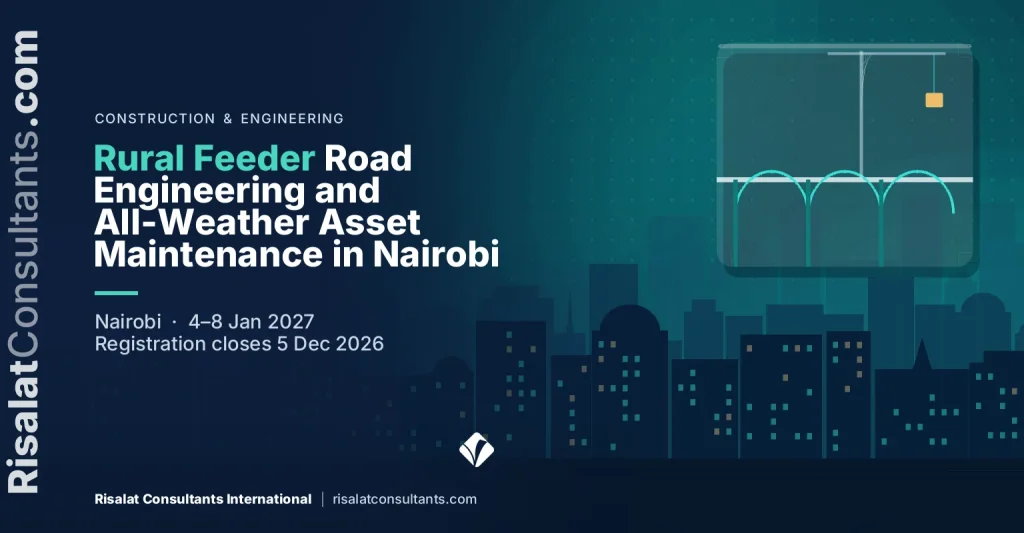
- 4–8 janv. 2027 (5 jours)
- Lieu
- Nairobi, Kenya
- Frais par participant
- 3 250 £ (GBP)
- Paiement
- Sur facture et par virement bancaire
- Clôture des inscriptions
- 5 déc. 2026
- Certificat
- Certificat de participation
- Option intra
- Organisez-le pour votre équipe, à vos dates
Sur cette page 14 sections
Présentation du programme
Rural feeder road networks form the backbone of agricultural supply chains and socio-economic integration across East Africa. Ensuring these unpaved and low-volume routes remain passable throughout adverse weather requires specialised engineering, climate-resilient drainage configurations, and systemic maintenance regimes. This intensive course provides engineers, planners, and inspectors with technical expertise to construct and protect all-weather corridors using proven gravel, earth, and low-volume sealed road methodologies. Participants evaluate foundational geotechnical designs alongside sustainable surface options designed to withstand intense seasonal precipitation.
The programme integrates established regional guidelines, including the Transport Research Laboratory Overseas Road Notes and Southern African Development Community low-volume road manuals. Technical modules analyse terrain-specific slope stabilisation, bio-engineering applications, and durable hydrology cross-drainage structures. Delegates study the transition from emergency reactive repairs to structured asset management frameworks. Through rigorous technical reviews, participants learn to select appropriate surfacing options such as single and double bituminous surface dressings, otta seals, and mechanically stabilised gravels while mitigating standard construction defects across varied topography.
Sustainable serviceability demands sound operational governance alongside civil engineering interventions. This training equips practitioners to implement performance-based maintenance concepts, establish clear quality assurance protocols, and develop workable community-driven road maintenance frameworks. By mastering precise site inspection regimes and contract oversight mechanisms, participants will safeguard public investments against rapid environmental deterioration. The curriculum culminates in practical maintenance prioritisation methodologies that optimise constrained transport agency resources, enhance institutional accountability, and deliver resilient access across key rural productive zones.
Investment in secondary and tertiary road infrastructure continues to accelerate under large-scale rural development initiatives, including the US$113m Rwanda Feeder Roads Development Project. With major capital directed towards upgrading agricultural transport corridors in mountainous and high-rainfall terrains, executing agencies face urgent delivery challenges. Technical teams must urgently bridge the gap between standard highway engineering and cost-effective low-volume road methodologies. Implementing climate-resilient drainage, controlling slope erosion, and setting up durable community maintenance frameworks are immediately necessary to prevent newly constructed feeder roads from degrading prematurely during seasonal rains.
Proposé par Risalat Consultants International à Nairobi (Kenya), il associe sessions animées par des experts, cas réels et travaux de groupe, afin que les participants puissent appliquer leurs acquis dans leur propre institution.
The Programme Strengthens Institutional Capability
- Assessment of low-volume road standards: SADC guidelines and TRL Overseas Road Note 31 applications
- Geotechnical site investigations, dynamic cone penetrometer testing, and subgrade strength evaluation
- Material selection: marginal gravels, mechanical stabilisation, and chemical additive applications
- Pavement layer design and surfacing alternatives: otta seals, slurry seals, and surface dressings
- Quality assurance protocols for subbase compaction and pavement construction
- Catchment analysis and hydrological run-off calculations for rural feeder corridors
- Design and sizing of pipe culverts, box culverts, and low-cost vented drifts
- Scour protection, energy dissipators, and outfall channel management
- Planification et priorisation des infrastructures
- Évaluation ex ante des projets et études de rentabilité
- Options de financement et partenariats public-privé
- Passation des marchés et contrats de travaux
It is designed for feeder road project engineers, rural transport planners, works inspectors and site supervisors and others who want practical, current skills in infrastructure, urban development and partnerships.
The Growing Importance of Rural Feeder Road Engineering and All-Weather Asset Maintenance in Nairobi
Les infrastructures et les services urbains façonnent la croissance, la santé et les perspectives. Les projets sont vastes, complexes et durables, et les faiblesses de planification, de financement ou de réalisation coûtent cher à corriger par la suite.
Les gouvernements combinent de plus en plus investissement public, partenariats avec le secteur privé et nouvelles technologies. Les équipes capables de planifier, d'évaluer, d'acheter et de gérer ces investissements obtiennent de meilleurs actifs et services.
Les organisations ont de plus en plus besoin de professionnels capables de :
- Planifier et prioriser les investissements d'infrastructure
- Évaluer les projets et préparer des études de rentabilité
- Choisir les modèles de financement et de réalisation
- Superviser les travaux en matière de délais, de coûts et de qualité
- Gérer les actifs tout au long de leur cycle de vie
Des systèmes solides en matière d'infrastructures, de développement urbain et de partenariats aident les organisations à :
- Choisir les bons investissements
- Livrer les projets dans les délais et le budget
- Attirer des financements et des partenaires
- Prolonger la durée de service des actifs
This Rural Feeder Road Engineering and All-Weather Asset Maintenance in Nairobi programme brings these elements together in a practical format, so that participants understand not only what good practice looks like but also how to introduce it in their own setting, with the people and resources they have.
Who Should Attend This Rural Feeder Road Engineering and All-Weather Asset Maintenance in Nairobi Training?
Ce programme s'adresse à :
- Feeder road project engineers
- Rural transport planners
- Works inspectors and site supervisors
- District infrastructure and transport officers
- Geotechnical and material testing engineers
- Contract managers supervising rural access programmes
- Civil engineers in public works ministries
- Monitoring and evaluation engineers on donor-funded projects
- Procurement specialists managing rural civil works contracts
- Planificateurs d'infrastructures et urbanistes
- Ingénieurs et responsables techniques
- Gestionnaires de projets et de programmes
Le programme convient aussi bien aux professionnels expérimentés qu’à ceux qui prennent de nouvelles responsabilités. Les groupes réunissant plusieurs institutions et pays sont encouragés, car les participants apprennent beaucoup de l’expérience des autres.
Cochez ce que votre équipe doit être capable de faire.
Rural Feeder Road Engineering and All-Weather Asset Maintenance in Nairobi Training Objectives
Upon successful completion of this Rural Feeder Road Engineering and All-Weather Asset Maintenance in Nairobi Training, participants will be able to:
- Apply low-volume sealed road design standards in compliance with regional engineering guidelines
- Evaluate slope stability risks and implement bio-engineering protection techniques for rural road embankments
- Design adequate hydrological cross-drainage structures, including culverts and drifts, for all-weather access
- Establish routine maintenance management systems using condition inventory and prioritisation tools
- Formulate community-based routine maintenance contracts and task-based performance specifications
- Execute technical quality inspections and compliance testing for gravel and bitumen-sealed feeder roads
- Analyse whole-life cycle costs to support resource allocation for secondary and tertiary networks
- Expliquer comment les infrastructures sont planifiées et priorisées
- Évaluer des projets et préparer une étude de rentabilité
- Comparer les modèles de financement et de réalisation, y compris les partenariats
Chaque objectif est mis en pratique pendant le programme à travers des exercices, des études de cas ou des travaux de groupe, afin que les participants repartent capables de le faire, et pas seulement de le décrire.
Contenu et structure du programme
- Assessment of low-volume road standards: SADC guidelines and TRL Overseas Road Note 31 applications
- Geotechnical site investigations, dynamic cone penetrometer testing, and subgrade strength evaluation
- Material selection: marginal gravels, mechanical stabilisation, and chemical additive applications
- Pavement layer design and surfacing alternatives: otta seals, slurry seals, and surface dressings
- Quality assurance protocols for subbase compaction and pavement construction
- Catchment analysis and hydrological run-off calculations for rural feeder corridors
- Design and sizing of pipe culverts, box culverts, and low-cost vented drifts
- Scour protection, energy dissipators, and outfall channel management
- Roadway horizontal and vertical alignment considerations in hilly and mountainous topography
- Construction supervision checkpoints for drainage structures and earthworks compliance
- Identification of slope failure mechanisms in deep cuts and high embankment fills
- Bio-engineering techniques: vetiver grass hedging, live staking, and brush layering
- Retaining structure design: stone masonry, gabion baskets, and reinforced earth walls
- Managing surface run-off on cut slopes using catch-water drains and berms
- Practical field assessments: identifying slope distress and prescribing remediation works
- Principles of road asset management and network-level condition data collection
- Conducting visual condition surveys: defect classification, roughness, and rutting evaluation
- Multi-criteria prioritisation models for routine, periodic, and emergency maintenance
- Budget allocation and whole-life costing for unpaved versus low-volume sealed options
- Field inspection simulation: documenting defects and generating asset condition registers
- Contracting models: performance-based maintenance contracts versus traditional admeasurement contracts
- Designing community-based maintenance schemes and length-worker task-rate systems
- Drafting technical specifications, service level targets, and payment measurement indicators
- Site inspection management: non-conformance reporting, snag lists, and defect liability administration
- Preparation of institutional action plans for all-weather rural asset preservation
Contenu détaillé jour par jour
Le programme se déroule sur 5 jours. Chaque journée associe apports d'experts, travail pratique et un atelier ou une étude de cas de clôture :
- First Day: Low-Volume Sealed Road Design and Geotechnical Characterisation
- Second Day: Hydrology, Cross-Drainage, and All-Weather Alignment Engineering
- Third Day: Slope Stabilisation, Bio-Engineering, and Climate Resilience
- Fourth Day: Asset Management Frameworks and Condition Inventory Systems
- Fifth Day: Maintenance Contracting, Community Schemes, and Quality Inspections
Contenu détaillé jour par jour
First Day | Low-Volume Sealed Road Design and Geotechnical Characterisation
- Assessment of low-volume road standards: SADC guidelines and TRL Overseas Road Note 31 applications
- Geotechnical site investigations, dynamic cone penetrometer testing, and subgrade strength evaluation
- Material selection: marginal gravels, mechanical stabilisation, and chemical additive applications
- Pavement layer design and surfacing alternatives: otta seals, slurry seals, and surface dressings
- Quality assurance protocols for subbase compaction and pavement construction
Workshop: Low-Volume Sealed Road Design and Geotechnical Characterisation: Applying It to Your Institution
En petits groupes, les participants appliquent les méthodes du jour à des exemples tirés de leurs institutions et conviennent d'étapes concrètes pour la suite.
Second Day | Hydrology, Cross-Drainage, and All-Weather Alignment Engineering
- Catchment analysis and hydrological run-off calculations for rural feeder corridors
- Design and sizing of pipe culverts, box culverts, and low-cost vented drifts
- Scour protection, energy dissipators, and outfall channel management
- Roadway horizontal and vertical alignment considerations in hilly and mountainous topography
- Construction supervision checkpoints for drainage structures and earthworks compliance
Workshop: Hydrology, Cross-Drainage, and All-Weather Alignment Engineering: Applying It to Your Institution
En petits groupes, les participants appliquent les méthodes du jour à des exemples tirés de leurs institutions et conviennent d'étapes concrètes pour la suite.
Third Day | Slope Stabilisation, Bio-Engineering, and Climate Resilience
- Identification of slope failure mechanisms in deep cuts and high embankment fills
- Bio-engineering techniques: vetiver grass hedging, live staking, and brush layering
- Retaining structure design: stone masonry, gabion baskets, and reinforced earth walls
- Managing surface run-off on cut slopes using catch-water drains and berms
- Practical field assessments: identifying slope distress and prescribing remediation works
Case Study: Slope Stabilisation, Bio-Engineering, and Climate Resilience in Practice
Les participants analysent un cas réaliste, comparent les choix effectués aux bonnes pratiques et en tirent des enseignements applicables à leur propre contexte.
Fourth Day | Asset Management Frameworks and Condition Inventory Systems
- Principles of road asset management and network-level condition data collection
- Conducting visual condition surveys: defect classification, roughness, and rutting evaluation
- Multi-criteria prioritisation models for routine, periodic, and emergency maintenance
- Budget allocation and whole-life costing for unpaved versus low-volume sealed options
- Field inspection simulation: documenting defects and generating asset condition registers
Workshop: Asset Management Frameworks and Condition Inventory Systems: Applying It to Your Institution
En petits groupes, les participants appliquent les méthodes du jour à des exemples tirés de leurs institutions et conviennent d'étapes concrètes pour la suite.
Fifth Day | Maintenance Contracting, Community Schemes, and Quality Inspections
- Contracting models: performance-based maintenance contracts versus traditional admeasurement contracts
- Designing community-based maintenance schemes and length-worker task-rate systems
- Drafting technical specifications, service level targets, and payment measurement indicators
- Site inspection management: non-conformance reporting, snag lists, and defect liability administration
- Preparation of institutional action plans for all-weather rural asset preservation
Capstone Exercise: Rural Feeder Road Engineering and All-Weather Asset Maintenance in Nairobi Action Plan for Your Institution
Les participants synthétisent la semaine dans un plan d'action pour leur institution, avec des priorités, des responsables et des premières étapes, puis le présentent à leurs pairs et aux animateurs pour recueillir leurs retours.
Rural Feeder Road Engineering and All-Weather Asset Maintenance in Nairobi Training Methodology
The training employs interactive technical lectures, standard engineering design exercises, and real-world project case studies from donor-funded rural road programmes. Participants work with engineering spreadsheets, pavement design charts, and defect inspection catalogues to address practical design problems. Group activities focus on drafting community maintenance agreements, analysing geotechnical data sets, and designing cross-drainage structures for difficult terrains. Daily peer reviews and structured technical discussions ensure direct applicability to ongoing feeder road works.
Le programme associe :
- Sessions animées par des experts sur les pratiques actuelles
- Études de cas régionales et internationales
- Travaux de groupe et exercices pratiques
- Simulations et jeux de rôle le cas échéant
- Discussion des défis rencontrés par les participants dans l'exercice de leurs fonctions
- Apprentissage entre pairs, d'institutions et de pays différents
- Des outils et modèles pratiques à réutiliser au travail
- Réflexion quotidienne et plan d'action
Avant le programme, une courte pré-évaluation aide les animateurs à comprendre le rôle et les priorités de chaque participant, afin d’adapter les exemples et les exercices au groupe. Chaque journée se termine par une brève réflexion au cours de laquelle les participants notent ce qu’ils appliqueront dans leur travail.
Résultats attendus
Upon completion of this Rural Feeder Road Engineering and All-Weather Asset Maintenance in Nairobi Training, participants will be able to:
- Ability to design cost-effective low-volume sealed roads tailored to rural traffic levels and terrain
- Competence in selecting and executing bio-engineering measures for slope and embankment protection
- Proficiency in calculating hydraulic capacity and detailing durable drainage structures for flood resilience
- Capacity to deploy routine maintenance management systems for secondary and tertiary networks
- Skill in drafting, negotiating, and monitoring performance-based community road maintenance contracts
- Preparedness to manage rigorous site inspections and technical quality assurance regimes on active work sites
- Planifier et prioriser les investissements d'infrastructure
- Évaluer les projets et préparer des études de rentabilité
Les participants repartent avec un plan d'action personnel et des outils pratiques utilisables dans leur institution dès la première semaine de retour. Les institutions qui envoient plusieurs participants peuvent s'appuyer sur le programme pour convenir de méthodes et de modèles communs entre équipes, ce qui facilite la pérennité des améliorations.
3 250 £ par participant · facture et virement bancaire · réduction pour les groupes de 5 personnes ou plus
Cinq personnes ou plus d'une même organisation : demandez le tarif de groupe lors de votre demande de facture.
À partir de dix participants, une version intra pour votre institution peut revenir moins cher par personne. Demander un devis intra.
Clôture des inscriptions dans 23 jours (5 déc. 2026)
Institutional Application of Rural Feeder Road Engineering and All-Weather Asset Maintenance in Nairobi Training
Ce programme aide les organisations à renforcer :
- Planification des investissements
- Évaluation ex ante des projets
- Gestion des partenariats
- Supervision des travaux
- Gestion des actifs
Les participants repartent avec des outils pratiques pour améliorer :
- Études de rentabilité
- Répartition des risques
- Gestion des contrats
- Planification de la maintenance
- Suivi des services
Le programme est conçu pour que l'apprentissage passe de la salle de formation à l'institution. Les participants travaillent, dans la mesure du possible, sur leurs propres processus et documents, et repartent avec un plan d'action que leurs responsables peuvent examiner et soutenir.
Pertinence régionale & mise en application
Europe
Les institutions européennes mettent en œuvre les infrastructures, le développement urbain et les partenariats dans des cadres réglementaires détaillés et des programmes de réforme. Les participants venus d'Europe peuvent comparer leurs pratiques avec celles de collègues d'autres régions et vérifier comment des méthodes éprouvées fonctionnent dans d'autres conditions.
Afrique
Partout en Afrique, les ministères, les agences et les équipes de projet qui travaillent dans les infrastructures, le développement urbain et les partenariats opèrent de plus en plus aux côtés de programmes financés par les bailleurs, qui exigent des systèmes clairs et des éléments probants. Le programme aide les participants à adapter les bonnes pratiques aux institutions et aux ressources avec lesquelles ils travaillent.
Moyen-Orient
Au Moyen-Orient, les stratégies nationales de développement et les plans de diversification imposent des exigences croissantes en matière d'infrastructures, de développement urbain et de partenariats. Les participants examinent comment bâtir, au sein des organismes publics et des entreprises, les capacités dont ces plans ont besoin.
Asie
Les institutions asiatiques conjuguent croissance rapide et programmes de modernisation ambitieux. Les participants venus d'Asie peuvent partager leur expérience du déploiement rapide de systèmes à grande échelle et découvrir les approches adoptées ailleurs.
Pacifique
Les petits États insulaires et du Pacifique sont confrontés à des contraintes particulières de taille, d'éloignement et de capacités. Le programme met en avant des approches pratiques et proportionnées des infrastructures, du développement urbain et des partenariats, adaptées aux institutions de plus petite taille.
Holding the programme in Nairobi, Kenya brings participants together away from their daily pressures, so they can compare how infrastructure, urban development and partnerships is handled in different settings. The same programme can also be delivered in-house for one institution, in its own country or online, with cases taken from its current work.
- Intrants
- Activités
- Produits
- Effets
- Impact
Profil du pays d'accueil – Kenya
Programmes, ateliers, immersions et formations à Nairobi, Kenya, par Risalat Consultants International
Se former hors de son pays permet aux participants de se concentrer, de porter un regard neuf sur leur propre institution et de constituer un réseau avec des collègues d'autres pays.
Rural Feeder Road Engineering and All-Weather Asset Maintenance in Nairobi Training Deliverables
Les participants sont accompagnés avant, pendant et après le programme, afin que la préparation, l'apprentissage et le suivi forment une expérience continue.
Avant le programme
- Pré-évaluation des participants
- Rural Feeder Road Engineering and All-Weather Asset Maintenance in Nairobi Readiness Assessment
- Rural Feeder Road Engineering and All-Weather Asset Maintenance in Nairobi Resource Pack
- Lectures préparatoires
- Aide et conseils gratuits pour le visa
Pendant le programme
- Accueil à l'aéroport & assistance à l'arrivée
- Hébergement avec petit-déjeuner
- Dîner de bienvenue et de réseautage
- Kit de formation Risalat (sac, gourde, mug, t-shirt, casquette, protège-passeport, stylos, carnet, magnet & porte-clés)
- Comprehensive Rural Feeder Road Engineering and All-Weather Asset Maintenance in Nairobi Training Manual
- Modèle d'évaluation ex ante de projet
- Matrice de répartition des risques en PPP
- Liste de contrôle de la supervision des travaux
- Modèle de plan de gestion des actifs
- Ateliers pratiques & simulations
- Discussions de groupe & apprentissage entre pairs
- Déjeuner et pauses-café quotidiens
- Accès complet aux installations du lieu de formation
- Mini tablette avec supports pédagogiques numériques
- Visite de terrain (le cas échéant)
- Visite récréative de la ville
Après le programme
- Certificat de participation
- Distinction Risalat de participation au programme
- Documents de référence après la formation
- Liste de contrôle pour la revue des études de rentabilité
- Modèle de plan de maintenance
- Accompagnement après la formation & conseils de suivi
- Rapport du programme
Les institutions peuvent aussi demander une version intra sur mesure de ce programme, dispensée dans leurs locaux ou en ligne. Demander une proposition.
Common Challenges in Rural Feeder Road Engineering and All-Weather Asset Maintenance in Nairobi, And How This Training Helps
Comment les institutions peuvent-elles planifier et hiérarchiser leurs investissements d'infrastructure ?
The programme addresses this directly on the first day (Low-Volume Sealed Road Design and Geotechnical Characterisation), where participants practise the methods involved and adapt them to their own institution, then build it into their action plan.
Comment les institutions peuvent-elles évaluer des projets et préparer des dossiers d'investissement ?
The programme addresses this directly on the second day (Hydrology, Cross-Drainage, and All-Weather Alignment Engineering), where participants practise the methods involved and adapt them to their own institution, then build it into their action plan.
Comment les institutions peuvent-elles choisir leurs modèles de financement et d'exécution ?
The programme addresses this directly on the third day (Slope Stabilisation, Bio-Engineering, and Climate Resilience), where participants practise the methods involved and adapt them to their own institution, then build it into their action plan.
Comment les institutions peuvent-elles superviser les travaux en matière de délais, de coûts et de qualité ?
The programme addresses this directly on the fourth day (Asset Management Frameworks and Condition Inventory Systems), where participants practise the methods involved and adapt them to their own institution, then build it into their action plan.
Comment les institutions peuvent-elles gérer leurs actifs tout au long de leur cycle de vie ?
The programme addresses this directly on the fifth day (Maintenance Contracting, Community Schemes, and Quality Inspections), where participants practise the methods involved and adapt them to their own institution, then build it into their action plan.
Questions fréquentes
When and where does the Rural Feeder Road Engineering and All-Weather Asset Maintenance in Nairobi programme take place?
It runs from 4 Jan 2027 to 8 Jan 2027, in Nairobi, Kenya. The registration deadline is shown at the top of this page.
Qui devrait participer ?
The programme is designed for feeder road project engineers, rural transport planners, works inspectors and site supervisors, district infrastructure and transport officers, and others who want practical skills in infrastructure, urban development and partnerships.
Recevrai-je un certificat ?
Oui. Les participants qui terminent le programme reçoivent un certificat de participation délivré par Risalat Consultants International.
Ce programme peut-il être dispensé pour notre seule institution ?
Oui. Nous pouvons proposer une version intra sur mesure dans vos locaux, dans une autre ville ou en ligne, construite autour de vos propres cas. Utilisez la demande de proposition sur cette page.
Faut-il une expérience préalable en infrastructures, développement urbain et partenariats ?
Aucune formation spécialisée n'est requise au-delà d'une expérience dans une fonction similaire. Une courte pré-évaluation aide les animateurs à adapter les sessions au groupe.
Who Will Deliver This Programme
Each date is delivered by a team assigned from Risalat's expert network for this subject. For this programme we assign:
How we choose them: Experience in the region of the participants or comparable settings; Command of the financier rules that apply (World Bank, ADB, AfDB, EU, UN) where relevant; Delivery in English; other languages on request for in-house groups; No conflict of interest with participants' institutions.
Names and short CVs of the assigned experts are shared with registered participants and sponsoring organisations before the programme, on request. Are you an expert in this subject? Join our expert network.
Training courses in NairobiInfrastructure, Planning, and Development training courses
Pourquoi Nairobi pour ce programme
Nairobi accueille le PNUE, ONU-Habitat et de nombreux bureaux régionaux, avec des vols vers toute l'Afrique.
The Rural Feeder Road Engineering and All-Weather Asset Maintenance in Nairobi programme in January 2027 brings together officials and professionals from across the Africa region and beyond. Sessions combine short inputs, case studies and group work on participants' own files, and the city's institutions can be added as a study visit on request.
Accès : Jomo Kenyatta (NBO).
Vérifiez si vous avez besoin d'un visa avec le vérificateur de visa gratuit, et demandez une lettre d'invitation une fois inscrit.
Le même thème dans d'autres villes
- Rural Road Drainage and Climate Proofing in Fragile Zones in Dakar (Dakar)
- Rural Agricultural Corridor Road Maintenance and Feeder Logistics in Dakar (Dakar)
Autres programmes à Nairobi
- Island Volcanic Aquifer Management and Saline Intrusion Control in Nairobi
- Decentralised Renewable Energy Concessions and Solar Hybrid Systems in Nairobi
- Women Livelihood Grants Administration and GBV Prevention Integration in Nairobi
- Local Governance Planning and Community Sub-Project Fiduciary Controls in Nairobi
- Environmental & Social Management Frameworks for Solar Developments in Nairobi
For teams and institutions
Bring your team
Teams that learn together apply more at work. Tell us how many people and how you would like to take part: we reply with a group quote within two working days.
Other dates and cities for this subject: Infrastructure, Roads and Transport Projects training courses (161 upcoming dates).
Plus de formations au Kenya · Tous les programmes en Afrique · Calendrier complet des formations
Plan this programme in a roadmap: why it matters, why to approve it, the dates to plan and the career it builds.