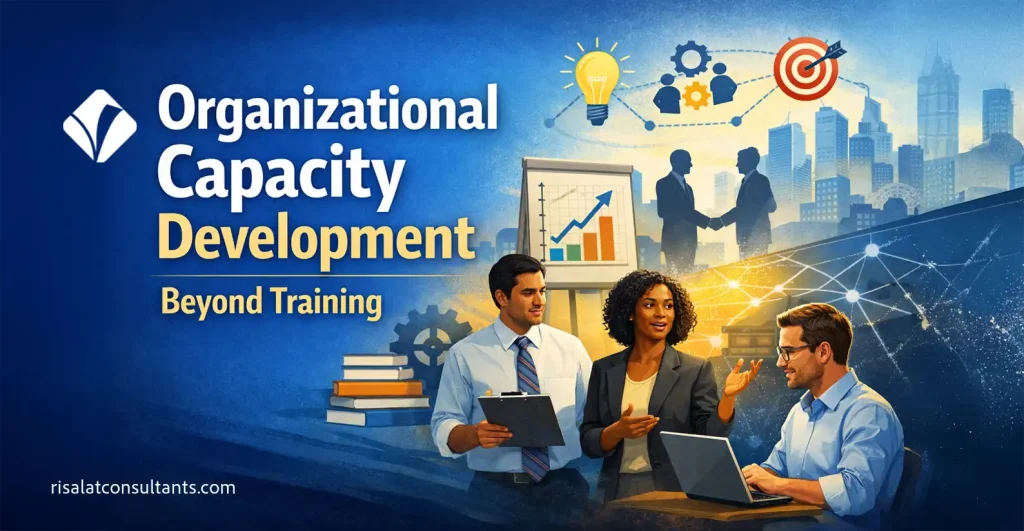
In short: Training and capacity building explained: why training alone rarely lasts, and how systems, leadership and follow-up turn capacity building into results.
Free self-check: the governance self-audit gives a quick check of governance, controls and accountability, in about 10 minutes.
Ideas clave
Training and capacity building are not the same thing: training builds individual skills, while capacity building changes what a whole organisation can deliver.
- Different levels – training works on individuals; capacity building works on people, systems, processes and leadership together.
- Training is one tool – it lasts only when procedures, incentives and management allow people to use new skills.
- Financiers pay for capacity – projects such as ADB’s early warning investment in Mongolia list capacity building as a planned output.
- Gaps are often institutional – ITU found capacity development is one of the weakest areas of national cybersecurity in most countries.
- Measure results, not attendance – agree performance indicators first and check them months later.
Introducción
La formación y el desarrollo de capacidades se utilizan a menudo como si significaran lo mismo, pero operan a diferentes niveles. La formación desarrolla los conocimientos y habilidades de las personas. El desarrollo de capacidades fortalece lo que una organización realmente puede ofrecer: su personal, sus sistemas y procedimientos, su liderazgo, y los recursos e incentivos que permiten a las personas utilizar lo que saben. La formación es una herramienta dentro del desarrollo de capacidades y, por sí sola, rara vez cambia los resultados de forma duradera.
This matters for ministries, agencies and project teams because large budgets are spent on workshops and courses that produce certificates but not better services. This guide explains why training alone often falls short, what effective capacity building looks like and how to design and measure it.
Training and Capacity Building Compared
| Formación | Fortalecimiento de capacidades | |
|---|---|---|
| Concentración | Individual knowledge and skills | Lo que la organización puede ofrecer |
| Typical activities | Cursos, talleres, aprendizaje en línea | Training plus new procedures, systems, coaching, leadership support, resources |
| Timeframe | Days to weeks | Months to years |
| Measure of success | Habilidades adquiridas, certificados | Changes in performance and services |
Why Training Alone Often Falls Short
Skills without systems
Staff can learn a new procurement or financial procedure in a course, but if the agency’s forms, approval steps and software still follow the old process, the new skill cannot be used.
No time or expectation to apply
When participants return to full workloads and managers do not ask what they learned, new practices fade within weeks.
The wrong people in the room
Training chosen from a catalogue, or offered to whoever is available, often reaches people who will not use the skill, while those who need it are left out.
Missing leadership and incentives
If good performance is not recognised and poor performance has no consequence, there is little reason to change established habits.
What Effective Capacity Building Looks Like
Effective capacity building works on several levels at once:
- Individuals: targeted training based on a needs assessment, with practice on real work
- Teams: coaching, peer learning and shared tools that make the new way the normal way
- Sistemas y procedimientos: manuales actualizados, plantillas, software y pasos de aprobación
- Leadership: managers who set expectations, remove barriers and review progress
- Resources and incentives: time, budget and recognition for applying new skills
What Financiers Are Paying For
Development partners increasingly finance capacity as part of investment projects, not as an add-on. ADB’s Strengthening Integrated Early Warning System in Mongolia Project, approved in November 2025, includes an output to strengthen capacity for early warning and disaster preparedness, and the project record notes a strong need for capacity building and training. In Bangladesh, the World Bank’s SITA project supports five government agencies, including the procurement authority, the revenue board and the audit office, to modernise systems and strengthen institutions.
In both cases, equipment and systems are only part of the investment. Agencies must also be able to operate, maintain and improve them, which is a capacity building task.
Capacity Gaps Are Often Institutional
National reviews regularly find that laws and strategies are in place but the capacity to apply them is weaker. ITU’s Global Cybersecurity Index 2024 found that legal measures are the strongest pillar in most countries, while capacity development and technical measures are relatively weak. The same pattern appears in procurement, financial management and disaster risk management: the rule exists, the skills, systems and staffing to apply it lag behind.
How to Design a Capacity Building Programme
- Define the performance problem. What should the organisation deliver better, and how will you know?
- Diagnose the causes. Separate skill gaps from gaps in systems, procedures, leadership and resources.
- Combine tools. Use training for skills, and other measures for the other causes.
- Select participants deliberately. Train the people who will apply the skill, together with their managers.
- Build in application. Give each participant a work task to complete with the new skill.
- Follow up. Coaching, check-ins and peer support over the following months.
- Measure performance. Check the agreed indicators after 60 to 90 days and again after six months.
Medición de la creación de capacidad
Counting people trained says little about capacity. Better measures look at what the organisation delivers, for example:
- Processing times for applications, payments or procurement
- Error rates and repeat work
- Audit and compliance findings
- Cobertura del servicio y satisfacción del usuario
- Use of new systems and procedures in daily work
El informe sobre el futuro del empleo 2025 del Foro Económico Mundial señala que el 50 por ciento de los trabajadores había completado formación como parte de estrategias de aprendizaje a largo plazo, frente al 41 por ciento en 2023. Se imparte más formación; la pregunta para cada organización es si esta cambia los resultados.
Capacity at Three Levels
Capacity development is often described at three linked levels. Working on only one rarely produces lasting change.
| Nivel | Qué abarca | Examples of support |
|---|---|---|
| Individual | Knowledge, skills and attitudes of staff | Training, coaching, mentoring, certification |
| Organisational | Structures, procedures, systems, leadership and culture | Process redesign, manuals, information systems, management support |
| Enabling environment | Laws, policies, budgets and coordination between institutions | Asesoramiento político, regulación, planificación presupuestaria, mecanismos de coordinación |
A training programme that ignores the other two levels can leave staff skilled but unable to act. A new law or system that ignores individual skills can leave it unused.
A Practical Timeline for Financed Projects
In projects financed by development partners, capacity building works best when it is planned with the project, not added later.
- Preparation: assess the capacity of the implementing agency and include capacity actions and budget in the project design.
- First six months: train the project team in procurement, financial management, safeguards and reporting before the first contracts are signed.
- Year one: introduce updated procedures and tools, with coaching on the first real cases.
- Mid-term: review performance indicators, refresh training where gaps remain and train trainers inside the agency.
- Closing: transfer manuals, tools and training materials to the permanent institution so capacity remains after the project ends.
Making Capacity Last: Training of Trainers and Institutional Ownership
External training ends; institutions continue. To make capacity last, agencies can build a small group of internal trainers, include new skills in induction programmes for new staff, keep manuals and templates up to date and link training to career progression. Several current projects, such as the disaster resilience work in Mongolia, include dedicated training centres for exactly this reason.
An Example: A Procurement Unit Moving to e-GP
Consider a procurement unit required to move all tenders onto an electronic system. Training alone would teach officers how to use the system. Capacity building would also update the unit’s procedures and approval steps, give evaluation committees clear guidance, provide help-desk support for the first months, set targets for processing times and complaints, and brief senior managers on how to read the system’s reports. The difference is not in the training itself but in everything around it.
Common Mistakes to Avoid
- Counting people trained as the result. Numbers trained say little about what changed.
- Training the wrong people. Select participants by the tasks they perform.
- Eventos únicos. Los talleres individuales rara vez cambian la práctica sin seguimiento.
- Ignoring systems and procedures. New skills need forms, approvals and software that allow them.
- Sin plan de salida. La capacidad creada por un proyecto debe ser asumida por la institución antes de que este concluya.
Choosing Support for Capacity Building
When agencies look for external support, the questions to ask are practical. Does the provider start by understanding the performance problem, or by offering a course list? Will the content use the agency’s own procedures, documents and cases? Is there a plan for coaching or follow-up after the training? Will materials and tools be handed over so the agency can keep using them? And how will results be measured? Providers that can answer these questions clearly are more likely to help build capacity that lasts.
Capacity Building and Gender and Inclusion
Los planes de capacidad deben verificar quién se beneficia. Las plazas de capacitación, la mentoría y las visitas de estudio suelen destinarse al mismo personal sénior, mientras que las mujeres, el personal junior y el de las oficinas regionales quedan excluidos. Establecer criterios de selección, realizar un seguimiento de la participación y ofrecer formatos que se adapten al personal con responsabilidades de cuidado o con opciones de viaje limitadas ayuda a que el desarrollo de capacidades sea más justo y eficaz, ya que las habilidades llegan a quienes realizan el trabajo.
Linking Capacity Building to Budgets
Capacity actions are often underfunded because they are planned as a single training line. A better approach costs each element separately: training, coaching, procedure updates, system changes and follow-up. This makes it easier to protect the follow-up budget, which is usually the first to be cut, and to show financiers what each part delivers.
Indicios de que la capacidad está creciendo
Capacity is growing when the agency handles new tasks with less outside help, when its own staff train newcomers, when procedures are followed without reminders and when performance indicators improve and stay improved. It is also visible when the agency can explain its own results and plan the next steps itself. These signs take time to appear, which is why capacity building should be reviewed over years, not weeks, and why the plan should name who in the institution owns each change. When that ownership is clear, external support can step back gradually and the gains remain after the project or programme ends.
Using Peer Learning Between Agencies
Agencies facing the same reform can learn a great deal from each other. Peer exchanges, joint workshops and short visits to an agency that has already made the change give staff practical examples, realistic expectations and contacts they can call when problems arise.
Preguntas críticas que deberían plantearse los responsables gubernamentales y de proyectos
What performance problem are we trying to solve?
Comience desde el servicio o resultado, no desde una lista de cursos.
¿Es la brecha realmente sobre habilidades?
Check systems, procedures, staffing and incentives before choosing training.
Will participants be able to use what they learn?
Make sure the tools, approvals and time are in place before the training ends.
Who follows up?
Name the manager or team responsible for supporting application after training.
¿Cómo sabremos que funcionó?
Agree indicators in advance and check them months later.
Cómo puede ayudar Risalat
Risalat combines training with the systems, coaching and follow-up that make capacity last, through open and in-house programmes and consulting. Organisations can start with the free institutional capacity assessment or the training needs assessment.
Preguntas frecuentes
What is the difference between training and capacity building?
Training builds the skills of individuals. Capacity building, or capacity development, strengthens what an organisation can do: its people, systems, processes, leadership and resources together. Training is one tool within it.
Why does training alone often fail to build capacity?
Porque las habilidades se pierden si los sistemas, procedimientos, incentivos y gestión de la organización no permiten que las personas las utilicen. El cambio duradero requiere capacitación vinculada a esos elementos.
¿Cómo se puede medir el desarrollo de capacidades?
By agreeing performance indicators before the work starts, such as processing times, error rates or compliance findings, and checking them several months later, rather than counting people trained.
Do donor-financed projects pay for capacity building?
Many do. For example, ADB's early warning project in Mongolia includes an output to strengthen capacity for early warning and disaster preparedness and notes a strong need for capacity building and training.
Free roadmap: Africa’s Capacity Building: a 12-month plan for your team
Ver


- World Bank Projects and Operations Banco Mundial
- Marco y Regulaciones de Adquisiciones para Proyectos Banco Mundial
Know people who should read this? Become an Ambassador or write with Risalat.
Socios para el éxito de los proyectos desde 2011: diagnósticos, asesoría y aprendizaje aplicado para ministerios, organismos públicos y equipos de proyecto.
¿Necesita ayuda para llevar esto a la práctica?
Empiece con un diagnóstico gratuito de 10 minutos o hable con nuestros expertos.