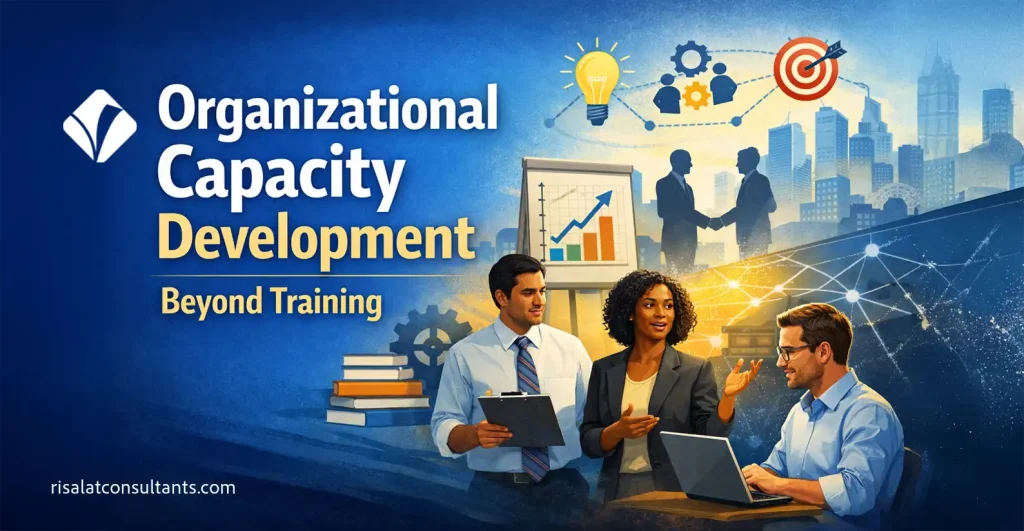
In short: Training and capacity building explained: why training alone rarely lasts, and how systems, leadership and follow-up turn capacity building into results.
Free self-check: the governance self-audit gives a quick check of governance, controls and accountability, in about 10 minutes.
Ключевые выводы
Training and capacity building are not the same thing: training builds individual skills, while capacity building changes what a whole organisation can deliver.
- Different levels – training works on individuals; capacity building works on people, systems, processes and leadership together.
- Training is one tool – it lasts only when procedures, incentives and management allow people to use new skills.
- Financiers pay for capacity – projects such as ADB’s early warning investment in Mongolia list capacity building as a planned output.
- Gaps are often institutional – ITU found capacity development is one of the weakest areas of national cybersecurity in most countries.
- Measure results, not attendance – agree performance indicators first and check them months later.
Введение
Обучение и наращивание потенциала часто используются так, будто они означают одно и то же, но они работают на разных уровнях. Обучение формирует знания и навыки отдельных людей. Наращивание потенциала, также называемое развитием потенциала, усиливает то, что организация действительно может предоставить: ее людей, ее системы и процедуры, ее руководство, а также ресурсы и стимулы, которые позволяют людям использовать то, что они знают. Обучение является одним из инструментов наращивания потенциала, и само по себе оно редко меняет результаты надолго.
This matters for ministries, agencies and project teams because large budgets are spent on workshops and courses that produce certificates but not better services. This guide explains why training alone often falls short, what effective capacity building looks like and how to design and measure it.
Training and Capacity Building Compared
| Обучение | Развитие потенциала | |
|---|---|---|
| Сосредоточенная работа | Индивидуальные знания и навыки | Что организация может предоставить |
| Типичные мероприятия | Курсы, семинары, электронное обучение | Training plus new procedures, systems, coaching, leadership support, resources |
| Timeframe | Days to weeks | Months to years |
| Measure of success | Полученные навыки, сертификаты | Изменения в результатах работы и услугах |
Why Training Alone Often Falls Short
Skills without systems
Staff can learn a new procurement or financial procedure in a course, but if the agency’s forms, approval steps and software still follow the old process, the new skill cannot be used.
No time or expectation to apply
When participants return to full workloads and managers do not ask what they learned, new practices fade within weeks.
The wrong people in the room
Training chosen from a catalogue, or offered to whoever is available, often reaches people who will not use the skill, while those who need it are left out.
Missing leadership and incentives
If good performance is not recognised and poor performance has no consequence, there is little reason to change established habits.
What Effective Capacity Building Looks Like
Effective capacity building works on several levels at once:
- Физические лица: целевое обучение на основе оценки потребностей с практикой на реальных задачах
- Teams: coaching, peer learning and shared tools that make the new way the normal way
- Системы и процедуры: обновленные руководства, шаблоны, программное обеспечение и этапы утверждения
- Leadership: managers who set expectations, remove barriers and review progress
- Ресурсы и стимулы: время, бюджет и признание за применение новых навыков
What Financiers Are Paying For
Development partners increasingly finance capacity as part of investment projects, not as an add-on. ADB’s Strengthening Integrated Early Warning System in Mongolia Project, approved in November 2025, includes an output to strengthen capacity for early warning and disaster preparedness, and the project record notes a strong need for capacity building and training. In Bangladesh, the World Bank’s SITA project supports five government agencies, including the procurement authority, the revenue board and the audit office, to modernise systems and strengthen institutions.
In both cases, equipment and systems are only part of the investment. Agencies must also be able to operate, maintain and improve them, which is a capacity building task.
Capacity Gaps Are Often Institutional
National reviews regularly find that laws and strategies are in place but the capacity to apply them is weaker. ITU’s Global Cybersecurity Index 2024 found that legal measures are the strongest pillar in most countries, while capacity development and technical measures are relatively weak. The same pattern appears in procurement, financial management and disaster risk management: the rule exists, the skills, systems and staffing to apply it lag behind.
How to Design a Capacity Building Programme
- Define the performance problem. What should the organisation deliver better, and how will you know?
- Diagnose the causes. Separate skill gaps from gaps in systems, procedures, leadership and resources.
- Combine tools. Use training for skills, and other measures for the other causes.
- Select participants deliberately. Train the people who will apply the skill, together with their managers.
- Build in application. Give each participant a work task to complete with the new skill.
- Follow up. Coaching, check-ins and peer support over the following months.
- Measure performance. Check the agreed indicators after 60 to 90 days and again after six months.
Оценка наращивания потенциала
Подсчет числа обученных специалистов дает мало информации о потенциале. Более надежные показатели отражают результаты работы организации, например:
- Processing times for applications, payments or procurement
- Error rates and repeat work
- Audit and compliance findings
- Охват услугами и удовлетворенность пользователей
- Use of new systems and procedures in daily work
В «Отчете о будущем рабочие мест за 2025 год» Всемирного экономического форума отмечается, что 50 процентов работников прошли обучение в рамках долгосрочных стратегий обучения по сравнению с 41 процентом в 2023 году. Обучения становится больше; вопрос для каждой организации заключается в том, приводит ли это к изменениям результатов.
Capacity at Three Levels
Capacity development is often described at three linked levels. Working on only one rarely produces lasting change.
| Уровень | Содержание программы | Examples of support |
|---|---|---|
| Индивидуальный | Knowledge, skills and attitudes of staff | Обучение, коучинг, наставничество, сертификация |
| Organisational | Структуры, процедуры, системы, руководство и культура | Process redesign, manuals, information systems, management support |
| Enabling environment | Laws, policies, budgets and coordination between institutions | Консультации по вопросам политики, регулирование, бюджетное планирование, механизмы координации |
A training programme that ignores the other two levels can leave staff skilled but unable to act. A new law or system that ignores individual skills can leave it unused.
A Practical Timeline for Financed Projects
В проектах, финансируемых партнерами по развитию, наращивание потенциала дает наилучшие результаты, когда оно планируется вместе с проектом, а не добавляется позже.
- Preparation: assess the capacity of the implementing agency and include capacity actions and budget in the project design.
- First six months: train the project team in procurement, financial management, safeguards and reporting before the first contracts are signed.
- Year one: introduce updated procedures and tools, with coaching on the first real cases.
- Mid-term: review performance indicators, refresh training where gaps remain and train trainers inside the agency.
- Closing: transfer manuals, tools and training materials to the permanent institution so capacity remains after the project ends.
Making Capacity Last: Training of Trainers and Institutional Ownership
Внешнее обучение заканчивается, организации продолжают работу. Чтобы потенциал сохранялся, агентства могут сформировать небольшую группу внутренних тренеров, включить новые навыки в программы ввода в должность новых сотрудников, поддерживать актуальность руководств и шаблонов, а также увязать обучение с карьерным ростом. Некоторые текущие проекты, такие как работа по повышению устойчивости к стихийным бедствиям в Монголии, включают специализированные учебные центры именно по этой причине.
An Example: A Procurement Unit Moving to e-GP
Consider a procurement unit required to move all tenders onto an electronic system. Training alone would teach officers how to use the system. Capacity building would also update the unit’s procedures and approval steps, give evaluation committees clear guidance, provide help-desk support for the first months, set targets for processing times and complaints, and brief senior managers on how to read the system’s reports. The difference is not in the training itself but in everything around it.
Common Mistakes to Avoid
- Counting people trained as the result. Numbers trained say little about what changed.
- Training the wrong people. Select participants by the tasks they perform.
- Разовые мероприятия. Одиночные семинары редко меняют практику без последующей работы.
- Ignoring systems and procedures. New skills need forms, approvals and software that allow them.
- План выхода отсутствует. Ответственность за потенциал, созданный проектом, должна быть принята институтом до завершения проекта.
Choosing Support for Capacity Building
Когда ведомства ищут внешнюю поддержку, возникающие вопросы носят практический характер. Начинает ли провайдер с понимания проблемы эффективности или с предложения списка курсов? Будет ли контент использовать собственные процедуры, документы и кейсы ведомства? Существует ли план коучинга или последующего сопровождения после тренинга? Будут ли материалы и инструменты переданы ведомству, чтобы оно могло продолжать их использовать? И как будут измеряться результаты? Провайдеры, которые могут четко ответить на эти вопросы, с большей вероятностью помогут создать устойчивый потенциал.
Capacity Building and Gender and Inclusion
В планах развития потенциала следует учитывать получателей выгоды. Места на обучение, коучинг и учебные поездки часто достаются одним и тем же руководящим сотрудникам, в то время как женщины, начинающие специалисты и работники региональных офисов остаются в стороне. Определение критериев отбора, отслеживание участия и предложение форматов, удобных для сотрудников с семейными обязанностями или ограниченными возможностями поездок, способствуют тому, что наращивание потенциала становится более справедливым и результативным, поскольку навыки доходят до тех, кто непосредственно выполняет работу.
Linking Capacity Building to Budgets
Capacity actions are often underfunded because they are planned as a single training line. A better approach costs each element separately: training, coaching, procedure updates, system changes and follow-up. This makes it easier to protect the follow-up budget, which is usually the first to be cut, and to show financiers what each part delivers.
Признаки роста потенциала
Capacity is growing when the agency handles new tasks with less outside help, when its own staff train newcomers, when procedures are followed without reminders and when performance indicators improve and stay improved. It is also visible when the agency can explain its own results and plan the next steps itself. These signs take time to appear, which is why capacity building should be reviewed over years, not weeks, and why the plan should name who in the institution owns each change. When that ownership is clear, external support can step back gradually and the gains remain after the project or programme ends.
Using Peer Learning Between Agencies
Agencies facing the same reform can learn a great deal from each other. Peer exchanges, joint workshops and short visits to an agency that has already made the change give staff practical examples, realistic expectations and contacts they can call when problems arise.
Ключевые вопросы, которые должны задавать руководители государственных органов и проектов
What performance problem are we trying to solve?
Начинайте с услуги или результата, а не со списка курсов.
Действительно ли дело в нехватке навыков?
Check systems, procedures, staffing and incentives before choosing training.
Will participants be able to use what they learn?
Make sure the tools, approvals and time are in place before the training ends.
Who follows up?
Name the manager or team responsible for supporting application after training.
Как мы узнаем, что это сработало?
Agree indicators in advance and check them months later.
Чем может помочь Risalat
Risalat combines training with the systems, coaching and follow-up that make capacity last, through open and in-house programmes and consulting. Organisations can start with the free institutional capacity assessment or the training needs assessment.
Часто задаваемые вопросы
What is the difference between training and capacity building?
Training builds the skills of individuals. Capacity building, or capacity development, strengthens what an organisation can do: its people, systems, processes, leadership and resources together. Training is one tool within it.
Why does training alone often fail to build capacity?
Потому что навыки утрачиваются, если системы, процедуры, стимулы и менеджмент организации не позволяют людям их использовать. Устойчивые изменения требуют обучения, связанного с этими элементами.
Как можно измерить наращивание потенциала?
By agreeing performance indicators before the work starts, such as processing times, error rates or compliance findings, and checking them several months later, rather than counting people trained.
Do donor-financed projects pay for capacity building?
Many do. For example, ADB's early warning project in Mongolia includes an output to strengthen capacity for early warning and disaster preparedness and notes a strong need for capacity building and training.
Free roadmap: Africa’s Capacity Building: a 12-month plan for your team
Смотреть


- World Bank Projects and Operations Всемирный банк
- Система и правила закупок для проектов Всемирный банк
Know people who should read this? Become an Ambassador or write with Risalat.
Партнеры в успехе проектов с 2011 года: диагностика, консультационная поддержка и прикладное обучение для министерств, государственных ведомств и проектных команд.
Нужна помощь, чтобы применить это на практике?
Начните с бесплатной 10-минутной диагностики или обратитесь к нашим экспертам.