Datos clave
- Fechas
- 8–12 feb 2027 (5 días)
- Dónde
- NH Valencia Center, Valencia, Spain
- Tarifa por participante
- 3.950 £ (GBP)
- Pago
- Mediante factura y transferencia bancaria
- Cierre de inscripciones
- 20 dic 2026
- Formato
- 5-day short course: a practical capacity-building programme for government, NGO and project teams in Valencia
- Certificado
- Certificado de finalización
- Opción interna
- Impártalo para su equipo, en sus fechas
En esta página 15 secciones
Descripción del programa
Every programme, project and public policy promises change. Knowing whether that change is happening, for whom and at what cost is harder. Many organisations collect data mainly to report upward, while decisions on budgets, priorities and course corrections are made with little evidence. Strategic performance monitoring and evaluation (M&E) closes that gap by linking objectives, indicators, data and decisions in one system.
The reference points have moved. The OECD Development Assistance Committee adopted revised evaluation criteria in December 2019, adding coherence to relevance, effectiveness, efficiency, impact and sustainability. The UN Evaluation Group’s Norms and Standards, updated in 2016, set expectations on independence, utility, credibility and ethics. Financiers such as the World Bank expect a clear results framework with baselines, targets and a monitoring plan for every operation.
Spain offers a timely benchmark. Law 27/2022 institutionalised public policy evaluation in the central administration, and in February 2026 a royal decree approved the statute of the new State Agency for Public Policy Evaluation. The Independent Authority for Fiscal Responsibility (AIReF) is running a multi-year spending review cycle for 2022-2026, and regional authorities such as the Generalitat Valenciana manage EU cohesion programmes under a performance framework with common indicators and published targets.
This five-day programme in Valencia gives managers and M&E professionals a complete, practical toolkit: from theory of change and results frameworks to indicators, data systems, evaluation design, cost-effectiveness and reporting that informs decisions. Real reforms and financed programmes are used as case material throughout.
Risalat Consultants International (RCI) works alongside ministries, agencies, project implementation units and NGOs to build M&E systems that are proportionate, credible and used.
The Programme Strengthens Institutional Capability
- Theory of change and results chain design
- Results frameworks and logical frameworks
- Indicator selection, definitions and reference sheets
- Baselines, milestones and targets
- Data collection planning and quality assurance
- Muestreo para encuestas y seguimiento
- Dashboards and performance reporting
- Evaluation design using the OECD DAC criteria
- Evaluability assessment and evaluation questions
- Análisis de rentabilidad y relación calidad-precio
- Impact evaluation options and their limits
- M&E budgeting and staffing
- Stakeholder participation and accountability
- Evaluation ethics and independence
- Management response and follow-up of recommendations
- Vinculación de la información de rendimiento a los presupuestos
Participants work on their own programme or project throughout the week and leave with a draft M&E plan.
The Growing Importance of Strategic Performance Monitoring and Evaluation
Los presupuestos públicos están bajo presión y el escrutinio va en aumento. En España, el ciclo de revisiones de gasto de la AIReF ha abarcado áreas como los instrumentos financieros para sectores productivos, el ingreso mínimo vital, las prestaciones por incapacidad temporal y la ayuda oficial al desarrollo, y en abril de 2026 el gobierno añadió las políticas de empleo y partes del programa plurirregional FEDER 2014-2020. Cada revisión plantea la misma pregunta a los gestores: ¿está este gasto alcanzando sus objetivos de manera eficiente?
EU cohesion policy shows the same shift. For 2021-2027 the Commission sets common output and result indicators, publishes programme targets on its Cohesion Open Data platform and updated its performance guidance in February 2025. The mid-term review regulations adopted in September 2025 allow programmes to redirect funds to new priorities such as housing, water resilience, energy transition and defence, which means indicators, targets and evaluation plans must be revised mid-course.
Las organizaciones necesitan cada vez más profesionales capaces de:
- Building a theory of change that people actually use
- Designing results frameworks with measurable indicators
- Setting realistic baselines, milestones and targets
- Planning data collection, verification and storage
- Producing dashboards that support decisions
- Puesta en marcha y gestión de evaluaciones
- Applying the OECD DAC criteria in evaluation questions
- Choosing between impact evaluation designs
- Assessing cost-effectiveness and value for money
- Budgeting and staffing an M&E function
- Revising indicators when programmes are reprogrammed
- Writing findings that lead to management action
Strong M&E systems help organisations:
- Detect problems early and correct course
- Asignar presupuestos a lo que funciona
- Demonstrate results to financiers and citizens
- Meet reporting obligations without duplicating effort
- Aprender del éxito y del fracaso
- Improve the quality of new programme design
- Strengthen accountability and trust
- Prepararse para auditorías y revisiones del gasto
Good M&E is proportionate. The aim is not more data but better decisions, made at the right time by the people responsible.
Who Should Attend This Strategic Performance M&E Training?
Este programa está dirigido a:
- M&E managers, officers and specialists
- Gerentes de proyectos y programas
- Project implementation unit coordinators
- Planning and strategy directors
- Oficiales de rendimiento y resultados en ministerios
- Budget and finance officers working on performance budgeting
- Policy analysts and evaluation unit staff
- EU funds managing authority and intermediate body staff
- Donor and development agency programme staff
- NGO programme and MEAL staff
- Auditores internos e inspectores
- Researchers and independent evaluators
- Executive managers who use performance data
Mixed teams of managers, M&E staff and finance officers gain most, because they can agree on one results framework and one reporting cycle.
Marque lo que su equipo necesita ser capaz de hacer.
Strategic Performance M&E Training Objectives
Upon successful completion of this Strategic Performance M&E Training, participants will be able to:
- Build a theory of change and results chain for a programme or policy
- Design a results framework with clear indicators, baselines and targets
- Redactar hojas de referencia de indicadores que garanticen una medición coherente
- Plan data collection, sampling and data quality checks
- Diseñar un cuadro de mando de rendimiento simple para gerentes
- Frame evaluation questions using the revised OECD DAC criteria
- Apply the UNEG Norms and Standards to evaluation management
- Compare impact evaluation options under budget, time and data limits
- Assess cost-effectiveness and value for money
- Preparar un presupuesto de M&E y un plan de personal
- Informar sobre los hallazgos y realizar el seguimiento de las respuestas de la gerencia
Each objective is practised on participants’ own programmes, so tools are tested before they are taken home.
Source: Valencia Plaza, presentation of the ERDF 2021-2027 programme by the Generalitat (March 2023)
1. Which criterion was added when the OECD DAC revised its evaluation criteria in 2019?
The revised criteria adopted by the DAC in December 2019 added coherence to the five existing criteria (OECD, Better Criteria for Better Evaluation).
2. ¿Qué órgano español lleva a cabo el ciclo de revisión del gasto 2022-2026?
Spain's Ministry of Finance states that AIReF carries out the 2022-2026 spending review, with Phase III authorised in April 2026.
3. How many general norms do the UNEG Norms and Standards for Evaluation (2016) set out?
The 2016 UNEG document sets ten general norms, such as utility, credibility and independence, plus four institutional norms.
Contenido y estructura del programa
- Principles of results-based management
- Monitoring, evaluation, review and audit compared
- The project and policy cycle and where M&E fits
- Theory of change: pathways, assumptions and risks
- Cadenas de resultados: insumos, actividades, productos, resultados, impacto
- Logical framework and its limits
- Linking strategic plans to programme results
- From theory of change to results framework
- Selecting indicators: relevance, clarity and cost
- Output, outcome and impact indicators
- Indicator reference sheets and definitions
- Baselines, milestones and targets
- Disaggregation by sex, age, location and disability
- Common indicators in EU cohesion programmes
- Planning data collection: who, what, when and how
- Métodos cuantitativos y cualitativos
- Administrative data and its quality
- Sampling basics for surveys and monitoring
- Evaluación y verificación de la calidad de los datos
- Protección de datos y ética en la recopilación de datos
- Data storage, management and roles
- The revised OECD DAC criteria, including coherence
- Normas y estándares de la UNEG para la evaluación
- Evaluability assessment and evaluation questions
- Evaluación formativa, sumativa y en tiempo real
- Impact evaluation designs and their limits
- Cost-effectiveness and cost-benefit analysis
- Spending reviews: the AIReF approach
- Redacción de informes de evaluación y seguimiento que se leen
- Presenting data to different audiences
- Respuesta de la gerencia y seguimiento de recomendaciones
- Vinculación de la información de rendimiento a los presupuestos
- Learning reviews and adaptive management
- M&E budgets, staffing and capacity plans
- Participatory and accountability approaches
Contenido completo día a día
The week moves from strategy and design to data, evaluation and use.
- Day 1: results-based management and theory of change
- Day 2: results frameworks and indicators
- Day 3: data systems, sampling and dashboards
- Day 4: evaluation design, criteria and value for money
- Day 5: reporting, use and the M&E plan
Contenido completo día a día
First Day | Results-Based Management and Theory of Change
- Principles of results-based management
- Monitoring, evaluation, review and audit compared
- The project and policy cycle and where M&E fits
- Theory of change: pathways, assumptions and risks
- Cadenas de resultados: insumos, actividades, productos, resultados, impacto
- Logical framework and its limits
- Linking strategic plans to programme results
- Stakeholder mapping for M&E
- Spain’s Law 27/2022 and the new State Evaluation Agency
Workshop: Building a Theory of Change
Participants draft a theory of change for their own programme or policy, showing the pathway from activities to long-term results and the assumptions that must hold. Peers test each pathway for gaps and risks, and the facilitator links the results to the eight-step results framework approach described in World Bank Independent Evaluation Group guidance.
Second Day | Results Frameworks, Indicators and Targets
- From theory of change to results framework
- Selecting indicators: relevance, clarity and cost
- Output, outcome and impact indicators
- Indicator reference sheets and definitions
- Baselines, milestones and targets
- Disaggregation by sex, age, location and disability
- Common indicators in EU cohesion programmes
- Revising indicators after reprogramming
- Evitar incentivos perversos y la manipulación del sistema
Estudio de caso: Indicadores en el programa FEDER de la Comunitat Valenciana
Using the public programme for the Comunitat Valenciana ERDF 2021-2027, with more than EUR 1.19 billion across digital transition, energy efficiency and social inclusion, teams examine how priorities connect to indicators and targets. They then consider what would need to change if funds were moved to new priorities under the 2025 mid-term review.
Third Day | Data Systems, Sampling and Dashboards
- Planning data collection: who, what, when and how
- Métodos cuantitativos y cualitativos
- Administrative data and its quality
- Sampling basics for surveys and monitoring
- Evaluación y verificación de la calidad de los datos
- Protección de datos y ética en la recopilación de datos
- Data storage, management and roles
- Designing dashboards for decision-makers
- Using open data and published targets
Workshop: Designing a Performance Dashboard
Teams build a one-page dashboard for a senior management meeting using a set of programme indicators. They choose what to show, set traffic-light thresholds, add short narrative explanations and test whether a director could make a decision from the page in five minutes. Each team also lists the data quality checks behind every figure.
Fourth Day | Evaluation Design, Criteria and Value for Money
- The revised OECD DAC criteria, including coherence
- Normas y estándares de la UNEG para la evaluación
- Evaluability assessment and evaluation questions
- Evaluación formativa, sumativa y en tiempo real
- Impact evaluation designs and their limits
- Cost-effectiveness and cost-benefit analysis
- Spending reviews: the AIReF approach
- Commissioning and managing external evaluators
- Ethics, independence and minimising bias
Case Study: Spending Review and Evaluation in Spain
Drawing on Spain’s 2022-2026 spending review cycle run by AIReF and the evaluation duties set by Law 27/2022, teams design evaluation questions for a public spending area of their choice. They map each question to the DAC criteria, select a feasible method and estimate what the evaluation would cost and how long it would take.
Fifth Day | Reporting, Learning and the M&E Plan
- Redacción de informes de evaluación y seguimiento que se leen
- Presenting data to different audiences
- Respuesta de la gerencia y seguimiento de recomendaciones
- Vinculación de la información de rendimiento a los presupuestos
- Learning reviews and adaptive management
- M&E budgets, staffing and capacity plans
- Participatory and accountability approaches
- Recovery and reconstruction monitoring: lessons from Valencia
- Capstone presentations and action planning
Capstone Exercise: A Complete M&E Plan
Each participant or team presents an M&E plan for their own programme: theory of change, results framework, three indicator reference sheets, a data collection plan, a dashboard mock-up, an evaluation plan and an M&E budget. Peers and the facilitator review each plan against the UNEG Norms and the DAC criteria, and participants leave with a revised version.
Strategic Performance M&E Training Methodology
The programme is applied and evidence-based. Short inputs are followed by exercises on participants’ own programmes, using real reforms and financed programmes as reference cases.
El programa combina:
- Presentaciones breves de expertos
- Work on participants’ own programmes
- Estudios de caso de reformas españolas y de la UE
- Group exercises on theory of change and indicators
- Spreadsheet exercises on targets and cost-effectiveness
- Dashboard design practice
- Peer review of results frameworks
- Evaluation design simulations
- Templates and checklists for immediate use
- Daily feedback and reflection
- Planificación de acciones para la organización del participante
Before the programme, participants can complete RCI’s free M&E and MEAL Assessment to benchmark their current system. The results help facilitators adapt examples to the group.
- Insumos
- Actividades
- Productos
- Efectos
- Impacto
Resultados esperados
Upon completion of this Strategic Performance M&E Training, participants will be able to:
- Lead the design of a theory of change and results framework
- Define indicators that can be measured consistently
- Plan data collection and quality assurance
- Present performance information in a clear dashboard
- Commission and manage evaluations to recognised standards
- Assess value for money using simple cost-effectiveness tools
- Budget and staff an M&E function realistically
- Turn findings into management action
- Implementar un plan de mejora de M&E
Estos resultados ayudan a las instituciones a hacer un mejor uso de los fondos públicos y de los donantes, y a informar sobre los resultados con confianza.
3.950 £ por participante · factura y transferencia bancaria · los grupos de 5 o más personas reciben un descuento
Cinco o más personas de una misma organización: solicite la tarifa de grupo al pedir la factura.
Ten or more: an in-house version for your institution may cost less per person. Ask for an in-house quote.
La inscripción cierra en 27 días (20 dic 2026)
Institutional Application of Strategic Performance M&E Training
Este programa ayuda a las organizaciones a fortalecer:
- Results-based planning and budgeting
- Theories of change for strategies and programmes
- Results frameworks and indicator systems
- Data quality and management
- Performance dashboards and reporting cycles
- Evaluation policies and plans
- Evaluation commissioning and quality assurance
- Management response systems
- Value-for-money assessment
- M&E staffing, budgets and roles
- Stakeholder participation and accountability
Los participantes regresan con herramientas prácticas para mejorar:
- Theory of change template
- Results framework matrix
- Indicator reference sheet
- Data collection and sampling plan
- Data quality checklist
- Dashboard template
- Evaluation terms of reference outline
- M&E budget template
- Management response tracker
For a wider view of delivery risks, organisations can combine the programme with RCI’s Project Health Check, which reviews schedule, budget, procurement and results performance together.
Pertinencia y aplicación regionales
Europa
EU member states manage 2021-2027 cohesion programmes under a performance framework with common indicators, and the 2025 mid-term review requires many programmes to revise priorities and targets. Spain’s new evaluation agency and AIReF spending reviews give European participants a practical comparison.
África
Ministries and project implementation units in Africa manage World Bank, AfDB and other financed operations that require results frameworks, regular progress reports and independent evaluations. The sessions on indicators, data quality and M&E budgeting address common reporting gaps.
Oriente Medio
Governments in the Middle East are linking national visions and strategies to performance targets and dashboards. The programme helps teams connect strategic goals to measurable programme results.
Asia
Asian governments and development partners increasingly use results-based financing and performance budgeting, which depend on reliable indicators and verification. The data quality and value-for-money sessions apply directly.
América Latina
Latin American countries have long experience with national evaluation systems and performance budgeting. Participants can compare these with Spain’s newer evaluation agency and the EU approach.
En todas las regiones se aplica la misma disciplina: una lógica clara, un pequeño conjunto de buenos indicadores, datos fiables y evaluaciones que la gente utilice.
Perfil del país anfitrión: España
España es una monarquía parlamentaria y miembro fundador de la zona del euro, organizada en 17 comunidades autónomas y dos ciudades autónomas. Valencia, su tercera ciudad más grande, combina un centro histórico con modernas instalaciones para conferencias, buen transporte y un clima mediterráneo que la convierte en un lugar cómodo para aprender.
Spain is a useful benchmark for strategic M&E. Law 27/2022 institutionalised policy evaluation in the central administration, and the statute of the State Agency for Public Policy Evaluation, in force since February 2026, gives it duties on methodology, ex ante evaluation, strategic evaluation plans and training. AIReF’s spending reviews link evaluation to budget decisions. In the Comunitat Valenciana, the Generalitat manages an ERDF programme of more than EUR 1.19 billion for 2021-2027 with a published evaluation plan, and the region is recovering from the October 2024 floods with support that includes EUR 846 million from the EU Solidarity Fund approved in June 2026, which raises practical questions about tracking reconstruction results.
El aeropuerto de Valencia y el tren de alta velocidad conectan la ciudad con Madrid, Barcelona y muchas ciudades europeas. España aplica las normas del espacio Schengen: muchas nacionalidades pueden visitarla sin visado para estancias cortas, mientras que otras necesitan un visado Schengen obtenido con antelación en un consulado español. RCI proporciona cartas de invitación y asesoramiento sobre visados a los participantes inscritos.
Entregables de la capacitación en seguimiento y evaluación del desempeño estratégico
Every deliverable supports the participant’s own M&E plan, so that the work started in Valencia continues after the programme.
Antes del programa
- Evaluación previa del participante
- M&E Readiness Assessment
- M&E Resource Pack
- Materiales de lectura preparatoria
- Apoyo y asesoramiento gratuitos para el visado
Durante el programa
- Recogida en el aeropuerto y asistencia de bienvenida
- Accommodation with breakfast: 6 nights, check-in Sunday 7 February 2027, check-out Saturday 13 February 2027 (one night before and one night after the programme)
- Cena de bienvenida y networking
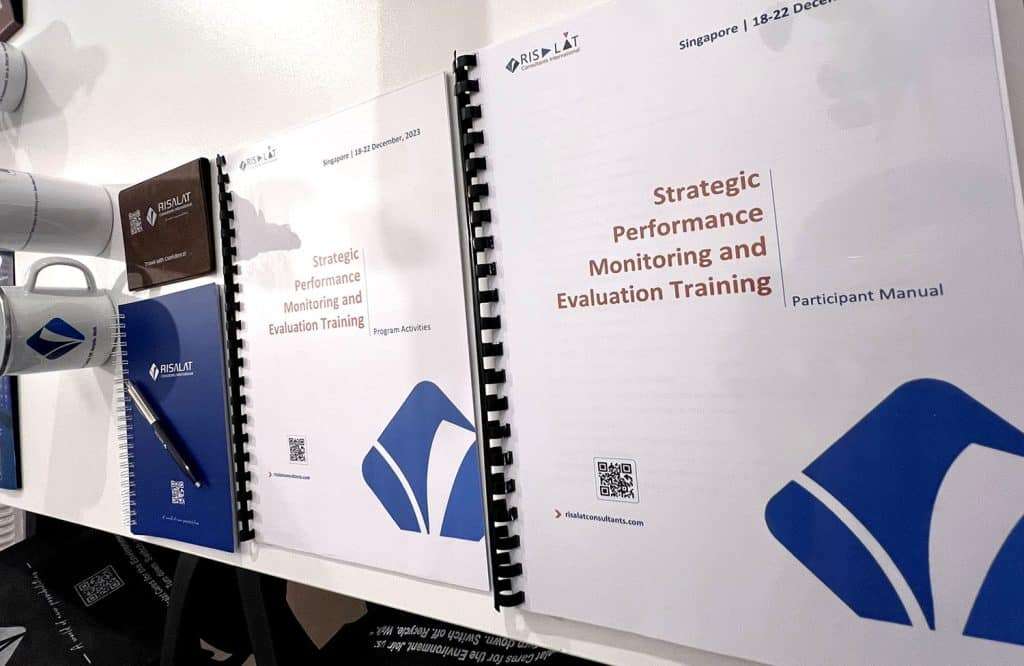
- Kit de formación de Risalat (bolsa, botella, taza, camiseta, gorra, funda de pasaporte, bolígrafos, cuaderno, imán y llavero)
- Comprehensive M&E Training Manual
- Plantilla de teoría del cambio
- Results Framework Matrix
- Plantilla de ficha de referencia de indicadores
- Lista de verificación de la calidad de los datos
- Plantilla de panel de desempeño
- Evaluation Terms of Reference Outline
- M&E Budget Template
- Talleres prácticos y simulaciones
- Debates en grupo y aprendizaje entre pares
- Almuerzo y refrigerios diarios
- Acceso completo a las instalaciones de la sede de formación
- Mini Pad / tableta con materiales didácticos digitales
- Visita de campo (cuando proceda)
- Recorrido turístico por la ciudad
Después del programa
- Certificado de finalización
- Reconocimiento a la participación en programas de Risalat
- Materiales de consulta posteriores a la formación
- Draft M&E Plan for the Participant’s Programme
- Seguimiento de respuestas de gestión
- Summary of OECD DAC Criteria and UNEG Norms
- Apoyo posterior a la formación y orientación de seguimiento
- Informe del programa
Ministries, agencies, project implementation units and NGOs can request a tailored proposal for an in-house version of this programme, adapted to their programmes, financier requirements and reporting systems.
Common Challenges in Strategic Performance Monitoring and Evaluation, And How This Training Helps
How can we stop M&E from becoming a reporting exercise only?
El primer día vincula el seguimiento y la evaluación con las decisiones a través de la gestión basada en resultados y una teoría del cambio, y el quinto día establece las respuestas de gestión para que las conclusiones conduzcan a la acción.
How do we choose indicators that are meaningful and measurable?
The Second Day covers indicator selection, reference sheets, baselines and targets, using the EU common indicator approach and participants’ own programmes.
How can we trust the data we report?
Data quality assessment, verification and data management roles are covered on the Third Day, with a checklist participants can apply immediately.
How do we present performance information that managers actually use?
The Third Day dashboard workshop tests whether a director can make a decision from one page in five minutes.
How can we evaluate with a limited budget and limited data?
The Fourth Day compares evaluation designs against budget, time and data limits, and shows how evaluability assessment avoids costly evaluations that cannot answer their questions.
How do we show value for money?
Cost-effectiveness and cost-benefit tools are practised on the Fourth Day, with Spain’s spending reviews as a reference for linking evaluation to budget decisions.
How should indicators change when a programme is reprogrammed?
El estudio de caso del segundo día sobre los programas de cohesión de la UE y la revisión de mitad de periodo de 2025 muestra cómo revisar los objetivos sin perder la lógica de resultados.
How do we resource the M&E function?
The Fifth Day covers M&E budgets, staffing and capacity plans, and the capstone includes a costed plan for each participant’s programme.
Preguntas frecuentes
Who should attend this M&E training?
M&E managers and officers, project and programme managers, PIU coordinators, planning and budget officers, EU funds staff, NGO MEAL staff and evaluators.
¿Qué marcos utiliza el programa?
The revised OECD DAC evaluation criteria adopted in 2019, the UNEG Norms and Standards for Evaluation (2016), World Bank results framework guidance and the EU cohesion policy performance framework.
¿Por qué el programa se lleva a cabo en Valencia?
Spain has institutionalised policy evaluation through Law 27/2022 and a new State Evaluation Agency, AIReF runs spending reviews, and the Comunitat Valenciana manages a large ERDF programme, so participants see these systems at work.
Will we work on our own programmes?
Yes. Participants apply each tool to their own programme or project and leave with a draft M&E plan, including a results framework, dashboard and evaluation plan.
¿Puede impartirse el programa de forma interna?
Yes. Institutions can request a tailored version adapted to their programmes, financier requirements and reporting systems.
Who Will Deliver This Programme
Each date is delivered by a team assigned from Risalat's expert network for this subject. For this programme we assign:
How we choose them: Experience in the region of the participants or comparable settings; Command of the financier rules that apply (World Bank, ADB, AfDB, EU, UN) where relevant; Delivery in English; other languages on request for in-house groups; No conflict of interest with participants' institutions.
Training courses in ValenciaM&E & Performance Management training courses
Why Valencia for this programme
Valencia, Spain, was chosen for this programme because it is easy to reach for the participants we expect and has suitable venues for practical, interactive training.
The Strategic Performance Monitoring & Evaluation Training in Valencia programme in February 2027 brings together officials and professionals. Sessions combine short inputs, case studies and group work on participants' own files, and the city's institutions can be added as a study visit on request.
Compruebe si necesita visado con el Verificador de visados gratuito y solicite una carta de invitación una vez inscrito.
El mismo tema en otras ciudades
- Mini Degree in Environmental and Social Safeguards in Istanbul (Istanbul)
- Digital Government and Citizen e-Services Training for North African Officials in Sliema (Sliema)
- Mini Degree in Leadership and Public Policy in London (London)
- Digital Government and Citizen e-Services Training for North African Officials in St Julian’s (St Julian's)
- Mini Degree in Digital Government and AI in Tallinn (Tallinn)
- Mini Degree in Donor-Funded Project Management in Dubai (Dubai)
Relacionado: Seguimiento, evaluación y aprendizaje · Constructor de fichas de referencia de indicadores gratuito · todos los programas
For teams and institutions
Bring your team
Teams that learn together apply more at work. Tell us how many people and how you would like to take part: we reply with a group quote within two working days.
Watch: this programme in short



Otras fechas y ciudades para este tema: Cursos de capacitación en seguimiento y evaluación (59 próximas fechas).
Más cursos de formación en España · Todos los programas en Europa · Calendario de formación completo
Planificar este programa en una hoja de ruta: por qué es importante, por qué aprobarlo, las fechas a planificar y la carrera que construye.