Points clés
- Dates
- 8–12 févr. 2027 (5 jours)
- Lieu
- NH Valencia Center, Valencia, Spain
- Frais par participant
- 3 950 £ (GBP)
- Paiement
- Sur facture et par virement bancaire
- Clôture des inscriptions
- 20 déc. 2026
- Format
- 5-day short course: a practical capacity-building programme for government, NGO and project teams in Valencia
- Certificat
- Certificat de participation
- Option intra
- Organisez-le pour votre équipe, à vos dates
Sur cette page 15 sections
Présentation du programme
Every programme, project and public policy promises change. Knowing whether that change is happening, for whom and at what cost is harder. Many organisations collect data mainly to report upward, while decisions on budgets, priorities and course corrections are made with little evidence. Strategic performance monitoring and evaluation (M&E) closes that gap by linking objectives, indicators, data and decisions in one system.
The reference points have moved. The OECD Development Assistance Committee adopted revised evaluation criteria in December 2019, adding coherence to relevance, effectiveness, efficiency, impact and sustainability. The UN Evaluation Group’s Norms and Standards, updated in 2016, set expectations on independence, utility, credibility and ethics. Financiers such as the World Bank expect a clear results framework with baselines, targets and a monitoring plan for every operation.
Spain offers a timely benchmark. Law 27/2022 institutionalised public policy evaluation in the central administration, and in February 2026 a royal decree approved the statute of the new State Agency for Public Policy Evaluation. The Independent Authority for Fiscal Responsibility (AIReF) is running a multi-year spending review cycle for 2022-2026, and regional authorities such as the Generalitat Valenciana manage EU cohesion programmes under a performance framework with common indicators and published targets.
This five-day programme in Valencia gives managers and M&E professionals a complete, practical toolkit: from theory of change and results frameworks to indicators, data systems, evaluation design, cost-effectiveness and reporting that informs decisions. Real reforms and financed programmes are used as case material throughout.
Risalat Consultants International (RCI) works alongside ministries, agencies, project implementation units and NGOs to build M&E systems that are proportionate, credible and used.
The Programme Strengthens Institutional Capability
- Theory of change and results chain design
- Results frameworks and logical frameworks
- Sélection des indicateurs, définitions et fiches de référence
- Baselines, milestones and targets
- Data collection planning and quality assurance
- Échantillonnage pour les enquêtes et le suivi
- Dashboards and performance reporting
- Evaluation design using the OECD DAC criteria
- Évaluation de l'évaluabilité et questions d'évaluation
- Cost-effectiveness and value-for-money analysis
- Impact evaluation options and their limits
- Budgétisation et dotation en personnel pour le suivi et l'évaluation
- Stakeholder participation and accountability
- Evaluation ethics and independence
- Management response and follow-up of recommendations
- Lier l'information sur la performance aux budgets
Participants work on their own programme or project throughout the week and leave with a draft M&E plan.
The Growing Importance of Strategic Performance Monitoring and Evaluation
Public budgets are under pressure and scrutiny is rising. In Spain, AIReF’s spending review cycle has covered areas such as financial instruments for productive sectors, the minimum income scheme, temporary disability benefits and official development assistance, and in April 2026 the government added employment policies and parts of the 2014-2020 ERDF multi-regional programme. Each review asks the same question managers face: is this spending achieving its objectives efficiently?
EU cohesion policy shows the same shift. For 2021-2027 the Commission sets common output and result indicators, publishes programme targets on its Cohesion Open Data platform and updated its performance guidance in February 2025. The mid-term review regulations adopted in September 2025 allow programmes to redirect funds to new priorities such as housing, water resilience, energy transition and defence, which means indicators, targets and evaluation plans must be revised mid-course.
Les organisations ont de plus en plus besoin de professionnels capables de :
- Building a theory of change that people actually use
- Designing results frameworks with measurable indicators
- Setting realistic baselines, milestones and targets
- Planning data collection, verification and storage
- Producing dashboards that support decisions
- Commissioning and managing evaluations
- Applying the OECD DAC criteria in evaluation questions
- Choosing between impact evaluation designs
- Assessing cost-effectiveness and value for money
- Budgeting and staffing an M&E function
- Revising indicators when programmes are reprogrammed
- Writing findings that lead to management action
Strong M&E systems help organisations:
- Detect problems early and correct course
- Allocate budgets to what works
- Démontrer les résultats aux bailleurs de fonds et aux citoyens
- Meet reporting obligations without duplicating effort
- Learn from success and failure
- Improve the quality of new programme design
- Strengthen accountability and trust
- Se préparer aux audits et aux examens des dépenses
Good M&E is proportionate. The aim is not more data but better decisions, made at the right time by the people responsible.
Who Should Attend This Strategic Performance M&E Training?
Ce programme s'adresse à :
- Gestionnaires, responsables et spécialistes du S&E
- Gestionnaires de projets et de programmes
- Project implementation unit coordinators
- Planning and strategy directors
- Performance and results officers in ministries
- Budget and finance officers working on performance budgeting
- Policy analysts and evaluation unit staff
- EU funds managing authority and intermediate body staff
- Donor and development agency programme staff
- NGO programme and MEAL staff
- Internal auditors and inspectors
- Researchers and independent evaluators
- Executive managers who use performance data
Mixed teams of managers, M&E staff and finance officers gain most, because they can agree on one results framework and one reporting cycle.
Cochez ce que votre équipe doit être capable de faire.
Strategic Performance M&E Training Objectives
Upon successful completion of this Strategic Performance M&E Training, participants will be able to:
- Build a theory of change and results chain for a programme or policy
- Concevoir un cadre de résultats doté d'indicateurs clairs, de situations de référence et de cibles
- Write indicator reference sheets that ensure consistent measurement
- Plan data collection, sampling and data quality checks
- Design a simple performance dashboard for managers
- Frame evaluation questions using the revised OECD DAC criteria
- Apply the UNEG Norms and Standards to evaluation management
- Compare impact evaluation options under budget, time and data limits
- Assess cost-effectiveness and value for money
- Préparer un budget de S&E et un plan de dotation en personnel
- Report findings and track management responses
Each objective is practised on participants’ own programmes, so tools are tested before they are taken home.
Source: Valencia Plaza, presentation of the ERDF 2021-2027 programme by the Generalitat (March 2023)
1. Which criterion was added when the OECD DAC revised its evaluation criteria in 2019?
Les critères révisés adoptés par le CAD en décembre 2019 ont apporté de la cohérence aux cinq critères existants (OCDE, Critères améliorés pour une meilleure évaluation).
2. Which Spanish body carries out the 2022-2026 spending review cycle?
Spain's Ministry of Finance states that AIReF carries out the 2022-2026 spending review, with Phase III authorised in April 2026.
3. How many general norms do the UNEG Norms and Standards for Evaluation (2016) set out?
The 2016 UNEG document sets ten general norms, such as utility, credibility and independence, plus four institutional norms.
Contenu et structure du programme
- Principles of results-based management
- Monitoring, evaluation, review and audit compared
- The project and policy cycle and where M&E fits
- Theory of change: pathways, assumptions and risks
- Results chains: inputs, activities, outputs, outcomes, impact
- Logical framework and its limits
- Linking strategic plans to programme results
- From theory of change to results framework
- Selecting indicators: relevance, clarity and cost
- Output, outcome and impact indicators
- Indicator reference sheets and definitions
- Baselines, milestones and targets
- Disaggregation by sex, age, location and disability
- Indicateurs communs dans les programmes de cohésion de l'UE
- Planning data collection: who, what, when and how
- Méthodes quantitatives et qualitatives
- Administrative data and its quality
- Sampling basics for surveys and monitoring
- Data quality assessment and verification
- Data protection and ethics in data collection
- Data storage, management and roles
- The revised OECD DAC criteria, including coherence
- UNEG Norms and Standards for evaluation
- Évaluation de l'évaluabilité et questions d'évaluation
- Formative, summative and real-time evaluation
- Impact evaluation designs and their limits
- Cost-effectiveness and cost-benefit analysis
- Examens des dépenses : l'approche de l'AIReF
- Writing evaluation and monitoring reports that are read
- Presenting data to different audiences
- Management response and tracking recommendations
- Lier l'information sur la performance aux budgets
- Revues d'apprentissage et gestion adaptative
- M&E budgets, staffing and capacity plans
- Participatory and accountability approaches
Contenu détaillé jour par jour
The week moves from strategy and design to data, evaluation and use.
- Day 1: results-based management and theory of change
- Day 2: results frameworks and indicators
- Day 3: data systems, sampling and dashboards
- Day 4: evaluation design, criteria and value for money
- Day 5: reporting, use and the M&E plan
Contenu détaillé jour par jour
First Day | Results-Based Management and Theory of Change
- Principles of results-based management
- Monitoring, evaluation, review and audit compared
- The project and policy cycle and where M&E fits
- Theory of change: pathways, assumptions and risks
- Results chains: inputs, activities, outputs, outcomes, impact
- Logical framework and its limits
- Linking strategic plans to programme results
- Stakeholder mapping for M&E
- Spain’s Law 27/2022 and the new State Evaluation Agency
Workshop: Building a Theory of Change
Participants draft a theory of change for their own programme or policy, showing the pathway from activities to long-term results and the assumptions that must hold. Peers test each pathway for gaps and risks, and the facilitator links the results to the eight-step results framework approach described in World Bank Independent Evaluation Group guidance.
Second Day | Results Frameworks, Indicators and Targets
- From theory of change to results framework
- Selecting indicators: relevance, clarity and cost
- Output, outcome and impact indicators
- Indicator reference sheets and definitions
- Baselines, milestones and targets
- Disaggregation by sex, age, location and disability
- Indicateurs communs dans les programmes de cohésion de l'UE
- Revising indicators after reprogramming
- Avoiding perverse incentives and gaming
Case Study: Indicators in the Comunitat Valenciana ERDF Programme
Using the public programme for the Comunitat Valenciana ERDF 2021-2027, with more than EUR 1.19 billion across digital transition, energy efficiency and social inclusion, teams examine how priorities connect to indicators and targets. They then consider what would need to change if funds were moved to new priorities under the 2025 mid-term review.
Third Day | Data Systems, Sampling and Dashboards
- Planning data collection: who, what, when and how
- Méthodes quantitatives et qualitatives
- Administrative data and its quality
- Sampling basics for surveys and monitoring
- Data quality assessment and verification
- Data protection and ethics in data collection
- Data storage, management and roles
- Designing dashboards for decision-makers
- Using open data and published targets
Workshop: Designing a Performance Dashboard
Teams build a one-page dashboard for a senior management meeting using a set of programme indicators. They choose what to show, set traffic-light thresholds, add short narrative explanations and test whether a director could make a decision from the page in five minutes. Each team also lists the data quality checks behind every figure.
Fourth Day | Evaluation Design, Criteria and Value for Money
- The revised OECD DAC criteria, including coherence
- UNEG Norms and Standards for evaluation
- Évaluation de l'évaluabilité et questions d'évaluation
- Formative, summative and real-time evaluation
- Impact evaluation designs and their limits
- Cost-effectiveness and cost-benefit analysis
- Examens des dépenses : l'approche de l'AIReF
- Commissioning and managing external evaluators
- Ethics, independence and minimising bias
Case Study: Spending Review and Evaluation in Spain
S'appuyant sur le cycle d'examen des dépenses 2022-2026 de l'Espagne mené par l'AIReF et sur les obligations d'évaluation fixées par la loi 27/2022, les équipes conçoivent des questions d'évaluation pour un domaine de dépenses publiques de leur choix. Elles associent chaque question aux critères du CAD, sélectionnent une méthode réalisable et estiment le coût et la durée de l'évaluation.
Fifth Day | Reporting, Learning and the M&E Plan
- Writing evaluation and monitoring reports that are read
- Presenting data to different audiences
- Management response and tracking recommendations
- Lier l'information sur la performance aux budgets
- Revues d'apprentissage et gestion adaptative
- M&E budgets, staffing and capacity plans
- Participatory and accountability approaches
- Recovery and reconstruction monitoring: lessons from Valencia
- Capstone presentations and action planning
Capstone Exercise: A Complete M&E Plan
Each participant or team presents an M&E plan for their own programme: theory of change, results framework, three indicator reference sheets, a data collection plan, a dashboard mock-up, an evaluation plan and an M&E budget. Peers and the facilitator review each plan against the UNEG Norms and the DAC criteria, and participants leave with a revised version.
Strategic Performance M&E Training Methodology
The programme is applied and evidence-based. Short inputs are followed by exercises on participants’ own programmes, using real reforms and financed programmes as reference cases.
Le programme associe :
- Courtes présentations d'experts
- Work on participants’ own programmes
- Études de cas sur les réformes espagnoles et de l'UE
- Group exercises on theory of change and indicators
- Spreadsheet exercises on targets and cost-effectiveness
- Dashboard design practice
- Peer review of results frameworks
- Evaluation design simulations
- Templates and checklists for immediate use
- Daily feedback and reflection
- Plan d'action pour l'organisation du participant
Before the programme, participants can complete RCI’s free M&E and MEAL Assessment to benchmark their current system. The results help facilitators adapt examples to the group.
- Intrants
- Activités
- Produits
- Effets
- Impact
Résultats attendus
Upon completion of this Strategic Performance M&E Training, participants will be able to:
- Piloter la conception d'une théorie du changement et d'un cadre de résultats
- Define indicators that can be measured consistently
- Plan data collection and quality assurance
- Present performance information in a clear dashboard
- Commission and manage evaluations to recognised standards
- Assess value for money using simple cost-effectiveness tools
- Budget and staff an M&E function realistically
- Turn findings into management action
- Implement an M&E improvement plan
These outcomes help institutions make better use of public and donor funds and report results with confidence.
3 950 £ par participant · facture et virement bancaire · réduction pour les groupes de 5 personnes ou plus
Cinq personnes ou plus d'une même organisation : demandez le tarif de groupe lors de votre demande de facture.
Ten or more: an in-house version for your institution may cost less per person. Ask for an in-house quote.
Registration closes in 28 days (20 Dec 2026)
Institutional Application of Strategic Performance M&E Training
Ce programme aide les organisations à renforcer :
- Results-based planning and budgeting
- Theories of change for strategies and programmes
- Results frameworks and indicator systems
- Data quality and management
- Performance dashboards and reporting cycles
- Evaluation policies and plans
- Evaluation commissioning and quality assurance
- Management response systems
- Value-for-money assessment
- M&E staffing, budgets and roles
- Stakeholder participation and accountability
Les participants repartent avec des outils pratiques pour améliorer :
- Theory of change template
- Results framework matrix
- Indicator reference sheet
- Data collection and sampling plan
- Data quality checklist
- Dashboard template
- Evaluation terms of reference outline
- M&E budget template
- Management response tracker
For a wider view of delivery risks, organisations can combine the programme with RCI’s Project Health Check, which reviews schedule, budget, procurement and results performance together.
Pertinence régionale & mise en application
Europe
EU member states manage 2021-2027 cohesion programmes under a performance framework with common indicators, and the 2025 mid-term review requires many programmes to revise priorities and targets. Spain’s new evaluation agency and AIReF spending reviews give European participants a practical comparison.
Afrique
Ministries and project implementation units in Africa manage World Bank, AfDB and other financed operations that require results frameworks, regular progress reports and independent evaluations. The sessions on indicators, data quality and M&E budgeting address common reporting gaps.
Moyen-Orient
Governments in the Middle East are linking national visions and strategies to performance targets and dashboards. The programme helps teams connect strategic goals to measurable programme results.
Asie
Asian governments and development partners increasingly use results-based financing and performance budgeting, which depend on reliable indicators and verification. The data quality and value-for-money sessions apply directly.
Amérique latine
Latin American countries have long experience with national evaluation systems and performance budgeting. Participants can compare these with Spain’s newer evaluation agency and the EU approach.
Dans toutes les régions, la même discipline s'applique : une logique claire, un petit ensemble de bons indicateurs, des données fiables et des évaluations que les gens utilisent.
Profil du pays d'accueil – Espagne
Spain is a parliamentary monarchy and a founding member of the euro area, organised in 17 autonomous communities and two autonomous cities. Valencia, its third-largest city, combines a historic centre with modern conference facilities, good transport and a Mediterranean climate that makes it a comfortable place to learn.
Spain is a useful benchmark for strategic M&E. Law 27/2022 institutionalised policy evaluation in the central administration, and the statute of the State Agency for Public Policy Evaluation, in force since February 2026, gives it duties on methodology, ex ante evaluation, strategic evaluation plans and training. AIReF’s spending reviews link evaluation to budget decisions. In the Comunitat Valenciana, the Generalitat manages an ERDF programme of more than EUR 1.19 billion for 2021-2027 with a published evaluation plan, and the region is recovering from the October 2024 floods with support that includes EUR 846 million from the EU Solidarity Fund approved in June 2026, which raises practical questions about tracking reconstruction results.
Valencia airport and high-speed rail connect the city with Madrid, Barcelona and many European cities. Spain applies Schengen visa rules: many nationalities can visit visa-free for short stays, while others need a Schengen visa obtained in advance from a Spanish consulate. RCI provides invitation letters and visa advice to registered participants.
Strategic Performance M&E Training Deliverables
Every deliverable supports the participant’s own M&E plan, so that the work started in Valencia continues after the programme.
Avant le programme
- Pré-évaluation des participants
- M&E Readiness Assessment
- M&E Resource Pack
- Lectures préparatoires
- Aide et conseils gratuits pour le visa
Pendant le programme
- Accueil à l'aéroport & assistance à l'arrivée
- Accommodation with breakfast: 6 nights, check-in Sunday 7 February 2027, check-out Saturday 13 February 2027 (one night before and one night after the programme)
- Dîner de bienvenue et de réseautage
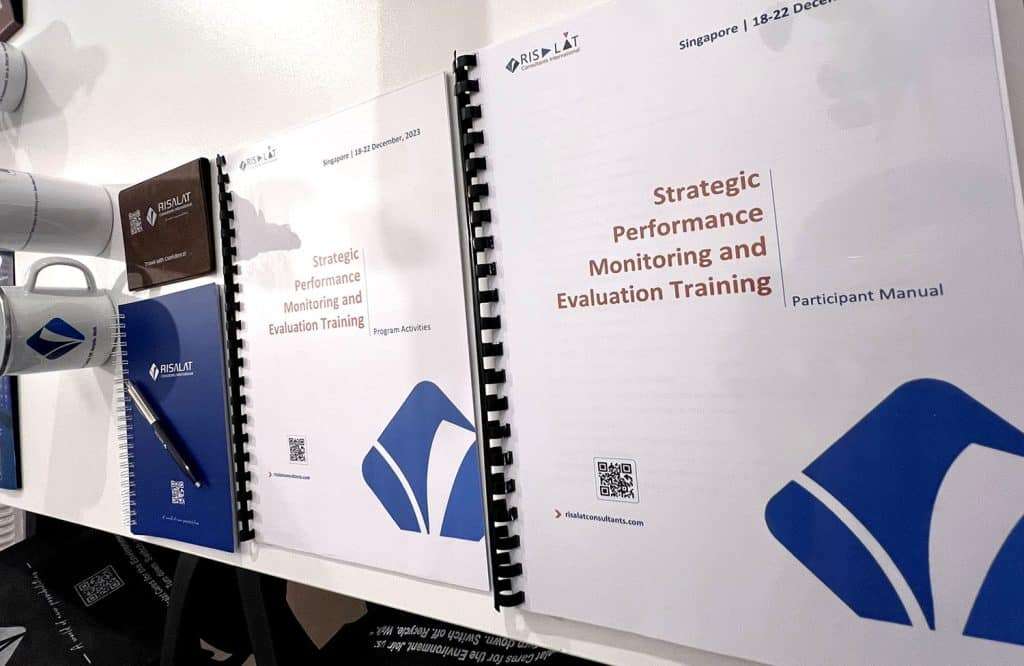
- Kit de formation Risalat (sac, gourde, mug, t-shirt, casquette, protège-passeport, stylos, carnet, magnet & porte-clés)
- Comprehensive M&E Training Manual
- Modèle de théorie du changement
- Results Framework Matrix
- Modèle de fiche de référence des indicateurs
- Liste de contrôle de la qualité des données
- Modèle de tableau de bord de la performance
- Evaluation Terms of Reference Outline
- M&E Budget Template
- Ateliers pratiques & simulations
- Discussions de groupe & apprentissage entre pairs
- Déjeuner et pauses-café quotidiens
- Accès complet aux installations du lieu de formation
- Mini tablette avec supports pédagogiques numériques
- Visite de terrain (le cas échéant)
- Visite récréative de la ville
Après le programme
- Certificat de participation
- Distinction Risalat de participation au programme
- Documents de référence après la formation
- Draft M&E Plan for the Participant’s Programme
- Suivi des réponses de la direction
- Summary of OECD DAC Criteria and UNEG Norms
- Accompagnement après la formation & conseils de suivi
- Rapport du programme
Les ministères, agences, unités d'exécution de projets et ONG peuvent demander une proposition sur mesure pour une version interne de ce programme, adaptée à leurs programmes, aux exigences des bailleurs de fonds et à leurs systèmes de reporting.
Common Challenges in Strategic Performance Monitoring and Evaluation, And How This Training Helps
How can we stop M&E from becoming a reporting exercise only?
The First Day links M&E to decisions through results-based management and a theory of change, and the Fifth Day sets up management responses so findings lead to action.
Comment choisir des indicateurs qui ont du sens et qui sont mesurables ?
The Second Day covers indicator selection, reference sheets, baselines and targets, using the EU common indicator approach and participants’ own programmes.
How can we trust the data we report?
Les rôles d'évaluation de la qualité des données, de vérification et de gestion des données sont abordés le troisième jour, avec une liste de contrôle que les participants peuvent appliquer immédiatement.
How do we present performance information that managers actually use?
The Third Day dashboard workshop tests whether a director can make a decision from one page in five minutes.
How can we evaluate with a limited budget and limited data?
The Fourth Day compares evaluation designs against budget, time and data limits, and shows how evaluability assessment avoids costly evaluations that cannot answer their questions.
How do we show value for money?
Cost-effectiveness and cost-benefit tools are practised on the Fourth Day, with Spain’s spending reviews as a reference for linking evaluation to budget decisions.
How should indicators change when a programme is reprogrammed?
The Second Day case study on EU cohesion programmes and the 2025 mid-term review shows how to revise targets without losing the results logic.
Comment doter en ressources la fonction de suivi et d'évaluation (M&E) ?
The Fifth Day covers M&E budgets, staffing and capacity plans, and the capstone includes a costed plan for each participant’s programme.
Questions fréquentes
Who should attend this M&E training?
M&E managers and officers, project and programme managers, PIU coordinators, planning and budget officers, EU funds staff, NGO MEAL staff and evaluators.
Quels cadres de référence le programme utilise-t-il ?
The revised OECD DAC evaluation criteria adopted in 2019, the UNEG Norms and Standards for Evaluation (2016), World Bank results framework guidance and the EU cohesion policy performance framework.
Why is the programme held in Valencia?
Spain has institutionalised policy evaluation through Law 27/2022 and a new State Evaluation Agency, AIReF runs spending reviews, and the Comunitat Valenciana manages a large ERDF programme, so participants see these systems at work.
Will we work on our own programmes?
Yes. Participants apply each tool to their own programme or project and leave with a draft M&E plan, including a results framework, dashboard and evaluation plan.
Le programme peut-il être dispensé en intra ?
Yes. Institutions can request a tailored version adapted to their programmes, financier requirements and reporting systems.
Who Will Deliver This Programme
Each date is delivered by a team assigned from Risalat's expert network for this subject. For this programme we assign:
How we choose them: Experience in the region of the participants or comparable settings; Command of the financier rules that apply (World Bank, ADB, AfDB, EU, UN) where relevant; Delivery in English; other languages on request for in-house groups; No conflict of interest with participants' institutions.
Training courses in ValenciaM&E & Performance Management training courses
Why Valencia for this programme
Valence, en Espagne, a été choisie pour ce programme car elle est facile d'accès pour les participants attendus et dispose de sites adaptés à une formation pratique et interactive.
The Strategic Performance Monitoring & Evaluation Training in Valencia programme in February 2027 brings together officials and professionals. Sessions combine short inputs, case studies and group work on participants' own files, and the city's institutions can be added as a study visit on request.
Vérifiez si vous avez besoin d'un visa avec le vérificateur de visa gratuit, et demandez une lettre d'invitation une fois inscrit.
Le même thème dans d'autres villes
- Mini Degree in Environmental and Social Safeguards in Istanbul (Istanbul)
- Digital Government and Citizen e-Services Training for North African Officials in Sliema (Sliema)
- Mini Degree in Leadership and Public Policy in London (London)
- Digital Government and Citizen e-Services Training for North African Officials in St Julian’s (St Julian's)
- Mini Degree in Digital Government and AI in Tallinn (Tallinn)
- Mini Degree in Donor-Funded Project Management in Dubai (Dubai)
Voir aussi : Suivi, évaluation et apprentissage · générateur gratuit de fiches de référence des indicateurs · tous les programmes
Pour les équipes et les institutions
Bring your team
Teams that learn together apply more at work. Tell us how many people and how you would like to take part: we reply with a group quote within two working days.
Watch: this programme in short



Other dates and cities for this subject: Monitoring and Evaluation training courses (59 upcoming dates).
Plus de formations en Espagne · Tous les programmes en Europe · Calendrier complet des formations
Plan this programme in a roadmap: why it matters, why to approve it, the dates to plan and the career it builds.