Datos clave
- Fechas
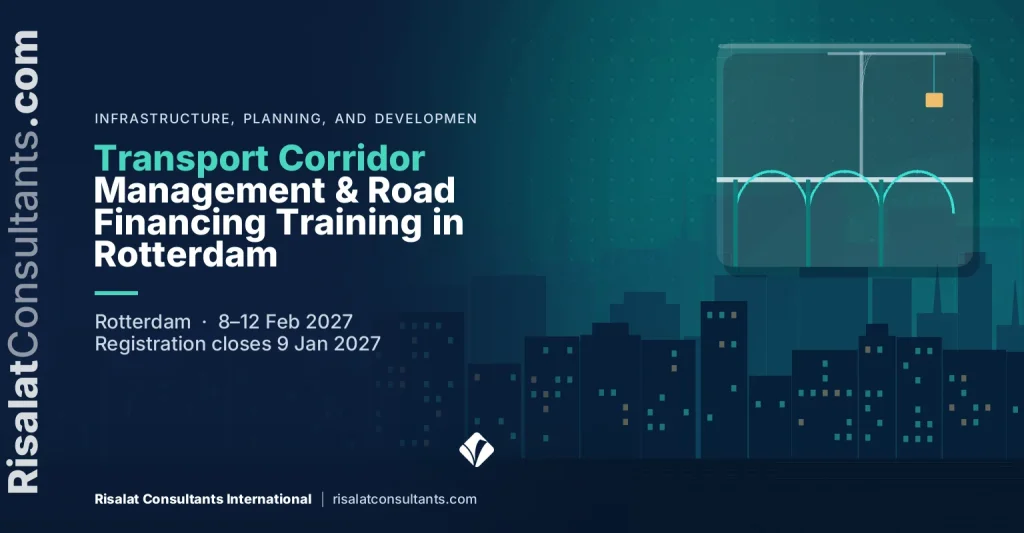
- 8–12 feb 2027 (5 días)
- Dónde
- Shared on registration, Rotterdam, Netherlands
- Tarifa por participante
- 3.630 £ (GBP)
- Pago
- Mediante factura y transferencia bancaria
- Cierre de inscripciones
- 9 ene 2027
- Certificado
- Certificado de finalización
- Opción interna
- Impártalo para su equipo, en sus fechas
En esta página 16 secciones
Descripción del programa
A resurfaced highway does little for trade if trucks still queue for days at a border, if overloaded vehicles break up the pavement within a few seasons, or if the road fund cannot pay for maintenance. Transport Corridor Management & Road Financing Training in Rotterdam is a five-day programme for the institutions that must make a corridor work as one system: road agencies, road funds, transport ministries, safety regulators, border agencies and the project implementation units (PIUs) of financed corridor projects.
The programme is designed around the World Bank-financed Transport Corridors for Economic Resilience (TRACER) project in Zambia (P180801), a US$270 million IDA grant approved in February 2024 with an expected closing date of 27 February 2030. Its Project Appraisal Document describes familiar problems: trucks waiting up to four days at the Nakonde border, which handles about a fifth of Zambia’s customs consignments; a road fund that collects only about 20 percent of estimated annual maintenance needs; and floods that have cut access on the Serenje–Mpika section for one to two weeks at a time.
TRACER goes beyond civil works: 203 km of climate-resilient rehabilitation, a one-stop border post (OSBP) at Nakonde, a SMART corridor sub-component, and US$15 million under Component 3 for sectoral capacity development, including capacity building for the Road Development Agency (RDA), the National Road Fund Agency (NRFA), the Ministry of Transport and Logistics (MTL) and the Road Transport and Safety Agency (RTSA), and public-private partnership (PPP) enabling work.
Rotterdam gives participants a working benchmark: a port at the northern end of the Rhine-Alpine corridor, structured national road asset management and, since July 2026, a distance-based truck charge. Participants study these systems critically and adapt what fits.
Every day ends with a practical exercise, and on the Fifth Day each team presents a corridor performance and financing action plan for its own agency or PIU.
The Programme Strengthens Institutional Capability
- Corridor performance indicators: travel time, border clearance time and cost
- Border waiting time measurement and time release studies
- One-stop border post operating models and joint controls
- Axle-load control strategy, weighbridges and weigh-in-motion screening
- Road fund revenue analysis: fuel levies, tolls and border fees
- Maintenance needs assessment and funding gap analysis
- Road asset management systems, condition data and life-cycle planning
- PPP enabling environment, project screening and fiscal risk
- Climate risk screening and resilient design standards for corridors
- Environmental and social risk management under the World Bank ESF
- Resettlement, labour influx and SEA/SH risk on corridor works
- PIU planning, procurement and contract supervision
Participants leave able to describe their corridor in numbers, show where time and money are lost, and defend a realistic plan to fix both.
The Growing Importance of Transport Corridor Management and Road Financing
Financiers now treat corridors as systems. TRACER’s results framework targets a fall in truck travel time between Dar es Salaam and Lusaka from 74 to 51.5 hours, in truck clearance time at Nakonde from 39 to 18 hours, and in small-trader crossing time from 20 hours to 2, alongside 80 government staff trained.
Neighbouring corridors face similar pressures. The World Bank’s Southern Africa Trade and Connectivity Project (P164847), US$380 million for Malawi and Mozambique on the Nacala corridor, was rated Moderately Unsatisfactory in April 2025 with about a third disbursed and a June 2027 closing date. At Nakonde, a UK-funded US$12 million first phase of upgrades, implemented with TradeMark Africa, opened in March 2026. These investments pay off only if the institutions behind the corridor can measure, finance and maintain it.
Las organizaciones necesitan cada vez más profesionales capaces de:
- Defining and tracking corridor performance indicators that financiers accept
- Running time release studies at border crossings
- Designing OSBP procedures with partner-country agencies
- Setting axle-load enforcement strategies backed by reliable data
- Building road fund revenue models and testing charging options
- Estimating maintenance needs from condition data
- Screening road projects for PPP suitability and fiscal exposure
- Applying climate risk screening to corridor design and maintenance
- Managing high-risk environmental and social obligations on works contracts
- Coordinating several agencies within one PIU
Strong corridor management and road financing systems help organisations:
- Reduce transit times and transport costs for traders
- Protect new pavements from early failure caused by overloading
- Close the gap between maintenance needs and available funds
- Use tolls and border fees well as revenue sources
- Attract private investment on a sound fiscal basis
- Keep corridors open during floods and extreme weather
- Lower road deaths on high-risk sections
- Meet financier requirements on safeguards and results
Agencies that can show what a corridor costs, earns and delivers are better placed to secure budgets and plan the next phase of investment.
Who Should Attend This Transport Corridor Management Training?
Este programa está dirigido a:
- Directors and senior engineers of road development agencies
- Planning, asset management and maintenance managers
- Road fund executives, revenue and finance officers
- Transport ministry policy and planning officers
- Road safety and transport regulator staff
- Axle-load control and weighbridge managers
- Customs, immigration and border management officers
- Trade facilitation and single window coordinators
- PPP unit and ministry of finance officials
- Project coordinators and PIU managers of corridor projects
- PIU procurement, financial management and M&E specialists
- Environmental, social and OHS specialists on road works
Mixed teams from the same corridor gain most, because they can agree shared indicators and responsibilities before returning home.
Marque lo que su equipo necesita ser capaz de hacer.
Transport Corridor Management Training Objectives
Upon successful completion of this Transport Corridor Management Training, participants will be able to:
- Design a corridor performance dashboard with travel time, clearance time and cost indicators
- Plan and interpret a border time release study
- Assess OSBP readiness and identify procedural bottlenecks
- Prepare an axle-load control strategy combining weighbridges, weigh-in-motion and enforcement
- Analyse road fund revenue and quantify the maintenance funding gap
- Use asset condition data to prioritise maintenance and rehabilitation
- Screen a road project for PPP suitability and contingent liabilities
- Apply climate risk screening to corridor design and maintenance planning
- Manage high environmental and social risks on corridor works under the World Bank ESF
- Set up PIU routines for procurement, supervision and results reporting
The objectives follow the problems in TRACER’s appraisal: slow borders, damaged pavements, underfunded maintenance, climate exposure and demanding safeguards.
Source: World Bank, TRACER Project Appraisal Document (P180801), results framework
1. According to TRACER's appraisal, what share of estimated annual road maintenance needs does Zambia's road fund collect?
The TRACER Project Appraisal Document states that NRFA collects only about 20 percent of the estimated annual resources required for maintenance.
2. How long could trucks wait at the Nakonde border crossing, according to the TRACER appraisal?
The appraisal notes waits of up to four days at Nakonde, which processes about 20 percent of Zambia's customs consignments.
3. How much does TRACER allocate to Component 3, sectoral capacity development and project management?
Component 3 is US$15 million, covering corridor management support, a railway strategy, studies and capacity building for RDA, NRFA, MTL and RTSA, and project management.
Contenido y estructura del programa
- What makes a corridor: infrastructure, services, procedures and institutions
- Corridor governance models: committees, secretariats and bilateral agreements
- Mapping agency mandates along a corridor: road, fund, regulator, border, rail
- Core indicators: travel time, border clearance time, transport cost and reliability
- Data sources: GPS truck data, border systems, traffic counts and surveys
- Setting baselines and targets the way financiers’ results frameworks do
- Reading the TRACER results framework: 74 to 51.5 hours, 39 to 18 hours
- Why trucks wait: documents, inspections, payments, parking and working hours
- Time release studies: method, sampling and interpreting the results
- OSBP legal frameworks, joint controls and shared facilities
- Case: Nakonde and Tunduma on the Dar es Salaam Corridor
- Scanners, smart gates and risk-based inspection
- Single windows, pre-arrival processing and electronic cargo tracking
- Small-scale cross-border traders, gender and simplified regimes
- How overloading shortens pavement life and raises maintenance costs
- Weighbridge networks, weigh-in-motion screening and site selection
- Enforcement modalities: fines, offloading, data sharing and integrity safeguards
- Harmonised regional axle-load limits and cross-border enforcement
- Road fund models: fuel levies, tolls, border fees and transit charges
- Estimating the maintenance funding gap from network and condition data
- Distance-based truck charging: design choices from the Dutch truck levy
- Road asset management principles: inventory, condition, risk and life-cycle cost
- Balancing performance, cost and risk: the Rijkswaterstaat approach
- Asset management systems and the ISO 55001 standard
- Performance-based and output-based maintenance contracts
- PPP enabling environment: policy, legal framework, project screening and fiscal risk
- Toll concessions and availability payments: when each fits
- Climate hazards on corridors: floods, erosion and extreme heat
- Why corridor works are often rated High E&S risk
- ESS1, ESS2, ESS4 and ESS5: assessment, labour, community safety and resettlement
- Labour influx and SEA/SH risk management on road contracts
- Occupational health and safety supervision on site
- PIU structures for multi-agency corridor projects
- Procurement planning, STEP and contract packaging
- Contract supervision, variations and payment control
Contenido completo día a día
The five days move from measuring corridor performance to financing, protecting and delivering it.
- First Day: corridor governance and performance measurement
- Second Day: borders, OSBPs and trade facilitation
- Third Day: axle-load control, road user charges and road fund revenue
- Fourth Day: asset management, PPPs and climate resilience
- Fifth Day: E&S risk, PIU delivery and the capstone plan
Contenido completo día a día
First Day | Corridor Governance and Performance Measurement
- What makes a corridor: infrastructure, services, procedures and institutions
- Corridor governance models: committees, secretariats and bilateral agreements
- Mapping agency mandates along a corridor: road, fund, regulator, border, rail
- Core indicators: travel time, border clearance time, transport cost and reliability
- Data sources: GPS truck data, border systems, traffic counts and surveys
- Setting baselines and targets the way financiers’ results frameworks do
- Reading the TRACER results framework: 74 to 51.5 hours, 39 to 18 hours
- Designing a corridor performance dashboard for ministers and partners
Workshop: Building a Corridor Performance Dashboard
Teams choose a corridor they work on, select the five indicators that matter most to traders and financiers, name the data source and owner for each, and draft a one-page dashboard with baselines and targets, tested against TRACER’s results framework.
Second Day | Border Crossings, OSBPs and Trade Facilitation
- Why trucks wait: documents, inspections, payments, parking and working hours
- Time release studies: method, sampling and interpreting the results
- OSBP legal frameworks, joint controls and shared facilities
- Case: Nakonde and Tunduma on the Dar es Salaam Corridor
- Scanners, smart gates and risk-based inspection
- Single windows, pre-arrival processing and electronic cargo tracking
- Small-scale cross-border traders, gender and simplified regimes
- Truck parking, staging areas and traffic management near borders
Case Study: Halving Clearance Time at a Busy Border
Using published figures for Nakonde, where TRACER targets a cut in truck clearance from 39 to 18 hours, teams map each step of a crossing, separate waiting from processing time, and propose sequenced procedural and digital measures with owners on both sides of the border.
Third Day | Axle-Load Control and Road Fund Revenue
- How overloading shortens pavement life and raises maintenance costs
- Weighbridge networks, weigh-in-motion screening and site selection
- Enforcement modalities: fines, offloading, data sharing and integrity safeguards
- Harmonised regional axle-load limits and cross-border enforcement
- Road fund models: fuel levies, tolls, border fees and transit charges
- Estimating the maintenance funding gap from network and condition data
- Distance-based truck charging: design choices from the Dutch truck levy
- Revenue forecasting, collection costs and leakage controls
Workshop: Closing a Road Fund Gap
Starting from the finding that the road fund collects about 20 percent of estimated maintenance needs, teams build a simple revenue and needs model, test better collection, adjusted charges and new instruments, and list the legal and institutional steps each requires.
Fourth Day | Asset Management, PPPs and Climate Resilience
- Road asset management principles: inventory, condition, risk and life-cycle cost
- Balancing performance, cost and risk: the Rijkswaterstaat approach
- Asset management systems and the ISO 55001 standard
- Performance-based and output-based maintenance contracts
- PPP enabling environment: policy, legal framework, project screening and fiscal risk
- Toll concessions and availability payments: when each fits
- Climate hazards on corridors: floods, erosion and extreme heat
- Resilient design standards, drainage and emergency access planning
Workshop: A Resilient Maintenance Plan for a Corridor Section
Teams prioritise works on a sample 200 km section using condition, traffic and flood exposure data, choose between conventional and performance-based contracts, test whether any part suits a PPP, and present a three-year plan with costs and funding sources.
Fifth Day | E&S Risk and PIU Delivery
- Why corridor works are often rated High E&S risk
- ESS1, ESS2, ESS4 and ESS5: assessment, labour, community safety and resettlement
- Labour influx and SEA/SH risk management on road contracts
- Occupational health and safety supervision on site
- PIU structures for multi-agency corridor projects
- Procurement planning, STEP and contract packaging
- Contract supervision, variations and payment control
- Results reporting, disbursement tracking and mid-term reviews
Capstone Exercise: Corridor Performance and Financing Action Plan
Each team presents a 12-month plan for its own corridor or project: indicators and baselines, border and axle-load measures, a road fund proposal, climate and E&S risk actions, and PIU responsibilities. Peers challenge the plan as a steering committee would.
- Fondos
- Entidad
- Proyecto
- Resultados
- MRV
Transport Corridor Management Training Methodology
The programme is practical and built on published project documents, with short inputs followed by group work on familiar corridors and data.
El programa combina:
- Expert briefings by transport, finance and safeguards practitioners
- Case studies from TRACER and other financed corridor projects
- Corridor performance dashboard and time release study templates
- Road fund revenue and maintenance needs modelling
- Axle-load enforcement scenario exercises
- Asset prioritisation using condition and traffic data
- PPP screening and fiscal risk checklists
- E&S risk and SEA/SH case discussions
- Benchmark sessions on Dutch port, corridor and road practice
- Peer exchange across agencies and countries
Participants bring a short note on one corridor or agency issue, which shapes the workshops and capstone plans.
Visitas técnicas y programa en terreno
Where hosts confirm availability, a half-day technical visit is added on a theme such as port-hinterland logistics, road traffic management or an inland terminal. Visits are arranged closer to the date and are not guaranteed; otherwise a benchmark session with practitioners is held at the venue.
Resultados esperados
Upon completion of this Transport Corridor Management Training, participants will be able to:
- Report corridor performance with clear, owned indicators
- Identify the main causes of border delay and propose sequenced remedies
- Recommend a credible axle-load control strategy
- Quantify a maintenance funding gap and options to reduce it
- Prioritise maintenance using asset data
- Judge whether a road project suits a PPP
- Manage high E&S risks on corridor contracts
- Run PIU routines that keep a corridor project on track
Teams also return with a draft action plan ready for their next implementation review.
3.630 £ por participante · factura y transferencia bancaria · los grupos de 5 o más personas reciben un descuento
Cinco o más personas de una misma organización: solicite la tarifa de grupo al pedir la factura.
Diez o más: una versión interna para su institución puede costar menos por persona. Solicite un presupuesto para una formación interna.
Las inscripciones se cierran en 64 días (9 ene 2027)
Institutional Application of Transport Corridor Management Training
Este programa ayuda a las organizaciones a fortalecer:
- Corridor coordination between road, border, safety and finance agencies
- Corridor performance monitoring and public reporting
- OSBP operations and joint border procedures
- Axle-load control policy and enforcement
- Road fund revenue management and forecasting
- Road asset management systems and data
- PPP preparation and fiscal risk review
- Climate-resilient design and maintenance standards
- E&S risk management and contractor oversight
- PIU procurement, supervision and reporting
Los participantes regresan con herramientas prácticas para mejorar:
- Corridor performance dashboards
- Axle-load enforcement plans
- Road fund revenue and needs models
- Maintenance prioritisation matrices
- PPP screening checklists
- Climate risk screening sheets
- E&S and SEA/SH supervision checklists
- PIU results and disbursement trackers
Institutions can check their starting point with Risalat’s institutional capacity assessment, and PIUs behind schedule can use the project health check.
Pertinencia y aplicación regionales
Africa: Zambia and the Dar es Salaam Corridor
TRACER focuses on the Dar es Salaam Corridor, Zambia’s busiest by traffic volume. It finances 203 km of climate-resilient rehabilitation between Serenje and Mpika, a section with one of the region’s worst accident records, US$22 million for the Nakonde OSBP, a US$54 million SMART corridor sub-component and studies for sections of the Nacala and Trans-Caprivi corridors. Environmental and social risk is rated High, and procurement continues, including a May 2026 consultancy on enforcing a 2018 statutory instrument. For a wider look at the project, see our article on what the Zambia TRACER project funds.
Africa: Southern and Eastern Africa corridors
The Southern Africa Trade and Connectivity Project for Malawi and Mozambique combines Nacala corridor road upgrading with border modernisation; its April 2025 report showed no progress yet on a border clearance indicator at Zobue–Mwanza. At Nakonde, which handles about 800 trucks a day, first-phase upgrades added a cargo scanner, smart gates and a truck yard, while Zambia and the DRC used a PPP for the Kasomeno–Mwenda road and Luapula bridge.
Europa
The Rhine-Alpine corridor, which the European Commission calls one of Europe’s busiest freight routes, links Rotterdam and Antwerp to Genoa through five countries by rail, road and waterway. The Netherlands replaced the Eurovignette with a distance-based truck charge on 1 July 2026, a reference for road funds weighing new instruments.
Asia and the Middle East
Corridor projects in Central Asia, South Asia and the Middle East face similar border delay, overloading and maintenance funding questions, and can apply the same indicators and financing tools.
In every region, corridor investments deliver when performance is measured, assets are protected and maintenance is financed.
Perfil del país anfitrión: Países Bajos
Rotterdam is the Netherlands’ second city and home to a seaport that handled 428.4 million tonnes of cargo and 14.2 million TEU of containers in 2025. It is compact, well served by public transport and used to international visitors.
The port anchors the Rhine-Alpine corridor, where road, rail and waterways are planned as one network, including the Betuwe freight railway to Germany. Rijkswaterstaat, which manages the national road and water networks, aims for an optimal balance between network performance, cost and risk and is aligning its asset management system with ISO 55001. Since 1 July 2026 trucks above 3.5 tonnes pay a per-kilometre charge on most motorways, with most revenue returned to the sector. Sessions focus on the principles behind these systems rather than copying them.
There are no direct flights from Lusaka to the Netherlands; participants usually connect through a hub such as Nairobi, Johannesburg, Dubai or Doha to Amsterdam Schiphol, then take a direct train to Rotterdam in around half an hour. Zambian citizens need a Schengen short-stay visa. According to the Netherlands government, residents of Zambia apply at the Swedish application centre of VFS Global in Lusaka. Apply early and confirm current requirements with the visa centre; Risalat provides invitation letters and visa guidance. February is cold and wet.
Transport Corridor Management Training Deliverables
Participants receive preparation, tools and follow-up support so the week leads to change at work.
Antes del programa
- Evaluación previa del participante
- Corridor Management Readiness Assessment
- Corridor Management and Road Financing Resource Pack
- Materiales de lectura preparatoria
- Apoyo y asesoramiento gratuitos para el visado
Durante el programa
- Recogida en el aeropuerto y asistencia de bienvenida
- Alojamiento con desayuno
- Cena de bienvenida y networking
- Kit de formación de Risalat (bolsa, botella, taza, camiseta, gorra, funda de pasaporte, bolígrafos, cuaderno, imán y llavero)
- Comprehensive Transport Corridor Management Training Manual
- Corridor Performance Dashboard Template
- Time Release Study Planning Toolkit
- Axle-Load Enforcement Planning Template
- Road Fund Revenue and Maintenance Needs Model
- PPP Screening Checklist for Road Projects
- Corridor Climate Risk Screening Sheet
- E&S and SEA/SH Supervision Checklist
- Talleres prácticos y simulaciones
- Debates en grupo y aprendizaje entre pares
- Almuerzo y refrigerios diarios
- Acceso completo a las instalaciones de la sede de formación
- Mini Pad / tableta con materiales didácticos digitales
- Visita de campo (cuando proceda)
- Recorrido turístico por la ciudad
Después del programa
- Certificado de finalización
- Reconocimiento a la participación en programas de Risalat
- Materiales de consulta posteriores a la formación
- Corridor Performance and Financing Action Plan
- PIU Results and Disbursement Tracker
- Apoyo posterior a la formación y orientación de seguimiento
- Informe del programa
Road agencies, road funds, ministries and PIUs can also request a tailored in-house version built around their own corridor, data and procedures. Please use our request a proposal form to discuss dates, location and content.
Common Challenges in Transport Corridor Management and Road Financing, And How This Training Helps
How can agencies agree on one set of corridor performance figures?
Agencies often measure travel and border times differently. The First Day workshop builds a shared dashboard with defined indicators, data owners and reporting cycles.
How can a border cut waiting time when new buildings are not enough?
Much delay sits in procedures, payments and coordination. The Second Day uses time release methods to separate waiting from processing time and builds a sequenced reform package for an OSBP.
How can axle-load enforcement work without encouraging informal payments?
Weighbridges alone do not stop overloading. The Third Day covers weigh-in-motion screening, data sharing, transparent penalties and integrity safeguards.
How can a road fund that covers a fifth of maintenance needs make a stronger case for revenue?
The Third Day workshop builds a needs and revenue model so road funds can show the cost of underfunding and present options finance ministries recognise.
How can maintenance budgets be prioritised when funds are scarce?
The Fourth Day uses condition, traffic and risk data to rank works so limited funds protect the most valuable assets first.
How can agencies decide whether a road project is suitable for a PPP?
The Fourth Day applies a checklist on traffic risk, affordability, contingent liabilities and the legal framework to show when a PPP adds value.
How can corridor works with a High E&S risk rating stay compliant?
The Fifth Day works through resettlement, labour influx, SEA/SH and OHS risks, with supervision checklists for PIU specialists and contractors.
How can a multi-agency PIU keep a corridor project on schedule?
The Fifth Day covers PIU structures, procurement, supervision and reporting, and the capstone plan assigns responsibilities across agencies.
Preguntas frecuentes
Who is this transport corridor management training for?
Staff of road agencies, road funds, transport ministries, road safety regulators, border agencies, PPP units and the PIUs of corridor projects, as well as supervision consultants and contractors' senior staff.
Is the programme linked to the Zambia TRACER project?
Yes. Case material comes from the World Bank-financed TRACER project (P180801), whose US$15 million Component 3 includes capacity building for RDA, NRFA, MTL and RTSA and PPP enabling work. The methods apply equally to other corridor projects.
Why is the programme held in Rotterdam?
Rotterdam's port handled 428.4 million tonnes of cargo in 2025 and is the northern gateway of the Rhine-Alpine corridor, and the Netherlands offers working examples of road asset management and distance-based truck charging that participants can compare with their own systems.
How do Zambian participants apply for a visa?
Zambian citizens need a Schengen short-stay visa. The Netherlands government states that residents of Zambia apply at the Swedish application centre of VFS Global in Lusaka. Risalat provides invitation letters and visa guidance.
¿Puede impartirse el programa de forma interna?
Yes. Agencies and PIUs can request a tailored version built around their own corridor, data and procedures through Risalat's proposal form.
Training courses in RotterdamInfrastructure, Planning, and Development training courses
Por qué Róterdam para este programa
Se eligió Róterdam (Países Bajos) para este programa porque es de fácil acceso para los participantes previstos y cuenta con sedes adecuadas para una formación práctica e interactiva.
The Transport Corridor Management & Road Financing Training in Rotterdam programme in February 2027 brings together officials and professionals. Sessions combine short inputs, case studies and group work on participants' own files, and the city's institutions can be added as a study visit on request.
Compruebe si necesita visado con el Verificador de visados gratuito y solicite una carta de invitación una vez inscrito.
El mismo tema en otras ciudades
- Formación en financiación del mantenimiento vial & supervisión de contratos en Nairobi (Nairobi)
- Formación en prácticas sostenibles de la cadena de suministro en Singapur (Singapur)
- Environmental and Social Safeguards Training and Tour in Copenhagen (Copenhagen)
Otros programas en Róterdam
Más cursos de formación en los Países Bajos · Todos los programas en Europa · Calendario de formación completo