Points clés
- Dates
- 1–5 févr. 2027 (5 jours)
- Lieu
- TBD, San Jose, Costa Rica
- Frais par participant
- 4 930 £ (GBP)
- Paiement
- Sur facture et par virement bancaire
- Clôture des inscriptions
- 23 déc. 2026
- Format
- 5-day short course: a practical capacity-building programme for government, NGO and project teams in San Jose
- Certificat
- Certificat de participation
- Option intra
- Organisez-le pour votre équipe, à vos dates
Sur cette page 11 sections
Présentation du programme
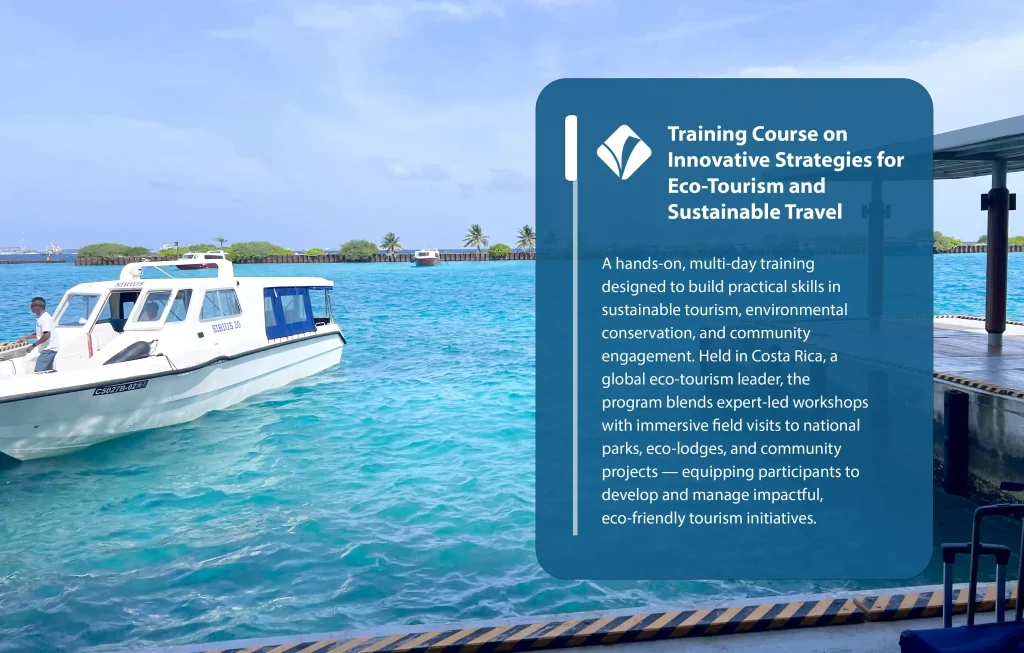
As the global tourism industry shifts toward sustainability, it is no longer enough to "do less harm". This training in San Jose dives into regenerative practices, inclusive travel design, and innovative green operations that empower destinations and businesses to thrive while protecting the planet. From digital storytelling to climate-conscious product design, participants explore creative, actionable, and measurable ways to reshape the future of travel.
Delivered by Risalat Consultants International in San Jose, Costa Rica, the programme combines expert-led sessions, real cases, and group work, allowing participants to apply what they learn directly to their own institutions. The course is suited for professionals and stakeholders engaged in sustainable tourism, conservation, and community development who require practical and current capabilities.
The curriculum links strategic principles with practical implementation, preparing professionals to address destination planning, heritage conservation, and environmental management while balancing the priorities of visitors and host communities.
Le programme renforce les capacités institutionnelles en matière de :
- Defining regenerative tourism
- Comparing sustainability vs. regeneration
- Introduction to regenerative frameworks and metrics
- Geo-cultural asset mapping techniques
- Community engagement and co-design strategies
- Indigenous partnerships in tourism development
- Building zero-waste hospitality systems
- Pratiques éthiques dans le tourisme de nature et d'aventure
- Planification et gestion des destinations
- Principes du tourisme durable
- Conservation et gestion du patrimoine
- Marketing et expérience visiteur
- Fonds
- Entité
- Projet
- Résultats
- MRV
Why this matters now
Les organisations ont de plus en plus besoin de professionnels capables de :
- Planifier des destinations qui concilient visiteurs et communautés
- Protéger et gérer le patrimoine
- Promouvoir les destinations et améliorer l'expérience visiteur
- Associer les communautés et partager les bénéfices
- Suivre la performance et les impacts du tourisme
Strong tourism, culture and heritage systems help organisations:
- Développer le tourisme de manière durable
- Protéger le patrimoine et l'environnement
- Créer des emplois et des entreprises locales
- Attirer les investissements et les partenaires
Public concerné
Ce programme s'adresse à :
- Design regenerative tourism models that restore local environments and empower communities
- Apply geo-cultural mapping techniques for sustainable destination planning
- Develop zero-waste and circular economy strategies in tourism operations
- Integrate indigenous knowledge and ethical co-creation into travel experiences
- Innovate climate-conscious travel products and eco-certification practices
- Utilize digital storytelling and ethical branding to promote eco-destinations
- Personnel des ministères et agences du tourisme
- Gestionnaires de destinations
- Responsables du patrimoine et de la culture
- Élus et agents des collectivités locales
- Propriétaires et dirigeants d'entreprises touristiques
- Personnel du marketing et de la promotion
- Sustainability officers and development organizations
Cochez ce que votre équipe doit être capable de faire.
Objectifs du programme
À l'issue de ce programme, les participants seront en mesure de :
- Expliquer les principes du tourisme durable
- Planifier et gérer une destination avec les parties prenantes
- Appliquer des pratiques de conservation et de gestion du patrimoine
- Élaborer des plans de marketing et d'expérience visiteur
- Associer les communautés et partager équitablement les bénéfices
- Build partnerships with the private sector
- Suivre la performance et les impacts du tourisme
- Prepare for crises and risks
- Prepare an action plan for their destination
Training Structure & Contents
- Defining regenerative tourism
- Comparing sustainability vs. regeneration
- Introduction to regenerative frameworks and metrics
- Global shifts and regenerative principles
- Environmental stewardship fundamentals
- Workshop: Regenerative Tourism & Global Trends: Applying It to Your Institution
- Small group application of daily methods to institutional examples and agreeing practical next steps
- Geo-cultural asset mapping techniques
- Community engagement and co-design strategies
- Indigenous partnerships in tourism development
- Stakeholder collaboration and benefit-sharing mechanisms
- Local context integration for destination planning
- Workshop: Destination Mapping & Community Empowerment: Applying It to Your Institution
- Small group application of daily methods to institutional examples and agreeing practical next steps
- Building zero-waste hospitality systems
- Pratiques éthiques dans le tourisme de nature et d'aventure
- Case study: Circular tourism hubs
- Developing circular economy strategies in operations
- Eco-certification standards and accountability
- Case Study: Circular Operations & Ethical Experiences in Practice
- Participant analysis of realistic cases to draw operational lessons
- Designing low-emission travel products
- Carbon offset integration
- Green mobility solutions for eco-destinations
- Climate-conscious product design methods
- Managing visitor footprints in sensitive areas
- Workshop: Climate-Conscious Innovation & Mobility: Applying It to Your Institution
- Small group application of daily methods to institutional examples and agreeing practical next steps
- Récit numérique pour l'écotourisme
- Construire une identité de marque écoresponsable
- Ethical branding and destination promotion
- Action planning and feedback session
- Institutional alignment and implementation prioritisation
- Capstone Exercise: Innovative Strategies for Eco-Tourism and Sustainable Travel Action Plan for Your Institution
- Presentation of participant action plans for feedback from peers and facilitators
Contenu détaillé jour par jour
First Day | Regenerative Tourism & Global Trends
- Defining regenerative tourism
- Comparing sustainability vs. regeneration
- Introduction to regenerative frameworks and metrics
- Global shifts and regenerative principles
- Environmental stewardship fundamentals
- Workshop: Regenerative Tourism & Global Trends: Applying It to Your Institution
- Small group application of daily methods to institutional examples and agreeing practical next steps
Second Day | Destination Mapping & Community Empowerment
- Geo-cultural asset mapping techniques
- Community engagement and co-design strategies
- Indigenous partnerships in tourism development
- Stakeholder collaboration and benefit-sharing mechanisms
- Local context integration for destination planning
- Workshop: Destination Mapping & Community Empowerment: Applying It to Your Institution
- Small group application of daily methods to institutional examples and agreeing practical next steps
Third Day | Circular Operations & Ethical Experiences
- Building zero-waste hospitality systems
- Pratiques éthiques dans le tourisme de nature et d'aventure
- Case study: Circular tourism hubs
- Developing circular economy strategies in operations
- Eco-certification standards and accountability
- Case Study: Circular Operations & Ethical Experiences in Practice
- Participant analysis of realistic cases to draw operational lessons
Quatrième jour | Innovation et mobilité respectueuses du climat
- Designing low-emission travel products
- Carbon offset integration
- Green mobility solutions for eco-destinations
- Climate-conscious product design methods
- Managing visitor footprints in sensitive areas
- Workshop: Climate-Conscious Innovation & Mobility: Applying It to Your Institution
- Small group application of daily methods to institutional examples and agreeing practical next steps
Fifth Day | Branding, Storytelling & Strategic Action
- Récit numérique pour l'écotourisme
- Construire une identité de marque écoresponsable
- Ethical branding and destination promotion
- Action planning and feedback session
- Institutional alignment and implementation prioritisation
- Capstone Exercise: Innovative Strategies for Eco-Tourism and Sustainable Travel Action Plan for Your Institution
- Presentation of participant action plans for feedback from peers and facilitators
Méthodologie de formation
The training covers environmental stewardship, community engagement, eco-certification, and tourism planning. Before the programme, a short pre-assessment helps the facilitators understand each participant's role and priorities, so that examples and exercises can be adjusted to the group. Each day ends with a short reflection in which participants note what they will apply at work, ensuring that learning moves effectively from the classroom into the organisation.
- Interactive Workshops: Facilitated sessions with presentations, group discussions, and problem-solving exercises
- Field-Based Learning: Guided visits to national parks, eco-lodges, rural tourism initiatives, and conservation projects
- Participatory Group Work: Small teams co-develop eco-tourism models or action plans tailored to their local contexts
- Simulation & Role-Play: Stakeholder negotiation exercises around land use, conservation conflicts, or visitor impact
- Digital Tools & GIS Mapping: Introductory sessions on using basic digital tools for eco-tourism planning and monitoring
- Reflection & Action Planning: Daily and final reflection sessions to connect learning to real-world application
- Sessions animées par des experts sur les pratiques actuelles
- Études de cas régionales et internationales
Résultats attendus
- Planifier les destinations de manière durable
- Protéger et gérer le patrimoine
- Promouvoir efficacement les destinations
- Associer les communautés et partager les bénéfices
- Suivre la performance et les impacts
- Piloter l'amélioration de leur destination
4 930 £ par participant · facture et virement bancaire · remise pour les groupes de 5 personnes ou plus
Cinq personnes ou plus d'une même organisation : demandez le tarif de groupe lors de votre demande de facture.
Ten or more: an in-house version for your institution may cost less per person. Ask for an in-house quote.
Registration closes in 31 days (23 Dec 2026)
Pertinence régionale & mise en application
Europe: European institutions apply tourism, culture and heritage within detailed regulatory frameworks and reform agendas. Participants from Europe can compare their practice with colleagues from other regions and test how established methods work under different conditions.
Africa: Across Africa, ministries, agencies and project teams working in tourism, culture and heritage increasingly operate alongside donor-financed programmes that expect clear systems and evidence. The programme helps participants adapt good practice to the institutions and resources they work with.
Middle East: In the Middle East, national initiatives increasingly focus on cultural heritage, destination development, and economic diversification.
Profil du pays d'accueil
Why Costa Rica is the Smart Choice for Eco-Tourism Training and Investment:
- Costa Rica is a proven global leader in eco-tourism, attracting over 3 million visitors annually, with nearly 50% seeking nature-based experiences.
- Over 25% of its land is protected through national parks and reserves, hosting over 500,000 species, which accounts for about 5% of global biodiversity.
- Costa Rica’s Certification for Sustainable Tourism (CST) programme, recognized by the UNWTO, ensures accountability and quality across eco-lodging and tour operations.
- The Payment for Environmental Services (PES) programme has helped reforest more than 1 million hectares, showcasing a successful public-private partnership model for conservation.
- The country features a stable political climate, strong legal frameworks, and a national goal of net-zero emissions by 2050, offering low-risk, high-impact opportunities for NGOs and investors.
- Costa Rica ranks among the top 5 in the Global Green Economy Index, and its eco-tourism sector contributes nearly 6.3% of GDP.
- It provides an ideal setting for capacity-building, community engagement, and showcasing scalable sustainability models, presenting a high-demand, values-driven market with measurable returns.
Who Will Deliver This Programme
Each date is delivered by a team assigned from Risalat's expert network for this subject. For this programme we assign:
How we choose them: Experience in the region of the participants or comparable settings; Command of the financier rules that apply (World Bank, ADB, AfDB, EU, UN) where relevant; Delivery in English; other languages on request for in-house groups; No conflict of interest with participants' institutions.
Formations à San JoséCultural Heritage & Sustainable Tourism training courses
Why San Jose for this programme
San Jose, Costa Rica, was chosen for this programme because it is easy to reach for the participants we expect and has suitable venues for practical, interactive training.
The Innovative Strategies for Eco-Tourism and Sustainable Travel programme in February 2027 brings together officials and professionals. Sessions combine short inputs, case studies and group work on participants' own files, and the city's institutions can be added as a study visit on request.
Vérifiez si vous avez besoin d'un visa avec le vérificateur de visa gratuit, et demandez une lettre d'invitation une fois inscrit.
Le même thème dans d'autres villes
Voir aussi : Tourisme et gestion des destinations · outil gratuit Planificateur de visites d'immersion · tous les programmes
Free roadmap: Charting a Sustainable Course: a 12-month plan for your team
- UN Tourism UN Tourism
- UNESCO World Heritage Centre UNESCO
Is there tourism and culture training for government officials in San Jose in February 2027?
Le cours « Stratégies innovantes pour l'écotourisme et le voyage durable » peut-il être dispensé en interne pour une seule organisation ?
Quels autres programmes Risalat propose-t-il en tourisme et culture ?
Comment les organisations s'inscrivent-elles et paient-elles ?
Pour les équipes et les institutions
Bring your team
Teams that learn together apply more at work. Tell us how many people and how you would like to take part: we reply with a group quote within two working days.
More training courses in Costa Rica · Tous les programmes dans les Amériques · Calendrier complet des formations
Plan this programme in a roadmap: why it matters, why to approve it, the dates to plan and the career it builds.