Key facts
- Dates
- 12–16 Jul 2027 (5 days)
- Where
- Istanbul, Türkiye
- Fee per participant
- £3,850 (GBP)
- Payment
- By invoice and bank transfer
- Registration closes
- 2 Jun 2027
- Format
- 5-day short course: a practical capacity-building programme for government, NGO and project teams in Istanbul
- Groups
- Teams of 3 or more qualify for a group discount, offered case by case: ask for a group quote.
- In-house option
- Run it for your team, on your dates
On this page 9 sections
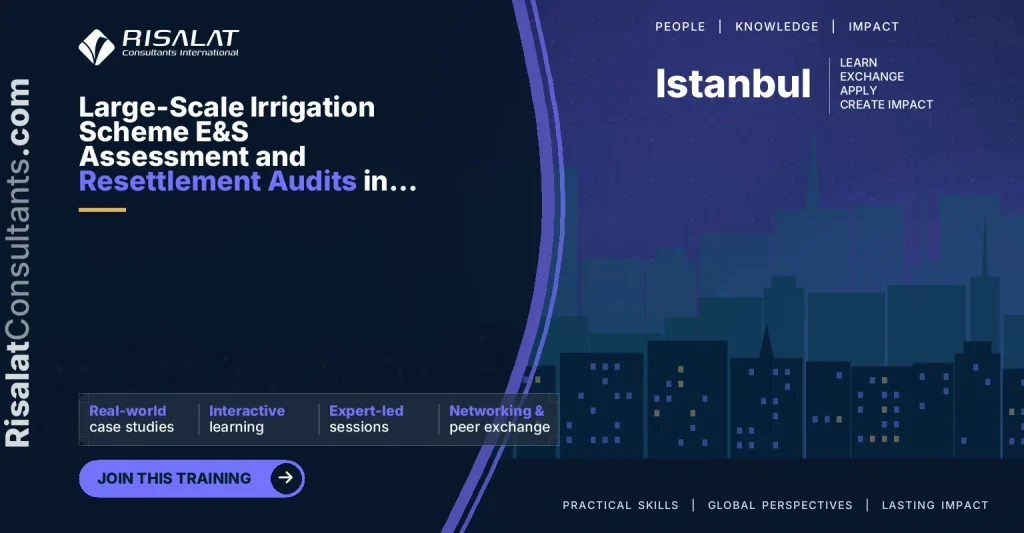
Large-Scale Irrigation Scheme E&S Assessment and Resettlement Audits in Istanbul
Programme Overview
Large-scale canal irrigation schemes demand robust environmental and social governance to manage footprint impacts across extensive command areas. This five-day training programme in Istanbul provides practitioners with comprehensive methodologies to deliver environmental and social assessments, biodiversity management plans, and resettlement instruments. Participants review direct, indirect, and cumulative impacts linked to hydraulic infrastructure, land clearing, earthworks, and downstream hydrological alterations, ensuring that project designs incorporate viable mitigation hierarchies from the initial feasibility stages through to operational management.
Free self-check: the governance self-audit gives a quick check of governance, controls and accountability, in about 10 minutes.
The curriculum examines the technical execution of baseline social and environmental surveys, stakeholder engagement campaigns, and livelihood restoration programmes. Participants explore involuntary and voluntary resettlement pathways, compensation matrices, and physical relocation protocols aligned with international lender requirements. By focusing on practical engineering and safeguard intersections, the course clarifies how irrigation designs affect land tenure, water rights, cultural resources, and vulnerable rural populations, enabling technical specialists to deliver legally compliant and socially acceptable command-area development plans.
Delivered through interactive technical modules, the course emphasizes contractor oversight, site-specific Environmental and Social Management Plans, and verifiable environmental auditing workflows. Major agricultural transformation initiatives require rigorous safeguards capacity to fulfil procurement criteria and lender appraisal conditions, as demonstrated by technical assignments such as the preparation of environmental and social instruments for the SPIN Rabbah Irrigation Scheme. Implementing agencies must align hydraulic engineering with the World Bank Environmental and Social Framework, AfDB Integrated Safeguards System, and international standards on land acquisition and biodiversity conservation.
The programme strengthens institutional capability in:
- Analysis of the World Bank ESF, AfDB ISS, and national environmental legislation for irrigation projects
- Screening and scoping boundaries: command areas, intake structures, main canals, and downstream floodplains
- Baseline methodologies for hydrological alterations, soil salinisation, and command-area water quality
- Cumulative impact assessment approaches for shared river basins and multi-user abstraction schemes
- Stakeholder identification, engagement planning, and informed consultation with water user associations
- Application of ESS6 and related lender benchmarks to agricultural development and canal networks
- Drafting Biodiversity Management Plans: mitigating barriers to wildlife corridors and wetland loss
- Integrated Pest Management Plans: vector control, agrochemical runoff, and water quality protection
- Fraud risk assessment and fraud risk registers
- Design and testing of internal controls
- The Three Lines model and the role of oversight
- Audit planning, evidence and documentation
Why this matters now
Organisations increasingly require professionals capable of:
- Identify and rate fraud and control risks in their own processes
- Design controls that are proportionate and testable
- Gather and document reliable audit evidence
- Recognise red flags early and escalate them correctly
- Turn findings into practical, agreed actions
Strong fraud, audit and internal control systems help organisations:
- Reduce losses and ineligible expenditure
- Pass external audits with fewer findings
- Strengthen trust with financiers and citizens
- Respond to allegations in a fair and documented way
Who Should Attend
This programme is designed for:
- Irrigation and drainage engineers from public water resource ministries
- Environmental safeguards specialists assigned to project implementation units
- Social development and gender officers working on agricultural schemes
- Land acquisition and compensation officers in river basin authorities
- Surveyors and valuation professionals handling agricultural displacement
- Health, safety, and environment supervisors managing canal civil works
- Biodiversity and natural resource management officers
- Monitoring and evaluation specialists responsible for safeguards compliance audits
- Internal auditors and audit managers
- Finance managers and accountants
- Compliance and risk officers
- Procurement officers and managers
Tick what your team needs to be able to do.
Programme Objectives
By the end of this programme participants will be able to:
- Formulate bankable Environmental and Social Impact Assessments and site-specific management plans for large-scale canal schemes
- Design comprehensive Biodiversity Management Plans addressing riparian habitats, aquatic ecology, and vegetation clearance along canals
- Structure Resettlement Action Plans and livelihood restoration frameworks in compliance with multilateral lender standards
- Conduct resettlement audits to identify non-compliance, compensation gaps, and legacy grievances across command areas
- Integrate environmental and social clauses into civil works bidding documents and hydraulic construction contracts
- Implement project-level grievance redress mechanisms tailored to rural landholders, downstream users, and pastoralist groups
- Establish contractor supervision protocols and auditing workflows for continuous monitoring of environmental and social performance
- Explain how and why fraud happens, using recognised fraud risk models
- Carry out a fraud and control risk assessment for a real process
- Map controls to risks using the Three Lines model
Training Structure & Contents
- Analysis of the World Bank ESF, AfDB ISS, and national environmental legislation for irrigation projects
- Screening and scoping boundaries: command areas, intake structures, main canals, and downstream floodplains
- Baseline methodologies for hydrological alterations, soil salinisation, and command-area water quality
- Cumulative impact assessment approaches for shared river basins and multi-user abstraction schemes
- Stakeholder identification, engagement planning, and informed consultation with water user associations
- Workshop: Applying scoping, baseline, and legal framework methods to institutional examples and agreeing practical next steps
- Application of ESS6 and related lender benchmarks to agricultural development and canal networks
- Drafting Biodiversity Management Plans: mitigating barriers to wildlife corridors and wetland loss
- Integrated Pest Management Plans: vector control, agrochemical runoff, and water quality protection
- Minimum ecological flow requirements and downstream riparian habitat preservation methods
- Screening for critical natural habitats and designing legally compliant ecological offset schemes
- Workshop: Applying biodiversity, pesticide, and ecological safeguard methods to institutional examples
- Alignment with ESS5 and multilateral land acquisition and livelihood restoration standards
- Differentiating voluntary land contribution protocols from involuntary physical and economic displacement
- Census methodologies, asset inventory, socioeconomic surveys, and cutoff date declarations
- Valuation methods for standing crops, economic trees, irrigation infrastructure, and communal grazing rights
- Formulating Resettlement Action Plans, entitlement matrices, and livelihood restoration packages
- Case Study: Analysing land acquisition and resettlement choices against good practice to draw transferable lessons
- Audit protocols for past land acquisition, unaddressed compensation, and historical project grievances
- Corrective Action Plan preparation: bridging the gap between national practice and lender standards
- Designing tiered Grievance Redress Mechanisms for community disputes and contractor relations
- Managing labour influx, gender-based violence risks, and worker camp social requirements
- Field documentation, evidence collection, and verification of compensation disbursement records
- Workshop: Applying resettlement audits, legacy dispute resolution, and grievance management methods to institutional examples
- Translating ESMPs into enforceable environmental and social clauses within civil works contracts
- Contractor oversight workflows, non-conformance tracking, and penalty enforcement mechanisms
- Occupational health and safety supervision for heavy hydraulic machinery, excavations, and canal lining
- Water-related disease vector monitoring and public health safeguards in command areas
- Preparation of verifiable audit reports and documentation for external verification and lender reviews
- Workshop: Formulating institutional action plans for safeguards compliance, internal audit, and contractor oversight
Full day-by-day contents
First Day | E&S Scoping, Baselines, and Legal Frameworks for Irrigation
- Analysis of the World Bank ESF, AfDB ISS, and national environmental legislation for irrigation projects
- Screening and scoping boundaries: command areas, intake structures, main canals, and downstream floodplains
- Baseline methodologies for hydrological alterations, soil salinisation, and command-area water quality
- Cumulative impact assessment approaches for shared river basins and multi-user abstraction schemes
- Stakeholder identification, engagement planning, and informed consultation with water user associations
- Workshop: Applying scoping, baseline, and legal framework methods to institutional examples and agreeing practical next steps
Second Day | Biodiversity Management, Pesticides, and Ecological Safeguards
- Application of ESS6 and related lender benchmarks to agricultural development and canal networks
- Drafting Biodiversity Management Plans: mitigating barriers to wildlife corridors and wetland loss
- Integrated Pest Management Plans: vector control, agrochemical runoff, and water quality protection
- Minimum ecological flow requirements and downstream riparian habitat preservation methods
- Screening for critical natural habitats and designing legally compliant ecological offset schemes
- Workshop: Applying biodiversity, pesticide, and ecological safeguard methods to institutional examples
Third Day | Land Acquisition, Voluntary Strategies, and Involuntary Resettlement
- Alignment with ESS5 and multilateral land acquisition and livelihood restoration standards
- Differentiating voluntary land contribution protocols from involuntary physical and economic displacement
- Census methodologies, asset inventory, socioeconomic surveys, and cutoff date declarations
- Valuation methods for standing crops, economic trees, irrigation infrastructure, and communal grazing rights
- Formulating Resettlement Action Plans, entitlement matrices, and livelihood restoration packages
- Case Study: Analysing land acquisition and resettlement choices against good practice to draw transferable lessons
Fourth Day | Resettlement Audits, Legacy Issues, and Grievance Management
- Audit protocols for past land acquisition, unaddressed compensation, and historical project grievances
- Corrective Action Plan preparation: bridging the gap between national practice and lender standards
- Designing tiered Grievance Redress Mechanisms for community disputes and contractor relations
- Managing labour influx, gender-based violence risks, and worker camp social requirements
- Field documentation, evidence collection, and verification of compensation disbursement records
- Workshop: Applying resettlement audits, legacy dispute resolution, and grievance management methods to institutional examples
Fifth Day | Contractor E&S Oversight, Auditing, and Institutional Reporting
- Translating ESMPs into enforceable environmental and social clauses within civil works contracts
- Contractor oversight workflows, non-conformance tracking, and penalty enforcement mechanisms
- Occupational health and safety supervision for heavy hydraulic machinery, excavations, and canal lining
- Water-related disease vector monitoring and public health safeguards in command areas
- Preparation of verifiable audit reports and documentation for external verification and lender reviews
- Workshop: Formulating institutional action plans for safeguards compliance, internal audit, and contractor oversight
Training Methodology
Delivered by Risalat Consultants International in Istanbul, Turkey, the programme combines expert-led technical sessions, practical real-case analyses, and small-group exercises to ensure participants can apply acquired tools directly within their home institutions.
- Expert-led instructional presentations on international safeguard frameworks, engineering intersections, and internal controls
- Small-group workshops dedicated to applying daily technical topics to participant organisations
- Real-life project case study evaluations comparing field practices to lender benchmarks
- Practical risk mapping, auditing workflow development, and corrective action planning exercises
Expected Outcomes
- Capacity to formulate bankable environmental and social assessments, ESMPs, and Biodiversity Management Plans
- Skills to design Resettlement Action Plans, execute asset inventories, and establish fair valuation matrices
- Competency to conduct resettlement audits, resolve legacy grievances, and draft Corrective Action Plans
- Ability to enforce contractual environmental and social obligations during civil works construction
- Improved capability to assess fraud and internal control risks using the Three Lines model
- Enhanced preparation for passing external safeguards audits and lender appraisals
£3,850 per participant · invoice and bank transfer · groups of 5 or more receive a discount
Five or more from one organisation: ask for the group rate on the invoice request.
Ten or more: an in-house version for your institution may cost less per person. Ask for an in-house quote.
Registration closes in 185 days (2 Jun 2027)
Who Will Deliver This Programme
Each date is delivered by a team assigned from Risalat's expert network for this subject. For this programme we assign:
How we choose them: Experience in the region of the participants or comparable settings; Command of the financier rules that apply (World Bank, ADB, AfDB, EU, UN) where relevant; Delivery in English; other languages on request for in-house groups; No conflict of interest with participants' institutions.
Training courses in IstanbulClimate Change & Environment training courses
Why Istanbul for this programme
Istanbul sits between Europe and Asia, with direct flights from most capitals and easy visas for many delegations.
The Large-Scale Irrigation Scheme E&S Assessment and Resettlement Audits in Istanbul programme in July 2027 brings together officials and professionals from across the Europe and Asia region and beyond. Sessions combine short inputs, case studies and group work on participants' own files, and the city's institutions can be added as a study visit on request.
Getting there: Istanbul Airport (IST).
Check whether you need a visa with the free Visa Checker, and ask for an invitation letter once you are registered.
Other programmes in Istanbul
- Mini Degree in Environmental and Social Safeguards in Istanbul
- Risk-Based Internal Audit in the Public Sector in Istanbul
- AI for Public Procurement and Contract Management Training in Istanbul
- Seed Sector Modernisation and Climate-Smart Seed Certification in Istanbul
- Credit Guarantee Scheme Administration and MSME Risk Underwriting in Istanbul
Related: Enterprise and SME development programmes · free Training Needs Assessment · all programmes
Questions before you nominate your team? Book a 30-minute call with us, or ask for this programme in-house.
Teams often travel here from Pakistan, Mongolia, Kazakhstan, Uzbekistan, Kyrgyzstan, Tajikistan, Turkmenistan, Azerbaijan. Funding, visa letters and group rates are explained on each country page.
Is there water and sanitation training for government officials in Istanbul in July 2027?
Can "Large-Scale Irrigation Scheme E&S Assessment and Resettlement Audits in Istanbul" be delivered in-house for one organisation?
Which other water and sanitation programmes does Risalat run?
How do organisations register and pay?
For teams and institutions
Bring your team
Teams that learn together apply more at work. Tell us how many people and how you would like to take part: we reply with a group quote within two working days.
Watch: this programme in short
Other dates and cities for this subject: Financial Management for Donor-Funded Projects training courses (67 upcoming dates).
More training courses in Türkiye · All programmes in Europe · Full training calendar
Plan this programme in a roadmap: why it matters, why to approve it, the dates to plan and the career it builds.