Key facts
- Dates
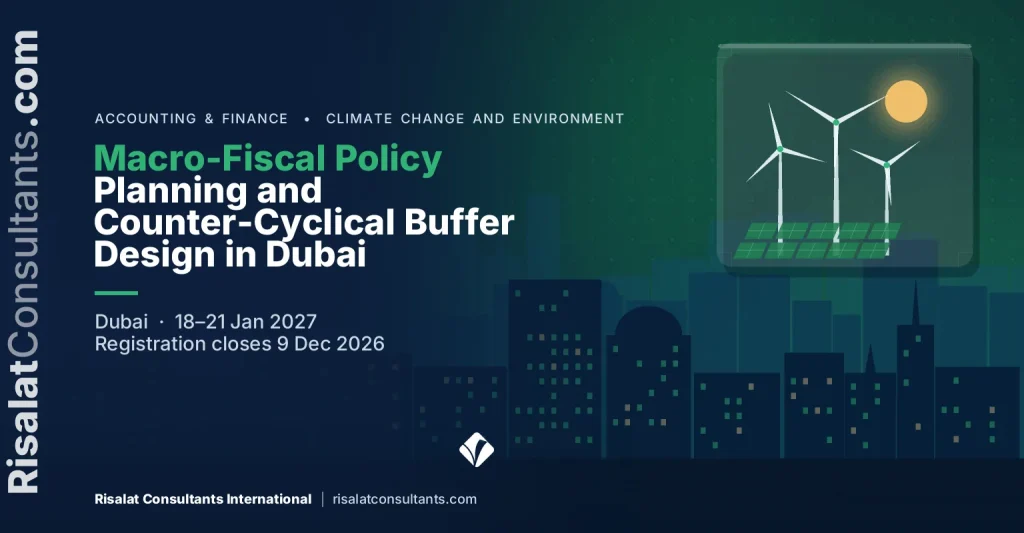
- 18–21 Jan 2027 (4 days)
- Where
- Dubai, United Arab Emirates
- Fee per participant
- £3,000 (GBP)
- Payment
- By invoice and bank transfer
- Registration closes
- 9 Dec 2026
- Format
- 4-day short course: a practical capacity-building programme for government, NGO and project teams in Dubai
- In-house option
- Run it for your team, on your dates
On this page 9 sections
Programme Overview
Macroeconomic volatility, terms of trade shocks, and climate vulnerability require robust domestic policy mechanisms to safeguard fiscal stability and economic growth. This four-day intensive programme equips public finance professionals with modern techniques for macro-fiscal forecasting, debt sustainability analysis, and medium-term planning. Delivered in Dubai, United Arab Emirates, by Risalat Consultants International, the curriculum integrates theoretical foundations with real-world application, drawing upon international surveillance standards and development partner frameworks to modernise institutional fiscal management across developing and emerging economies.
Participants explore the technical design and operationalisation of counter-cyclical buffers, fiscal rules, and sovereign contingency funds. Through structured analysis of structural balances and automatic stabilisers, delegates examine methods to protect critical social and capital expenditure during downturns. The course provides structured exposure to macroeconomic consistency frameworks, expenditure prioritisation methodologies, and fiscal risk matrices necessary to align public spending trajectories with medium-term development objectives.
Practical workshops enable practitioners to model revenue sensitivity against commodity fluctuations, exchange rate movements, and external shocks. Attendees translate macroeconomic projections into multi-year fiscal frameworks and develop response strategies for exogenous disturbances. By evaluating international institutional practices, participants enhance their capacity to formulate transparent, rules-based fiscal policies that strengthen sovereign creditworthiness, reinforce policy credibility, and support sustainable economic transformation. This course also responds to the operational need within public finance institutions to satisfy structural benchmarks and policy actions associated with large-scale development policy operations, such as the Tanzania Second Inclusive and Resilient Growth Development Policy Financing.
The programme strengthens institutional capability in:
- Linkages across the four macroeconomic sectors: real, fiscal, external, and monetary
- Formulating baseline macro-fiscal projections using modern financial programming techniques
- Developing Medium-Term Fiscal Frameworks (MTFF) aligned with national development objectives
- Integrating medium-term debt strategies with macro-fiscal expenditure ceilings
- Practical laboratory: building a baseline macro-fiscal scenario and structural balance calculator
- Typology of fiscal rules: debt ceilings, expenditure caps, and budget balance requirements
- Methodologies for estimating structural budget balances and cyclical output gaps
- Designing transparent escape clauses and correction mechanisms for major crises
- Climate and environmental risk assessment
- Adaptation and mitigation planning
- Sector strategies for energy, water and land
- Project design for climate and environmental goals
Why this matters now
Organisations increasingly require professionals capable of:
- Assess climate and environmental risks to their services and assets
- Design projects that meet climate and environmental goals
- Prepare proposals that financiers can approve
- Measure and report results credibly
- Work with communities and partners across sectors
Strong climate, environment and natural resources systems help organisations:
- Protect services and infrastructure from climate risks
- Access climate and environmental finance
- Meet national and international commitments
- Use natural resources sustainably
Who Should Attend
This programme is designed for:
- Macroeconomic policy economists from ministries of finance and planning
- Budget department directors and senior expenditure controllers
- Central bank macroeconomic analysts and monetary policy specialists
- Debt management office directors and technical policy analysts
- Fiscal policy and economic research unit technical officers
- Macro-fiscal surveillance experts from revenue authorities
- Economists from national planning commissions and economic advisory councils
- Public finance advisors working within donor-funded institutional support programmes
- Technical policy analysts preparing development policy operations
- Climate change and environment officers
- Energy, water and agriculture sector staff
- Planning and policy officers
Tick what your team needs to be able to do.
Programme Objectives
By the end of this programme participants will be able to:
- Construct multi-year macro-fiscal frameworks aligned with IMF and World Bank consistency standards
- Calibrate operational fiscal rules to anchor public debt and safeguard structural fiscal balances
- Design counter-cyclical fiscal buffers and rule-based public contingency financing mechanisms
- Conduct revenue sensitivity analyses and stress tests against external and domestic shocks
- Formulate medium-term expenditure frameworks that protect priority social and capital investments
- Quantify fiscal risks arising from state-owned enterprises, natural hazards, and contingent liabilities
- Evaluate policy matrices to support the implementation of development policy financing operations
- Explain the main climate and environmental challenges for their sector
- Assess climate and environmental risks to services and assets
- Plan adaptation and mitigation measures
Training Structure & Contents
- Linkages across the four macroeconomic sectors: real, fiscal, external, and monetary
- Formulating baseline macro-fiscal projections using modern financial programming techniques
- Developing Medium-Term Fiscal Frameworks (MTFF) aligned with national development objectives
- Integrating medium-term debt strategies with macro-fiscal expenditure ceilings
- Practical laboratory: building a baseline macro-fiscal scenario and structural balance calculator
- Workshop: Macroeconomic Consistency and Multi-Year Fiscal Frameworks: Applying It to Your Institution
- Typology of fiscal rules: debt ceilings, expenditure caps, and budget balance requirements
- Methodologies for estimating structural budget balances and cyclical output gaps
- Designing transparent escape clauses and correction mechanisms for major crises
- Conducting debt sustainability analysis using modern sovereign risk frameworks
- Case application: evaluating compliance and trade-offs under alternative fiscal rule regimes
- Workshop: Fiscal Rules, Debt Sustainability, and Escape Clauses: Applying It to Your Institution
- Operational architecture of counter-cyclical buffers and sovereign stabilisation funds
- Public finance mechanisms for funding contingent reserves and emergency response
- Managing automatic stabilisers versus discretionary fiscal interventions during recessions
- Fiscal risk management: identifying, quantifying, and mitigating explicit and implicit contingent liabilities
- Simulation exercise: designing a fiscal stabilization fund rule for commodity and climate shocks
- Case Study: Counter-Cyclical Buffers and Contingency Financing Mechanisms in Practice
- Protecting pro-growth capital expenditure and targeted social protection during fiscal adjustment
- Translating policy matrices into medium-term budget priorities in development policy operations
- Revenue sensitivity modelling against terms of trade shifts and macroeconomic volatility
- Institutional governance: coordination mechanisms between central banks, ministries, and revenue bodies
- Action planning: presentation of institutional reform roadmaps for counter-cyclical fiscal policy
- Capstone Exercise: Macro-Fiscal Policy Planning and Counter-Cyclical Buffer Design in Dubai Action Plan for Your Institution
- Assessment of climate and environmental risks to public services and assets
- Adaptation and mitigation planning within multi-year spending frameworks
- Sector strategies for resilient energy, water, and land management
- Formulating project proposals aligned with climate and environmental financing standards
- Credible measurement, reporting, and inter-sectoral partner coordination
Full day-by-day contents
First Day | Macroeconomic Consistency and Multi-Year Fiscal Frameworks
- Linkages across the four macroeconomic sectors: real, fiscal, external, and monetary
- Formulating baseline macro-fiscal projections using modern financial programming techniques
- Developing Medium-Term Fiscal Frameworks (MTFF) aligned with national development objectives
- Integrating medium-term debt strategies with macro-fiscal expenditure ceilings
- Practical laboratory: building a baseline macro-fiscal scenario and structural balance calculator
- Workshop: Macroeconomic Consistency and Multi-Year Fiscal Frameworks: Applying It to Your Institution
Second Day | Fiscal Rules, Debt Sustainability, and Escape Clauses
- Typology of fiscal rules: debt ceilings, expenditure caps, and budget balance requirements
- Methodologies for estimating structural budget balances and cyclical output gaps
- Designing transparent escape clauses and correction mechanisms for major crises
- Conducting debt sustainability analysis using modern sovereign risk frameworks
- Case application: evaluating compliance and trade-offs under alternative fiscal rule regimes
- Workshop: Fiscal Rules, Debt Sustainability, and Escape Clauses: Applying It to Your Institution
Third Day | Counter-Cyclical Buffers and Contingency Financing Mechanisms
- Operational architecture of counter-cyclical buffers and sovereign stabilisation funds
- Public finance mechanisms for funding contingent reserves and emergency response
- Managing automatic stabilisers versus discretionary fiscal interventions during recessions
- Fiscal risk management: identifying, quantifying, and mitigating explicit and implicit contingent liabilities
- Simulation exercise: designing a fiscal stabilization fund rule for commodity and climate shocks
- Case Study: Counter-Cyclical Buffers and Contingency Financing Mechanisms in Practice
Fourth Day | Expenditure Prioritisation and Policy Matrix Implementation
- Protecting pro-growth capital expenditure and targeted social protection during fiscal adjustment
- Translating policy matrices into medium-term budget priorities in development policy operations
- Revenue sensitivity modelling against terms of trade shifts and macroeconomic volatility
- Institutional governance: coordination mechanisms between central banks, ministries, and revenue bodies
- Action planning: presentation of institutional reform roadmaps for counter-cyclical fiscal policy
- Capstone Exercise: Macro-Fiscal Policy Planning and Counter-Cyclical Buffer Design in Dubai Action Plan for Your Institution
Fifth Day | Climate Risk Integration and Sector Strategy Alignment
- Assessment of climate and environmental risks to public services and assets
- Adaptation and mitigation planning within multi-year spending frameworks
- Sector strategies for resilient energy, water, and land management
- Formulating project proposals aligned with climate and environmental financing standards
- Credible measurement, reporting, and inter-sectoral partner coordination
Training Methodology
The training employs an applied adult-learning methodology combining technical presentations, macroeconomic modelling workshops, and practical institutional simulations. Delegates work in peer groups using international public finance case studies and empirical policy data. Practical sessions utilise spreadsheet-based macro-fiscal models, allowing participants to test policy rules, simulate economic shocks, and draft operational buffer mechanisms for direct adaptation within their home institutions.
- Expert-led sessions on current practice
- Regional and international case studies
- Group work and practical exercises
- Simulations and role plays where relevant
- Discussion of participants’ own challenges
- Peer learning across institutions and countries
- Practical tools and templates
Expected Outcomes
- Ability to design multi-year macro-fiscal projections and consistency frameworks
- Capacity to implement operational fiscal rules and escape clauses
- Skills to design counter-cyclical buffers and sovereign contingency reserves
- Competence in conducting debt sustainability analyses and fiscal stress tests
- Capability to integrate climate risk assessment into sector budgeting and expenditure prioritisation
£3,000 per participant · invoice and bank transfer · groups of 5 or more receive a discount
Five or more from one organisation: ask for the group rate on the invoice request.
Ten or more: an in-house version for your institution may cost less per person. Ask for an in-house quote.
Registration closes in 10 days (9 Dec 2026)
Who Will Deliver This Programme
Each date is delivered by a team assigned from Risalat's expert network for this subject. For this programme we assign:
How we choose them: Experience in the region of the participants or comparable settings; Command of the financier rules that apply (World Bank, ADB, AfDB, EU, UN) where relevant; Delivery in English; other languages on request for in-house groups; No conflict of interest with participants' institutions.
Training courses in DubaiAccounting & Finance training courses
Why Dubai for this programme
Dubai is a one-flight hub for Africa, Asia and Europe, with simple visas for many nationalities and modern training venues.
The Macro-Fiscal Policy Planning and Counter-Cyclical Buffer Design in Dubai programme in January 2027 brings together officials and professionals from across the Middle East region and beyond. Sessions combine short inputs, case studies and group work on participants' own files, and the city's institutions can be added as a study visit on request.
Getting there: Dubai International (DXB).
Check whether you need a visa with the free Visa Checker, and ask for an invitation letter once you are registered.
Other programmes in Dubai
- Mini Degree in Internal Audit and Risk Management in Dubai
- Refugee and Host Community Programme Management in Dubai
- Performance Audit for Supreme Audit Institutions in Dubai
- Artificial Intelligence for Public Sector Leaders Training in Dubai
- Records and Archives Management for Public Institutions in Dubai
Questions before you nominate your team? Book a 30-minute call with us, or ask for this programme in-house.
Teams often travel here from Maldives, Sri Lanka, Bangladesh, Nepal, Pakistan, Afghanistan, Kazakhstan, Uzbekistan. Funding, visa letters and group rates are explained on each country page.
Is there climate change and environment training for government officials in Dubai in January 2027?
Can "Macro-Fiscal Policy Planning and Counter-Cyclical Buffer Design in Dubai" be delivered in-house for one organisation?
Which other climate change and environment programmes does Risalat run?
How do organisations register and pay?
For teams and institutions
Bring your team
Teams that learn together apply more at work. Tell us how many people and how you would like to take part: we reply with a group quote within two working days.
Watch: this programme in short


Other dates and cities for this subject: Public Financial Management training courses (65 upcoming dates).
More training courses in the United Arab Emirates · All programmes in Middle East · Full training calendar
Plan this programme in a roadmap: why it matters, why to approve it, the dates to plan and the career it builds.