Factos essenciais
- Datas
- 26–29 jan. 2027 (4 dias)
- Local
- Inntel Hotels Rotterdam Centre, Roterdão, Países Baixos
- Preço por participante
- £3.950 (GBP)
- Pagamento
- Por fatura e transferência bancária
- Encerramento das inscrições
- 17 dez. 2026
- Formato
- 4-day short course: a practical capacity-building programme for government, NGO and project teams in Rotterdam
- Opção interna
- Realize-o para a sua equipa, nas datas que preferir
Nesta página 12 secções
Visão geral do programa
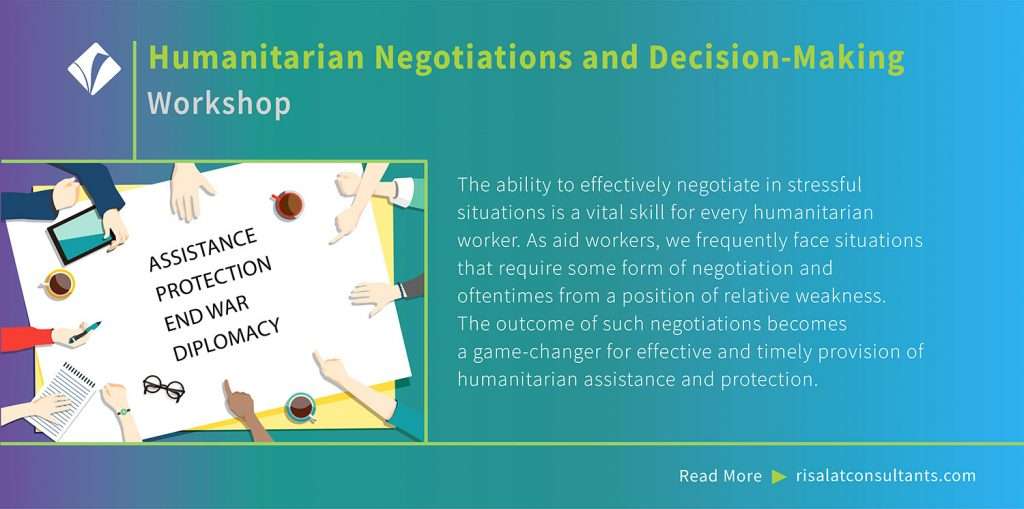
The ability to effectively negotiate in stressful situations is a vital skill for every humanitarian worker. Aid workers frequently face situations that require some form of negotiation, oftentimes from a position of relative weakness. The outcome of such negotiations becomes a game-changer for effective and timely provision of humanitarian assistance and protection. Volatile contexts, short time, and limited power to exert influence on the parties are the characteristics that make humanitarian negotiations unique.
Training on Humanitarian Negotiations and Decision-Making has been designed to target the improvement in individual and organizational negotiation skills. The programme actively works to equip participants with a set of practical tools, methods, and skills that help them analyse the environment where the humanitarian negotiation takes place and build the strategy for achieving desired objectives.
Realizado pela Risalat Consultants International em Roterdão (Países Baixos), combina sessões conduzidas por especialistas, casos reais e trabalho de grupo, para que os participantes possam aplicar o que aprendem na sua própria instituição.
O programa reforça a capacidade institucional em:
- Understanding Humanitarian Negotiations and accompanying challenges
- Humanitarian Negotiations and International Humanitarian Law
- Diferentes modos de Negociação
- Characteristics of humanitarian engagement and negotiations with armed groups
- Characteristics of humanitarian negotiations with government authorities
- Humanitarian Negotiations with Donors
- Humanitarian Negotiations with Civilians
- Multi-Party Humanitarian Negotiations
- Pensamento estratégico e definição de orientações
- Liderar e desenvolver equipas
- Tomada de decisão e resolução de problemas
- Comunicação e influência
Why this matters now
As organizações precisam cada vez mais de profissionais capazes de:
- Definir uma orientação e prioridades claras
- Liderar e motivar equipas em contextos de mudança
- Comunicar e negociar de forma eficaz
- Gerir o desempenho de forma justa
- Tomar decisões acertadas sob pressão
Sistemas sólidos de liderança, gestão e comunicação ajudam as organizações a:
- Transformar estratégias em resultados
- Criar equipas motivadas e capazes
- Gerir a mudança com menos resistência
- Melhorar as relações com parceiros e partes interessadas
Quem deve participar
Este programa destina-se a:
- Improve interpersonal, communication, and diplomatic skills
- Master advocacy tools and techniques
- Learn how to negotiate the best agreement from the position of relative weakness
- Liderar e participar em negociações em contextos humanitários e de proteção
- Effectively analyze negotiating environment and build negotiation strategies under time-stress
- Comprehend the peculiarities of humanitarian negotiations with governments, military, armed groups, donors, and civilians
- Diretores e quadros superiores
- Chefes de departamento e de unidade
- Quadros intermédios e chefes de equipa
- Gestores de projetos e programas
- Pessoal de RH e de desenvolvimento organizacional
- Profissionais que se preparam para funções de liderança
Assinale o que a sua equipa precisa de ser capaz de fazer.
Objetivos do programa
No final deste programa, os participantes serão capazes de:
- Explicar as abordagens atuais à liderança em instituições públicas e privadas
- Definir a orientação e as prioridades da sua equipa
- Liderar, motivar e desenvolver pessoas
- Tomar decisões com métodos estruturados
- Comunicar com clareza e influenciar os outros
- Negociar e gerir conflitos
- Planear e liderar a mudança
- Gerir o desempenho de forma justa
- Preparar um plano pessoal de desenvolvimento da liderança
Training Structure & Contents
- Understanding Humanitarian Negotiations and accompanying challenges
- Humanitarian Negotiations and International Humanitarian Law
- Diferentes modos de Negociação
- Characteristics of humanitarian engagement and negotiations with armed groups
- Characteristics of humanitarian negotiations with government authorities
- Humanitarian Negotiations with Donors and Civilians
- Workshop: Applying methods to institutional examples and agreeing practical next steps
- Defining the motivation for negotiation
- Setting Negotiation Objectives
- Partners in humanitarian negotiations
- Interests, Position, and Power in humanitarian negotiations
- Stress and Time-Pressure in Humanitarian Negotiations
- Assessing Leverage and Maximizing Compatibility and Leverage
- Workshop: Applying negotiation objectives and leverage to institutional settings
- Diplomacy in Humanitarian Negotiations
- Personal Negotiation Styles
- Face-to-face negotiation and building relationship
- Managing cultural differences
- Language and Interpreters
- Dealing with Failure in Negotiation and following through
- Case Study: Diplomacy and negotiation styles in practice
- Peer-to-peer workshop
- Review of negotiation strategies under time-stress
- Integrating multi-party humanitarian negotiations
- Capstone Exercise: Action plan for participant institutions
- Setting priorities, owners and first steps
- Presenting action plans for peer and facilitator feedback
- Consolidation of individual and organizational negotiation skills
- Frameworks for leading and motivating teams through change
- Structured tools for decision-making under pressure
- Communication and stakeholder engagement review
- Finalising the personal leadership and negotiation development plan
Conteúdo completo, dia a dia
First Day | Understanding Humanitarian Negotiations and accompanying challenges
- Understanding Humanitarian Negotiations and accompanying challenges
- Humanitarian Negotiations and International Humanitarian Law
- Diferentes modos de Negociação
- Characteristics of humanitarian engagement and negotiations with armed groups
- Characteristics of humanitarian negotiations with government authorities
- Humanitarian Negotiations with Donors and Civilians
- Workshop: Applying methods to institutional examples and agreeing practical next steps
Second Day | Defining the motivation for negotiation, Setting Negotiation Objectives
- Defining the motivation for negotiation
- Setting Negotiation Objectives
- Partners in humanitarian negotiations
- Interests, Position, and Power in humanitarian negotiations
- Stress and Time-Pressure in Humanitarian Negotiations
- Assessing Leverage and Maximizing Compatibility and Leverage
- Workshop: Applying negotiation objectives and leverage to institutional settings
Terceiro Dia | Diplomacia em Negociações Humanitárias, Estilos de Negociação Pessoal
- Diplomacy in Humanitarian Negotiations
- Personal Negotiation Styles
- Face-to-face negotiation and building relationship
- Managing cultural differences
- Language and Interpreters
- Dealing with Failure in Negotiation and following through
- Case Study: Diplomacy and negotiation styles in practice
Fourth Day | Peer-to-peer workshop and Institutional Action Planning
- Peer-to-peer workshop
- Review of negotiation strategies under time-stress
- Integrating multi-party humanitarian negotiations
- Capstone Exercise: Action plan for participant institutions
- Setting priorities, owners and first steps
- Presenting action plans for peer and facilitator feedback
Fifth Day | Consolidation and Implementation Framework
- Consolidation of individual and organizational negotiation skills
- Frameworks for leading and motivating teams through change
- Structured tools for decision-making under pressure
- Communication and stakeholder engagement review
- Finalising the personal leadership and negotiation development plan
Metodologia de formação
Humanitarian Negotiations and Decision-Making is a highly interactive training with particular emphasis on knowledge exchange. The presenter uses proven adult-learning techniques to facilitate the conversation between the delegates. Several case studies and scenarios are discussed, and participants engage in real-life simulations where they can practise communication skills and work on personal negotiation styles. A short pre-assessment helps facilitators understand roles and priorities, and each day ends with a short reflection on practical application.
- Sessões conduzidas por especialistas sobre as práticas atuais
- Estudos de caso regionais e internacionais
- Trabalho de grupo e exercícios práticos
- Simulações e dramatizações, quando relevante
- Discussão dos desafios dos próprios participantes
- Aprendizagem entre pares de várias instituições e países
- Ferramentas e modelos práticos para levar para o trabalho
- Reflexão diária e planeamento de ações
Resultados esperados
- Definir uma orientação e prioridades claras
- Liderar e desenvolver equipas
- Tomar decisões acertadas
- Comunicar e negociar de forma eficaz
- Liderar a mudança com menos resistência
- Planear o seu próprio desenvolvimento enquanto líderes
- Return with a personal action plan and practical tools for immediate institutional use
- Establish shared methods and templates across organisational teams
£3.950 por participante · fatura e transferência bancária · grupos de 5 ou mais pessoas beneficiam de desconto
Cinco ou mais participantes da mesma organização: peça a tarifa de grupo no pedido de fatura.
Ten or more: an in-house version for your institution may cost less per person. Ask for an in-house quote.
As inscrições encerram em 25 dias (17 dez 2026)
Relevância regional e aplicação
Europe: European institutions apply leadership, management and communication within detailed regulatory frameworks and reform agendas. Participants from Europe can compare their practice with colleagues from other regions and test how established methods work under different conditions.
Africa: Across Africa, ministries, agencies and project teams working in leadership, management and communication increasingly operate alongside donor-financed programmes that expect clear systems and evidence. The programme helps participants adapt good practice to the institutions and resources they work with.
Middle East: In the Middle East, national development strategies and diversification plans place growing demands on leadership, management and communication. Participants explore how to build the capability these plans need inside public bodies and companies.
Asia: Institutions across Asia combine rapid growth with ambitious modernisation programmes. Participants from Asia can share their experience of scaling systems quickly and learn from approaches used elsewhere.
Pacific: Small island and Pacific states face particular constraints of size, distance and capacity. The programme highlights practical, proportionate approaches to leadership, management and communication that suit smaller institutions.
Perfil do país anfitrião
Rotterdam, Netherlands: Studying away from their own country gives participants time to reflect away from daily pressures, compare how leadership, management and communication is handled in different settings, and build professional networks.
Who Will Deliver This Programme
Each date is delivered by a team assigned from Risalat's expert network for this subject. For this programme we assign:
How we choose them: Experience in the region of the participants or comparable settings; Command of the financier rules that apply (World Bank, ADB, AfDB, EU, UN) where relevant; Delivery in English; other languages on request for in-house groups; No conflict of interest with participants' institutions.
Training courses in RotterdamCursos de formação para humanitários
Porquê Roterdão para este programa
Rotterdam is home to Europe's largest seaport, offering direct insight into international trade, modern logistics, and maritime management. Visiting officials can examine flood protection infrastructure such as the Maeslantkering and observe urban regeneration projects across the city. The location is easily accessible through Rotterdam The Hague Airport and frequent rail connections from Amsterdam Airport Schiphol.
The Training on Humanitarian Negotiations and Decision-Making programme in January 2027 brings together officials and professionals from across Europe, Africa, the Middle East and Asia. Sessions combine short inputs, case studies and group work on participants' own files, and the city's institutions can be added as a study visit on request.
Getting there: Rotterdam The Hague Airport (RTM).
Verifique se precisa de visto com o Verificador de Vistos gratuito e peça uma carta-convite depois de se inscrever.
O mesmo tema noutras cidades
- Formação Avançada em Gestão de Aquisições e Negociação Estratégica (Tbilissi)
- Humanitarian Cooperation and Diplomacy Training in Brussels (Brussels)
Outros programas em Roterdão
- Urban Flood Risk Reduction and Drainage Master Planning in Rotterdam
- Urban Flood Resilience & Nature-Based Stormwater Drainage Engineering in Rotterdam
- Inland Waterway Navigation Systems & Multimodal Corridor Modernisation in Rotterdam
- Treinamento em Gestão de Corredores de Transporte e Financiamento Rodoviário em Roterdã
- Formação em Fundamentos Ambientais, Sociais e de Governação (ESG)
- ReliefWeb OCHA
Is there negotiation and communication training for government officials in Rotterdam in January 2027?
Can "Training on Humanitarian Negotiations and Decision-Making" be delivered in-house for one organisation?
Which other negotiation and communication programmes does Risalat run?
Como se inscrevem e pagam as organizações?
For teams and institutions
Bring your team
Teams that learn together apply more at work. Tell us how many people and how you would like to take part: we reply with a group quote within two working days.
Other dates and cities for this subject: Humanitarian Programme Management training courses (44 upcoming dates).
More training courses in the Netherlands · Todos os programas na Europa · Calendário de formação completo
Planear este programa num roteiro: porque importa, porque o aprovar, as datas a planear e a carreira que constrói.