Points clés
- Dates
- 26–29 janv. 2027 (4 jours)
- Lieu
- Inntel Hotels Rotterdam Centre, Rotterdam, Pays-Bas
- Frais par participant
- 3 950 £ (GBP)
- Paiement
- Sur facture et par virement bancaire
- Clôture des inscriptions
- 17 déc. 2026
- Format
- 4-day short course: a practical capacity-building programme for government, NGO and project teams in Rotterdam
- Option intra
- Organisez-le pour votre équipe, à vos dates
Sur cette page 12 sections
Présentation du programme
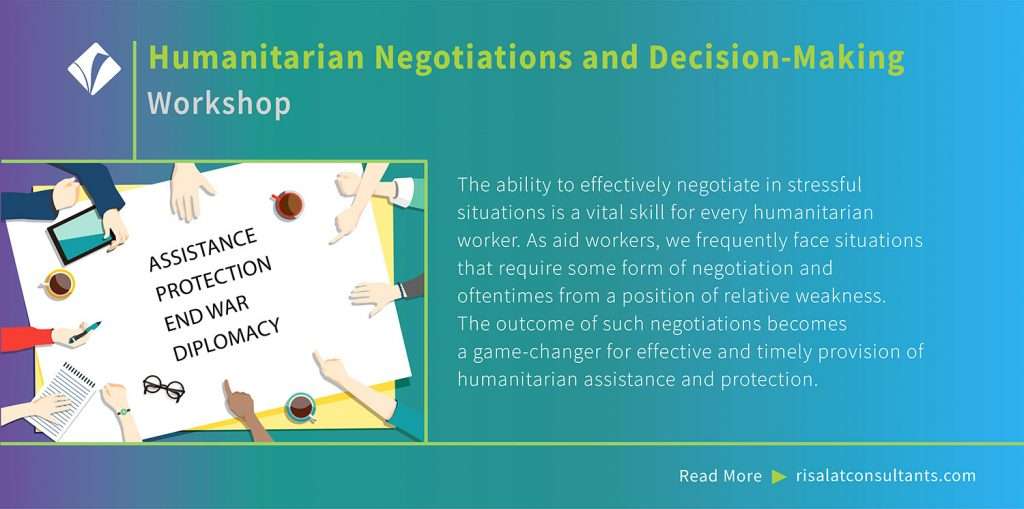
The ability to effectively negotiate in stressful situations is a vital skill for every humanitarian worker. Aid workers frequently face situations that require some form of negotiation, oftentimes from a position of relative weakness. The outcome of such negotiations becomes a game-changer for effective and timely provision of humanitarian assistance and protection. Volatile contexts, short time, and limited power to exert influence on the parties are the characteristics that make humanitarian negotiations unique.
Training on Humanitarian Negotiations and Decision-Making has been designed to target the improvement in individual and organizational negotiation skills. The programme actively works to equip participants with a set of practical tools, methods, and skills that help them analyse the environment where the humanitarian negotiation takes place and build the strategy for achieving desired objectives.
Proposé par Risalat Consultants International à Rotterdam (Pays-Bas), il associe sessions animées par des experts, cas réels et travaux de groupe, afin que les participants puissent appliquer leurs acquis dans leur propre institution.
Le programme renforce les capacités institutionnelles en matière de :
- Understanding Humanitarian Negotiations and accompanying challenges
- Humanitarian Negotiations and International Humanitarian Law
- Different modes of Negotiation
- Characteristics of humanitarian engagement and negotiations with armed groups
- Characteristics of humanitarian negotiations with government authorities
- Humanitarian Negotiations with Donors
- Humanitarian Negotiations with Civilians
- Multi-Party Humanitarian Negotiations
- Réflexion stratégique et définition d'une orientation
- Diriger et faire progresser les équipes
- Prise de décision et résolution de problèmes
- Communication et influence
Why this matters now
Les organisations ont de plus en plus besoin de professionnels capables de :
- Fixer une orientation et des priorités claires
- Diriger et motiver les équipes dans le changement
- Communiquer et négocier efficacement
- Gérer la performance de manière équitable
- Prendre de bonnes décisions sous pression
Des systèmes solides de leadership, de management et de communication aident les organisations à :
- Transformer les stratégies en résultats
- Constituer des équipes motivées et compétentes
- Gérer le changement en limitant les résistances
- Améliorer les relations avec les partenaires et les parties prenantes
Public concerné
Ce programme s'adresse à :
- Improve interpersonal, communication, and diplomatic skills
- Master advocacy tools and techniques
- Learn how to negotiate the best agreement from the position of relative weakness
- Lead and participate in negotiations in humanitarian and protection contexts
- Effectively analyze negotiating environment and build negotiation strategies under time-stress
- Comprehend the peculiarities of humanitarian negotiations with governments, military, armed groups, donors, and civilians
- Directeurs et cadres supérieurs
- Chefs de département et d'unité
- Cadres intermédiaires et chefs d'équipe
- Gestionnaires de projets et de programmes
- Personnel RH et développement organisationnel
- Personnel se préparant à des fonctions de direction
Cochez ce que votre équipe doit être capable de faire.
Objectifs du programme
À l'issue de ce programme, les participants seront en mesure de :
- Expliquer les approches actuelles du leadership dans les institutions publiques et privées
- Fixer l'orientation et les priorités de leur équipe
- Diriger, motiver et faire progresser les personnes
- Prendre des décisions à l'aide de méthodes structurées
- Communiquer clairement et influencer
- Négocier et gérer les conflits
- Planifier et conduire le changement
- Gérer la performance de manière équitable
- Préparer un plan personnel de développement du leadership
Training Structure & Contents
- Understanding Humanitarian Negotiations and accompanying challenges
- Humanitarian Negotiations and International Humanitarian Law
- Different modes of Negotiation
- Characteristics of humanitarian engagement and negotiations with armed groups
- Characteristics of humanitarian negotiations with government authorities
- Humanitarian Negotiations with Donors and Civilians
- Workshop: Applying methods to institutional examples and agreeing practical next steps
- Defining the motivation for negotiation
- Setting Negotiation Objectives
- Partners in humanitarian negotiations
- Interests, Position, and Power in humanitarian negotiations
- Stress and Time-Pressure in Humanitarian Negotiations
- Assessing Leverage and Maximizing Compatibility and Leverage
- Workshop: Applying negotiation objectives and leverage to institutional settings
- Diplomacy in Humanitarian Negotiations
- Personal Negotiation Styles
- Face-to-face negotiation and building relationship
- Managing cultural differences
- Language and Interpreters
- Dealing with Failure in Negotiation and following through
- Case Study: Diplomacy and negotiation styles in practice
- Peer-to-peer workshop
- Review of negotiation strategies under time-stress
- Integrating multi-party humanitarian negotiations
- Capstone Exercise: Action plan for participant institutions
- Setting priorities, owners and first steps
- Presenting action plans for peer and facilitator feedback
- Consolidation of individual and organizational negotiation skills
- Frameworks for leading and motivating teams through change
- Structured tools for decision-making under pressure
- Communication and stakeholder engagement review
- Finalising the personal leadership and negotiation development plan
Contenu détaillé jour par jour
First Day | Understanding Humanitarian Negotiations and accompanying challenges
- Understanding Humanitarian Negotiations and accompanying challenges
- Humanitarian Negotiations and International Humanitarian Law
- Different modes of Negotiation
- Characteristics of humanitarian engagement and negotiations with armed groups
- Characteristics of humanitarian negotiations with government authorities
- Humanitarian Negotiations with Donors and Civilians
- Workshop: Applying methods to institutional examples and agreeing practical next steps
Deuxième jour | Définir la motivation de la négociation, fixer les objectifs de négociation
- Defining the motivation for negotiation
- Setting Negotiation Objectives
- Partners in humanitarian negotiations
- Interests, Position, and Power in humanitarian negotiations
- Stress and Time-Pressure in Humanitarian Negotiations
- Assessing Leverage and Maximizing Compatibility and Leverage
- Workshop: Applying negotiation objectives and leverage to institutional settings
Third Day | Diplomacy in Humanitarian Negotiations, Personal Negotiation Styles
- Diplomacy in Humanitarian Negotiations
- Personal Negotiation Styles
- Face-to-face negotiation and building relationship
- Managing cultural differences
- Language and Interpreters
- Dealing with Failure in Negotiation and following through
- Case Study: Diplomacy and negotiation styles in practice
Fourth Day | Peer-to-peer workshop and Institutional Action Planning
- Peer-to-peer workshop
- Review of negotiation strategies under time-stress
- Integrating multi-party humanitarian negotiations
- Capstone Exercise: Action plan for participant institutions
- Setting priorities, owners and first steps
- Presenting action plans for peer and facilitator feedback
Fifth Day | Consolidation and Implementation Framework
- Consolidation of individual and organizational negotiation skills
- Frameworks for leading and motivating teams through change
- Structured tools for decision-making under pressure
- Communication and stakeholder engagement review
- Finalising the personal leadership and negotiation development plan
Méthodologie de formation
Humanitarian Negotiations and Decision-Making is a highly interactive training with particular emphasis on knowledge exchange. The presenter uses proven adult-learning techniques to facilitate the conversation between the delegates. Several case studies and scenarios are discussed, and participants engage in real-life simulations where they can practise communication skills and work on personal negotiation styles. A short pre-assessment helps facilitators understand roles and priorities, and each day ends with a short reflection on practical application.
- Sessions animées par des experts sur les pratiques actuelles
- Études de cas régionales et internationales
- Travaux de groupe et exercices pratiques
- Simulations et jeux de rôle le cas échéant
- Discussion des défis rencontrés par les participants dans l'exercice de leurs fonctions
- Apprentissage entre pairs, d'institutions et de pays différents
- Des outils et modèles pratiques à réutiliser au travail
- Réflexion quotidienne et plan d'action
Résultats attendus
- Fixer une orientation et des priorités claires
- Diriger et faire progresser les équipes
- Prendre de bonnes décisions
- Communiquer et négocier efficacement
- Conduire le changement en limitant les résistances
- Planifier leur propre développement en tant que dirigeants
- Return with a personal action plan and practical tools for immediate institutional use
- Establish shared methods and templates across organisational teams
3 950 £ par participant · facture et virement bancaire · réduction pour les groupes de 5 personnes ou plus
Cinq personnes ou plus d'une même organisation : demandez le tarif de groupe lors de votre demande de facture.
Dix personnes ou plus : une version interne pour votre institution peut coûter moins cher par personne. Demandez un devis pour une formation interne.
Registration closes in 25 days (17 Dec 2026)
Pertinence régionale & mise en application
Europe: European institutions apply leadership, management and communication within detailed regulatory frameworks and reform agendas. Participants from Europe can compare their practice with colleagues from other regions and test how established methods work under different conditions.
Africa: Across Africa, ministries, agencies and project teams working in leadership, management and communication increasingly operate alongside donor-financed programmes that expect clear systems and evidence. The programme helps participants adapt good practice to the institutions and resources they work with.
Middle East: In the Middle East, national development strategies and diversification plans place growing demands on leadership, management and communication. Participants explore how to build the capability these plans need inside public bodies and companies.
Asia: Institutions across Asia combine rapid growth with ambitious modernisation programmes. Participants from Asia can share their experience of scaling systems quickly and learn from approaches used elsewhere.
Pacific: Small island and Pacific states face particular constraints of size, distance and capacity. The programme highlights practical, proportionate approaches to leadership, management and communication that suit smaller institutions.
Profil du pays d'accueil
Rotterdam, Netherlands: Studying away from their own country gives participants time to reflect away from daily pressures, compare how leadership, management and communication is handled in different settings, and build professional networks.
Who Will Deliver This Programme
Each date is delivered by a team assigned from Risalat's expert network for this subject. For this programme we assign:
How we choose them: Experience in the region of the participants or comparable settings; Command of the financier rules that apply (World Bank, ADB, AfDB, EU, UN) where relevant; Delivery in English; other languages on request for in-house groups; No conflict of interest with participants' institutions.
Training courses in RotterdamHumanitarians training courses
Pourquoi Rotterdam pour ce programme
Rotterdam is home to Europe's largest seaport, offering direct insight into international trade, modern logistics, and maritime management. Visiting officials can examine flood protection infrastructure such as the Maeslantkering and observe urban regeneration projects across the city. The location is easily accessible through Rotterdam The Hague Airport and frequent rail connections from Amsterdam Airport Schiphol.
The Training on Humanitarian Negotiations and Decision-Making programme in January 2027 brings together officials and professionals from across Europe, Africa, the Middle East and Asia. Sessions combine short inputs, case studies and group work on participants' own files, and the city's institutions can be added as a study visit on request.
Getting there: Rotterdam The Hague Airport (RTM).
Vérifiez si vous avez besoin d'un visa avec le vérificateur de visa gratuit, et demandez une lettre d'invitation une fois inscrit.
Le même thème dans d'autres villes
- Formation avancée en gestion des achats et négociations stratégiques (Tbilissi)
- Humanitarian Cooperation and Diplomacy Training in Brussels (Brussels)
Autres programmes à Rotterdam
- Urban Flood Risk Reduction and Drainage Master Planning in Rotterdam
- Urban Flood Resilience & Nature-Based Stormwater Drainage Engineering in Rotterdam
- Inland Waterway Navigation Systems & Multimodal Corridor Modernisation in Rotterdam
- Transport Corridor Management & Road Financing Training in Rotterdam
- Formation aux fondamentaux environnementaux, sociaux et de gouvernance (ESG)
- ReliefWeb OCHA
Is there negotiation and communication training for government officials in Rotterdam in January 2027?
Can "Training on Humanitarian Negotiations and Decision-Making" be delivered in-house for one organisation?
Which other negotiation and communication programmes does Risalat run?
Comment les organisations s'inscrivent-elles et paient-elles ?
Pour les équipes et les institutions
Bring your team
Teams that learn together apply more at work. Tell us how many people and how you would like to take part: we reply with a group quote within two working days.
Autres dates et villes pour ce sujet : Cours de formation en gestion de programmes humanitaires (44 dates à venir).
More training courses in the Netherlands · Tous les programmes en Europe · Calendrier complet des formations
Plan this programme in a roadmap: why it matters, why to approve it, the dates to plan and the career it builds.