Ключевые факты
- Даты
- 26–29 янв. 2027 (4 дня)
- Где
- Inntel Hotels Rotterdam Centre, Роттердам, Нидерланды
- Стоимость на одного участника
- £3 950 (GBP)
- Оплата
- По счету банковским переводом
- Регистрация закрывается
- 17 дек. 2026
- Формат
- 4-day short course: a practical capacity-building programme for government, NGO and project teams in Rotterdam
- Корпоративный формат
- Проведите ее для своей команды в удобные вам даты
На этой странице 12 разделов
Обзор программы
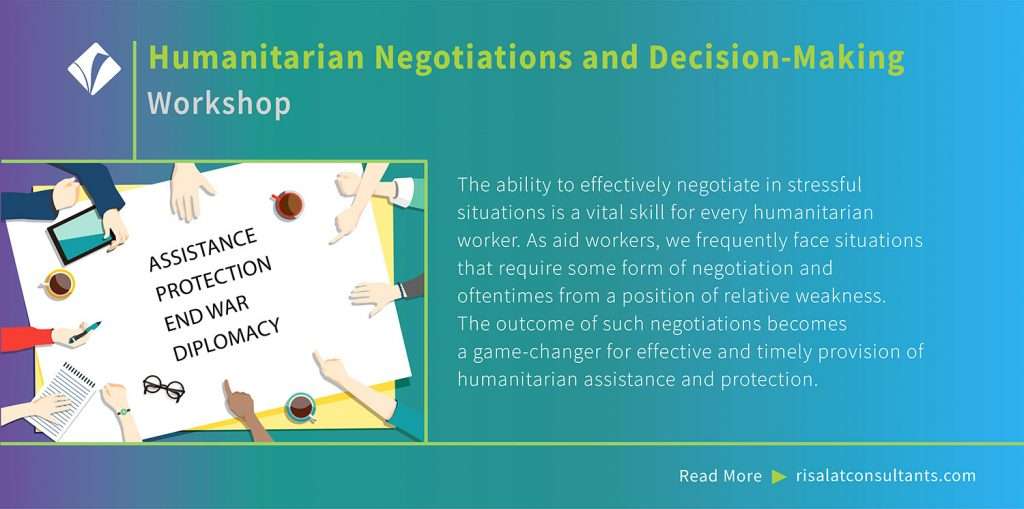
The ability to effectively negotiate in stressful situations is a vital skill for every humanitarian worker. Aid workers frequently face situations that require some form of negotiation, oftentimes from a position of relative weakness. The outcome of such negotiations becomes a game-changer for effective and timely provision of humanitarian assistance and protection. Volatile contexts, short time, and limited power to exert influence on the parties are the characteristics that make humanitarian negotiations unique.
Training on Humanitarian Negotiations and Decision-Making has been designed to target the improvement in individual and organizational negotiation skills. The programme actively works to equip participants with a set of practical tools, methods, and skills that help them analyse the environment where the humanitarian negotiation takes place and build the strategy for achieving desired objectives.
Программа, которую Risalat Consultants International проводит в Роттердаме (Нидерланды), сочетает занятия под руководством экспертов, реальные кейсы и групповую работу, чтобы участники могли применять полученные знания в своей организации.
Программа укрепляет институциональный потенциал в следующих областях:
- Understanding Humanitarian Negotiations and accompanying challenges
- Humanitarian Negotiations and International Humanitarian Law
- Различные режимы ведения переговоров
- Characteristics of humanitarian engagement and negotiations with armed groups
- Characteristics of humanitarian negotiations with government authorities
- Humanitarian Negotiations with Donors
- Humanitarian Negotiations with Civilians
- Multi-Party Humanitarian Negotiations
- Стратегическое мышление и определение направления
- Руководство командами и их развитие
- Принятие решений и решение проблем
- Коммуникация и влияние
Why this matters now
Организациям все больше нужны специалисты, способные:
- Задавать четкое направление и приоритеты
- Руководить командами и мотивировать их в период изменений
- Эффективно общаться и вести переговоры
- Справедливо управлять эффективностью
- Принимать взвешенные решения в условиях давления
Сильные системы лидерства, менеджмента и коммуникации помогают организациям:
- Превращать стратегии в результаты
- Формировать мотивированные и компетентные команды
- Управлять изменениями с меньшим сопротивлением
- Улучшать отношения с партнерами и заинтересованными сторонами
Кому стоит участвовать
Программа предназначена для:
- Improve interpersonal, communication, and diplomatic skills
- Master advocacy tools and techniques
- Learn how to negotiate the best agreement from the position of relative weakness
- Руководство переговорами и участие в них в гуманитарных контекстах и контекстах защиты
- Effectively analyze negotiating environment and build negotiation strategies under time-stress
- Comprehend the peculiarities of humanitarian negotiations with governments, military, armed groups, donors, and civilians
- Директора и руководители высшего звена
- Руководители департаментов и отделов
- Руководители среднего звена и тимлиды
- Руководители проектов и программ
- Специалисты по управлению персоналом и организационному развитию
- Сотрудники, готовящиеся к руководящим должностям
Отметьте, что должна уметь ваша команда.
Цели программы
По завершении программы участники смогут:
- Объяснять современные подходы к лидерству в государственных и частных организациях
- Задавать направление и приоритеты для своей команды
- Руководить людьми, мотивировать и развивать их
- Принимать решения с помощью структурированных методов
- Ясно выражать мысли и влиять на других
- Вести переговоры и управлять конфликтами
- Планировать изменения и руководить ими
- Справедливо управлять эффективностью
- Составить личный план развития лидерских качеств
Training Structure & Contents
- Understanding Humanitarian Negotiations and accompanying challenges
- Humanitarian Negotiations and International Humanitarian Law
- Различные режимы ведения переговоров
- Characteristics of humanitarian engagement and negotiations with armed groups
- Characteristics of humanitarian negotiations with government authorities
- Humanitarian Negotiations with Donors and Civilians
- Workshop: Applying methods to institutional examples and agreeing practical next steps
- Defining the motivation for negotiation
- Setting Negotiation Objectives
- Partners in humanitarian negotiations
- Interests, Position, and Power in humanitarian negotiations
- Stress and Time-Pressure in Humanitarian Negotiations
- Assessing Leverage and Maximizing Compatibility and Leverage
- Workshop: Applying negotiation objectives and leverage to institutional settings
- Diplomacy in Humanitarian Negotiations
- Personal Negotiation Styles
- Face-to-face negotiation and building relationship
- Managing cultural differences
- Language and Interpreters
- Dealing with Failure in Negotiation and following through
- Case Study: Diplomacy and negotiation styles in practice
- Peer-to-peer workshop
- Review of negotiation strategies under time-stress
- Integrating multi-party humanitarian negotiations
- Capstone Exercise: Action plan for participant institutions
- Setting priorities, owners and first steps
- Presenting action plans for peer and facilitator feedback
- Consolidation of individual and organizational negotiation skills
- Frameworks for leading and motivating teams through change
- Structured tools for decision-making under pressure
- Communication and stakeholder engagement review
- Finalising the personal leadership and negotiation development plan
Полное содержание по дням
First Day | Understanding Humanitarian Negotiations and accompanying challenges
- Understanding Humanitarian Negotiations and accompanying challenges
- Humanitarian Negotiations and International Humanitarian Law
- Различные режимы ведения переговоров
- Characteristics of humanitarian engagement and negotiations with armed groups
- Characteristics of humanitarian negotiations with government authorities
- Humanitarian Negotiations with Donors and Civilians
- Workshop: Applying methods to institutional examples and agreeing practical next steps
Второй день | Определение мотивации для переговоров, постановка целей переговоров
- Defining the motivation for negotiation
- Setting Negotiation Objectives
- Partners in humanitarian negotiations
- Interests, Position, and Power in humanitarian negotiations
- Stress and Time-Pressure in Humanitarian Negotiations
- Assessing Leverage and Maximizing Compatibility and Leverage
- Workshop: Applying negotiation objectives and leverage to institutional settings
Третий день | Дипломатия в гуманитарных переговорах, личные стили ведения переговоров
- Diplomacy in Humanitarian Negotiations
- Personal Negotiation Styles
- Face-to-face negotiation and building relationship
- Managing cultural differences
- Language and Interpreters
- Dealing with Failure in Negotiation and following through
- Case Study: Diplomacy and negotiation styles in practice
Fourth Day | Peer-to-peer workshop and Institutional Action Planning
- Peer-to-peer workshop
- Review of negotiation strategies under time-stress
- Integrating multi-party humanitarian negotiations
- Capstone Exercise: Action plan for participant institutions
- Setting priorities, owners and first steps
- Presenting action plans for peer and facilitator feedback
Fifth Day | Consolidation and Implementation Framework
- Consolidation of individual and organizational negotiation skills
- Frameworks for leading and motivating teams through change
- Structured tools for decision-making under pressure
- Communication and stakeholder engagement review
- Finalising the personal leadership and negotiation development plan
Методология обучения
Humanitarian Negotiations and Decision-Making is a highly interactive training with particular emphasis on knowledge exchange. The presenter uses proven adult-learning techniques to facilitate the conversation between the delegates. Several case studies and scenarios are discussed, and participants engage in real-life simulations where they can practise communication skills and work on personal negotiation styles. A short pre-assessment helps facilitators understand roles and priorities, and each day ends with a short reflection on practical application.
- Занятия под руководством экспертов по актуальной практике
- Региональные и международные кейсы
- Групповая работа и практические упражнения
- Симуляции и ролевые игры, где это уместно
- Обсуждение собственных задач участников
- Обмен опытом между организациями и странами
- Практические инструменты и шаблоны для работы
- Ежедневная рефлексия и планирование действий
Ожидаемые результаты
- Задавать четкое направление и приоритеты
- Руководить командами и развивать их
- Принимать взвешенные решения
- Эффективно общаться и вести переговоры
- Руководить изменениями с меньшим сопротивлением
- Планировать собственное развитие как руководителя
- Return with a personal action plan and practical tools for immediate institutional use
- Establish shared methods and templates across organisational teams
£3 950 за участника · счет и банковский перевод · группам от 5 человек предоставляется скидка
Пять и более участников от одной организации: укажите групповой тариф в запросе счета.
Ten or more: an in-house version for your institution may cost less per person. Ask for an in-house quote.
Регистрация закрывается через 25 дней (17 дек. 2026 г.)
Региональная актуальность и применение
Europe: European institutions apply leadership, management and communication within detailed regulatory frameworks and reform agendas. Participants from Europe can compare their practice with colleagues from other regions and test how established methods work under different conditions.
Africa: Across Africa, ministries, agencies and project teams working in leadership, management and communication increasingly operate alongside donor-financed programmes that expect clear systems and evidence. The programme helps participants adapt good practice to the institutions and resources they work with.
Middle East: In the Middle East, national development strategies and diversification plans place growing demands on leadership, management and communication. Participants explore how to build the capability these plans need inside public bodies and companies.
Asia: Institutions across Asia combine rapid growth with ambitious modernisation programmes. Participants from Asia can share their experience of scaling systems quickly and learn from approaches used elsewhere.
Pacific: Small island and Pacific states face particular constraints of size, distance and capacity. The programme highlights practical, proportionate approaches to leadership, management and communication that suit smaller institutions.
Профиль принимающей страны
Rotterdam, Netherlands: Studying away from their own country gives participants time to reflect away from daily pressures, compare how leadership, management and communication is handled in different settings, and build professional networks.
Who Will Deliver This Programme
Each date is delivered by a team assigned from Risalat's expert network for this subject. For this programme we assign:
How we choose them: Experience in the region of the participants or comparable settings; Command of the financier rules that apply (World Bank, ADB, AfDB, EU, UN) where relevant; Delivery in English; other languages on request for in-house groups; No conflict of interest with participants' institutions.
Training courses in RotterdamHumanitarians training courses
Почему эта программа проходит в Роттердаме
Rotterdam is home to Europe's largest seaport, offering direct insight into international trade, modern logistics, and maritime management. Visiting officials can examine flood protection infrastructure such as the Maeslantkering and observe urban regeneration projects across the city. The location is easily accessible through Rotterdam The Hague Airport and frequent rail connections from Amsterdam Airport Schiphol.
The Training on Humanitarian Negotiations and Decision-Making programme in January 2027 brings together officials and professionals from across Europe, Africa, the Middle East and Asia. Sessions combine short inputs, case studies and group work on participants' own files, and the city's institutions can be added as a study visit on request.
Getting there: Rotterdam The Hague Airport (RTM).
Узнайте, нужна ли вам виза, с помощью бесплатного сервиса «Проверка визы» и запросите приглашение после регистрации.
Та же тема в других городах
- Обучение по углубленному управлению закупками и стратегическим переговорам (Тбилиси)
- Humanitarian Cooperation and Diplomacy Training in Brussels (Brussels)
Другие программы в Роттердаме
- Urban Flood Risk Reduction and Drainage Master Planning in Rotterdam
- Urban Flood Resilience & Nature-Based Stormwater Drainage Engineering in Rotterdam
- Inland Waterway Navigation Systems & Multimodal Corridor Modernisation in Rotterdam
- Обучение управлению транспортными коридорами и финансированию дорог в Роттердаме
- Обучение основам экологического, социального и корпоративного управления (ESG)
- ReliefWeb OCHA
Is there negotiation and communication training for government officials in Rotterdam in January 2027?
Can "Training on Humanitarian Negotiations and Decision-Making" be delivered in-house for one organisation?
Which other negotiation and communication programmes does Risalat run?
Как организации регистрируются и оплачивают участие?
Для команд и организаций
Bring your team
Teams that learn together apply more at work. Tell us how many people and how you would like to take part: we reply with a group quote within two working days.
Другие даты и города по этой теме: учебные курсы по управлению гуманитарными программами (44 предстоящие даты).
More training courses in the Netherlands · Все программы в Европе · Полный календарь обучения
Запланировать эту программу в дорожной карте: почему это важно, зачем это утверждать, даты планирования и карьера, которую это создает.