Key facts
- Dates
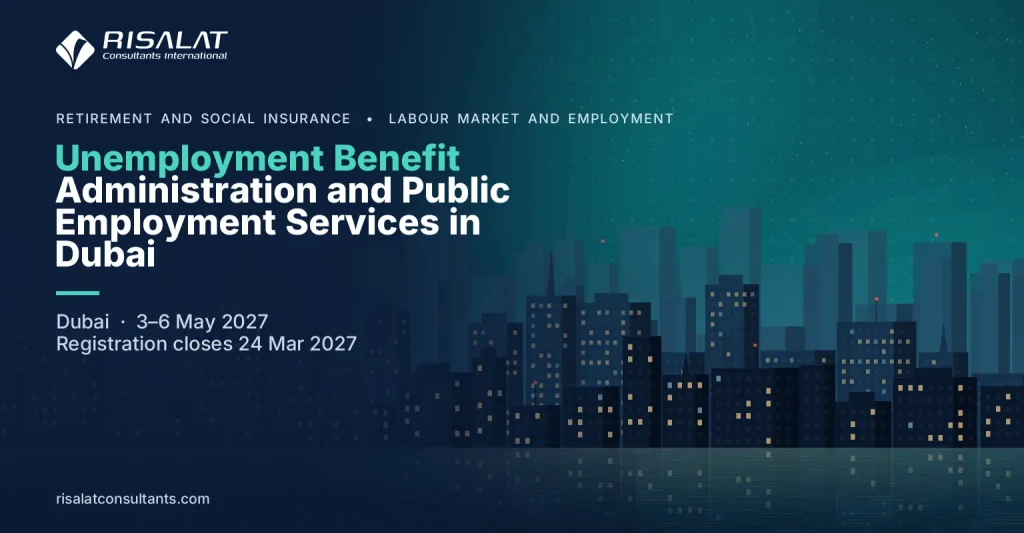
- 3–6 May 2027 (4 days)
- Where
- Dubai, United Arab Emirates
- Fee per participant
- £3,300 (GBP)
- Payment
- By invoice and bank transfer
- Registration closes
- 24 Mar 2027
- Format
- 4-day short course: a practical capacity-building programme for government, NGO and project teams in Dubai
- In-house option
- Run it for your team, on your dates
On this page 10 sections
Unemployment Benefit Administration and Public Employment Services in Dubai
Programme Overview
This executive training programme delivers operational insights into administering contributory unemployment benefit schemes alongside modern public employment services. Designed for social protection practitioners, labour specialists, and employment centre administrators, the curriculum addresses the transition from informal assistance to institutionalised labour market safety nets. Participants analyse international administrative models, institutional governance structures, and the regulatory underpinnings required to deliver resilient income support that balances fiscal sustainability with adequate worker coverage across varying economic sectors.
Free self-check: the training needs assessment gives a free training needs assessment (TNA) for your team, in about 10 minutes.
Delegates explore practical mechanisms to connect passive income replacement with dynamic, active labour market programmes. The course concentrates on modern profiling methodologies, employment counselling, and evidence-based matching infrastructures that accelerate sustainable re-entry into the workforce. Through targeted operational case studies, participants examine the alignment of institutional mandates, data-sharing protocols across government entities, and the technical requirements for operating efficient job centres capable of serving diverse job-seeker cohorts, including displaced workers, youth, and self-employed individuals transitioning between economic activities.
Digital service delivery and programme integrity form the practical core of this course. Attendees evaluate strategies to build fraud-resistant claims verification pipelines, automated contribution tracking mechanisms, and citizen-centric digital portals. The sessions highlight international standards, including International Labour Organization conventions and modern enterprise architecture approaches, enabling public agencies to modernise IT legacy setups, safeguard public resources, and design transparent, accessible social security administration frameworks that maintain public trust under fluctuating economic cycles.
The programme strengthens institutional capability in:
- International standards and legal frameworks: ILO Convention 102 and Convention 168 benchmarks;
- Operational parameters of contributory unemployment funds: financing, vesting, and eligibility rules;
- Establishing unified social registries: beneficiary identification and cross-government interoperability;
- Employer contribution collection: compliance monitoring, payroll deductions, and audit trails;
- Institutional governance models: delineating social security funds, ministries, and delivery agencies;
- Integrating passive income maintenance with active labour market programmes (ALMPs);
- Job-seeker segmentation and profiling tools: statistical models and caseworker assessment matrices;
- Structuring personalised action plans: mutual obligation frameworks and sanction administration;
- Fraud risk assessment and fraud risk registers;
- Design and testing of internal controls;
- The Three Lines model and the role of oversight;
- Audit planning, evidence, and documentation.
- Transaction
- Record
- Control
- Evidence
- Opinion
Why this matters now
Organisations increasingly require professionals capable of:
- Identifying and rating fraud and control risks in their own processes;
- Designing controls that are proportionate and testable;
- Gathering and documenting reliable audit evidence;
- Recognising red flags early and escalating them correctly;
- Turning findings into practical, agreed actions.
Strong fraud, audit, and internal control systems help organisations:
- Reduce losses and ineligible expenditure;
- Pass external audits with fewer findings;
- Strengthen trust with financiers and citizens;
- Respond to allegations in a fair and documented way.
Who Should Attend
This programme is designed for:
- Social security and pension administration officials managing statutory schemes;
- Public employment service directors and employment centre branch managers;
- Labour market policy specialists and economic advisers in public agencies;
- Operations managers implementing contributory unemployment insurance funds;
- Project management unit staff managing donor-financed labour market reforms;
- Ministry of labour, employment, and youth empowerment technical teams;
- IT systems architects designing national social registry and portal platforms;
- Internal audit and compliance officers overseeing social benefit disbursement;
- Monitoring and evaluation specialists assessing active labour market programmes;
- Client services heads managing citizen-facing claims intake operations;
- Internal auditors and audit managers;
- Finance managers and accountants.
Tick what your team needs to be able to do.
Programme Objectives
By the end of this programme participants will be able to:
- Evaluate institutional models and legal foundations for contributory unemployment benefit schemes;
- Design operational workflows for contribution tracking, benefit calculation, and claims adjudication;
- Establish robust active labour market programmes linked directly to income support disbursements;
- Construct digital client profiling and automated job-matching pipelines for public employment centres;
- Implement risk-based verification controls to prevent fraud, error, and overpayments in benefit delivery;
- Formulate institutional data-exchange protocols connecting tax authorities, registries, and employment offices;
- Structure accessible digital self-service portals and multi-channel client engagement models;
- Deploy end-to-end claims intake architecture across digital portals, counter services, and assisted applications;
- Automate entitlement calculations regarding qualifying employment periods, wage bases, and benefit duration;
- Execute risk-based fraud prevention by designing data-matching algorithms and real-time verification checks.
Training Structure & Contents
- International standards and legal frameworks: ILO Convention 102 and Convention 168 benchmarks;
- Operational parameters of contributory unemployment funds: financing, vesting, and eligibility rules;
- Establishing unified social registries: beneficiary identification and cross-government interoperability;
- Employer contribution collection: compliance monitoring, payroll deductions, and audit trails;
- Institutional governance models: delineating social security funds, ministries, and delivery agencies;
- Workshop on institutional foundations: applying frameworks and methods to institutional examples to agree practical next steps.
- End-to-end claims intake architecture: digital portals, counter services, and assisted applications;
- Automating entitlement calculations: qualifying employment periods, wage bases, and benefit duration;
- Risk-based fraud prevention: designing data-matching algorithms and real-time verification checks;
- Managing appeals, grievances, and disputes: statutory tribunals and administrative review mechanisms;
- Internal controls and payment distribution: secure electronic fund transfers and reconciliations;
- Workshop on claims processing and integrity: applying operational methods to institutional examples and setting action steps.
- Integrating passive income maintenance with active labour market programmes (ALMPs);
- Job-seeker segmentation and profiling tools: statistical models and caseworker assessment matrices;
- Structuring personalised action plans: mutual obligation frameworks and sanction administration;
- Employment matching systems: competency frameworks, vacancy registration, and employer liaison;
- Targeted activation pathways: reskilling, apprenticeships, and subsidised employment opportunities;
- Case study analysis: reviewing practical public employment service and activation cases against good practice.
- Designing intuitive digital client portals: self-service claims, status tracking, and reporting;
- Multi-channel service delivery: managing physical employment centres alongside remote channels;
- Key performance indicators: tracking placement rates, benefit duration, and activation cost-efficiency;
- Change management and staff capability building in newly formed labour administration bodies;
- Action planning: drafting operational roadmaps for national employment and benefit platforms;
- Capstone exercise synthesizing digital modernisation, claims delivery, and activation roadmaps.
- Evaluating institutional governance models and delineations across funds, ministries, and delivery agencies;
- Application of the Three Lines model and defining the role of oversight in social protection funds;
- Conducting fraud risk assessments and establishing institutional fraud risk registers;
- Design, implementation, and testing of internal controls in benefit disbursement systems;
- Audit planning, documentation, and gathering reliable audit evidence for statutory schemes;
- Institutional readiness planning for transition economies, island states, and systemic reform initiatives.
Full day-by-day contents
First Day | Institutional Foundations of Unemployment Insurance and Registration Systems
- International standards and legal frameworks: ILO Convention 102 and Convention 168 benchmarks;
- Operational parameters of contributory unemployment funds: financing, vesting, and eligibility rules;
- Establishing unified social registries: beneficiary identification and cross-government interoperability;
- Employer contribution collection: compliance monitoring, payroll deductions, and audit trails;
- Institutional governance models: delineating social security funds, ministries, and delivery agencies;
- Workshop on institutional foundations: applying frameworks and methods to institutional examples to agree practical next steps.
Second Day | Claims Processing, Verification Mechanisms, and Programme Integrity
- End-to-end claims intake architecture: digital portals, counter services, and assisted applications;
- Automating entitlement calculations: qualifying employment periods, wage bases, and benefit duration;
- Risk-based fraud prevention: designing data-matching algorithms and real-time verification checks;
- Managing appeals, grievances, and disputes: statutory tribunals and administrative review mechanisms;
- Internal controls and payment distribution: secure electronic fund transfers and reconciliations;
- Workshop on claims processing and integrity: applying operational methods to institutional examples and setting action steps.
Third Day | Public Employment Services, Activation Policies, and Case Management
- Integrating passive income maintenance with active labour market programmes (ALMPs);
- Job-seeker segmentation and profiling tools: statistical models and caseworker assessment matrices;
- Structuring personalised action plans: mutual obligation frameworks and sanction administration;
- Employment matching systems: competency frameworks, vacancy registration, and employer liaison;
- Targeted activation pathways: reskilling, apprenticeships, and subsidised employment opportunities;
- Case study analysis: reviewing practical public employment service and activation cases against good practice.
Fourth Day | Digital Modernisation, Service Delivery Channels, and Performance Management
- Designing intuitive digital client portals: self-service claims, status tracking, and reporting;
- Multi-channel service delivery: managing physical employment centres alongside remote channels;
- Key performance indicators: tracking placement rates, benefit duration, and activation cost-efficiency;
- Change management and staff capability building in newly formed labour administration bodies;
- Action planning: drafting operational roadmaps for national employment and benefit platforms;
- Capstone exercise synthesizing digital modernisation, claims delivery, and activation roadmaps.
Fifth Day | Governance, Audit Oversight, and Systemic Sustainability
- Evaluating institutional governance models and delineations across funds, ministries, and delivery agencies;
- Application of the Three Lines model and defining the role of oversight in social protection funds;
- Conducting fraud risk assessments and establishing institutional fraud risk registers;
- Design, implementation, and testing of internal controls in benefit disbursement systems;
- Audit planning, documentation, and gathering reliable audit evidence for statutory schemes;
- Institutional readiness planning for transition economies, island states, and systemic reform initiatives.
Training Methodology
Delivered by Risalat Consultants International in Dubai, United Arab Emirates, this programme combines expert-led sessions, practical case analysis, and collaborative group exercises to ensure delegates can directly apply tools and frameworks within their home institutions.
- Expert-led presentations detailing international benchmarks, administrative models, and regulatory structures;
- Small-group workshops dedicated to applying daily methods to institutional challenges;
- Operational case study evaluations comparing real-world implementations with international good practice;
- Hands-on action planning exercises to formulate implementation roadmaps.
Expected Outcomes
- Enhanced capability to administer contributory unemployment benefit schemes aligned with ILO conventions;
- Strengthened integration between passive benefit disbursement and active labour market activation policies;
- Ability to design robust, fraud-resistant claims verification workflows and data-matching controls;
- Capacity to structure unified social registries and cross-governmental data-exchange protocols;
- Improved operational design for multi-channel public employment centres and digital self-service portals;
- Formulation of practical action plans to support institutional transition and audit compliance.
£3,300 per participant · invoice and bank transfer · groups of 5 or more receive a discount
Five or more from one organisation: ask for the group rate on the invoice request.
Ten or more: an in-house version for your institution may cost less per person. Ask for an in-house quote.
Registration closes in 116 days (24 Mar 2027)
Who Will Deliver This Programme
Each date is delivered by a team assigned from Risalat's expert network for this subject. For this programme we assign:
How we choose them: Experience in the region of the participants or comparable settings; Command of the financier rules that apply (World Bank, ADB, AfDB, EU, UN) where relevant; Delivery in English; other languages on request for in-house groups; No conflict of interest with participants' institutions.
Training courses in DubaiRetirement and Social Insurance training courses
Why Dubai for this programme
Dubai is a one-flight hub for Africa, Asia and Europe, with simple visas for many nationalities and modern training venues.
The Unemployment Benefit Administration and Public Employment Services in Dubai programme in May 2027 brings together officials and professionals from across the Middle East region and beyond. Sessions combine short inputs, case studies and group work on participants' own files, and the city's institutions can be added as a study visit on request.
Getting there: Dubai International (DXB).
Check whether you need a visa with the free Visa Checker, and ask for an invitation letter once you are registered.
The same topic in other cities
- Unemployment Insurance & Integrated Employment Services Delivery in Kuala Lumpur (Kuala Lumpur)
- Youth Apprenticeship Frameworks & Tourism Sector Reskilling in Dubai (Dubai)
- Digital Social Protection Training: AI-Enabled Social Protection & Integrated Case Management (Lisbon)
Other programmes in Dubai
- Mini Degree in Internal Audit and Risk Management in Dubai
- Refugee and Host Community Programme Management in Dubai
- Performance Audit for Supreme Audit Institutions in Dubai
- Artificial Intelligence for Public Sector Leaders Training in Dubai
- Records and Archives Management for Public Institutions in Dubai
Questions before you nominate your team? Book a 30-minute call with us, or ask for this programme in-house.
Teams often travel here from Maldives, Sri Lanka, Bangladesh, Nepal, Pakistan, Afghanistan, Kazakhstan, Uzbekistan. Funding, visa letters and group rates are explained on each country page.
Is there labour market and employment training for government officials in Dubai in May 2027?
Can "Unemployment Benefit Administration and Public Employment Services in Dubai" be delivered in-house for one organisation?
Which other labour market and employment programmes does Risalat run?
How do organisations register and pay?
For teams and institutions
Bring your team
Teams that learn together apply more at work. Tell us how many people and how you would like to take part: we reply with a group quote within two working days.
Watch: this programme in short


More training courses in the United Arab Emirates · All programmes in Middle East · Full training calendar
Plan this programme in a roadmap: why it matters, why to approve it, the dates to plan and the career it builds.