关键信息
- 日期
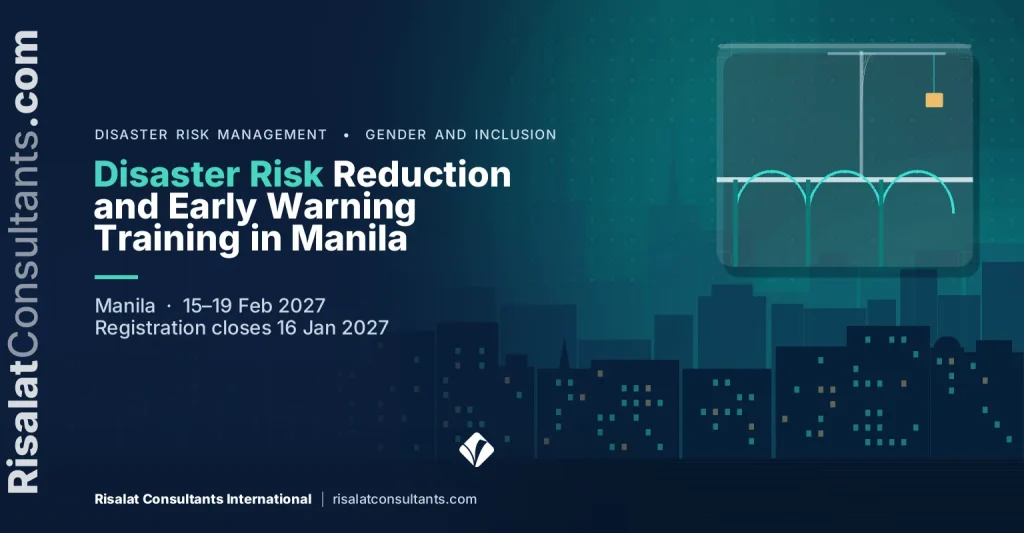
- 2027年2月15–19日(5天)
- 地点
- Shared on registration, Manila, Philippines
- 每位学员费用
- £3,630(英镑)
- 付款
- 通过发票和银行转账付款
- 报名截止
- 2027年1月16日
- 证书
- 结业证书
- 内训选项
- 按您的日期,为您的团队专场举办
本页内容16个部分
培训项目概述
Early warning only saves lives when every link works: hazards are monitored, forecasts are turned into clear warnings, the warnings reach the people at risk, and those people and the agencies around them know what to do. When one link is weak, a well-funded system can still fail on the day.
Governments and their partners are investing heavily in these links. In Mongolia, the Asian Development Bank approved the Strengthening Integrated Early Warning System in Mongolia Project on 6 November 2025, with a US$2 million grant and loans of US$18 million and US$12 million. Its planned outputs are enhanced national multi-hazard monitoring and warning dissemination technology, a disaster risk monitoring system, and stronger capacity for early warning and disaster preparedness, and the project record states a strong need for capacity building and training. The executing agency is the National Emergency Management Agency (NEMA).
In September 2026, ADB approved a further US$100 million loan for the Strengthening Mongolia’s Disaster Resilience Capacity Project. It finances modern firefighting vehicles and equipment, search and rescue capacity, an upgrade of NEMA’s Integrated Disaster Management System and a national emergency response training centre, and it aims to train and equip 200 community volunteer groups in high-risk areas across 120 soums by 2031. In Nepal, the Swiss-funded ReCAP project is working towards an agreed institutional model for river-basin early warning with the National Disaster Risk Reduction and Management Authority (NDRRMA), with detailed plans for the Dudhkoshi and Upper Arun basins.
Equipment and systems arrive first; the people who will run them need to be ready at the same time. This programme in Manila brings together staff of disaster authorities, early warning agencies and project teams to work through the full warning chain, from risk information to community action, and to plan how their own system will perform in the next season.
The Programme Strengthens Institutional Capability
- Multi-hazard risk assessment and risk information
- Hazard monitoring and forecasting arrangements
- Warning thresholds and decision rules
- Roles and mandates across the warning chain
- Warning messages people understand and act on
- Dissemination channels, including mobile and broadcast
- Reaching remote, mobile and vulnerable communities
- Emergency operations centre procedures
- Coordination between national and local levels
- Community volunteer groups and preparedness
- Drills, exercises and readiness checks
- Information management and GIS in emergencies
- Integrated disaster management information systems
- After-action reviews and learning from events
- Planning and managing donor-financed disaster projects
- Training centres and sustained staff training
- Measuring warning performance
- Budgeting for operation and maintenance
The programme is designed for disaster authorities and the agencies that work with them, and it can be delivered in-house for one country’s system.
- 投入
- 活动
- 产出
- 成果
- 影响
The Growing Importance of Early Warning Capacity
Disaster management in many countries is moving from response after the event to action before it. ADB describes its Mongolia investment in exactly those terms: strengthening proactive disaster management, investing in the national agency, in an integrated information system and in trained community volunteers. Nepal’s work on river-basin early warning reflects the same shift, with institutions agreeing who does what before the flood rather than during it.
That shift places new demands on staff. Officers who were trained for response must now design thresholds, manage information systems, run exercises, train volunteers and report results to financiers. This programme is built around those tasks.
各机构日益需要具备以下能力的专业人员:
- Turning risk assessments into operational warning thresholds
- Agreeing roles between forecasters, authorities and local government
- Writing warning messages that trigger the right action
- Choosing and testing dissemination channels
- Running an emergency operations centre during an event
- Training and supporting community volunteer groups
- Designing and running drills and simulation exercises
- Using GIS and information systems for decisions
- Conducting after-action reviews
- Planning operation and maintenance of new equipment
- Reporting progress on donor-financed disaster projects
- Building sustainable in-house training programmes
Strong early warning systems help organisations:
- Give people more time to act
- Reduce losses of life and assets
- Coordinate agencies under pressure
- Use new equipment and systems fully
- Keep volunteers motivated and ready
- Learn from every event
- Show financiers measurable results
- 增强公众对官方预警的信任
The programme focuses on the institutional side of early warning: decisions, roles, procedures and people.
Who Should Attend This Early Warning Training?
本培训项目适合:
- Directors and senior staff of national disaster management authorities
- Emergency operations centre managers and duty officers
- Early warning and forecasting officers
- Hydrometeorological agency staff
- GIS, risk information and data specialists
- Local and provincial disaster management officers
- Community preparedness and volunteer coordinators
- Fire, rescue and civil protection managers
- Communication officers who issue public warnings
- Training centre managers and trainers
- Planners in ministries of finance and planning working on disaster risk
- Coordinators and specialists of disaster projects financed by ADB, the World Bank and others
- Humanitarian and Red Cross or Red Crescent partners
- Utility and infrastructure operators with emergency roles
Teams that include both a national authority and a local or provincial office benefit most, since many warning failures happen between levels.
勾选您的团队需要具备的能力。
Early Warning Training Objectives
Upon successful completion of this Early Warning Training, participants will be able to:
- Describe each link of a people-centred early warning chain
- Use risk information to set warning thresholds and triggers
- Define roles and mandates for each warning decision
- Write warning messages that are clear and actionable
- Select dissemination channels for different groups
- Run emergency operations centre procedures during an event
- Organise and train community volunteer groups
- Design and evaluate a drill or simulation exercise
- Use information systems and GIS for operational decisions
- Conduct an after-action review and act on its findings
- Plan operation and maintenance for new systems and equipment
- Prepare a 90-day improvement plan for their own system
Each objective is practised in a workshop, so participants return with outputs, not only notes.
Source: ADB project 53039-001 (approved 6 November 2025) and ADB news release on project 59506-001 (28 September 2026).
1. What does ADB's 2026 Mongolia disaster resilience project aim to achieve for communities by 2031?
ADB's September 2026 release states the project will train and equip 200 community volunteer groups across 120 soums.
2. Which agency is the executing agency for Mongolia's integrated early warning project?
ADB's project page for 53039-001 names the National Emergency Management Agency as executing agency.
3. Which river basins does Nepal's ReCAP project plan early warning for?
The SDC project record targets a government-endorsed early warning plan for the Dudhkoshi and Upper Arun basins.
培训项目内容与结构
- Opening: participants’ hazards and systems
- The four elements of people-centred early warning
- Multi-hazard risk assessment for warning design
- Hazard monitoring networks and data flows
- Forecasting: what forecasts can and cannot tell
- Case: Mongolia’s integrated early warning project
- Case: Nepal’s river-basin early warning arrangements
- From forecast to decision: thresholds and triggers
- Impact-based forecasting and warnings
- Who decides: mandates and legal frameworks
- Standard operating procedures for warnings
- Uncertainty and false alarms: managing trust
- Warning message content and wording
- Colour codes, levels and instructions
- Dissemination channels: broadcast, mobile, sirens and people
- Reaching remote, nomadic and mountain communities
- Last-mile communication through local leaders and volunteers
- Inclusion: older people, people with disabilities, women and children
- Redundancy when networks fail
- Community volunteer groups: roles and training
- Equipment for volunteers and its upkeep
- Emergency operations centres: set-up and activation
- Incident management and command structures
- Information management and situation reports
- Integrated disaster management information systems
- GIS dashboards for decision makers
- Coordination with fire, rescue, health and utilities
- National and local coordination during escalation
- Designing drills and exercises
- After-action reviews and lessons learned
- Measuring warning performance
- Operation and maintenance of systems and equipment
- Building a national emergency training centre programme
- Planning and reporting on donor-financed disaster projects
- Budgeting for preparedness
完整的每日课程内容
The five days follow the warning chain from risk to action:
- Day 1: risk information and the warning chain
- Day 2: thresholds, decisions and warning messages
- Day 3: dissemination and reaching every community
- Day 4: emergency operations and coordination
- Day 5: preparedness, learning and action plans
完整的每日课程内容
First Day | Risk Information and the Warning Chain
- Opening: participants’ hazards and systems
- The four elements of people-centred early warning
- Multi-hazard risk assessment for warning design
- Hazard monitoring networks and data flows
- Forecasting: what forecasts can and cannot tell
- Case: Mongolia’s integrated early warning project
- Case: Nepal’s river-basin early warning arrangements
- Risk information for planners and financiers
- Mapping participants’ own warning chains
Workshop: Our Warning Chain Map
Each team maps its national warning chain, from monitoring station to household, marks every hand-over and identifies the three weakest links, which they work on through the week.
Second Day | Thresholds, Decisions and Warning Messages
- From forecast to decision: thresholds and triggers
- Impact-based forecasting and warnings
- Who decides: mandates and legal frameworks
- Standard operating procedures for warnings
- Uncertainty and false alarms: managing trust
- Warning message content and wording
- Colour codes, levels and instructions
- Messages for different languages and groups
- Testing messages with communities
Workshop: Thresholds and Messages for One Hazard
Teams choose one hazard from their country, set warning levels and triggers, and write the messages for each level, then test them on peers acting as residents, herders or local officials.
Third Day | Dissemination and Reaching Every Community
- Dissemination channels: broadcast, mobile, sirens and people
- Reaching remote, nomadic and mountain communities
- Last-mile communication through local leaders and volunteers
- Inclusion: older people, people with disabilities, women and children
- Redundancy when networks fail
- Community volunteer groups: roles and training
- Equipment for volunteers and its upkeep
- Feedback from communities into the system
- Case: training community groups across many districts
Workshop: Last-Mile Plan
Teams design how a warning reaches one remote district, including volunteers, backup channels and confirmation that people received and understood it.
Fourth Day | Emergency Operations and Coordination
- Emergency operations centres: set-up and activation
- Incident management and command structures
- Information management and situation reports
- Integrated disaster management information systems
- GIS dashboards for decision makers
- Coordination with fire, rescue, health and utilities
- National and local coordination during escalation
- Working with humanitarian and international partners
- Public communication during the event
Case Study: Simulation of a Multi-Hazard Event
Participants run an emergency operations centre through a timed scenario with changing forecasts and incoming reports, making warning, evacuation and resource decisions and producing situation reports.
Fifth Day | Preparedness, Learning and Action Plans
- Designing drills and exercises
- After-action reviews and lessons learned
- Measuring warning performance
- Operation and maintenance of systems and equipment
- Building a national emergency training centre programme
- Planning and reporting on donor-financed disaster projects
- Budgeting for preparedness
- 个人与团队行动规划
Capstone Exercise: 90-Day Early Warning Improvement Plan
Each team presents a 90-day plan to fix the weakest links found on Day 1, with responsibilities, costs to check and indicators, reviewed by facilitators and peers.
Early Warning Training Methodology
The programme is practical and scenario based. Short expert inputs are followed by team exercises on participants’ own hazards and systems.
本培训项目融合了:
- Expert-led sessions on early warning and emergency management
- Country cases from Mongolia and Nepal
- Warning chain mapping on participants’ own systems
- Threshold and message design exercises
- Last-mile communication planning
- A timed emergency operations simulation
- Drill design and after-action review practice
- Peer review between countries
- Templates and checklists participants keep
- Individual and team action planning
Mixed groups from several countries compare solutions, which often shows teams that a problem they thought unique has already been solved elsewhere.
预期成果
Upon completion of this Early Warning Training, participants will be able to:
- Identify and fix weak links in their warning chain
- Set clear thresholds and decision rules
- Issue warnings people understand and act on
- Reach remote and vulnerable communities reliably
- Run an emergency operations centre with confidence
- Prepare and support community volunteer groups
- Design and evaluate drills
- Learn systematically from every event
- Plan sustainable operation of new systems
Agencies gain staff who can make new systems and equipment deliver what the investment promised.
每位学员£3,630 · 发票与银行转账 · 5人及以上团体可享折扣
同一机构五人及以上:请在申请发票时索取团体价。
Ten or more: an in-house version for your institution may cost less per person. Ask for an in-house quote.
Registration closes in 60 days (16 Jan 2027)
Institutional Application of Early Warning Training
本培训项目帮助机构加强:
- Warning standard operating procedures
- Roles and mandates across agencies
- Warning message standards
- Dissemination and redundancy arrangements
- Community preparedness programmes
- Emergency operations centre procedures
- Information management and reporting
- Drill and exercise programmes
- After-action review practice
- Operation and maintenance planning
- In-house training capacity
学员将带着实用工具回到工作岗位,以提升:
- Warning chain map with weakest links
- Threshold and message set for one hazard
- Last-mile communication plan
- Emergency operations centre checklist
- Situation report template
- Drill design template
- After-action review template
- 90天改进计划
Project teams can also use Risalat’s free project health check to review their disaster project’s delivery risks before or after the programme.
区域相关性与应用
亚洲
Mongolia is investing in a national multi-hazard early warning system and in a stronger emergency agency, with ADB financing of US$32 million for early warning and US$100 million for disaster resilience capacity. Nepal is agreeing an institutional model for river-basin early warning with its national disaster authority. Other countries in South and Central Asia face similar hazards and similar institutional questions.
太平洋地区
Pacific island countries face cyclones, floods and sea-level hazards with small agencies and dispersed populations, which makes last-mile communication and community preparedness especially important. The methods in this programme, from thresholds to volunteer groups, apply directly to small island systems.
Across these regions the challenge is the same: new technology must be matched by clear decisions, trained people and tested procedures.
东道国概况:菲律宾
Manila, the capital of the Philippines, is one of Asia’s major cities and a regional air hub with good connections across Asia and the Pacific. It offers a wide choice of training venues and accommodation in its business districts.
Manila is the headquarters city of the Asian Development Bank, which finances the Mongolia disaster projects used as the main cases in this programme, and the Philippines has long experience of typhoons and other hazards. This makes it a relevant setting for discussing early warning and preparedness. Any visits to institutions are arranged only when confirmed with the host and are not part of the guaranteed programme.
Entry requirements for the Philippines depend on nationality, so participants should check the official rules early. Risalat provides visa support letters for registered participants.
Early Warning Training Deliverables
Participants receive support before, during and after the programme so that learning turns into changes in their system.
培训开始前
- 学员课前评估
- Early Warning Readiness Assessment
- Early Warning Resource Pack
- 课前阅读资料
- 免费签证支持与咨询
培训期间
- 机场接机与欢迎协助
- Accommodation with breakfast: 6 nights, check-in Sunday 14 February 2027, check-out Saturday 20 February 2027 (one night before and one night after the programme)
- 欢迎交流晚宴
- Risalat培训礼包(背包、水瓶、马克杯、T恤、帽子、护照套、笔、笔记本、冰箱贴及钥匙扣)
- Comprehensive Early Warning Training Manual
- Warning Chain Mapping Template
- Threshold and Warning Message Template
- Emergency Operations Centre Checklist
- Drill and After-Action Review Templates
- 实践研讨与模拟演练
- 小组讨论与同伴学习
- 每日午餐与茶歇
- 全面使用培训场地设施
- 装有数字学习资料的迷你平板电脑
- 实地考察(如适用)
- 城市休闲观光
培训结束后
- 结业证书
- Risalat培训项目参与表彰奖
- 培训后参考资料
- 90-Day Early Warning Improvement Plan
- Last-Mile Communication Plan
- 培训后支持与跟进指导
- 培训项目报告
Disaster authorities and project units that want this programme for their own teams can request a tailored in-house version.
Common Challenges in Early Warning, And How This Training Helps
How can a new early warning system avoid failing at the last mile?
Day 3 is dedicated to dissemination and last-mile communication, including volunteers and backup channels for remote communities.
How can agencies agree who issues which warning?
Day 2 covers mandates, thresholds and standard operating procedures, so each warning decision has a clear owner.
How can warnings be written so people act on them?
Day 2 includes message design and testing with peers acting as different community groups.
How can an emergency operations centre stay in control during escalation?
The Day 4 simulation trains teams to manage information, decisions and situation reports under time pressure.
How can volunteer groups stay ready between events?
Days 3 and 5 cover volunteer roles, equipment upkeep and regular drills.
How can agencies show financiers that the investment works?
Day 5 covers warning performance measures, after-action reviews and project reporting.
How can new equipment keep working after the project ends?
Day 5 includes operation and maintenance planning and budgeting for preparedness.
常见问题
谁应参加?
Staff of national and local disaster management authorities, emergency operations centres, hydrometeorological and early warning agencies, GIS and risk information teams, planners and coordinators of disaster projects financed by ADB, the World Bank and other partners.
What is the difference between disaster risk reduction and early warning?
Disaster risk reduction covers everything that lowers losses before a disaster, from risk assessment to planning and investment. Early warning is one part of it: monitoring hazards, forecasting, issuing warnings and making sure people and agencies act on them in time.
Why Manila?
Manila is home to the Asian Development Bank, which finances major disaster resilience projects in Mongolia and across Asia and the Pacific, and the Philippines has long experience of typhoons and other hazards. It is also a regional air hub. Any institutional visits are confirmed separately and are not part of the guaranteed programme.
Will we work on our own early warning system?
Yes. Participants map their own warning chain on Day 1 and finish the week with a 90-day improvement plan for it.
Can this be delivered for one agency?
Yes. Disaster authorities and project units can request an in-house version built around their hazards, systems and project commitments.
Who Will Deliver This Programme
Each date is delivered by a team assigned from Risalat's expert network for this subject. For this programme we assign:
How we choose them: Experience in the region of the participants or comparable settings; Command of the financier rules that apply (World Bank, ADB, AfDB, EU, UN) where relevant; Delivery in English; other languages on request for in-house groups; No conflict of interest with participants' institutions.
Names and short CVs of the assigned experts are shared with registered participants and sponsoring organisations before the programme, on request. Are you an expert in this subject? Join our expert network.
Training courses in ManilaHumanitarians training courses
为何选择在马尼拉举办本培训项目
亚洲开发银行总部设在马尼拉,适合举办有关亚行程序和项目管理的培训项目。
The Disaster Risk Reduction and Early Warning Training in Manila programme in February 2027 brings together officials and professionals from across the Asia region and beyond. Sessions combine short inputs, case studies and group work on participants' own files, and the city's institutions can be added as a study visit on request.
交通: 尼诺伊·阿基诺国际机场(MNL)。
使用免费的签证查询工具确认您是否需要签证,完成报名后即可申请邀请函。
其他城市的同主题培训
- Emergency Geohazard Early Warning and Disaster Response Command in Dubai (Dubai)
- Adaptive Social Safety Nets and Scalable Disaster Shock Triggers in Kigali (Kigali)
- Shock-Responsive Social Registry and Early Warning Systems Design in Nairobi (Nairobi)
- Pastoral Rangeland Management and Livestock Value Chain Resilience in Nairobi (Nairobi)
- Integrated River Basin Modelling and Flood Risk Reduction in Bangkok (Bangkok)
- Urban Flood Resilience & Nature-Based Stormwater Drainage Engineering in Rotterdam (Rotterdam)
马尼拉的其他培训项目
Teams often travel here from Micronesia. Funding, visa letters and group rates are explained on each country page.
- 联合国减少灾害风险办公室 UNDRR
- 适应基金 适应基金
- 《以社区为基础的韧性建设:联合国开发计划署指导说明》(2025) 联合国开发计划署
For teams and institutions
Bring your team
Teams that learn together apply more at work. Tell us how many people and how you would like to take part: we reply with a group quote within two working days.
Other dates and cities for this subject: Disaster Risk Management and Emergency Response training courses (75 upcoming dates).
More training courses in the Philippines · 亚洲所有培训项目 · 完整培训日历
Plan this programme in a roadmap: why it matters, why to approve it, the dates to plan and the career it builds.