Key facts
- Dates
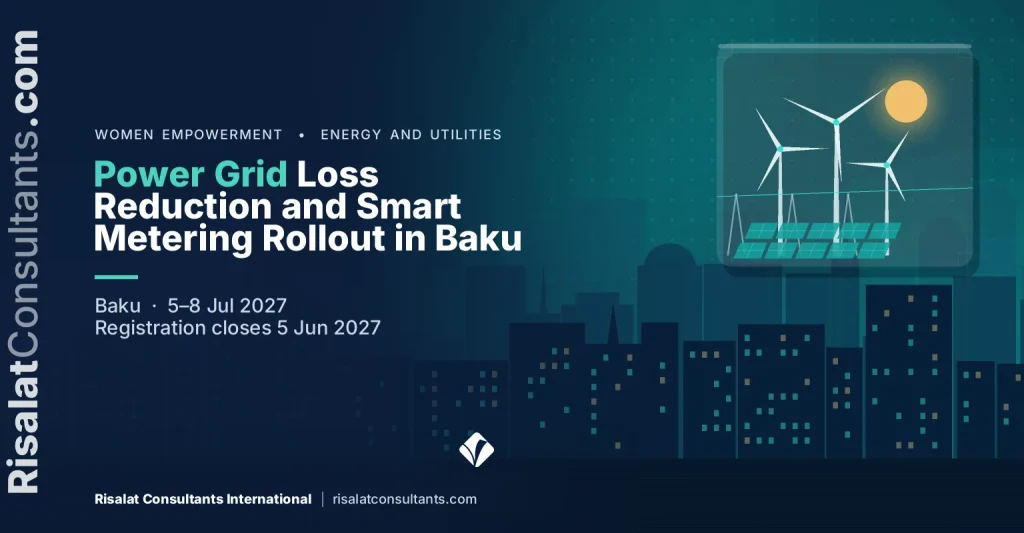
- 5–8 Jul 2027 (4 days)
- Where
- Baku, Azerbaijan
- Fee per participant
- £1,950 (GBP)
- Payment
- By invoice and bank transfer
- Registration closes
- 5 Jun 2027
- Certificate
- Certificate of completion
- In-house option
- Run it for your team, on your dates
On this page 15 sections
Programme Overview
Electrical distribution networks across Central Asia face operational challenges linked to aging physical infrastructure and non-technical distribution losses. This four-day intensive programme in Baku provides engineering and operations personnel with structured methods to audit, isolate, and mitigate system losses. Participants examine network modernization strategies, focusing on the interface between physical grid substructure and modern automated data acquisition systems, establishing a baseline for sustainable utility management in line with international power distribution engineering standards.
The curriculum addresses the transition from legacy metering to advanced automated metering infrastructure (AMI) and supervisory control and data acquisition (SCADA) deployments. Attendees study system interoperability, examining IEC 61968 and IEC 61850 protocols alongside DLMS/COSEM communication standards. Instruction focuses on practical network mapping, feeder metering, distribution transformer monitoring, and the data integration required to identify administrative discrepancies, meter tampering, and unmetered consumption within complex urban and rural grid topographies.
Delivered through practical analytical workshops, the training equips practitioners to draft technical specifications and operational rollout schedules tailored to utility-scale modernizations. Participants evaluate the economic and engineering trade-offs of physical network rehabilitation versus digital monitoring solutions. By bridging policy requirements with ground-level field deployment, the course ensures technical teams can execute systematic loss reduction interventions that comply with the governance, reporting, and operational benchmarks of multilateral development institutions.
Distribution utilities in Central Asia, particularly in Kyrgyzstan, face urgent mandates to reinforce operational viability and cut commercial losses under major public utility investments, including the US$50m Electricity Sector Modernization and Sustainability Project. Implementing digital metering solutions, establishing transformer-level energy accounting, and upgrading control architectures are critical prerequisites for network stability, financial recovery, and meeting verifiable delivery indicators established by international development financiers.
Delivered by Risalat Consultants International in Baku, Azerbaijan, it combines expert-led sessions, real cases and group work, so that participants can apply what they learn in their own institution.
The Programme Strengthens Institutional Capability
- Distinguishing technical losses from commercial and administrative losses in distribution networks
- Methodologies for feeder-level energy balancing and baseline calculation under IEEE and IEC standards
- Field inspection techniques for identifying unauthorized connections and metering bypass arrangements
- Transmission and distribution interface accounting: Substation boundary metering and data validation
- Practical loss-auditing workshop: Isolating revenue leakage using distribution feeder case models
- AMI system architecture: Metrology units, communications networks, and Head-End Systems (HES)
- Open communication standards: Evaluating DLMS/COSEM protocols and interoperability criteria
- Communication bearer selection: Cellular (NB-IoT/LTE-M), RF Mesh, and Power Line Carrier (PLC)
- Fraud risk assessment and fraud risk registers
- Design and testing of internal controls
- The Three Lines model and the role of oversight
- Audit planning, evidence and documentation
It is designed for distribution grid operations managers, metering engineers and technical specialists, transmission network technicians and dispatchers and others who want practical, current skills in fraud, audit and internal control.
The Growing Importance of Power Grid Loss Reduction and Smart Metering Rollout in Baku
Public bodies and donor-financed projects are expected to show that funds are used for their intended purpose. Auditors, oversight bodies and financiers increasingly look beyond the financial statements to the controls, records and behaviours behind them.
Fraud and control weaknesses rarely come from one failure. They grow where roles are unclear, records are incomplete and warning signs are not followed up. Teams that understand how fraud happens, and how controls stop it, protect both their institution and the people it serves.
Organisations increasingly require professionals capable of:
- Identify and rate fraud and control risks in their own processes
- Design controls that are proportionate and testable
- Gather and document reliable audit evidence
- Recognise red flags early and escalate them correctly
- Turn findings into practical, agreed actions
Strong fraud, audit and internal control systems help organisations:
- Reduce losses and ineligible expenditure
- Pass external audits with fewer findings
- Strengthen trust with financiers and citizens
- Respond to allegations in a fair and documented way
This Power Grid Loss Reduction and Smart Metering Rollout in Baku programme brings these elements together in a practical format, so that participants understand not only what good practice looks like but also how to introduce it in their own setting, with the people and resources they have.
Who Should Attend This Power Grid Loss Reduction and Smart Metering Rollout in Baku Training?
This programme is designed for:
- Distribution grid operations managers
- Metering engineers and technical specialists
- Transmission network technicians and dispatchers
- Commercial loss reduction taskforce leaders
- Utility data analysts and meter data management operators
- SCADA and network automation implementation teams
- Substation modernization project coordinators
- Project Implementation Unit (PIU) engineers managing donor-funded energy portfolios
- Standards, testing, and metrology officers within public power utilities
- Internal auditors and audit managers
- Finance managers and accountants
- Compliance and risk officers
The programme suits experienced professionals as well as those moving into new responsibilities. Groups that mix institutions and countries are encouraged, because participants learn a great deal from each other’s experience.
Tick what your team needs to be able to do.
Power Grid Loss Reduction and Smart Metering Rollout in Baku Training Objectives
Upon successful completion of this Power Grid Loss Reduction and Smart Metering Rollout in Baku Training, participants will be able to:
- Quantify technical and commercial distribution losses using feeder-level energy balancing and standard power flow calculations
- Formulate operational deployment schedules for automated metering infrastructure across designated consumer segments
- Evaluate SCADA and Advanced Distribution Management System (ADMS) components for remote monitoring of distribution substations
- Develop technical specifications for DLMS/COSEM compliant smart meters, data concentrators, and head-end software systems
- Apply IEC 61968 and IEC 61850 data integration standards to ensure interoperability between legacy assets and digital platforms
- Design anti-tampering, fraud detection, and meter inspection programmes to curtail non-technical revenue leakage
- Structure procurement and verification processes that align with the technical compliance standards of international funding institutions
- Explain how and why fraud happens, using recognised fraud risk models
- Carry out a fraud and control risk assessment for a real process
- Map controls to risks using the Three Lines model
Each objective is practised during the programme through exercises, cases or group work, so that participants leave able to do it, not only to describe it.
Programme Contents and Structure
- Distinguishing technical losses from commercial and administrative losses in distribution networks
- Methodologies for feeder-level energy balancing and baseline calculation under IEEE and IEC standards
- Field inspection techniques for identifying unauthorized connections and metering bypass arrangements
- Transmission and distribution interface accounting: Substation boundary metering and data validation
- Practical loss-auditing workshop: Isolating revenue leakage using distribution feeder case models
- AMI system architecture: Metrology units, communications networks, and Head-End Systems (HES)
- Open communication standards: Evaluating DLMS/COSEM protocols and interoperability criteria
- Communication bearer selection: Cellular (NB-IoT/LTE-M), RF Mesh, and Power Line Carrier (PLC)
- Cybersecurity, data privacy, and encryption protocols for smart metering assets and infrastructure
- Specifying Meter Data Management Systems (MDMS) and integrating automated billing interfaces
- SCADA hardware, Remote Terminal Units (RTUs), and distribution substation monitoring
- Communication protocols for grid telemetry: Assessing IEC 60870-5-104 and IEC 61850
- Distribution transformer monitoring: Thermal profiles, loading analysis, and outage detection
- Interfacing AMI events with Outage Management Systems (OMS) and operational dispatch controls
- System architecture simulation: Designing reliable telemetry schemes for constrained environments
- Drafting technical employer requirements and performance-based specifications for AMI tenders
- Site readiness assessments, logistics planning, and meter installation quality assurance
- Establishing Key Performance Indicators (KPIs) for contractor installation and network acceptance
- Verification frameworks for donor-financed operations: Meeting disbursement and loss reduction targets
- Group project: Developing an integrated smart metering implementation roadmap and loss abatement plan
Full day-by-day contents
The programme runs over 4 days. Each day combines expert input, practical work and a closing workshop or case study:
- First Day: Grid Loss Auditing and Energy Balancing Methodologies
- Second Day: Smart Metering Architecture and Advanced Metering Infrastructure (AMI)
- Third Day: SCADA Integration and Substation Automation
- Fourth Day: Procurement Specifications and Rollout Project Management
Full day-by-day contents
First Day | Grid Loss Auditing and Energy Balancing Methodologies
- Distinguishing technical losses from commercial and administrative losses in distribution networks
- Methodologies for feeder-level energy balancing and baseline calculation under IEEE and IEC standards
- Field inspection techniques for identifying unauthorized connections and metering bypass arrangements
- Transmission and distribution interface accounting: Substation boundary metering and data validation
- Practical loss-auditing workshop: Isolating revenue leakage using distribution feeder case models
Workshop: Grid Loss Auditing and Energy Balancing Methodologies: Applying It to Your Institution
Working in small groups, participants apply the day's methods to examples from their own institutions and agree practical next steps.
Second Day | Smart Metering Architecture and Advanced Metering Infrastructure (AMI)
- AMI system architecture: Metrology units, communications networks, and Head-End Systems (HES)
- Open communication standards: Evaluating DLMS/COSEM protocols and interoperability criteria
- Communication bearer selection: Cellular (NB-IoT/LTE-M), RF Mesh, and Power Line Carrier (PLC)
- Cybersecurity, data privacy, and encryption protocols for smart metering assets and infrastructure
- Specifying Meter Data Management Systems (MDMS) and integrating automated billing interfaces
Workshop: Smart Metering Architecture and Advanced Metering Infrastructure (AMI): Applying It to Your Institution
Working in small groups, participants apply the day's methods to examples from their own institutions and agree practical next steps.
Third Day | SCADA Integration and Substation Automation
- SCADA hardware, Remote Terminal Units (RTUs), and distribution substation monitoring
- Communication protocols for grid telemetry: Assessing IEC 60870-5-104 and IEC 61850
- Distribution transformer monitoring: Thermal profiles, loading analysis, and outage detection
- Interfacing AMI events with Outage Management Systems (OMS) and operational dispatch controls
- System architecture simulation: Designing reliable telemetry schemes for constrained environments
Case Study: SCADA Integration and Substation Automation in Practice
Participants analyse a realistic case, compare the choices made with good practice and draw lessons they can use in their own setting.
Fourth Day | Procurement Specifications and Rollout Project Management
- Drafting technical employer requirements and performance-based specifications for AMI tenders
- Site readiness assessments, logistics planning, and meter installation quality assurance
- Establishing Key Performance Indicators (KPIs) for contractor installation and network acceptance
- Verification frameworks for donor-financed operations: Meeting disbursement and loss reduction targets
- Group project: Developing an integrated smart metering implementation roadmap and loss abatement plan
Capstone Exercise: Power Grid Loss Reduction and Smart Metering Rollout in Baku Action Plan for Your Institution
Participants bring the week together in an action plan for their own institution, with priorities, owners and first steps, and present it for feedback from peers and facilitators.
- Collect
- Clean
- Store
- Analyse
- Decide
Power Grid Loss Reduction and Smart Metering Rollout in Baku Training Methodology
The training is conducted in an applied technical seminar format combining subject-matter presentations, operational case analyses, and practical working groups. Participants engage in hands-on specification reviews, energy-balancing simulations, and rollout sequencing exercises. Sessions encourage rigorous peer exchange on real-world engineering constraints, enabling cross-border comparison of network operations, regulatory environments, and field deployment challenges under international project standards.
The programme combines:
- Expert-led sessions on current practice
- Regional and international case studies
- Group work and practical exercises
- Simulations and role plays where relevant
- Discussion of participants' own challenges
- Peer learning across institutions and countries
- Practical tools and templates to take back to work
- Daily reflection and action planning
Before the programme, a short pre-assessment helps the facilitators understand each participant’s role and priorities, so that examples and exercises can be adjusted to the group. Each day ends with a short reflection in which participants note what they will apply at work.
Expected Outcomes
Upon completion of this Power Grid Loss Reduction and Smart Metering Rollout in Baku Training, participants will be able to:
- Ability to calculate and partition transmission and distribution losses using structured engineering methods
- Competence in drafting detailed technical specifications for smart meters and communication gateways
- Capability to design an interoperable AMI and SCADA network blueprint compliant with IEC standards
- Skill in building an operational rollout plan that minimises consumer outage times during installations
- Enhanced capacity to manage technical compliance within donor-funded utility modernization frameworks
- Tools to deploy data-driven monitoring that detects commercial fraud and optimizes distribution asset life
- Assess fraud and control risks in their own processes
- Design and test proportionate controls
Participants leave with a personal action plan and practical tools they can use in their institution from the first week back. Institutions that send several participants can use the programme to agree shared methods and templates across teams, which makes improvements easier to sustain.
£1,950 per participant · invoice and bank transfer · groups of 5 or more receive a discount
Five or more from one organisation: ask for the group rate on the invoice request.
Ten or more: an in-house version for your institution may cost less per person. Ask for an in-house quote.
Registration closes in 209 days (5 Jun 2027)
Institutional Application of Power Grid Loss Reduction and Smart Metering Rollout in Baku Training
This programme supports organisations in strengthening:
- Fraud and corruption risk management
- Internal control frameworks
- Audit and oversight arrangements
- Follow-up of audit findings
- Integrity and reporting channels
Participants return with practical tools to improve:
- Risk registers and control maps
- Audit planning and testing
- Evidence and documentation
- Reporting to management and boards
- Prevention of ineligible expenditure
The programme is built so that learning moves from the classroom into the institution. Participants work on their own processes and documents where possible, and leave with an action plan that their managers can review and support.
Regional Relevance & Application
Europe
European institutions apply fraud, audit and internal control within detailed regulatory frameworks and reform agendas. Participants from Europe can compare their practice with colleagues from other regions and test how established methods work under different conditions.
Africa
Across Africa, ministries, agencies and project teams working in fraud, audit and internal control increasingly operate alongside donor-financed programmes that expect clear systems and evidence. The programme helps participants adapt good practice to the institutions and resources they work with.
Middle East
In the Middle East, national development strategies and diversification plans place growing demands on fraud, audit and internal control. Participants explore how to build the capability these plans need inside public bodies and companies.
Asia
Institutions across Asia combine rapid growth with ambitious modernisation programmes. Participants from Asia can share their experience of scaling systems quickly and learn from approaches used elsewhere.
Pacific
Small island and Pacific states face particular constraints of size, distance and capacity. The programme highlights practical, proportionate approaches to fraud, audit and internal control that suit smaller institutions.
Holding the programme in Baku, Azerbaijan brings participants together away from their daily pressures, so they can compare how fraud, audit and internal control is handled in different settings. The same programme can also be delivered in-house for one institution, in its own country or online, with cases taken from its current work.
Host Country Profile – Azerbaijan
Programmes, Workshops, Exposures, Training Courses in Baku, Azerbaijan by Risalat Consultants International
Studying away from their own country gives participants time to focus, a fresh view of their own institution and the chance to build a network with colleagues from other countries.
Power Grid Loss Reduction and Smart Metering Rollout in Baku Training Deliverables
Participants receive support before, during and after the programme, so that preparation, learning and follow-up form one continuous experience.
Before the Programme
- Participant Pre-Assessment
- Power Grid Loss Reduction and Smart Metering Rollout in Baku Readiness Assessment
- Power Grid Loss Reduction and Smart Metering Rollout in Baku Resource Pack
- Preparatory Reading Materials
- Complimentary Visa Support & Advisory
During the Programme
- Airport Pickup & Welcome Assistance
- Accommodation with Breakfast
- Welcome Networking Dinner
- Risalat Training Kit (Bag, Bottle, Mug, T-Shirt, Cap, Passport Cover, Pens, Notebook, Magnet & Keychain)
- Comprehensive Power Grid Loss Reduction and Smart Metering Rollout in Baku Training Manual
- Fraud Risk Register Template
- Control Mapping Matrix
- Audit Evidence Checklist
- Findings and Follow-up Tracker
- Practical Workshops & Simulations
- Group Discussions & Peer Learning
- Daily Lunch and Refreshments
- Full Access to Training Venue Facilities
- Mini Pad / Tablet with Digital Learning Materials
- Field Visit (where applicable)
- Entertaining City Tour
After the Programme
- Certificate of Completion
- Risalat Programme Participation Recognition Award
- Post-Training Reference Materials
- Fraud Risk Self-Assessment Guide
- Control Testing Checklist
- Post-Training Support & Follow-Up Guidance
- Programme Report
Institutions can also request a tailored in-house version of this programme, delivered at their premises or online. Request a proposal.
Common Challenges in Power Grid Loss Reduction and Smart Metering Rollout in Baku, And How This Training Helps
How can institutions identify and rate fraud and control risks in their own processes?
The programme addresses this directly on the first day (Grid Loss Auditing and Energy Balancing Methodologies), where participants practise the methods involved and adapt them to their own institution, then build it into their action plan.
How can institutions design controls that are proportionate and testable?
The programme addresses this directly on the second day (Smart Metering Architecture and Advanced Metering Infrastructure (AMI)), where participants practise the methods involved and adapt them to their own institution, then build it into their action plan.
How can institutions gather and document reliable audit evidence?
The programme addresses this directly on the third day (SCADA Integration and Substation Automation), where participants practise the methods involved and adapt them to their own institution, then build it into their action plan.
How can institutions recognise red flags early and escalate them correctly?
The programme addresses this directly on the fourth day (Procurement Specifications and Rollout Project Management), where participants practise the methods involved and adapt them to their own institution, then build it into their action plan.
How can institutions turn findings into practical, agreed actions?
The programme addresses this directly on the first day (Grid Loss Auditing and Energy Balancing Methodologies), where participants practise the methods involved and adapt them to their own institution, then build it into their action plan.
Frequently Asked Questions
When and where does the Power Grid Loss Reduction and Smart Metering Rollout in Baku programme take place?
It runs from 5 Jul 2027 to 8 Jul 2027, in Baku, Azerbaijan. The registration deadline is shown at the top of this page.
Who should attend?
The programme is designed for distribution grid operations managers, metering engineers and technical specialists, transmission network technicians and dispatchers, commercial loss reduction taskforce leaders, and others who want practical skills in fraud, audit and internal control.
Will I receive a certificate?
Yes. Participants who complete the programme receive a Certificate of Completion from Risalat Consultants International.
Can this programme be delivered for our institution only?
Yes. We can deliver a tailored in-house version at your premises, in another city or online, built around your own cases. Use the proposal request on this page.
Do I need prior experience in fraud, audit and internal control?
No specialist background is required beyond experience in a related role. A short pre-assessment helps the facilitators adapt the sessions to the group.
Training courses in BakuWomen Empowerment training courses
Why Baku for this programme
Baku offers examples of ASAN service centres and energy sector development.
The Power Grid Loss Reduction and Smart Metering Rollout in Baku programme in July 2027 brings together officials and professionals from across the Caucasus region and beyond. Sessions combine short inputs, case studies and group work on participants' own files, and the city's institutions can be added as a study visit on request.
Getting there: Heydar Aliyev (GYD).
Check whether you need a visa with the free Visa Checker, and ask for an invitation letter once you are registered.
The same topic in other cities
- Power Grid Modernisation and Smart Transmission Asset Management in Cape Town (Cape Town)
- Off-Grid Solar Integration and Distribution Grid Modernisation in Dubai (Dubai)
- Smart Grid Modernisation, SCADA and Substation Automation in Kuala Lumpur (Kuala Lumpur)
- Advanced Metering Infrastructure and Smart Grid Operations in Baku (Baku)
- Advanced Metering Infrastructure and Smart Grid Operations in Baku (Baku)
- Water Utility Commercialisation, Tariff Design and Solar Pumping in Istanbul (Istanbul)
Other programmes in Baku
- Cross-Border Subsea and Grid Interconnection Engineering in Baku
- Case Management and Vulnerability Profiling in Social Protection in Baku
- Rural Feeder Road Rehabilitation and Asset Management in Baku
- Rural Water Supply Asset Management and Community Tariff Systems in Baku
- Wholesale Broadband Infrastructure and Open-Access Fibre Deployment in Baku
More training courses in Azerbaijan · All programmes in Asia · Full training calendar
Plan this programme in a roadmap: why it matters, why to approve it, the dates to plan and the career it builds.