Key facts
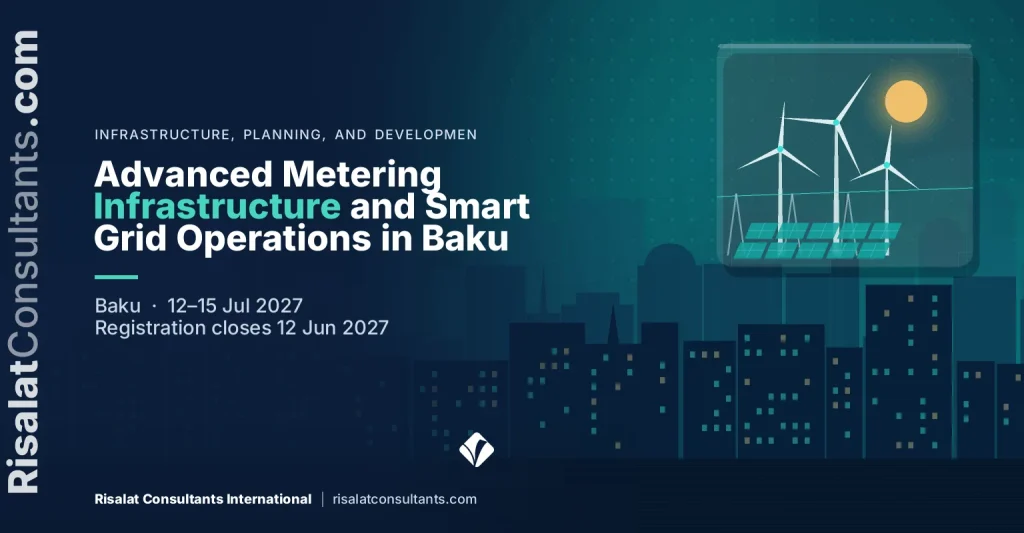
- Dates
- 12–15 Jul 2027 (4 days)
- Where
- Baku, Azerbaijan
- Fee per participant
- £2,600 (GBP)
- Payment
- By invoice and bank transfer
- Registration closes
- 12 Jun 2027
- Certificate
- Certificate of completion
- In-house option
- Run it for your team, on your dates
On this page 14 sections
Programme Overview
This four-day professional course provides comprehensive exposure to Advanced Metering Infrastructure (AMI) and smart grid operational integration for power distribution utilities. Hosted in Baku, the programme addresses critical modern grid architecture, ranging from smart electricity meters and secure communication channels to central Meter Data Management Systems (MDMS). Participants explore how modern digital infrastructure transforms network reliability, automates billing processes, and enhances end-to-end grid transparency in line with relevant international engineering standards and modern distribution utility practices.
The curriculum delivers a rigorous balance between engineering principles and strategic project implementation. Distribution specialists examine practical approaches for automated outage detection, fault localisation, and systematic power distribution loss tracking across medium and low-voltage networks. Delegates analyse the integration of smart metering data with supervisory control platforms, such as SCADA and Distribution Management Systems. Dedicated practical modules unpack the technical dependencies, data security protocols, and operational workflows required for utility-wide digital network modernisations.
Designed specifically for public sector institutions and utility implementation units, this training emphasises procurement oversight, engineering specifications, and field deployment management. Attendees engage in practical workshops focused on drafting robust technical requirements, establishing vendor-agnostic interoperability standards, and managing multi-phase rollout contracts. By examining real engineering frameworks, delegates gain the applied capacity needed to supervise complex donor-financed utility transitions, maintain contractor accountability, and safeguard commercial performance throughout large-scale smart grid deployments.
Power distribution networks across Central Asia, notably in Tajikistan, face urgent structural demands to curtail commercial losses, eliminate collection deficits, and stabilise electricity delivery to support national economic development. Modern grid distribution and metering modernisation efforts, such as those supported through the Additional Financing to Power Utility Financial Recovery Project, require distribution engineers and utility managers to master advanced operational concepts rapidly. Establishing robust Advanced Metering Infrastructure allows utilities to identify technical versus non-technical losses systematically, transition from manual readings to automated revenue cycles, and operate distribution systems with verifiable data integrity.
Delivered by Risalat Consultants International in Baku, Azerbaijan, it combines expert-led sessions, real cases and group work, so that participants can apply what they learn in their own institution.
The Programme Strengthens Institutional Capability
- Core components of modern AMI: Smart meters, data concentrator units, and head-end software systems
- Communication protocols and media: Cellular (NB-IoT/LTE-M), RF mesh, and Power Line Communication (PLC)
- Interoperability standards and conformance: Reviewing IEC 62056 (DLMS/COSEM) and ANSI standards
- Meter installation practices, physical security, anti-tampering design, and environmental testing
- Workshop: Formulating network architecture options for dense urban versus dispersed rural feeders
- Meter Data Management System (MDMS) architecture, data cleansing, and validation, editing, and estimation (VEE)
- Commercial and technical loss tracking: Energy balance calculations across low-voltage distribution transformers
- Automated revenue protection: Identifying meter bypass, anomalies, phase imbalances, and zero-consumption events
- Infrastructure planning and prioritisation
- Project appraisal and business cases
- Financing options and public-private partnerships
- Procurement and contracting for works
It is designed for distribution network engineers and planning specialists, smart grid modernisation project coordinators, electricity metering technicians and field testing teams and others who want practical, current skills in infrastructure, urban development and partnerships.
The Growing Importance of Advanced Metering Infrastructure and Smart Grid Operations in Baku
- Core components of modern AMI: Smart meters, data concentrator units, and head-end software systems
- Communication protocols and media: Cellular (NB-IoT/LTE-M), RF mesh, and Power Line Communication (PLC)
- Interoperability standards and conformance: Reviewing IEC 62056 (DLMS/COSEM) and ANSI standards
- Meter installation practices, physical security, anti-tampering design, and environmental testing
- Workshop: Formulating network architecture options for dense urban versus dispersed rural feeders
- Meter Data Management System (MDMS) architecture, data cleansing, and validation, editing, and estimation (VEE)
- Commercial and technical loss tracking: Energy balance calculations across low-voltage distribution transformers
- Automated revenue protection: Identifying meter bypass, anomalies, phase imbalances, and zero-consumption events
- Integration of meter data with enterprise billing, customer information systems, and enterprise resource planning
- Workshop: Analysing raw interval meter logs to pinpoint theft points and quantify distribution losses
- Convergence of AMI with SCADA, Outage Management Systems (OMS), and Distribution Management Systems (DMS)
- Automated outage detection: Last-gasp meter signals, nested outage identification, and restoration verification
- Power quality monitoring: Tracking voltage sags, swells, total harmonic distortion, and reactive power flows
- Field area network management, cybersecurity protocols, and secure data encryption per IEC 62351
- Workshop: Designing automated operational response workflows for feeder trips and localised power failures
- Drafting bankable technical specifications and employer requirements for international tenders
- Factory Acceptance Testing (FAT), Site Acceptance Testing (SAT), and meter sample batch verification
- Managing large-scale field deployment logistics: Warehousing, contractor management, and customer notification
- Key Performance Indicators for vendor SLA management, meter read rates, and daily communication success
- Interactive clinic: Reviewing common procurement pitfalls and supervision challenges in utility rollouts
Infrastructure and urban services shape growth, health and opportunity. Projects are large, complex and long-lived, and weaknesses in planning, financing or delivery are costly to fix later.
Governments increasingly combine public investment, partnerships with the private sector and new technologies. Teams who can plan, appraise, procure and manage these investments deliver better assets and services.
Organisations increasingly require professionals capable of:
- Plan and prioritise infrastructure investments
- Appraise projects and prepare business cases
- Choose financing and delivery models
- Supervise works for time, cost and quality
- Manage assets over their life
Strong infrastructure, urban development and partnerships systems help organisations:
- Select the right investments
- Deliver projects on time and on budget
- Attract financing and partners
- Keep assets working for longer
This Advanced Metering Infrastructure and Smart Grid Operations in Baku programme brings these elements together in a practical format, so that participants understand not only what good practice looks like but also how to introduce it in their own setting, with the people and resources they have.
Who Should Attend This Advanced Metering Infrastructure and Smart Grid Operations in Baku Training?
This programme is designed for:
- Distribution network engineers and planning specialists
- Smart grid modernisation project coordinators
- Electricity metering technicians and field testing teams
- Project Implementation Unit (PIU) engineering specialists
- Commercial loss reduction and revenue protection managers
- SCADA, telecommunications, and system integration specialists
- Distribution utility procurement and contract officers
- Power sector regulatory technical oversight staff
- Power utility operations and maintenance supervisors
- Infrastructure and urban planners
- Engineers and technical managers
- Project and programme managers
The programme suits experienced professionals as well as those moving into new responsibilities. Groups that mix institutions and countries are encouraged, because participants learn a great deal from each other’s experience.
Tick what your team needs to be able to do.
Advanced Metering Infrastructure and Smart Grid Operations in Baku Training Objectives
Upon successful completion of this Advanced Metering Infrastructure and Smart Grid Operations in Baku Training, participants will be able to:
- Evaluate Advanced Metering Infrastructure architectural components, communication media, and interoperability standards
- Configure functional requirements for Meter Data Management Systems and automated billing interfaces
- Implement operational procedures for automated outage detection, fault mapping, and service restoration verification
- Analyse distribution feeder data to isolate technical losses from non-technical commercial losses accurately
- Formulate operational interfaces between AMI data platforms, SCADA systems, and Distribution Management Systems
- Draft comprehensive technical specifications for smart meters, data concentrators, and communication head-ends
- Establish rigorous procurement oversight, field inspection, and commissioning protocols for utility-wide rollouts
- Explain how infrastructure is planned and prioritised
- Appraise projects and prepare a business case
- Compare financing and delivery models, including partnerships
Each objective is practised during the programme through exercises, cases or group work, so that participants leave able to do it, not only to describe it.
Programme Contents and Structure
The programme runs over 4 days. Each day combines expert input, practical work and a closing workshop or case study:
- First Day: AMI System Architecture, Hardware Standards, and Communication Networks
- Second Day: Meter Data Management, Loss Tracking, and Grid Visibility
- Third Day: Supervisory Integration, Outage Automation, and Network Operations
- Fourth Day: Procurement Specifications, Rollout Oversight, and Quality Assurance
Full day-by-day contents
First Day | AMI System Architecture, Hardware Standards, and Communication Networks
- Core components of modern AMI: Smart meters, data concentrator units, and head-end software systems
- Communication protocols and media: Cellular (NB-IoT/LTE-M), RF mesh, and Power Line Communication (PLC)
- Interoperability standards and conformance: Reviewing IEC 62056 (DLMS/COSEM) and ANSI standards
- Meter installation practices, physical security, anti-tampering design, and environmental testing
- Workshop: Formulating network architecture options for dense urban versus dispersed rural feeders
Workshop: AMI System Architecture, Hardware Standards, and Communication Networks: Applying It to Your Institution
Working in small groups, participants apply the day's methods to examples from their own institutions and agree practical next steps.
Second Day | Meter Data Management, Loss Tracking, and Grid Visibility
- Meter Data Management System (MDMS) architecture, data cleansing, and validation, editing, and estimation (VEE)
- Commercial and technical loss tracking: Energy balance calculations across low-voltage distribution transformers
- Automated revenue protection: Identifying meter bypass, anomalies, phase imbalances, and zero-consumption events
- Integration of meter data with enterprise billing, customer information systems, and enterprise resource planning
- Workshop: Analysing raw interval meter logs to pinpoint theft points and quantify distribution losses
Workshop: Meter Data Management, Loss Tracking, and Grid Visibility: Applying It to Your Institution
Working in small groups, participants apply the day's methods to examples from their own institutions and agree practical next steps.
Third Day | Supervisory Integration, Outage Automation, and Network Operations
- Convergence of AMI with SCADA, Outage Management Systems (OMS), and Distribution Management Systems (DMS)
- Automated outage detection: Last-gasp meter signals, nested outage identification, and restoration verification
- Power quality monitoring: Tracking voltage sags, swells, total harmonic distortion, and reactive power flows
- Field area network management, cybersecurity protocols, and secure data encryption per IEC 62351
- Workshop: Designing automated operational response workflows for feeder trips and localised power failures
Case Study: Supervisory Integration, Outage Automation, and Network Operations in Practice
Participants analyse a realistic case, compare the choices made with good practice and draw lessons they can use in their own setting.
Fourth Day | Procurement Specifications, Rollout Oversight, and Quality Assurance
- Drafting bankable technical specifications and employer requirements for international tenders
- Factory Acceptance Testing (FAT), Site Acceptance Testing (SAT), and meter sample batch verification
- Managing large-scale field deployment logistics: Warehousing, contractor management, and customer notification
- Key Performance Indicators for vendor SLA management, meter read rates, and daily communication success
- Interactive clinic: Reviewing common procurement pitfalls and supervision challenges in utility rollouts
Capstone Exercise: Advanced Metering Infrastructure and Smart Grid Operations in Baku Action Plan for Your Institution
Participants bring the week together in an action plan for their own institution, with priorities, owners and first steps, and present it for feedback from peers and facilitators.
Advanced Metering Infrastructure and Smart Grid Operations in Baku Training Methodology
The training methodology combines technical presentations with highly participatory, engineering-led workshops and diagnostic exercises. Participants review authentic functional diagrams, anonymised interval datasets, and international technical tender documents. Working in small groups, delegates simulate real operational decisions, including evaluating communication coverage trade-offs, calculating transformer-level energy discrepancies, and drafting technical compliance checklists for smart grid tenders.
The programme combines:
- Expert-led sessions on current practice
- Regional and international case studies
- Group work and practical exercises
- Simulations and role plays where relevant
- Discussion of participants' own challenges
- Peer learning across institutions and countries
- Practical tools and templates to take back to work
- Daily reflection and action planning
Before the programme, a short pre-assessment helps the facilitators understand each participant’s role and priorities, so that examples and exercises can be adjusted to the group. Each day ends with a short reflection in which participants note what they will apply at work.
Expected Outcomes
Upon completion of this Advanced Metering Infrastructure and Smart Grid Operations in Baku Training, participants will be able to:
- Define end-to-end AMI hardware, software, and communication topologies tailored to specific utility environments
- Supervise the configuration and operational deployment of enterprise-grade Meter Data Management Systems
- Deploy data-driven workflows for immediate outage verification, fault localisation, and commercial loss mitigation
- Integrate real-time metering feeds with utility SCADA, Outage Management, and operational planning software
- Prepare unambiguous, standard-compliant technical schedules for donor-financed smart metering tenders
- Enforce systematic acceptance testing and quality assurance protocols on contractors during field installations
- Plan and prioritise infrastructure investments
- Appraise projects and prepare business cases
Participants leave with a personal action plan and practical tools they can use in their institution from the first week back. Institutions that send several participants can use the programme to agree shared methods and templates across teams, which makes improvements easier to sustain.
£2,600 per participant · invoice and bank transfer · groups of 5 or more receive a discount
Five or more from one organisation: ask for the group rate on the invoice request.
Ten or more: an in-house version for your institution may cost less per person. Ask for an in-house quote.
Registration closes in 216 days (12 Jun 2027)
Institutional Application of Advanced Metering Infrastructure and Smart Grid Operations in Baku Training
This programme supports organisations in strengthening:
- Investment planning
- Project appraisal
- Partnership management
- Works supervision
- Asset management
Participants return with practical tools to improve:
- Business cases
- Risk allocation
- Contract management
- Maintenance planning
- Service monitoring
The programme is built so that learning moves from the classroom into the institution. Participants work on their own processes and documents where possible, and leave with an action plan that their managers can review and support.
Regional Relevance & Application
Europe
European institutions apply infrastructure, urban development and partnerships within detailed regulatory frameworks and reform agendas. Participants from Europe can compare their practice with colleagues from other regions and test how established methods work under different conditions.
Africa
Across Africa, ministries, agencies and project teams working in infrastructure, urban development and partnerships increasingly operate alongside donor-financed programmes that expect clear systems and evidence. The programme helps participants adapt good practice to the institutions and resources they work with.
Middle East
In the Middle East, national development strategies and diversification plans place growing demands on infrastructure, urban development and partnerships. Participants explore how to build the capability these plans need inside public bodies and companies.
Asia
Institutions across Asia combine rapid growth with ambitious modernisation programmes. Participants from Asia can share their experience of scaling systems quickly and learn from approaches used elsewhere.
Pacific
Small island and Pacific states face particular constraints of size, distance and capacity. The programme highlights practical, proportionate approaches to infrastructure, urban development and partnerships that suit smaller institutions.
Holding the programme in Baku, Azerbaijan brings participants together away from their daily pressures, so they can compare how infrastructure, urban development and partnerships is handled in different settings. The same programme can also be delivered in-house for one institution, in its own country or online, with cases taken from its current work.
- Collect
- Clean
- Store
- Analyse
- Decide
Host Country Profile – Azerbaijan
Programmes, Workshops, Exposures, Training Courses in Baku, Azerbaijan by Risalat Consultants International
Studying away from their own country gives participants time to focus, a fresh view of their own institution and the chance to build a network with colleagues from other countries.
Advanced Metering Infrastructure and Smart Grid Operations in Baku Training Deliverables
Participants receive support before, during and after the programme, so that preparation, learning and follow-up form one continuous experience.
Before the Programme
- Participant Pre-Assessment
- Advanced Metering Infrastructure and Smart Grid Operations in Baku Readiness Assessment
- Advanced Metering Infrastructure and Smart Grid Operations in Baku Resource Pack
- Preparatory Reading Materials
- Complimentary Visa Support & Advisory
During the Programme
- Airport Pickup & Welcome Assistance
- Accommodation with Breakfast
- Welcome Networking Dinner
- Risalat Training Kit (Bag, Bottle, Mug, T-Shirt, Cap, Passport Cover, Pens, Notebook, Magnet & Keychain)
- Comprehensive Advanced Metering Infrastructure and Smart Grid Operations in Baku Training Manual
- Project Appraisal Template
- PPP Risk Allocation Matrix
- Works Supervision Checklist
- Asset Management Plan Template
- Practical Workshops & Simulations
- Group Discussions & Peer Learning
- Daily Lunch and Refreshments
- Full Access to Training Venue Facilities
- Mini Pad / Tablet with Digital Learning Materials
- Field Visit (where applicable)
- Entertaining City Tour
After the Programme
- Certificate of Completion
- Risalat Programme Participation Recognition Award
- Post-Training Reference Materials
- Business Case Review Checklist
- Maintenance Planning Template
- Post-Training Support & Follow-Up Guidance
- Programme Report
Institutions can also request a tailored in-house version of this programme, delivered at their premises or online. Request a proposal.
Common Challenges in Advanced Metering Infrastructure and Smart Grid Operations in Baku, And How This Training Helps
How can institutions plan and prioritise infrastructure investments?
The programme addresses this directly on the first day (AMI System Architecture, Hardware Standards, and Communication Networks), where participants practise the methods involved and adapt them to their own institution, then build it into their action plan.
How can institutions appraise projects and prepare business cases?
The programme addresses this directly on the second day (Meter Data Management, Loss Tracking, and Grid Visibility), where participants practise the methods involved and adapt them to their own institution, then build it into their action plan.
How can institutions choose financing and delivery models?
The programme addresses this directly on the third day (Supervisory Integration, Outage Automation, and Network Operations), where participants practise the methods involved and adapt them to their own institution, then build it into their action plan.
How can institutions supervise works for time, cost and quality?
The programme addresses this directly on the fourth day (Procurement Specifications, Rollout Oversight, and Quality Assurance), where participants practise the methods involved and adapt them to their own institution, then build it into their action plan.
How can institutions manage assets over their life?
The programme addresses this directly on the first day (AMI System Architecture, Hardware Standards, and Communication Networks), where participants practise the methods involved and adapt them to their own institution, then build it into their action plan.
Frequently Asked Questions
When and where does the Advanced Metering Infrastructure and Smart Grid Operations in Baku programme take place?
It runs from 12 Jul 2027 to 15 Jul 2027, in Baku, Azerbaijan. The registration deadline is shown at the top of this page.
Who should attend?
The programme is designed for distribution network engineers and planning specialists, smart grid modernisation project coordinators, electricity metering technicians and field testing teams, project Implementation Unit (PIU) engineering specialists, and others who want practical skills in infrastructure, urban development and partnerships.
Will I receive a certificate?
Yes. Participants who complete the programme receive a Certificate of Completion from Risalat Consultants International.
Can this programme be delivered for our institution only?
Yes. We can deliver a tailored in-house version at your premises, in another city or online, built around your own cases. Use the proposal request on this page.
Do I need prior experience in infrastructure, urban development and partnerships?
No specialist background is required beyond experience in a related role. A short pre-assessment helps the facilitators adapt the sessions to the group.
Training courses in BakuInfrastructure, Planning, and Development training courses
Why Baku for this programme
Baku offers examples of ASAN service centres and energy sector development.
The Advanced Metering Infrastructure and Smart Grid Operations in Baku programme in July 2027 brings together officials and professionals from across the Caucasus region and beyond. Sessions combine short inputs, case studies and group work on participants' own files, and the city's institutions can be added as a study visit on request.
Getting there: Heydar Aliyev (GYD).
Check whether you need a visa with the free Visa Checker, and ask for an invitation letter once you are registered.
The same topic in other cities
- Off-Grid Solar Integration and Distribution Grid Modernisation in Dubai (Dubai)
- Smart Grid Modernisation, SCADA and Substation Automation in Kuala Lumpur (Kuala Lumpur)
- Advanced Metering Infrastructure and Smart Grid Operations in Baku (Baku)
- Power Grid Loss Reduction and Smart Metering Rollout in Baku (Baku)
- Power Utility Financial Recovery & Loss Reduction Strategies in Sydney (Sydney)
- Island Grid Modernization & Least-Cost Distribution Expansion in Bangkok (Bangkok)
Other programmes in Baku
- Cross-Border Subsea and Grid Interconnection Engineering in Baku
- Case Management and Vulnerability Profiling in Social Protection in Baku
- Rural Feeder Road Rehabilitation and Asset Management in Baku
- Rural Water Supply Asset Management and Community Tariff Systems in Baku
- Wholesale Broadband Infrastructure and Open-Access Fibre Deployment in Baku
- Procurement Framework and Regulations for Projects World Bank
- MAPS: Methodology for Assessing Procurement Systems MAPS Initiative
- Open Contracting Partnership Open Contracting Partnership
More training courses in Azerbaijan · All programmes in Asia · Full training calendar
Plan this programme in a roadmap: why it matters, why to approve it, the dates to plan and the career it builds.