Key facts
- Dates
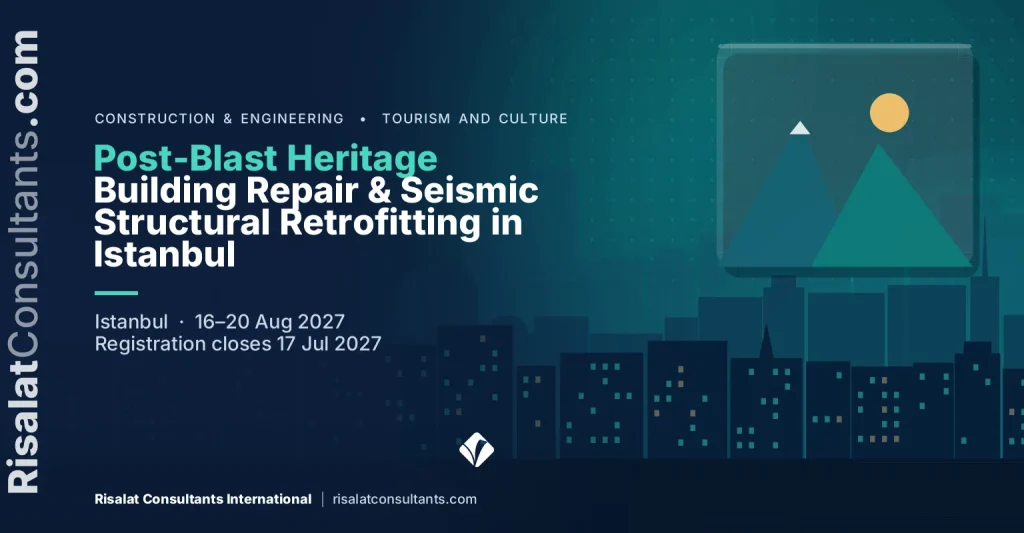
- 16–20 Aug 2027 (5 days)
- Where
- Istanbul, Turkey
- Fee per participant
- £3,250 (GBP)
- Payment
- By invoice and bank transfer
- Registration closes
- 17 Jul 2027
- Who it is for
- Municipal engineers managing urban recovery and public infrastructure portfolios; Historic building conservation officers from national and local a…
- Certificate
- Certificate of completion
- In-house option
- Run it for your team, on your dates
On this page 11 sections
Programme Overview
Municipal engineers and conservation professionals face complex engineering challenges when restoring blast-damaged historic residential fabric. This five-day training programme in Istanbul provides technical approaches to structural diagnostics, blast-induced trauma mitigation, and heritage-sensitive stabilization. Participants assess traditional sandstone, limestone, and timber composite assemblies through non-destructive testing methodologies, ensuring that emergency interventions safeguard authenticity while addressing critical structural vulnerabilities. International heritage charters and engineering standards guide every stage of the forensic assessment process.
The curriculum integrates earthquake resilience with post-disaster heritage recovery, examining how blast-weakened masonry behaves under seismic loading. Delegates explore repair strategies, including lime-based grout injection, timber tie-beam reinstatement, tie-rod installation, and fabric-reinforced cementitious matrix systems. Structural interventions are analysed to satisfy conservation principles alongside life-safety mandates, drawing technical comparisons between Ottoman-era unreinforced masonry in Istanbul and Levant-style residential typologies, particularly heritage fabrics characteristic of Beirut and surrounding historic urban centres.
Beyond physical repairs, the course equips project teams to manage procurement, structural compliance, and site supervision under donor-financed operational policies. Attendees review technical specifications, quality assurance protocols, and environmental and social management frameworks used by institutions like the World Bank. By evaluating contractor tenders and heritage conservation guidelines, participants leave prepared to supervise complex rehabilitation works, verify structural testing data, and enforce material standards across historic neighbourhoods undergoing rapid civil works recovery.
Urban centres recovering from devastating explosions require urgent intervention to salvage damaged historic housing stock before progressive structural collapse occurs. This training directly supports the civil works execution under the Beirut Housing Rehabilitation and Cultural and Creative Industries Recovery project by addressing the critical gap between conventional structural engineering and traditional fabric conservation. As donor-funded stabilization and permanent repair packages move into field delivery, public institutions and implementing agencies must deploy sound diagnostics, enforce seismic retrofitting standards, and supervise specialized contractor tenders without compromising the architectural integrity of damaged residential neighbourhoods.
Delivered by Risalat Consultants International in Istanbul, Turkey, it combines expert-led sessions, real cases and group work, so that participants can apply what they learn in their own institution.
The Programme Strengthens Institutional Capability
- Mechanics of blast shockwaves and dynamic response mechanisms of traditional load-bearing masonry
- Forensic inspection protocols: distinguishing blast-induced displacement from historic foundation settlement
- Non-destructive testing tools: sonic velocity tomography, flat-jack testing, and sclerometer assessments
- Damage classification methodologies aligned with international post-disaster rapid screening standards
- Workshop: Developing rapid visual structural screening sheets for blast-affected residential quarters
- Seismic behaviour of historic unreinforced masonry previously subjected to high-energy blast shock
- In-plane and out-of-plane failure mechanisms in multi-storey traditional load-bearing systems
- Diaphragm flexibility, timber floor-to-wall anchorages, and horizontal tying deficiencies
- Destination planning and management
- Sustainable tourism principles
- Heritage conservation and management
- Marketing and visitor experience
It is designed for municipal engineers managing urban recovery and public infrastructure portfolios, historic building conservation officers from national and local antiquities directorates, housing project implementation unit (PIU) civil engineers and technical specialists and others who want practical, current skills in tourism, culture and heritage.
The Growing Importance of Post-Blast Heritage Building Repair & Seismic Structural Retrofitting in Istanbul
Tourism, culture and heritage support jobs, local businesses and national identity. To grow sustainably, destinations need planning that balances visitors, communities and the environment.
Public bodies, operators and communities increasingly work together on destination management, marketing and heritage protection. Teams with these skills help places benefit from tourism without losing what makes them valuable.
Organisations increasingly require professionals capable of:
- Plan destinations that balance visitors and communities
- Protect and manage heritage
- Market destinations and improve visitor experience
- Involve communities and share benefits
- Monitor tourism performance and impacts
Strong tourism, culture and heritage systems help organisations:
- Grow tourism sustainably
- Protect heritage and the environment
- Create local jobs and businesses
- Attract investment and partners
This Post-Blast Heritage Building Repair & Seismic Structural Retrofitting in Istanbul programme brings these elements together in a practical format, so that participants understand not only what good practice looks like but also how to introduce it in their own setting, with the people and resources they have.
Who Should Attend This Post-Blast Heritage Building Repair & Seismic Structural Retrofitting in Istanbul Training?
This programme is designed for:
- Municipal engineers managing urban recovery and public infrastructure portfolios
- Historic building conservation officers from national and local antiquities directorates
- Housing project implementation unit (PIU) civil engineers and technical specialists
- Structural engineers responsible for non-destructive testing and diagnostic reporting
- Donor-financed project procurement officers overseeing specialized civil works tenders
- Urban planners drafting historic quarter rehabilitation guidelines and master plans
- Supervising consultant engineers monitoring site execution and material compliance
- Heritage site managers balancing life-safety regulations with fabric conservation mandates
- Contractor project managers delivering heritage structural retrofitting contracts
- Tourism ministry and agency staff
- Destination managers
- Heritage and culture officials
The programme suits experienced professionals as well as those moving into new responsibilities. Groups that mix institutions and countries are encouraged, because participants learn a great deal from each other’s experience.
Tick what your team needs to be able to do.
Post-Blast Heritage Building Repair & Seismic Structural Retrofitting in Istanbul Training Objectives
Upon successful completion of this Post-Blast Heritage Building Repair & Seismic Structural Retrofitting in Istanbul Training, participants will be able to:
- Appraise blast-induced structural trauma and residual capacity in historic unreinforced masonry assets
- Select non-destructive and semi-destructive testing methods to evaluate masonry integrity and mortar degradation
- Design heritage-sensitive seismic retrofitting interventions complying with the ICOMOS Charter and Eurocode 8
- Formulate lime-based grout formulations, stitching schemes, and structural timber repairs for historic dwellings
- Draft technical specifications and performance criteria for specialised heritage civil works contracts
- Supervise contractor execution protocols to prevent unapproved structural interventions on historic fabric
- Establish structural quality assurance frameworks aligning with international donor procurement guidelines
- Explain the principles of sustainable tourism
- Plan and manage a destination with stakeholders
- Apply heritage conservation and management practices
Each objective is practised during the programme through exercises, cases or group work, so that participants leave able to do it, not only to describe it.
Programme Contents and Structure
- Mechanics of blast shockwaves and dynamic response mechanisms of traditional load-bearing masonry
- Forensic inspection protocols: distinguishing blast-induced displacement from historic foundation settlement
- Non-destructive testing tools: sonic velocity tomography, flat-jack testing, and sclerometer assessments
- Damage classification methodologies aligned with international post-disaster rapid screening standards
- Workshop: Developing rapid visual structural screening sheets for blast-affected residential quarters
- Seismic behaviour of historic unreinforced masonry previously subjected to high-energy blast shock
- In-plane and out-of-plane failure mechanisms in multi-storey traditional load-bearing systems
- Diaphragm flexibility, timber floor-to-wall anchorages, and horizontal tying deficiencies
- Application of Eurocode 8 Part 3 provisions to historic structures and Levant residential typologies
- Case review: Structural stabilization of multi-leaf stone masonry assemblies in Istanbul
- Material compatibility: physical and chemical testing of natural hydraulic lime, pozzolans, and stone
- Low-pressure grout injection: mix design, rheological parameters, and injection grid execution
- Reversible strengthening: deep repointing, helical stainless steel stitching, and carbon tie rods
- Fabric-Reinforced Cementitious Matrix (FRCM) and Textile-Reinforced Mortar (TRM) for vault consolidation
- Practicum: Evaluating material test certificates and mortar mix designs for heritage residential works
- Structural assessment of traditional timber floor systems, roof trusses, and Ottoman Baghdadi lath-plaster walls
- Timber decay diagnostics: biological attack, moisture ingress post-blast, and residual load capacity
- Ductile connection details, steel collar enhancements, and reversible timber splicing methodologies
- Balancing international life-safety codes with the Venice Charter and ICOMOS Venice principles
- Field demonstration analysis: Seismic bracing of historic residential timber floors in Istanbul
- Drafting employer requirements and technical specifications for specialized heritage contractor tenders
- World Bank and international donor procurement guidelines applied to complex conservation works
- Tender evaluation: assessing contractor heritage competence, methodology statements, and equipment lists
- Supervision protocols, quality control checklists, and non-conformance management on heritage sites
- Capstone exercise: Formulating a comprehensive contractor supervision plan for a damaged historic building
Full day-by-day contents
The programme runs over 5 days. Each day combines expert input, practical work and a closing workshop or case study:
- First Day: Blast Mechanics, Structural Forensic Diagnostics, and Damage Mapping
- Second Day: Seismic Vulnerability and Structural Behaviour of Weakened Masonry
- Third Day: Conservation-Grade Repair Materials and Retrofitting Techniques
- Fourth Day: Timber and Roof Rehabilitation, Structural Carpentry, and Bracing
- Fifth Day: Procurement, Tender Packaging, and Donor-Funded Supervision
Full day-by-day contents
First Day | Blast Mechanics, Structural Forensic Diagnostics, and Damage Mapping
- Mechanics of blast shockwaves and dynamic response mechanisms of traditional load-bearing masonry
- Forensic inspection protocols: distinguishing blast-induced displacement from historic foundation settlement
- Non-destructive testing tools: sonic velocity tomography, flat-jack testing, and sclerometer assessments
- Damage classification methodologies aligned with international post-disaster rapid screening standards
- Workshop: Developing rapid visual structural screening sheets for blast-affected residential quarters
Workshop: Blast Mechanics, Structural Forensic Diagnostics, and Damage Mapping: Applying It to Your Institution
Working in small groups, participants apply the day's methods to examples from their own institutions and agree practical next steps.
Second Day | Seismic Vulnerability and Structural Behaviour of Weakened Masonry
- Seismic behaviour of historic unreinforced masonry previously subjected to high-energy blast shock
- In-plane and out-of-plane failure mechanisms in multi-storey traditional load-bearing systems
- Diaphragm flexibility, timber floor-to-wall anchorages, and horizontal tying deficiencies
- Application of Eurocode 8 Part 3 provisions to historic structures and Levant residential typologies
- Case review: Structural stabilization of multi-leaf stone masonry assemblies in Istanbul
Workshop: Seismic Vulnerability and Structural Behaviour of Weakened Masonry: Applying It to Your Institution
Working in small groups, participants apply the day's methods to examples from their own institutions and agree practical next steps.
Third Day | Conservation-Grade Repair Materials and Retrofitting Techniques
- Material compatibility: physical and chemical testing of natural hydraulic lime, pozzolans, and stone
- Low-pressure grout injection: mix design, rheological parameters, and injection grid execution
- Reversible strengthening: deep repointing, helical stainless steel stitching, and carbon tie rods
- Fabric-Reinforced Cementitious Matrix (FRCM) and Textile-Reinforced Mortar (TRM) for vault consolidation
- Practicum: Evaluating material test certificates and mortar mix designs for heritage residential works
Case Study: Conservation-Grade Repair Materials and Retrofitting Techniques in Practice
Participants analyse a realistic case, compare the choices made with good practice and draw lessons they can use in their own setting.
Fourth Day | Timber and Roof Rehabilitation, Structural Carpentry, and Bracing
- Structural assessment of traditional timber floor systems, roof trusses, and Ottoman Baghdadi lath-plaster walls
- Timber decay diagnostics: biological attack, moisture ingress post-blast, and residual load capacity
- Ductile connection details, steel collar enhancements, and reversible timber splicing methodologies
- Balancing international life-safety codes with the Venice Charter and ICOMOS Venice principles
- Field demonstration analysis: Seismic bracing of historic residential timber floors in Istanbul
Workshop: Timber and Roof Rehabilitation, Structural Carpentry, and Bracing: Applying It to Your Institution
Working in small groups, participants apply the day's methods to examples from their own institutions and agree practical next steps.
Fifth Day | Procurement, Tender Packaging, and Donor-Funded Supervision
- Drafting employer requirements and technical specifications for specialized heritage contractor tenders
- World Bank and international donor procurement guidelines applied to complex conservation works
- Tender evaluation: assessing contractor heritage competence, methodology statements, and equipment lists
- Supervision protocols, quality control checklists, and non-conformance management on heritage sites
- Capstone exercise: Formulating a comprehensive contractor supervision plan for a damaged historic building
Capstone Exercise: Post-Blast Heritage Building Repair & Seismic Structural Retrofitting in Istanbul Action Plan for Your Institution
Participants bring the week together in an action plan for their own institution, with priorities, owners and first steps, and present it for feedback from peers and facilitators.
Post-Blast Heritage Building Repair & Seismic Structural Retrofitting in Istanbul Training Methodology
The training uses technical lectures, engineering design exercises, and forensic analysis of real-world blast and seismic damage cases. Delegates evaluate physical material samples, calculate basic retrofitting details against international standards, and review contractor tender documentation from actual donor-funded rehabilitation projects. Facilitated peer discussions enable participants to contrast Levant residential structural systems with historical Ottoman engineering practices in Istanbul.
The programme combines:
- Expert-led sessions on current practice
- Regional and international case studies
- Group work and practical exercises
- Simulations and role plays where relevant
- Discussion of participants' own challenges
- Peer learning across institutions and countries
- Practical tools and templates to take back to work
- Daily reflection and action planning
Before the programme, a short pre-assessment helps the facilitators understand each participant’s role and priorities, so that examples and exercises can be adjusted to the group. Each day ends with a short reflection in which participants note what they will apply at work.
Expected Outcomes
Upon completion of this Post-Blast Heritage Building Repair & Seismic Structural Retrofitting in Istanbul Training, participants will be able to:
- Perform forensic structural diagnostics on blast-affected traditional stone and lime mortar assemblies
- Produce seismic retrofitting designs that balance building code compliance with architectural conservation principles
- Specify compatible repair mortars, grouts, and mechanical anchors suited to historic masonry typologies
- Inspect timber roof and floor diaphragm bracing systems to enhance structural stability against dynamic loads
- Evaluate contractor tender submissions for specialized heritage works using structured technical scoring matrices
- Implement quality control and site supervision protocols aligned with international financial institution standards
- Plan destinations sustainably
- Protect and manage heritage
Participants leave with a personal action plan and practical tools they can use in their institution from the first week back. Institutions that send several participants can use the programme to agree shared methods and templates across teams, which makes improvements easier to sustain.
£3,250 per participant · invoice and bank transfer · groups of 5 or more receive a discount
Five or more from one organisation: ask for the group rate on the invoice request.
Ten or more: an in-house version for your institution may cost less per person. Ask for an in-house quote.
Registration closes in 251 days (17 Jul 2027)
Institutional Application of Post-Blast Heritage Building Repair & Seismic Structural Retrofitting in Istanbul Training
This programme supports organisations in strengthening:
- Destination management
- Heritage protection
- Marketing
- Community involvement
- Performance monitoring
Participants return with practical tools to improve:
- Destination plans
- Visitor management
- Marketing plans
- Partnership agreements
- Tourism statistics
The programme is built so that learning moves from the classroom into the institution. Participants work on their own processes and documents where possible, and leave with an action plan that their managers can review and support.
Regional Relevance & Application
Europe
European institutions apply tourism, culture and heritage within detailed regulatory frameworks and reform agendas. Participants from Europe can compare their practice with colleagues from other regions and test how established methods work under different conditions.
Africa
Across Africa, ministries, agencies and project teams working in tourism, culture and heritage increasingly operate alongside donor-financed programmes that expect clear systems and evidence. The programme helps participants adapt good practice to the institutions and resources they work with.
Middle East
In the Middle East, national development strategies and diversification plans place growing demands on tourism, culture and heritage. Participants explore how to build the capability these plans need inside public bodies and companies.
Asia
Institutions across Asia combine rapid growth with ambitious modernisation programmes. Participants from Asia can share their experience of scaling systems quickly and learn from approaches used elsewhere.
Pacific
Small island and Pacific states face particular constraints of size, distance and capacity. The programme highlights practical, proportionate approaches to tourism, culture and heritage that suit smaller institutions.
Holding the programme in Istanbul, Turkey brings participants together away from their daily pressures, so they can compare how tourism, culture and heritage is handled in different settings. The same programme can also be delivered in-house for one institution, in its own country or online, with cases taken from its current work.
Host Country Profile – Turkey
Programmes, Workshops, Exposures, Training Courses in Istanbul, Turkey by Risalat Consultants International
Studying away from their own country gives participants time to focus, a fresh view of their own institution and the chance to build a network with colleagues from other countries.
Post-Blast Heritage Building Repair & Seismic Structural Retrofitting in Istanbul Training Deliverables
Participants receive support before, during and after the programme, so that preparation, learning and follow-up form one continuous experience.
Before the Programme
- Participant Pre-Assessment
- Post-Blast Heritage Building Repair & Seismic Structural Retrofitting in Istanbul Readiness Assessment
- Post-Blast Heritage Building Repair & Seismic Structural Retrofitting in Istanbul Resource Pack
- Preparatory Reading Materials
- Complimentary Visa Support & Advisory
During the Programme
- Airport Pickup & Welcome Assistance
- Accommodation with Breakfast
- Welcome Networking Dinner
- Risalat Training Kit (Bag, Bottle, Mug, T-Shirt, Cap, Passport Cover, Pens, Notebook, Magnet & Keychain)
- Comprehensive Post-Blast Heritage Building Repair & Seismic Structural Retrofitting in Istanbul Training Manual
- Destination Assessment Checklist
- Visitor Management Plan Template
- Marketing Plan Template
- Tourism Monitoring Template
- Practical Workshops & Simulations
- Group Discussions & Peer Learning
- Daily Lunch and Refreshments
- Full Access to Training Venue Facilities
- Mini Pad / Tablet with Digital Learning Materials
- Field Visit (where applicable)
- Entertaining City Tour
After the Programme
- Certificate of Completion
- Risalat Programme Participation Recognition Award
- Post-Training Reference Materials
- Heritage Site Management Checklist
- Community Benefit Plan Template
- Post-Training Support & Follow-Up Guidance
- Programme Report
Institutions can also request a tailored in-house version of this programme, delivered at their premises or online. Request a proposal.
Common Challenges in Post-Blast Heritage Building Repair & Seismic Structural Retrofitting in Istanbul, And How This Training Helps
How can institutions plan destinations that balance visitors and communities?
The programme addresses this directly on the first day (Blast Mechanics, Structural Forensic Diagnostics, and Damage Mapping), where participants practise the methods involved and adapt them to their own institution, then build it into their action plan.
How can institutions protect and manage heritage?
The programme addresses this directly on the second day (Seismic Vulnerability and Structural Behaviour of Weakened Masonry), where participants practise the methods involved and adapt them to their own institution, then build it into their action plan.
How can institutions market destinations and improve visitor experience?
The programme addresses this directly on the third day (Conservation-Grade Repair Materials and Retrofitting Techniques), where participants practise the methods involved and adapt them to their own institution, then build it into their action plan.
How can institutions involve communities and share benefits?
The programme addresses this directly on the fourth day (Timber and Roof Rehabilitation, Structural Carpentry, and Bracing), where participants practise the methods involved and adapt them to their own institution, then build it into their action plan.
How can institutions monitor tourism performance and impacts?
The programme addresses this directly on the fifth day (Procurement, Tender Packaging, and Donor-Funded Supervision), where participants practise the methods involved and adapt them to their own institution, then build it into their action plan.
Frequently Asked Questions
When and where does the Post-Blast Heritage Building Repair & Seismic Structural Retrofitting in Istanbul programme take place?
It runs from 16 Aug 2027 to 20 Aug 2027, in Istanbul, Turkey. The registration deadline is shown at the top of this page.
Who should attend?
The programme is designed for municipal engineers managing urban recovery and public infrastructure portfolios, historic building conservation officers from national and local antiquities directorates, housing project implementation unit (PIU) civil engineers and technical specialists, structural engineers responsible for non-destructive testing and diagnostic reporting, and others who want practical skills in tourism, culture and heritage.
Will I receive a certificate?
Yes. Participants who complete the programme receive a Certificate of Completion from Risalat Consultants International.
Can this programme be delivered for our institution only?
Yes. We can deliver a tailored in-house version at your premises, in another city or online, built around your own cases. Use the proposal request on this page.
Do I need prior experience in tourism, culture and heritage?
No specialist background is required beyond experience in a related role. A short pre-assessment helps the facilitators adapt the sessions to the group.
Training courses in IstanbulConstruction & Engineering training courses
Why Istanbul for this programme
Istanbul sits between Europe and Asia, with direct flights from most capitals and easy visas for many delegations.
The Post-Blast Heritage Building Repair & Seismic Structural Retrofitting in Istanbul programme in August 2027 brings together officials and professionals from across the Europe and Asia region and beyond. Sessions combine short inputs, case studies and group work on participants' own files, and the city's institutions can be added as a study visit on request.
Getting there: Istanbul Airport (IST).
Check whether you need a visa with the free Visa Checker, and ask for an invitation letter once you are registered.
Other programmes in Istanbul
- High-Volume Expressway Contract Supervision and Toll Operations in Istanbul
- High-Volume Expressway Contract Supervision and Toll Operations in Istanbul
- Integrated Financial Management Information Systems (IFMIS) Audit and PFM in Istanbul
- Shock-Responsive Safety Net Registry Design and Benefit Management in Istanbul
- Education Data Systems and School Grants Administration in Istanbul
- Procurement Framework and Regulations for Projects World Bank
- MAPS: Methodology for Assessing Procurement Systems MAPS Initiative
- Open Contracting Partnership Open Contracting Partnership
More training courses in Türkiye · All programmes in Europe · Full training calendar
Plan this programme in a roadmap: why it matters, why to approve it, the dates to plan and the career it builds.