Key facts
- Dates
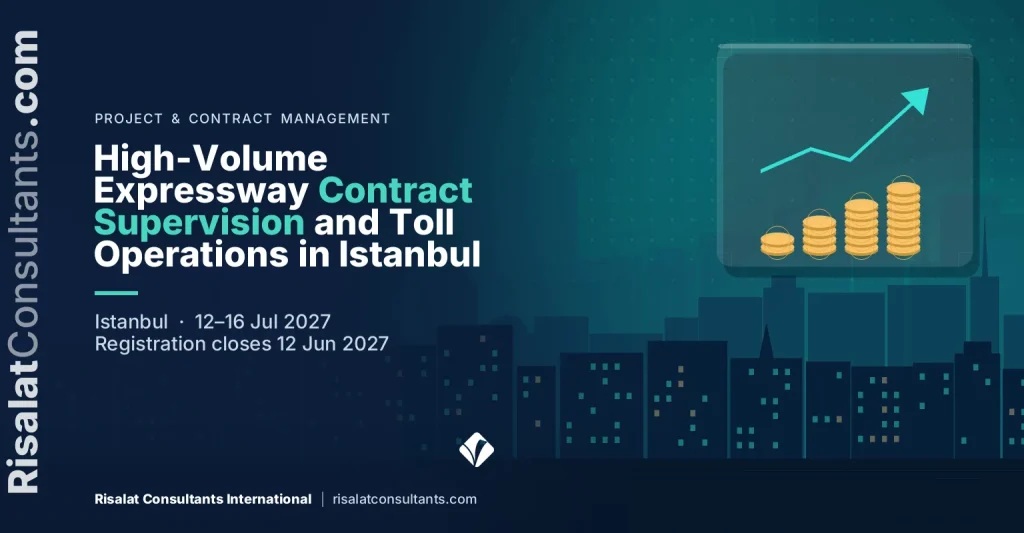
- 12–16 Jul 2027 (5 days)
- Where
- Istanbul, Turkey
- Fee per participant
- £3,100 (GBP)
- Payment
- By invoice and bank transfer
- Registration closes
- 12 Jun 2027
- Certificate
- Certificate of completion
- In-house option
- Run it for your team, on your dates
On this page 13 sections
Programme Overview
High-volume expressway corridors require robust engineering oversight, commercial discipline, and advanced traffic management to deliver their intended economic benefits. Road authorities executing complex highway expansions face substantial challenges in managing major design-build contracts, enforcing quality assurance on heavy-duty pavements, and establishing viable operational frameworks. This five-day executive training programme equips highway engineers and infrastructure planners with the technical and contractual capabilities required to supervise large-scale expressway developments in line with international standards.
Delivered in Istanbul, a premier global crossroads featuring sophisticated suspension bridges, dynamic toll plazas, and heavily trafficked orbital corridors, the course provides an immersive operational context. Participants evaluate real-world infrastructure delivery models, examining FIDIC contractual mechanisms alongside modern toll collection systems. The curriculum links structural durability, traffic flow optimisation, and revenue protection, offering public sector professionals direct exposure to the systems and operational controls required to sustain high-speed, high-capacity road assets throughout their lifecycle.
The training focuses on practical application, enabling delegates to scrutinise design-build documentation, supervise contractor compliance, and implement rigorous safety audits. Road officials explore the operational parameters of electronic toll collection, performance-based maintenance management, and incident response planning. By combining technical lectures, documentation reviews, and operational analysis of modern urban motorways, the programme empowers project implementation teams to protect public capital investments, minimise dispute risks, and maintain superior service standards on strategic transport corridors.
Public road agencies across developing economies are scaling up major trunk corridors to boost regional trade and industrial mobility. With substantial capital programmes under way, such as the US$370m Ethiopia Expressway Development Support Project, client institutions must urgently reinforce their internal engineering and commercial capacity. Ensuring strict contract supervision, safeguarding heavy-duty pavement quality against premature failure, and deploying secure revenue collection systems are vital prerequisites to guarantee financial sustainability and asset longevity for donor-backed expressway investments.
Delivered by Risalat Consultants International in Istanbul, Turkey, it combines expert-led sessions, real cases and group work, so that participants can apply what they learn in their own institution.
The Programme Strengthens Institutional Capability
- Contractual frameworks for high-volume expressways: FIDIC Yellow and Silver Book principles
- Defining the Employer Requirements: balancing functional performance with engineering discretion
- Supervision structures, Engineer roles, and contractor quality management plan verification
- Managing design approvals, variations, baseline programme reviews, and delay notifications
- Case analysis: resolving claims and disputes in major international highway joint ventures
- High-modulus asphalt and concrete pavement design standards for extreme axle loads
- Superpave mix design verification, aggregate gradation, and bitumen modifier performance
- Non-destructive testing methods: falling weight deflectometers and continuous surface profiling
- Infrastructure planning and prioritisation
- Project appraisal and business cases
- Financing options and public-private partnerships
- Procurement and contracting for works
It is designed for expressway and highway authority project directors, design-build contract managers and supervising engineers, transport infrastructure planners and economic advisers and others who want practical, current skills in infrastructure, urban development and partnerships.
The Growing Importance of High-Volume Expressway Contract Supervision and Toll Operations in Istanbul
Infrastructure and urban services shape growth, health and opportunity. Projects are large, complex and long-lived, and weaknesses in planning, financing or delivery are costly to fix later.
Governments increasingly combine public investment, partnerships with the private sector and new technologies. Teams who can plan, appraise, procure and manage these investments deliver better assets and services.
Organisations increasingly require professionals capable of:
- Plan and prioritise infrastructure investments
- Appraise projects and prepare business cases
- Choose financing and delivery models
- Supervise works for time, cost and quality
- Manage assets over their life
Strong infrastructure, urban development and partnerships systems help organisations:
- Select the right investments
- Deliver projects on time and on budget
- Attract financing and partners
- Keep assets working for longer
This High-Volume Expressway Contract Supervision and Toll Operations in Istanbul programme brings these elements together in a practical format, so that participants understand not only what good practice looks like but also how to introduce it in their own setting, with the people and resources they have.
Who Should Attend This High-Volume Expressway Contract Supervision and Toll Operations in Istanbul Training?
This programme is designed for:
- Expressway and highway authority project directors
- Design-build contract managers and supervising engineers
- Transport infrastructure planners and economic advisers
- Highway authority procurement and legal specialists
- Pavement quality assurance and materials engineers
- Toll operations managers and revenue systems analysts
- Road asset management and maintenance planning officers
- Transport ministry technical specialists and policymakers
- Road safety auditors and traffic management professionals
- Infrastructure and urban planners
- Engineers and technical managers
- Project and programme managers
The programme suits experienced professionals as well as those moving into new responsibilities. Groups that mix institutions and countries are encouraged, because participants learn a great deal from each other’s experience.
Tick what your team needs to be able to do.
High-Volume Expressway Contract Supervision and Toll Operations in Istanbul Training Objectives
Upon successful completion of this High-Volume Expressway Contract Supervision and Toll Operations in Istanbul Training, participants will be able to:
- Assess design-build highway contracts to identify commercial risks and contractor performance obligations under standard conditions
- Evaluate quality assurance protocols for asphalt and concrete pavements under heavy axle loading regimes
- Appraise toll collection architectures, comparing manual, electronic, and multi-lane free-flow technologies for operational suitability
- Draft enforceable performance-based maintenance specifications tailored to high-speed multilane expressway corridors
- Conduct comprehensive road safety audits across operational junctions, interchanges, and mainline expressway sections
- Formulate risk mitigation strategies for contractor claims, time extensions, and design variations on major civil works
- Establish structured incident management and operational protocols to preserve lane capacity and user safety
- Explain how infrastructure is planned and prioritised
- Appraise projects and prepare a business case
- Compare financing and delivery models, including partnerships
Each objective is practised during the programme through exercises, cases or group work, so that participants leave able to do it, not only to describe it.
Programme Contents and Structure
- Contractual frameworks for high-volume expressways: FIDIC Yellow and Silver Book principles
- Defining the Employer Requirements: balancing functional performance with engineering discretion
- Supervision structures, Engineer roles, and contractor quality management plan verification
- Managing design approvals, variations, baseline programme reviews, and delay notifications
- Case analysis: resolving claims and disputes in major international highway joint ventures
- High-modulus asphalt and concrete pavement design standards for extreme axle loads
- Superpave mix design verification, aggregate gradation, and bitumen modifier performance
- Non-destructive testing methods: falling weight deflectometers and continuous surface profiling
- Site compliance inspections: compaction monitoring, ride quality, and international roughness index benchmarks
- Addressing construction non-conformities, premature rutting, and batching plant quality audits
- Toll collection architectures: stop-and-go manual lanes, dedicated ETC, and open road tolling
- Automatic vehicle classification, automatic number plate recognition, and transponder integration
- Toll management software, clearing house operations, and financial audit trails
- Revenue leakage prevention, fraud detection, and enforcement frameworks for toll evasion
- Plaza geometric design, lane capacity calculation, and queuing mitigation strategies
- Road safety audit methodology based on PIARC guidelines for grade-separated motorways
- Geometric design safety reviews: sight distances, interchange tapers, and clear zone criteria
- Crash barrier selection and crash testing compliance according to EN 1317 and MASH standards
- Intelligent Transportation Systems: variable message signs, CCTV coverage, and lane control systems
- Developing multi-agency incident management procedures to clear expressway obstructions rapidly
- Performance-based road maintenance contracts: defining levels of service and performance indicators
- Drainage maintenance, structural bridge inspection routines, and slope stability monitoring
- Whole-life cycle costing and budget prioritisation for expressway resurfacing intervals
- Environmental mitigation and social safeguard compliance during expressway operation
- Synthesising the supervision strategy: finalising corridor operational frameworks and reporting
Full day-by-day contents
The programme runs over 5 days. Each day combines expert input, practical work and a closing workshop or case study:
- First Day: Design-Build Contract Administration and Employer Requirements
- Second Day: Pavement Engineering, Quality Assurance, and Materials Control
- Third Day: Toll Collection Systems, Technology, and Revenue Protection
- Fourth Day: Expressway Safety Audits and Traffic Incident Management
- Fifth Day: Asset Management, Performance Maintenance, and Corridor Oversight
Full day-by-day contents
First Day | Design-Build Contract Administration and Employer Requirements
- Contractual frameworks for high-volume expressways: FIDIC Yellow and Silver Book principles
- Defining the Employer Requirements: balancing functional performance with engineering discretion
- Supervision structures, Engineer roles, and contractor quality management plan verification
- Managing design approvals, variations, baseline programme reviews, and delay notifications
- Case analysis: resolving claims and disputes in major international highway joint ventures
Workshop: Design-Build Contract Administration and Employer Requirements: Applying It to Your Institution
Working in small groups, participants apply the day's methods to examples from their own institutions and agree practical next steps.
Second Day | Pavement Engineering, Quality Assurance, and Materials Control
- High-modulus asphalt and concrete pavement design standards for extreme axle loads
- Superpave mix design verification, aggregate gradation, and bitumen modifier performance
- Non-destructive testing methods: falling weight deflectometers and continuous surface profiling
- Site compliance inspections: compaction monitoring, ride quality, and international roughness index benchmarks
- Addressing construction non-conformities, premature rutting, and batching plant quality audits
Workshop: Pavement Engineering, Quality Assurance, and Materials Control: Applying It to Your Institution
Working in small groups, participants apply the day's methods to examples from their own institutions and agree practical next steps.
Third Day | Toll Collection Systems, Technology, and Revenue Protection
- Toll collection architectures: stop-and-go manual lanes, dedicated ETC, and open road tolling
- Automatic vehicle classification, automatic number plate recognition, and transponder integration
- Toll management software, clearing house operations, and financial audit trails
- Revenue leakage prevention, fraud detection, and enforcement frameworks for toll evasion
- Plaza geometric design, lane capacity calculation, and queuing mitigation strategies
Case Study: Toll Collection Systems, Technology, and Revenue Protection in Practice
Participants analyse a realistic case, compare the choices made with good practice and draw lessons they can use in their own setting.
Fourth Day | Expressway Safety Audits and Traffic Incident Management
- Road safety audit methodology based on PIARC guidelines for grade-separated motorways
- Geometric design safety reviews: sight distances, interchange tapers, and clear zone criteria
- Crash barrier selection and crash testing compliance according to EN 1317 and MASH standards
- Intelligent Transportation Systems: variable message signs, CCTV coverage, and lane control systems
- Developing multi-agency incident management procedures to clear expressway obstructions rapidly
Workshop: Expressway Safety Audits and Traffic Incident Management: Applying It to Your Institution
Working in small groups, participants apply the day's methods to examples from their own institutions and agree practical next steps.
Fifth Day | Asset Management, Performance Maintenance, and Corridor Oversight
- Performance-based road maintenance contracts: defining levels of service and performance indicators
- Drainage maintenance, structural bridge inspection routines, and slope stability monitoring
- Whole-life cycle costing and budget prioritisation for expressway resurfacing intervals
- Environmental mitigation and social safeguard compliance during expressway operation
- Synthesising the supervision strategy: finalising corridor operational frameworks and reporting
Capstone Exercise: High-Volume Expressway Contract Supervision and Toll Operations in Istanbul Action Plan for Your Institution
Participants bring the week together in an action plan for their own institution, with priorities, owners and first steps, and present it for feedback from peers and facilitators.
High-Volume Expressway Contract Supervision and Toll Operations in Istanbul Training Methodology
The course employs an applied, adult-learning methodology suited to senior technical practitioners. Learning is delivered through interactive lectures, deep-dive analyses of design-build project documentation, and collaborative workshops. Participants work through real contract scenarios, scrutinise raw pavement quality data, and conduct simulated safety audits on actual multilane layouts. Group sessions focus on solving engineering and contractual dilemmas faced by executing agencies on donor-funded corridors, supported by structured peer reviews.
The programme combines:
- Expert-led sessions on current practice
- Regional and international case studies
- Group work and practical exercises
- Simulations and role plays where relevant
- Discussion of participants' own challenges
- Peer learning across institutions and countries
- Practical tools and templates to take back to work
- Daily reflection and action planning
Before the programme, a short pre-assessment helps the facilitators understand each participant’s role and priorities, so that examples and exercises can be adjusted to the group. Each day ends with a short reflection in which participants note what they will apply at work.
- Transaction
- Record
- Control
- Evidence
- Opinion
Expected Outcomes
Upon completion of this High-Volume Expressway Contract Supervision and Toll Operations in Istanbul Training, participants will be able to:
- Critically review design-build submissions to verify strict alignment with employer contractual requirements
- Formulate rigorous pavement testing and quality control regimes using international durability benchmarks
- Specify and evaluate electronic toll collection equipment to safeguard revenue and maintain traffic throughput
- Produce detailed performance-based maintenance agreements with clear service indicators and deduction rules
- Lead road safety audit teams to identify geometric deficiencies and specify appropriate road containment systems
- Administer construction supervision mandates systematically to minimise contractor variations and costly disputes
- Plan and prioritise infrastructure investments
- Appraise projects and prepare business cases
Participants leave with a personal action plan and practical tools they can use in their institution from the first week back. Institutions that send several participants can use the programme to agree shared methods and templates across teams, which makes improvements easier to sustain.
£3,100 per participant · invoice and bank transfer · groups of 5 or more receive a discount
Five or more from one organisation: ask for the group rate on the invoice request.
Ten or more: an in-house version for your institution may cost less per person. Ask for an in-house quote.
Registration closes in 216 days (12 Jun 2027)
Institutional Application of High-Volume Expressway Contract Supervision and Toll Operations in Istanbul Training
This programme supports organisations in strengthening:
- Investment planning
- Project appraisal
- Partnership management
- Works supervision
- Asset management
Participants return with practical tools to improve:
- Business cases
- Risk allocation
- Contract management
- Maintenance planning
- Service monitoring
The programme is built so that learning moves from the classroom into the institution. Participants work on their own processes and documents where possible, and leave with an action plan that their managers can review and support.
Regional Relevance & Application
Europe
European institutions apply infrastructure, urban development and partnerships within detailed regulatory frameworks and reform agendas. Participants from Europe can compare their practice with colleagues from other regions and test how established methods work under different conditions.
Africa
Across Africa, ministries, agencies and project teams working in infrastructure, urban development and partnerships increasingly operate alongside donor-financed programmes that expect clear systems and evidence. The programme helps participants adapt good practice to the institutions and resources they work with.
Middle East
In the Middle East, national development strategies and diversification plans place growing demands on infrastructure, urban development and partnerships. Participants explore how to build the capability these plans need inside public bodies and companies.
Asia
Institutions across Asia combine rapid growth with ambitious modernisation programmes. Participants from Asia can share their experience of scaling systems quickly and learn from approaches used elsewhere.
Pacific
Small island and Pacific states face particular constraints of size, distance and capacity. The programme highlights practical, proportionate approaches to infrastructure, urban development and partnerships that suit smaller institutions.
Holding the programme in Istanbul, Turkey brings participants together away from their daily pressures, so they can compare how infrastructure, urban development and partnerships is handled in different settings. The same programme can also be delivered in-house for one institution, in its own country or online, with cases taken from its current work.
Host Country Profile – Turkey
Programmes, Workshops, Exposures, Training Courses in Istanbul, Turkey by Risalat Consultants International
Studying away from their own country gives participants time to focus, a fresh view of their own institution and the chance to build a network with colleagues from other countries.
High-Volume Expressway Contract Supervision and Toll Operations in Istanbul Training Deliverables
Participants receive support before, during and after the programme, so that preparation, learning and follow-up form one continuous experience.
Before the Programme
- Participant Pre-Assessment
- High-Volume Expressway Contract Supervision and Toll Operations in Istanbul Readiness Assessment
- High-Volume Expressway Contract Supervision and Toll Operations in Istanbul Resource Pack
- Preparatory Reading Materials
- Complimentary Visa Support & Advisory
During the Programme
- Airport Pickup & Welcome Assistance
- Accommodation with Breakfast
- Welcome Networking Dinner
- Risalat Training Kit (Bag, Bottle, Mug, T-Shirt, Cap, Passport Cover, Pens, Notebook, Magnet & Keychain)
- Comprehensive High-Volume Expressway Contract Supervision and Toll Operations in Istanbul Training Manual
- Project Appraisal Template
- PPP Risk Allocation Matrix
- Works Supervision Checklist
- Asset Management Plan Template
- Practical Workshops & Simulations
- Group Discussions & Peer Learning
- Daily Lunch and Refreshments
- Full Access to Training Venue Facilities
- Mini Pad / Tablet with Digital Learning Materials
- Field Visit (where applicable)
- Entertaining City Tour
After the Programme
- Certificate of Completion
- Risalat Programme Participation Recognition Award
- Post-Training Reference Materials
- Business Case Review Checklist
- Maintenance Planning Template
- Post-Training Support & Follow-Up Guidance
- Programme Report
Institutions can also request a tailored in-house version of this programme, delivered at their premises or online. Request a proposal.
Common Challenges in High-Volume Expressway Contract Supervision and Toll Operations in Istanbul, And How This Training Helps
How can institutions plan and prioritise infrastructure investments?
The programme addresses this directly on the first day (Design-Build Contract Administration and Employer Requirements), where participants practise the methods involved and adapt them to their own institution, then build it into their action plan.
How can institutions appraise projects and prepare business cases?
The programme addresses this directly on the second day (Pavement Engineering, Quality Assurance, and Materials Control), where participants practise the methods involved and adapt them to their own institution, then build it into their action plan.
How can institutions choose financing and delivery models?
The programme addresses this directly on the third day (Toll Collection Systems, Technology, and Revenue Protection), where participants practise the methods involved and adapt them to their own institution, then build it into their action plan.
How can institutions supervise works for time, cost and quality?
The programme addresses this directly on the fourth day (Expressway Safety Audits and Traffic Incident Management), where participants practise the methods involved and adapt them to their own institution, then build it into their action plan.
How can institutions manage assets over their life?
The programme addresses this directly on the fifth day (Asset Management, Performance Maintenance, and Corridor Oversight), where participants practise the methods involved and adapt them to their own institution, then build it into their action plan.
Frequently Asked Questions
When and where does the High-Volume Expressway Contract Supervision and Toll Operations in Istanbul programme take place?
It runs from 12 Jul 2027 to 16 Jul 2027, in Istanbul, Turkey. The registration deadline is shown at the top of this page.
Who should attend?
The programme is designed for expressway and highway authority project directors, design-build contract managers and supervising engineers, transport infrastructure planners and economic advisers, highway authority procurement and legal specialists, and others who want practical skills in infrastructure, urban development and partnerships.
Will I receive a certificate?
Yes. Participants who complete the programme receive a Certificate of Completion from Risalat Consultants International.
Can this programme be delivered for our institution only?
Yes. We can deliver a tailored in-house version at your premises, in another city or online, built around your own cases. Use the proposal request on this page.
Do I need prior experience in infrastructure, urban development and partnerships?
No specialist background is required beyond experience in a related role. A short pre-assessment helps the facilitators adapt the sessions to the group.
Training courses in IstanbulProject & Contract Management training courses
Why Istanbul for this programme
Istanbul sits between Europe and Asia, with direct flights from most capitals and easy visas for many delegations.
The High-Volume Expressway Contract Supervision and Toll Operations in Istanbul programme in July 2027 brings together officials and professionals from across the Europe and Asia region and beyond. Sessions combine short inputs, case studies and group work on participants' own files, and the city's institutions can be added as a study visit on request.
Getting there: Istanbul Airport (IST).
Check whether you need a visa with the free Visa Checker, and ask for an invitation letter once you are registered.
The same topic in other cities
- High-Volume Expressway Contract Supervision and Toll Operations in Istanbul (Istanbul)
- Economic Corridor Planning and Inter-Urban Highway Management in Kuala Lumpur (Kuala Lumpur)
Other programmes in Istanbul
- Public Health Emergency Preparedness and ICU Management in Istanbul
- Output and Performance-Based Road Contracts (OPRC) in Istanbul
- Integrated Financial Management Information Systems (IFMIS) Audit and PFM in Istanbul
- Shock-Responsive Safety Net Registry Design and Benefit Management in Istanbul
- Education Data Systems and School Grants Administration in Istanbul
Related: Procurement and contract management · free Procurement Maturity diagnostic · all programmes
More training courses in Türkiye · All programmes in Europe · Full training calendar
Plan this programme in a roadmap: why it matters, why to approve it, the dates to plan and the career it builds.