Key facts
- Dates
- 6–10 Sep 2027 (5 days)
- Where
- Johannesburg, South Africa
- Fee per participant
- £2,900 (GBP)
- Payment
- By invoice and bank transfer
- Registration closes
- 7 Aug 2027
- Who it is for
- Distribution network design engineers and technical officers; Power utility electrification project coordinators; Project Implementation Unit manag…
- Certificate
- Certificate of completion
- In-house option
- Run it for your team, on your dates
On this page 11 sections
Programme Overview
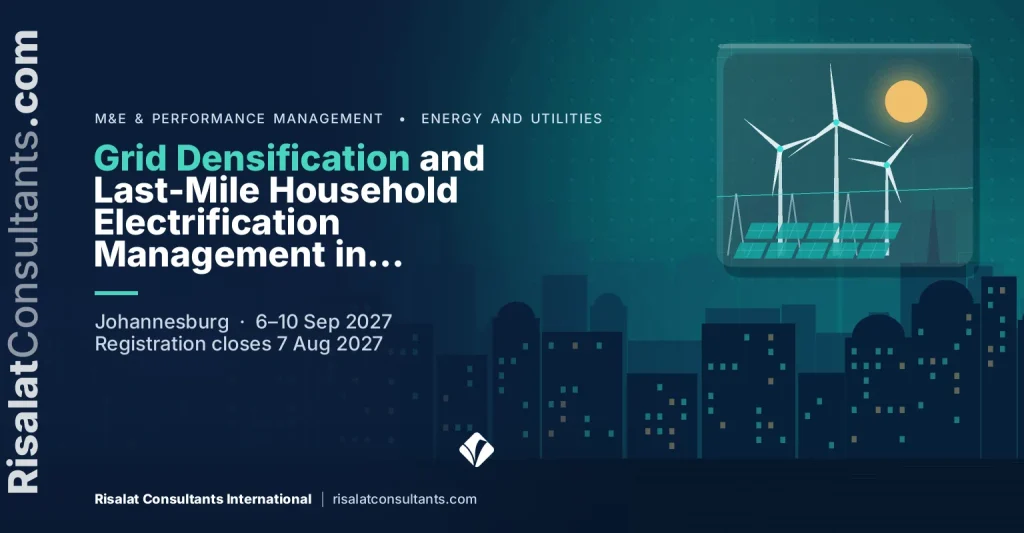
Grid densification presents the most capital-efficient pathway to accelerating household access in areas already reached by medium-voltage infrastructure. This five-day course equips power utility engineers and electrification project managers with engineering and operational methodologies to implement rapid last-mile connections. Delivered in Johannesburg, the programme reviews low-voltage network optimisation, customer connection architectures, and practical construction practices essential for bringing large volumes of residential customers safely and reliably onto national electricity networks.
Participants explore the operational interface between engineering design, procurement, and field delivery. The curriculum addresses technical specifications for low-voltage reticulation, aerial bundled conductor deployment, and pre-paid split metering topologies compliant with international standards. Attendees analyse approaches to reduce non-technical losses through tamper-evident equipment, anti-fraud configurations, and quality-controlled connection processes, ensuring that expanded distribution footprints remain financially sustainable for utilities during major connection drives.
Through structured case exercises and project tracking workshops, the course strengthens capabilities in supervising turnkey contractors, verifying connection milestones, and maintaining technical compliance during scale-up. Electrification teams examine field coordination structures, material inventory management, and digital monitoring systems that reduce deployment delays. By mastering these critical execution disciplines, practitioners enhance the speed and durability of last-mile connection programmes financed by international development finance institutions.
Public utilities and project implementation units face urgent pressure to accelerate off-grid and on-grid access, directly addressing project execution bottlenecks under major initiatives such as the US$150m Malawi Electricity Access Project. Closing the electrification gap requires utilities to shift from ad hoc extensions to standardised, high-volume grid densification. Building rigorous institutional capacity in contractor management, connection verification, and loss reduction is vital to achieving national access targets while safeguarding utility solvency.
Delivered by Risalat Consultants International in Johannesburg, South Africa, it combines expert-led sessions, real cases and group work, so that participants can apply what they learn in their own institution.
The Programme Strengthens Institutional Capability
- Principles of grid densification versus greenfield distribution extension
- Transformer load profiling, sizing, and low-voltage feeder radius calculations
- Aerial Bundled Conductor (ABC) design standards and mechanical tensioning
- Voltage drop mitigation and phase balancing on dense low-voltage lines
- Engineering exercise: transformer placement and reticulation routing design
- Standardising customer service drops and ready-board connection units
- Pre-payment split-metering systems and STS standard compliance
- Engineering anti-tamper configurations to eliminate non-technical losses
- Strategic thinking and direction setting
- Leading and developing teams
- Decision making and problem solving
- Communication and influence
It is designed for distribution network design engineers and technical officers, power utility electrification project coordinators, project Implementation Unit managers and procurement specialists and others who want practical, current skills in leadership, management and communication.
The Growing Importance of Grid Densification and Last-Mile Household Electrification Management in Johannesburg
Institutions change faster than ever: new policies, technologies and expectations from citizens and partners. Leaders and managers who can set direction, build teams and manage change make the difference between plans and results.
Strong leadership is a set of practical skills: deciding, communicating, negotiating, developing people and leading change. These skills can be learnt and improved with practice and feedback.
Organisations increasingly require professionals capable of:
- Set clear direction and priorities
- Lead and motivate teams through change
- Communicate and negotiate effectively
- Manage performance fairly
- Make sound decisions under pressure
Strong leadership, management and communication systems help organisations:
- Turn strategies into results
- Build motivated, capable teams
- Manage change with less resistance
- Improve relations with partners and stakeholders
This Grid Densification and Last-Mile Household Electrification Management in Johannesburg programme brings these elements together in a practical format, so that participants understand not only what good practice looks like but also how to introduce it in their own setting, with the people and resources they have.
Who Should Attend This Grid Densification and Last-Mile Household Electrification Management in Johannesburg Training?
This programme is designed for:
- Distribution network design engineers and technical officers
- Power utility electrification project coordinators
- Project Implementation Unit managers and procurement specialists
- Metering engineers and revenue protection managers
- Contractor supervisors and field inspection teams
- Energy ministry planning officers overseeing access programmes
- Low-voltage network operations and maintenance specialists
- Donor-funded infrastructure monitoring and evaluation officers
- Directors and senior managers
- Heads of department and unit
- Middle managers and team leaders
- Project and programme managers
The programme suits experienced professionals as well as those moving into new responsibilities. Groups that mix institutions and countries are encouraged, because participants learn a great deal from each other’s experience.
Tick what your team needs to be able to do.
Grid Densification and Last-Mile Household Electrification Management in Johannesburg Training Objectives
Upon successful completion of this Grid Densification and Last-Mile Household Electrification Management in Johannesburg Training, participants will be able to:
- Evaluate low-voltage network topologies and standard designs for rapid, cost-effective grid densification
- Specify pre-paid metering arrangements and split-meter architectures that minimise non-technical distribution losses
- Formulate structured contractor supervision and quality verification frameworks for large-scale connection campaigns
- Apply technical standards including IEC and national reticulation guidelines to last-mile customer connections
- Establish workflow controls for customer survey, application processing, connection verification, and database synchronisation
- Implement digital electrification monitoring tools and spatial trackers to monitor turnkey contractor progress
- Mitigate operational risks related to supply chain bottlenecks, substandard materials, and network safety hazards
- Explain current approaches to leadership in public and private institutions
- Set direction and priorities for their team
- Lead, motivate and develop people
Each objective is practised during the programme through exercises, cases or group work, so that participants leave able to do it, not only to describe it.
Programme Contents and Structure
- Principles of grid densification versus greenfield distribution extension
- Transformer load profiling, sizing, and low-voltage feeder radius calculations
- Aerial Bundled Conductor (ABC) design standards and mechanical tensioning
- Voltage drop mitigation and phase balancing on dense low-voltage lines
- Engineering exercise: transformer placement and reticulation routing design
- Standardising customer service drops and ready-board connection units
- Pre-payment split-metering systems and STS standard compliance
- Engineering anti-tamper configurations to eliminate non-technical losses
- Earthing arrangements and customer installation safety verification (IEC standards)
- Laboratory practical: testing meter installation integrity and bypass detection
- Packaging last-mile electrification contracts under World Bank procurement frameworks
- Establishing quality assurance plans and Factory Acceptance Testing (FAT) schedules
- Supervising contractor installation work and managing milestone disbursement claims
- Material logistics, inventory tracking, and preventing site material theft
- Case review: addressing contractor underperformance and schedule slippage
- Field inspection protocols and electrical safety commissioning checks
- GIS data capture standards for newly connected customers and transformers
- Standard operating procedures for customer application-to-energisation workflows
- Synchronising new connections with utility billing and ERP systems
- Practical simulation: field audit and connection compliance certification
- Key performance indicators for tracking large-scale electrification initiatives
- Design and deployment of digital dashboards for daily progress tracking
- Baseline post-connection loss monitoring and feeder metering methods
- Environmental and social safeguard compliance during densification works
- Action planning: drafting a densification operational plan for target project zones
Full day-by-day contents
The programme runs over 5 days. Each day combines expert input, practical work and a closing workshop or case study:
- First Day: Low-Voltage Network Topologies and Densification Engineering
- Second Day: Last-Mile Connection Standards, Metering, and Revenue Assurance
- Third Day: Turnkey Contractor Management and Field Supervision
- Fourth Day: Connection Verification, Commissioning, and Database Integration
- Fifth Day: Electrification Monitoring, Reporting, and Loss Management
Full day-by-day contents
First Day | Low-Voltage Network Topologies and Densification Engineering
- Principles of grid densification versus greenfield distribution extension
- Transformer load profiling, sizing, and low-voltage feeder radius calculations
- Aerial Bundled Conductor (ABC) design standards and mechanical tensioning
- Voltage drop mitigation and phase balancing on dense low-voltage lines
- Engineering exercise: transformer placement and reticulation routing design
Workshop: Low-Voltage Network Topologies and Densification Engineering: Applying It to Your Institution
Working in small groups, participants apply the day's methods to examples from their own institutions and agree practical next steps.
Second Day | Last-Mile Connection Standards, Metering, and Revenue Assurance
- Standardising customer service drops and ready-board connection units
- Pre-payment split-metering systems and STS standard compliance
- Engineering anti-tamper configurations to eliminate non-technical losses
- Earthing arrangements and customer installation safety verification (IEC standards)
- Laboratory practical: testing meter installation integrity and bypass detection
Workshop: Last-Mile Connection Standards, Metering, and Revenue Assurance: Applying It to Your Institution
Working in small groups, participants apply the day's methods to examples from their own institutions and agree practical next steps.
Third Day | Turnkey Contractor Management and Field Supervision
- Packaging last-mile electrification contracts under World Bank procurement frameworks
- Establishing quality assurance plans and Factory Acceptance Testing (FAT) schedules
- Supervising contractor installation work and managing milestone disbursement claims
- Material logistics, inventory tracking, and preventing site material theft
- Case review: addressing contractor underperformance and schedule slippage
Case Study: Turnkey Contractor Management and Field Supervision in Practice
Participants analyse a realistic case, compare the choices made with good practice and draw lessons they can use in their own setting.
Fourth Day | Connection Verification, Commissioning, and Database Integration
- Field inspection protocols and electrical safety commissioning checks
- GIS data capture standards for newly connected customers and transformers
- Standard operating procedures for customer application-to-energisation workflows
- Synchronising new connections with utility billing and ERP systems
- Practical simulation: field audit and connection compliance certification
Workshop: Connection Verification, Commissioning, and Database Integration: Applying It to Your Institution
Working in small groups, participants apply the day's methods to examples from their own institutions and agree practical next steps.
Fifth Day | Electrification Monitoring, Reporting, and Loss Management
- Key performance indicators for tracking large-scale electrification initiatives
- Design and deployment of digital dashboards for daily progress tracking
- Baseline post-connection loss monitoring and feeder metering methods
- Environmental and social safeguard compliance during densification works
- Action planning: drafting a densification operational plan for target project zones
Capstone Exercise: Grid Densification and Last-Mile Household Electrification Management in Johannesburg Action Plan for Your Institution
Participants bring the week together in an action plan for their own institution, with priorities, owners and first steps, and present it for feedback from peers and facilitators.
- Transaction
- Record
- Control
- Evidence
- Opinion
Grid Densification and Last-Mile Household Electrification Management in Johannesburg Training Methodology
The training employs a blended adult-learning approach combining interactive lectures, engineering design workshops, and practical documentation reviews. Participants work through real technical specifications, inspection forms, and network calculations drawn from active utility electrification projects. Facilitated group exercises and operational problem-solving sessions allow teams to benchmark their field practices against proven international utility models, concluding with the development of an actionable implementation matrix.
The programme combines:
- Expert-led sessions on current practice
- Regional and international case studies
- Group work and practical exercises
- Simulations and role plays where relevant
- Discussion of participants' own challenges
- Peer learning across institutions and countries
- Practical tools and templates to take back to work
- Daily reflection and action planning
Before the programme, a short pre-assessment helps the facilitators understand each participant’s role and priorities, so that examples and exercises can be adjusted to the group. Each day ends with a short reflection in which participants note what they will apply at work.
Expected Outcomes
Upon completion of this Grid Densification and Last-Mile Household Electrification Management in Johannesburg Training, participants will be able to:
- Optimised low-voltage engineering designs that lower per-connection costs while meeting international safety standards
- Robust quality assurance and inspection frameworks for supervising turnkey electrification contractors
- Reduced commercial and non-technical losses through the deployment of tamper-evident pre-payment metering systems
- Streamlined customer connection workflows that accelerate the path from application to energisation
- Enhanced verification protocols to ensure project milestones satisfy donor financing and disbursement conditions
- Functional digital tracking tools for monitoring field rollouts, material inventory, and contractor execution
- Set clear direction and priorities
- Lead and develop teams
Participants leave with a personal action plan and practical tools they can use in their institution from the first week back. Institutions that send several participants can use the programme to agree shared methods and templates across teams, which makes improvements easier to sustain.
£2,900 per participant · invoice and bank transfer · groups of 5 or more receive a discount
Five or more from one organisation: ask for the group rate on the invoice request.
Ten or more: an in-house version for your institution may cost less per person. Ask for an in-house quote.
Registration closes in 271 days (7 Aug 2027)
Institutional Application of Grid Densification and Last-Mile Household Electrification Management in Johannesburg Training
This programme supports organisations in strengthening:
- Leadership and management
- Team development
- Change management
- Communication
- Performance management
Participants return with practical tools to improve:
- Team plans
- Coaching
- Change plans
- Stakeholder communication
- Performance reviews
The programme is built so that learning moves from the classroom into the institution. Participants work on their own processes and documents where possible, and leave with an action plan that their managers can review and support.
Regional Relevance & Application
Europe
European institutions apply leadership, management and communication within detailed regulatory frameworks and reform agendas. Participants from Europe can compare their practice with colleagues from other regions and test how established methods work under different conditions.
Africa
Across Africa, ministries, agencies and project teams working in leadership, management and communication increasingly operate alongside donor-financed programmes that expect clear systems and evidence. The programme helps participants adapt good practice to the institutions and resources they work with.
Middle East
In the Middle East, national development strategies and diversification plans place growing demands on leadership, management and communication. Participants explore how to build the capability these plans need inside public bodies and companies.
Asia
Institutions across Asia combine rapid growth with ambitious modernisation programmes. Participants from Asia can share their experience of scaling systems quickly and learn from approaches used elsewhere.
Pacific
Small island and Pacific states face particular constraints of size, distance and capacity. The programme highlights practical, proportionate approaches to leadership, management and communication that suit smaller institutions.
Holding the programme in Johannesburg, South Africa brings participants together away from their daily pressures, so they can compare how leadership, management and communication is handled in different settings. The same programme can also be delivered in-house for one institution, in its own country or online, with cases taken from its current work.
Host Country Profile – South Africa
Risalat Consultants International runs open-enrolment training programmes in Johannesburg, South Africa for officials, project teams and professionals from across the region. Dates, fees and what each programme covers are listed above, and any programme can also be delivered in-house for your institution.
Studying away from their own country gives participants time to focus, a fresh view of their own institution and the chance to build a network with colleagues from other countries.
Grid Densification and Last-Mile Household Electrification Management in Johannesburg Training Deliverables
Participants receive support before, during and after the programme, so that preparation, learning and follow-up form one continuous experience.
Before the Programme
- Participant Pre-Assessment
- Grid Densification and Last-Mile Household Electrification Management in Johannesburg Readiness Assessment
- Grid Densification and Last-Mile Household Electrification Management in Johannesburg Resource Pack
- Preparatory Reading Materials
- Complimentary Visa Support & Advisory
During the Programme
- Airport Pickup & Welcome Assistance
- Accommodation with Breakfast
- Welcome Networking Dinner
- Risalat Training Kit (Bag, Bottle, Mug, T-Shirt, Cap, Passport Cover, Pens, Notebook, Magnet & Keychain)
- Comprehensive Grid Densification and Last-Mile Household Electrification Management in Johannesburg Training Manual
- Leadership Self-Assessment
- Team Development Plan Template
- Change Plan Template
- Negotiation Preparation Sheet
- Practical Workshops & Simulations
- Group Discussions & Peer Learning
- Daily Lunch and Refreshments
- Full Access to Training Venue Facilities
- Mini Pad / Tablet with Digital Learning Materials
- Field Visit (where applicable)
- Entertaining City Tour
After the Programme
- Certificate of Completion
- Risalat Programme Participation Recognition Award
- Post-Training Reference Materials
- Personal Development Plan Template
- Coaching Conversation Guide
- Post-Training Support & Follow-Up Guidance
- Programme Report
Institutions can also request a tailored in-house version of this programme, delivered at their premises or online. Request a proposal.
Common Challenges in Grid Densification and Last-Mile Household Electrification Management in Johannesburg, And How This Training Helps
How can institutions set clear direction and priorities?
The programme addresses this directly on the first day (Low-Voltage Network Topologies and Densification Engineering), where participants practise the methods involved and adapt them to their own institution, then build it into their action plan.
How can institutions lead and motivate teams through change?
The programme addresses this directly on the second day (Last-Mile Connection Standards, Metering, and Revenue Assurance), where participants practise the methods involved and adapt them to their own institution, then build it into their action plan.
How can institutions communicate and negotiate effectively?
The programme addresses this directly on the third day (Turnkey Contractor Management and Field Supervision), where participants practise the methods involved and adapt them to their own institution, then build it into their action plan.
How can institutions manage performance fairly?
The programme addresses this directly on the fourth day (Connection Verification, Commissioning, and Database Integration), where participants practise the methods involved and adapt them to their own institution, then build it into their action plan.
How can institutions make sound decisions under pressure?
The programme addresses this directly on the fifth day (Electrification Monitoring, Reporting, and Loss Management), where participants practise the methods involved and adapt them to their own institution, then build it into their action plan.
Frequently Asked Questions
When and where does the Grid Densification and Last-Mile Household Electrification Management in Johannesburg programme take place?
It runs from 6 Sep 2027 to 10 Sep 2027, in Johannesburg, South Africa. The registration deadline is shown at the top of this page.
Who should attend?
The programme is designed for distribution network design engineers and technical officers, power utility electrification project coordinators, project Implementation Unit managers and procurement specialists, metering engineers and revenue protection managers, and others who want practical skills in leadership, management and communication.
Will I receive a certificate?
Yes. Participants who complete the programme receive a Certificate of Completion from Risalat Consultants International.
Can this programme be delivered for our institution only?
Yes. We can deliver a tailored in-house version at your premises, in another city or online, built around your own cases. Use the proposal request on this page.
Do I need prior experience in leadership, management and communication?
No specialist background is required beyond experience in a related role. A short pre-assessment helps the facilitators adapt the sessions to the group.
Training courses in JohannesburgM&E & Performance Management training courses
Why Johannesburg for this programme
Johannesburg is Southern Africa's business centre with a wide flight network.
The Grid Densification and Last-Mile Household Electrification Management in Johannesburg programme in September 2027 brings together officials and professionals from across the Africa region and beyond. Sessions combine short inputs, case studies and group work on participants' own files, and the city's institutions can be added as a study visit on request.
Getting there: O. R. Tambo (JNB).
Check whether you need a visa with the free Visa Checker, and ask for an invitation letter once you are registered.
The same topic in other cities
- Grid Extension and Solar Distribution Management in Dubai (Dubai)
- Grid Expansion & Rural Off-Grid Electrification Planning in Brisbane (Brisbane)
Other programmes in Johannesburg
- Supervisory Control and Data Acquisition (SCADA) in Water Systems in Johannesburg
- Independent Power Producer Procurement & Power Purchase Agreements in Johannesburg
- MSME Credit Guarantee Scheme Design and Risk-Sharing Facilities in Johannesburg
- Solar Energy Integration for Rural Health Facilities in Johannesburg
- District Health Procurement and Medical Stores Management in Johannesburg
More training courses in South Africa · All programmes in Africa · Full training calendar
Plan this programme in a roadmap: why it matters, why to approve it, the dates to plan and the career it builds.