Key facts
- Dates
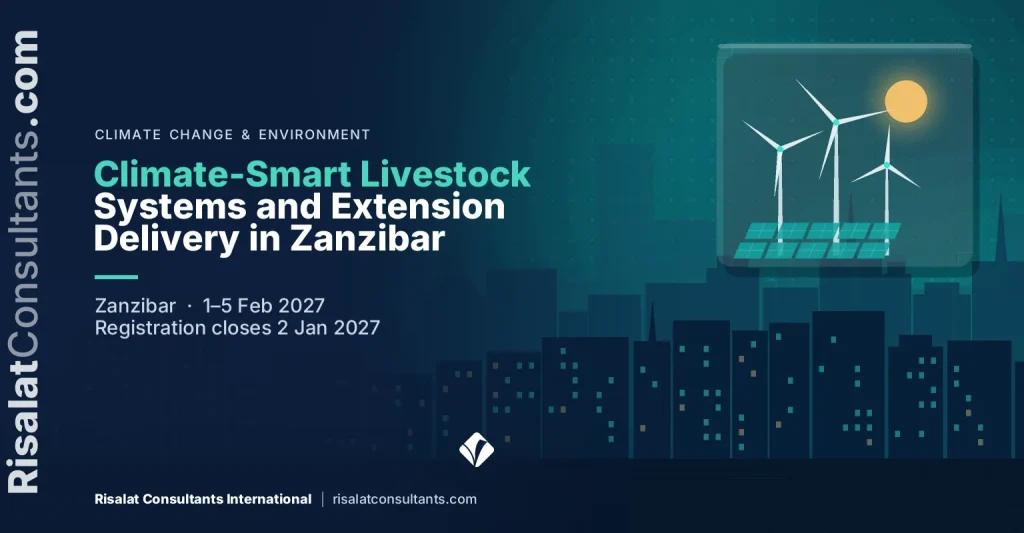
- 1–5 Feb 2027 (5 days)
- Where
- Zanzibar, Tanzania
- Fee per participant
- £3,050 (GBP)
- Payment
- By invoice and bank transfer
- Registration closes
- 2 Jan 2027
- Certificate
- Certificate of completion
- In-house option
- Run it for your team, on your dates
On this page 14 sections
Programme Overview
Livestock systems across East Africa face severe disruption from accelerating climate variability, land degradation, and prolonged dry spells. Sustainable livestock production requires an operational transition toward climate-smart approaches that safeguard animal health, optimise natural forage resources, and enhance household resilience. This five-day course equips technical leaders with the skills needed to design, implement, and monitor interventions that reconcile productivity goals with climate adaptation and mitigation priorities in vulnerable pastoral and agro-pastoral landscapes.
Delivered in Zanzibar, this programme offers an interactive learning environment focusing on practical applications in pasture conservation, drought-resilient breed selection, and integrated rangeland management. Participants examine the operational mechanics of decentralized extension systems, identifying bottlenecks in technology transfer and learning how to deploy participatory outreach models. The curriculum incorporates internationally recognised climate frameworks, ensuring all methodologies align with standards established by international development banks and regional agricultural authorities.
By bridging the gap between technical livestock science and field-level delivery, this training strengthens institutional capacity to implement donor-financed agricultural projects. Delegates formulate actionable strategies to enhance livestock value chains, reduce greenhouse gas emissions per unit of output, and engage communities effectively. The sessions provide participants with operational instruments, extension toolkits, and monitoring rubrics directly applicable to community-based agricultural transformation initiatives across East and Central Africa.
Agricultural transformation initiatives across sub-Saharan Africa, including large-scale programmes such as the Uganda Climate Smart Agricultural Transformation Project funded by the World Bank, demand enhanced institutional competencies in resilient livestock systems. As recurrent droughts and erratic rainfall destabilise pastoral livelihoods, implementing agencies and sector ministries require qualified personnel capable of deploying decentralised extension, disease surveillance, and forage security solutions that conform to contemporary environmental and social safeguards.
Delivered by Risalat Consultants International in Zanzibar, Tanzania, it combines expert-led sessions, real cases and group work, so that participants can apply what they learn in their own institution.
The Programme Strengthens Institutional Capability
- Principles of Climate-Smart Agriculture applied to pastoral and agro-pastoral production systems
- Overview of UNFCCC and FAO frameworks for livestock mitigation and adaptation
- Assessing feed-basket deficits and climate vulnerability in dryland ecosystems
- Livestock carbon accounting and emission intensity reduction strategies
- Integrating World Bank Environmental and Social Framework standards into livestock operations
- Pasture regeneration, rotational grazing schemes, and rangeland carrying capacity metrics
- Fodder conservation techniques: silage, hay preservation, and strategic feed reserves
- Small-scale water infrastructure and micro-catchment design for livestock watering points
- Climate and environmental risk assessment
- Adaptation and mitigation planning
- Sector strategies for energy, water and land
- Project design for climate and environmental goals
It is designed for livestock development officers in national ministries and local governments, district veterinary officers and animal health specialists, agricultural extension project staff from donor-funded programmes and others who want practical, current skills in climate, environment and natural resources.
The Growing Importance of Climate-Smart Livestock Systems and Extension Delivery in Zanzibar
Climate change, environmental pressure and resource management now shape national plans, budgets and investment decisions. Financiers increasingly expect climate and environmental considerations to be built into projects from the start.
Institutions that can plan for climate risks, manage natural resources well and prepare sound proposals are better placed to protect services and to access the funding available for this work.
Organisations increasingly require professionals capable of:
- Assess climate and environmental risks to their services and assets
- Design projects that meet climate and environmental goals
- Prepare proposals that financiers can approve
- Measure and report results credibly
- Work with communities and partners across sectors
Strong climate, environment and natural resources systems help organisations:
- Protect services and infrastructure from climate risks
- Access climate and environmental finance
- Meet national and international commitments
- Use natural resources sustainably
This Climate-Smart Livestock Systems and Extension Delivery in Zanzibar programme brings these elements together in a practical format, so that participants understand not only what good practice looks like but also how to introduce it in their own setting, with the people and resources they have.
Who Should Attend This Climate-Smart Livestock Systems and Extension Delivery in Zanzibar Training?
This programme is designed for:
- Livestock development officers in national ministries and local governments
- District veterinary officers and animal health specialists
- Agricultural extension project staff from donor-funded programmes
- Rangeland management officers and natural resource planners
- Project coordinators managing climate-smart agriculture initiatives
- Pastoral livelihood specialists from non-governmental organisations
- Monitoring and evaluation officers supporting livestock sector interventions
- Technical advisers supporting rural development and food security programmes
- Agro-pastoral community outreach supervisors
- Climate change and environment officers
- Energy, water and agriculture sector staff
- Planning and policy officers
The programme suits experienced professionals as well as those moving into new responsibilities. Groups that mix institutions and countries are encouraged, because participants learn a great deal from each other’s experience.
Tick what your team needs to be able to do.
Climate-Smart Livestock Systems and Extension Delivery in Zanzibar Training Objectives
Upon successful completion of this Climate-Smart Livestock Systems and Extension Delivery in Zanzibar Training, participants will be able to:
- Evaluate sustainable pasture development, water-harvesting, and rangeland rehabilitation techniques in arid and semi-arid lands
- Appraise the genetic and functional attributes of drought-tolerant livestock breeds to support adaptive breeding strategies
- Design decentralised, pluralistic agricultural extension delivery mechanisms tailored to pastoral and agro-pastoral communities
- Analyse livestock-related greenhouse gas emissions and identify targeted mitigation options using standard assessment guidelines
- Formulate community-level animal health surveillance, biosecurity, and emergency fodder preservation strategies
- Develop livestock value-addition and market-access plans that enhance household income stability in vulnerable rural districts
- Construct comprehensive project monitoring frameworks aligned with multilateral donor reporting requirements and safeguard systems
- Explain the main climate and environmental challenges for their sector
- Assess climate and environmental risks to services and assets
- Plan adaptation and mitigation measures
Each objective is practised during the programme through exercises, cases or group work, so that participants leave able to do it, not only to describe it.
Programme Contents and Structure
- Principles of Climate-Smart Agriculture applied to pastoral and agro-pastoral production systems
- Overview of UNFCCC and FAO frameworks for livestock mitigation and adaptation
- Assessing feed-basket deficits and climate vulnerability in dryland ecosystems
- Livestock carbon accounting and emission intensity reduction strategies
- Integrating World Bank Environmental and Social Framework standards into livestock operations
- Pasture regeneration, rotational grazing schemes, and rangeland carrying capacity metrics
- Fodder conservation techniques: silage, hay preservation, and strategic feed reserves
- Small-scale water infrastructure and micro-catchment design for livestock watering points
- Community-based rangeland tenure, conflict mitigation, and resource-sharing arrangements
- Managing invasive bush species and restoring degraded communal grazing areas
- Characterisation and management of indigenous, drought-resilient cattle, sheep, and goat breeds
- Community-based breeding programmes and genetic diversity conservation protocols
- Strengthening veterinary public health and decentralized animal disease surveillance
- Establishing cold chain infrastructure and preventive vaccination programmes for remote areas
- Digital tools for real-time reporting of livestock epidemics and climate shocks
- Critique of traditional top-down extension versus decentralized, demand-driven systems
- Designing Pastoralist and Farmer Field Schools for climate-resilient animal husbandry
- Deploying Community Animal Health Workers: operational guidelines and regulatory oversight
- Leveraging ICT, mobile platforms, and rural radio for weather and market advisory delivery
- Gender-sensitive and socially inclusive extension methodologies for pastoral women and youth
- Post-harvest milk, meat, and hide handling to reduce losses and improve hygiene standards
- Structuring viable livestock marketing associations and cooperative collection centres
- Developing bankable climate-smart livestock sub-project investment plans
- Formulating Results Frameworks and key performance indicators for donor-funded projects
- Participant action plan presentations and technical peer review
Full day-by-day contents
The programme runs over 5 days. Each day combines expert input, practical work and a closing workshop or case study:
- First Day: Climate-Smart Livestock Foundations and Environmental Assessments
- Second Day: Sustainable Forage, Water Harvesting, and Rangeland Governance
- Third Day: Drought-Tolerant Breed Selection and Animal Health Systems
- Fourth Day: Decentralized and Pluralistic Extension Delivery Models
- Fifth Day: Value Addition, Market Access, and Investment Planning
Full day-by-day contents
First Day | Climate-Smart Livestock Foundations and Environmental Assessments
- Principles of Climate-Smart Agriculture applied to pastoral and agro-pastoral production systems
- Overview of UNFCCC and FAO frameworks for livestock mitigation and adaptation
- Assessing feed-basket deficits and climate vulnerability in dryland ecosystems
- Livestock carbon accounting and emission intensity reduction strategies
- Integrating World Bank Environmental and Social Framework standards into livestock operations
Workshop: Climate-Smart Livestock Foundations and Environmental Assessments: Applying It to Your Institution
Working in small groups, participants apply the day's methods to examples from their own institutions and agree practical next steps.
Second Day | Sustainable Forage, Water Harvesting, and Rangeland Governance
- Pasture regeneration, rotational grazing schemes, and rangeland carrying capacity metrics
- Fodder conservation techniques: silage, hay preservation, and strategic feed reserves
- Small-scale water infrastructure and micro-catchment design for livestock watering points
- Community-based rangeland tenure, conflict mitigation, and resource-sharing arrangements
- Managing invasive bush species and restoring degraded communal grazing areas
Workshop: Sustainable Forage, Water Harvesting, and Rangeland Governance: Applying It to Your Institution
Working in small groups, participants apply the day's methods to examples from their own institutions and agree practical next steps.
Third Day | Drought-Tolerant Breed Selection and Animal Health Systems
- Characterisation and management of indigenous, drought-resilient cattle, sheep, and goat breeds
- Community-based breeding programmes and genetic diversity conservation protocols
- Strengthening veterinary public health and decentralized animal disease surveillance
- Establishing cold chain infrastructure and preventive vaccination programmes for remote areas
- Digital tools for real-time reporting of livestock epidemics and climate shocks
Case Study: Drought-Tolerant Breed Selection and Animal Health Systems in Practice
Participants analyse a realistic case, compare the choices made with good practice and draw lessons they can use in their own setting.
Fourth Day | Decentralized and Pluralistic Extension Delivery Models
- Critique of traditional top-down extension versus decentralized, demand-driven systems
- Designing Pastoralist and Farmer Field Schools for climate-resilient animal husbandry
- Deploying Community Animal Health Workers: operational guidelines and regulatory oversight
- Leveraging ICT, mobile platforms, and rural radio for weather and market advisory delivery
- Gender-sensitive and socially inclusive extension methodologies for pastoral women and youth
Workshop: Decentralized and Pluralistic Extension Delivery Models: Applying It to Your Institution
Working in small groups, participants apply the day's methods to examples from their own institutions and agree practical next steps.
Fifth Day | Value Addition, Market Access, and Investment Planning
- Post-harvest milk, meat, and hide handling to reduce losses and improve hygiene standards
- Structuring viable livestock marketing associations and cooperative collection centres
- Developing bankable climate-smart livestock sub-project investment plans
- Formulating Results Frameworks and key performance indicators for donor-funded projects
- Participant action plan presentations and technical peer review
Capstone Exercise: Climate-Smart Livestock Systems and Extension Delivery in Zanzibar Action Plan for Your Institution
Participants bring the week together in an action plan for their own institution, with priorities, owners and first steps, and present it for feedback from peers and facilitators.
- Funds
- Entity
- Project
- Results
- MRV
Climate-Smart Livestock Systems and Extension Delivery in Zanzibar Training Methodology
The training employs an adult-learning pedagogical approach combining technical lectures, interactive plenary debates, and structured syndicate group work. Participants analyse authentic case studies from sub-Saharan African pastoral districts, complete practical design exercises using real-world data, and review technical manuals from international development agencies. Facilitated peer-review sessions allow delegates to benchmark institutional challenges and collaboratively refine extension strategies directly applicable to their home duty stations.
The programme combines:
- Expert-led sessions on current practice
- Regional and international case studies
- Group work and practical exercises
- Simulations and role plays where relevant
- Discussion of participants' own challenges
- Peer learning across institutions and countries
- Practical tools and templates to take back to work
- Daily reflection and action planning
Before the programme, a short pre-assessment helps the facilitators understand each participant’s role and priorities, so that examples and exercises can be adjusted to the group. Each day ends with a short reflection in which participants note what they will apply at work.
Expected Outcomes
Upon completion of this Climate-Smart Livestock Systems and Extension Delivery in Zanzibar Training, participants will be able to:
- Demonstrated ability to select and implement climate-resilient forage production and preservation techniques for drought periods
- Proficiency in drafting breeding management guidelines that prioritise heat-tolerant and disease-resilient traits
- Capability to structure and administer decentralized agricultural extension networks using participatory methodologies
- Competence in designing localized biosecurity and veterinary preventive healthcare pathways under remote operating conditions
- Mastery of practical tools for formulating inclusive livestock market-access and value-addition proposals
- Formulation of a fully costed, project-aligned institutional action plan ready for implementation in home institutions
- Assess climate and environmental risks
- Plan adaptation and mitigation measures
Participants leave with a personal action plan and practical tools they can use in their institution from the first week back. Institutions that send several participants can use the programme to agree shared methods and templates across teams, which makes improvements easier to sustain.
£3,050 per participant · invoice and bank transfer · groups of 5 or more receive a discount
Five or more from one organisation: ask for the group rate on the invoice request.
Ten or more: an in-house version for your institution may cost less per person. Ask for an in-house quote.
Registration closes in 55 days (2 Jan 2027)
Institutional Application of Climate-Smart Livestock Systems and Extension Delivery in Zanzibar Training
This programme supports organisations in strengthening:
- Climate and environmental planning
- Project design
- Access to finance
- Results measurement
- Stakeholder involvement
Participants return with practical tools to improve:
- Risk assessments
- Concept notes
- Results frameworks
- Monitoring systems
- Partnership arrangements
The programme is built so that learning moves from the classroom into the institution. Participants work on their own processes and documents where possible, and leave with an action plan that their managers can review and support.
Regional Relevance & Application
Europe
European institutions apply climate, environment and natural resources within detailed regulatory frameworks and reform agendas. Participants from Europe can compare their practice with colleagues from other regions and test how established methods work under different conditions.
Africa
Across Africa, ministries, agencies and project teams working in climate, environment and natural resources increasingly operate alongside donor-financed programmes that expect clear systems and evidence. The programme helps participants adapt good practice to the institutions and resources they work with.
Middle East
In the Middle East, national development strategies and diversification plans place growing demands on climate, environment and natural resources. Participants explore how to build the capability these plans need inside public bodies and companies.
Asia
Institutions across Asia combine rapid growth with ambitious modernisation programmes. Participants from Asia can share their experience of scaling systems quickly and learn from approaches used elsewhere.
Pacific
Small island and Pacific states face particular constraints of size, distance and capacity. The programme highlights practical, proportionate approaches to climate, environment and natural resources that suit smaller institutions.
Holding the programme in Zanzibar, Tanzania brings participants together away from their daily pressures, so they can compare how climate, environment and natural resources is handled in different settings. The same programme can also be delivered in-house for one institution, in its own country or online, with cases taken from its current work.
Host Country Profile – Tanzania
Training programmes in Zanzibar suit professionals working in public sector administration, tourism management, marine resources, environmental sustainability, and regional trade.
Studying away from their own country gives participants time to focus, a fresh view of their own institution and the chance to build a network with colleagues from other countries.
Climate-Smart Livestock Systems and Extension Delivery in Zanzibar Training Deliverables
Participants receive support before, during and after the programme, so that preparation, learning and follow-up form one continuous experience.
Before the Programme
- Participant Pre-Assessment
- Climate-Smart Livestock Systems and Extension Delivery in Zanzibar Readiness Assessment
- Climate-Smart Livestock Systems and Extension Delivery in Zanzibar Resource Pack
- Preparatory Reading Materials
- Complimentary Visa Support & Advisory
During the Programme
- Airport Pickup & Welcome Assistance
- Accommodation with Breakfast
- Welcome Networking Dinner
- Risalat Training Kit (Bag, Bottle, Mug, T-Shirt, Cap, Passport Cover, Pens, Notebook, Magnet & Keychain)
- Comprehensive Climate-Smart Livestock Systems and Extension Delivery in Zanzibar Training Manual
- Climate Risk Screening Checklist
- Options Appraisal Template
- Concept Note Template
- Results Measurement Template
- Practical Workshops & Simulations
- Group Discussions & Peer Learning
- Daily Lunch and Refreshments
- Full Access to Training Venue Facilities
- Mini Pad / Tablet with Digital Learning Materials
- Field Visit (where applicable)
- Entertaining City Tour
After the Programme
- Certificate of Completion
- Risalat Programme Participation Recognition Award
- Post-Training Reference Materials
- Funding Readiness Checklist
- Monitoring and Reporting Template
- Post-Training Support & Follow-Up Guidance
- Programme Report
Institutions can also request a tailored in-house version of this programme, delivered at their premises or online. Request a proposal.
Common Challenges in Climate-Smart Livestock Systems and Extension Delivery in Zanzibar, And How This Training Helps
How can institutions assess climate and environmental risks to their services and assets?
The programme addresses this directly on the first day (Climate-Smart Livestock Foundations and Environmental Assessments), where participants practise the methods involved and adapt them to their own institution, then build it into their action plan.
How can institutions design projects that meet climate and environmental goals?
The programme addresses this directly on the second day (Sustainable Forage, Water Harvesting, and Rangeland Governance), where participants practise the methods involved and adapt them to their own institution, then build it into their action plan.
How can institutions prepare proposals that financiers can approve?
The programme addresses this directly on the third day (Drought-Tolerant Breed Selection and Animal Health Systems), where participants practise the methods involved and adapt them to their own institution, then build it into their action plan.
How can institutions measure and report results credibly?
The programme addresses this directly on the fourth day (Decentralized and Pluralistic Extension Delivery Models), where participants practise the methods involved and adapt them to their own institution, then build it into their action plan.
How can institutions work with communities and partners across sectors?
The programme addresses this directly on the fifth day (Value Addition, Market Access, and Investment Planning), where participants practise the methods involved and adapt them to their own institution, then build it into their action plan.
Frequently Asked Questions
When and where does the Climate-Smart Livestock Systems and Extension Delivery in Zanzibar programme take place?
It runs from 1 Feb 2027 to 5 Feb 2027, in Zanzibar, Tanzania. The registration deadline is shown at the top of this page.
Who should attend?
The programme is designed for livestock development officers in national ministries and local governments, district veterinary officers and animal health specialists, agricultural extension project staff from donor-funded programmes, rangeland management officers and natural resource planners, and others who want practical skills in climate, environment and natural resources.
Will I receive a certificate?
Yes. Participants who complete the programme receive a Certificate of Completion from Risalat Consultants International.
Can this programme be delivered for our institution only?
Yes. We can deliver a tailored in-house version at your premises, in another city or online, built around your own cases. Use the proposal request on this page.
Do I need prior experience in climate, environment and natural resources?
No specialist background is required beyond experience in a related role. A short pre-assessment helps the facilitators adapt the sessions to the group.
Training courses in ZanzibarClimate Change & Environment training courses
Why Zanzibar for this programme
Zanzibar offers a quiet island setting for leadership retreats and tourism topics.
The Climate-Smart Livestock Systems and Extension Delivery in Zanzibar programme in February 2027 brings together officials and professionals from across the Africa region and beyond. Sessions combine short inputs, case studies and group work on participants' own files, and the city's institutions can be added as a study visit on request.
Getting there: Abeid Amani Karume (ZNZ).
Check whether you need a visa with the free Visa Checker, and ask for an invitation letter once you are registered.
The same topic in other cities
Other programmes in Zanzibar
- Public Emergency Disease Surveillance & Epidemic Preparedness Planning in Zanzibar
- Foundational Literacy and Numeracy Assessment Systems Design in Zanzibar
- Informal Settlement Upgrading and Metropolitan Drainage Engineering in Zanzibar
- Productive Inclusion and Economic Graduation Model Implementation in Zanzibar
- Urban Municipal Capital Investment Planning and Infrastructure Delivery in Zanzibar
Related: Climate finance and energy programmes · free Climate Finance Proposal Readiness · all programmes
- United Nations Framework Convention on Climate Change UNFCCC
- UN Office for Disaster Risk Reduction UNDRR
- Adaptation Fund Adaptation Fund
More training courses in Tanzania · All programmes in Africa · Full training calendar
Plan this programme in a roadmap: why it matters, why to approve it, the dates to plan and the career it builds.