Points clés
- Dates
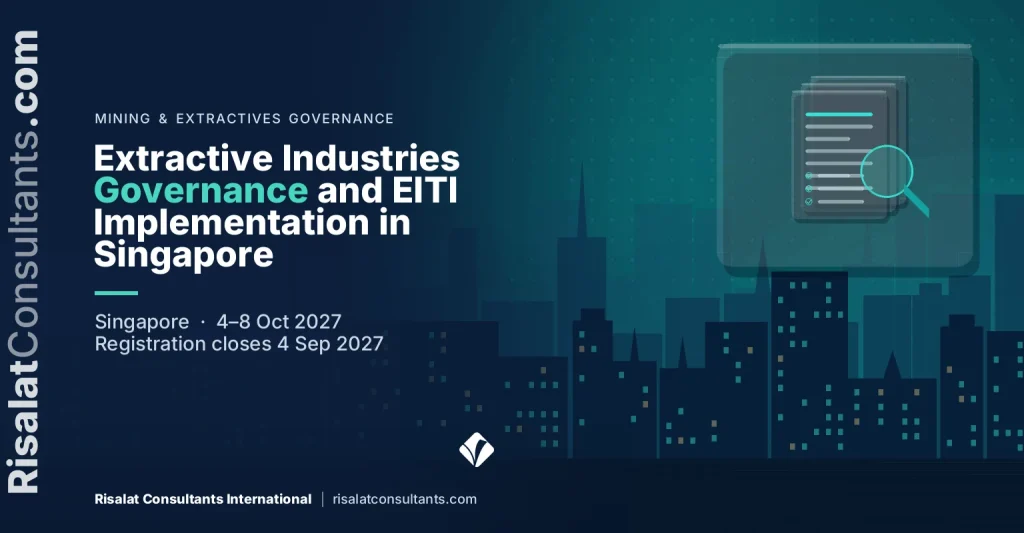
- 4–8 Oct 2027 (5 days)
- Lieu
- Singapour, Singapour
- Frais par participant
- 2 750 £ (GBP)
- Paiement
- Sur facture et par virement bancaire
- Clôture des inscriptions
- 4 Sep 2027
- Certificat
- Certificat de participation
- Option intra
- Organisez-le pour votre équipe, à vos dates
Sur cette page 15 sections
Présentation du programme
Good governance in the extractive industries remains critical for resource-rich developing nations seeking sustainable growth. This five-day executive programme in Singapore provides comprehensive training on managing oil, gas, and mineral sectors. Participants examine international governance benchmarks, legal frameworks, and modern institutional arrangements that curb corruption and protect public interests. The course links policy theory with sector-specific operational realities, giving public sector leaders the capacity to manage concessions and negotiate contracts equitably.
A central component of the training is the practical implementation of the Extractive Industries Transparency Initiative (EITI) Standard. Participants explore systematic disclosure of contracts, beneficial ownership, revenue collection, and subnational transfers. Through technical exercises, attendees learn to reconcile fiscal flows, enhance state-owned enterprise transparency, and integrate reporting systems into domestic administrative structures. This rigorous approach ensures that public revenues from natural resources translate into verifiable national development outcomes and social investments.
The programme also tackles the environmental, social, and climate challenges associated with extractive projects. Delegations evaluate environmental and social impact assessments, community consultation mechanisms, mine closure requirements, and artisanal mining formalisation. Using international standards from multilateral bodies, participants develop monitoring frameworks that hold operators accountable throughout the project lifecycle. Singapore's global status as a commodities trading and dispute resolution hub provides an excellent backdrop for this intensive learning experience.
Governments and international development finance institutions are intensifying their investments in extractive sector governance to prevent fiscal leakage, address climate impacts, and secure critical transition minerals. Ministries, revenue authorities, and project implementation units require immediate technical capacity to implement the updated EITI Standard, oversee complex concession agreements, and enforce environmental compliance. Strengthening institutional capability ensures that resource extraction supports macro-fiscal stability and domestic revenue mobilisation rather than economic vulnerability.
Proposé par Risalat Consultants International à Singapour, il associe sessions animées par des experts, cas réels et travaux de groupe, afin que les participants puissent appliquer leurs acquis dans leur propre institution.
The Programme Strengthens Institutional Capability
- Core principles of extractive industries governance and the natural resource charter
- Comparative legal frameworks: concessions, production sharing contracts, and service agreements
- Competitive bidding processes, open contracting, and licensing administration
- Institutional mandates: separating policy, regulatory, and commercial functions
- Mitigating corruption risks and managing conflicts of interest in resource awards
- Design of extractive fiscal regimes: royalties, resource rent taxes, and corporate income tax
- State participation models and governance of state-owned enterprises in extraction
- Managing transfer pricing, base erosion, and profit shifting in mineral exports
- Lancement et planification du projet
- Périmètre, calendrier et plans de travail
- Budgétisation et maîtrise des coûts
- Gestion des risques et des problèmes
It is designed for officials from ministries of mines, petroleum, and energy, staff from national EITI secretariats and multi-stakeholder groups, project managers and specialists from World Bank, ADB, AfDB, EU, and UN funded programmes and others who want practical, current skills in project and programme management.
The Growing Importance of Extractive Industries Governance and EITI Implementation in Singapore
De nombreux projets échouent non par manque de fonds, mais en raison d'une planification insuffisante, de rôles flous et de décisions lentes. Les bailleurs et les gouvernements attendent des projets livrés dans les délais, dans le respect du budget et avec les résultats convenus.
Les équipes de projet des organismes publics et des projets financés par les bailleurs doivent conjuguer planification, gestion des risques, passation des marchés, contrôle financier et reporting. De solides compétences en gestion de projet permettent à ces éléments de fonctionner ensemble.
Les organisations ont de plus en plus besoin de professionnels capables de :
- Planifier des projets avec un périmètre, un calendrier et un budget clairs
- Gérer les risques et les problèmes avant qu'ils n'entraînent des retards
- Coordonner la passation des marchés, la finance et le travail technique
- Rendre compte clairement de l'avancement aux bailleurs et à la direction
- Diriger les équipes et gérer les parties prenantes
Des systèmes solides de gestion de projets et de programmes aident les organisations à :
- Livrer les projets dans les délais et le budget
- Réduire les retards et les dépassements de coûts
- Satisfaire aux exigences des bailleurs
- Atteindre les résultats convenus
This Extractive Industries Governance and EITI Implementation in Singapore programme brings these elements together in a practical format, so that participants understand not only what good practice looks like but also how to introduce it in their own setting, with the people and resources they have.
Who Should Attend This Extractive Industries Governance and EITI Implementation in Singapore Training?
Ce programme s'adresse à :
- Officials from ministries of mines, petroleum, and energy
- Staff from national EITI secretariats and multi-stakeholder groups
- Project managers and specialists from World Bank, ADB, AfDB, EU, and UN funded programmes
- Auditors and inspectors from supreme audit institutions and tax authorities
- Legal advisors negotiating extractive contracts and mineral agreements
- Environmental agency officers monitoring mining and petroleum operations
- Executives from state-owned mining and hydrocarbon enterprises
- Regional and local government officers managing subnational resource revenues
- Policy specialists managing mineral supply chains and artisanal mining formalisation
- Gestionnaires de projets et de programmes
- Coordonnateurs et personnel des UGP
- Chargés de planification et de suivi
Le programme convient aussi bien aux professionnels expérimentés qu’à ceux qui prennent de nouvelles responsabilités. Les groupes réunissant plusieurs institutions et pays sont encouragés, car les participants apprennent beaucoup de l’expérience des autres.
Cochez ce que votre équipe doit être capable de faire.
Extractive Industries Governance and EITI Implementation in Singapore Training Objectives
Upon successful completion of this Extractive Industries Governance and EITI Implementation in Singapore Training, participants will be able to:
- Analyse legal, regulatory, and fiscal frameworks governing petroleum and mineral extraction
- Implement the requirements of the 2023 EITI Standard within national administrative systems
- Design transparent licensing rounds and contract allocation procedures that prevent corruption
- Audit resource revenues, tax payments, and subnational transfer mechanisms systematically
- Assess environmental and social impact assessments against international safeguard standards
- Establish clear beneficial ownership disclosure mechanisms and state-owned enterprise reporting protocols
- Formulate mine closure, rehabilitation, and social management plans for resource projects
- Expliquer le cycle de projet et le rôle de chaque partie prenante
- Préparer un plan de projet avec périmètre, calendrier et budget
- Établir un plan de travail et un diagramme de Gantt
Chaque objectif est mis en pratique pendant le programme à travers des exercices, des études de cas ou des travaux de groupe, afin que les participants repartent capables de le faire, et pas seulement de le décrire.
Contenu et structure du programme
- Core principles of extractive industries governance and the natural resource charter
- Comparative legal frameworks: concessions, production sharing contracts, and service agreements
- Competitive bidding processes, open contracting, and licensing administration
- Institutional mandates: separating policy, regulatory, and commercial functions
- Mitigating corruption risks and managing conflicts of interest in resource awards
- Design of extractive fiscal regimes: royalties, resource rent taxes, and corporate income tax
- State participation models and governance of state-owned enterprises in extraction
- Managing transfer pricing, base erosion, and profit shifting in mineral exports
- Subnational revenue allocation, community trusts, and sovereign wealth fund governance
- Fiscal modelling and revenue forecasting for national budget planning
- The 2023 EITI Standard: mandates, validation procedures, and multi-stakeholder governance
- Systematic disclosure: transitioning from standalone reporting to open government data
- Beneficial ownership transparency: registers, verification, and legal hurdles
- Contract transparency: publishing petroleum and mining agreements and legal exemptions
- Tracking domestic and international revenue flows through independent reconciliation
- Environmental and Social Impact Assessments (ESIA) aligned with international standards
- Free, Prior and Informed Consent (FPIC) and meaningful stakeholder consultation
- Mine closure, environmental bonds, site rehabilitation, and asset retirement obligations
- Water security, tailings dam safety management, and community health oversight
- Energy transition imperatives, decarbonising extraction, and critical minerals demand
- Artisanal and small-scale mining (ASM): formalisation strategies and supply chain tracing
- Strengthening national audit bodies and parliamentary oversight of extractive sectors
- Donor-funded project implementation mechanisms: tracking reform delivery and disbursements
- Data-driven policy making: utilising extractive data for public economic planning
- Formulation and presentation of country-specific institutional action plans
Contenu détaillé jour par jour
Le programme se déroule sur 5 jours. Chaque journée associe apports d'experts, travail pratique et un atelier ou une étude de cas de clôture :
- First Day: Sector Governance, Legal Architectures, and Licensing
- Second Day: Revenue Management, Fiscal Regimes, and State Participation
- Third Day: Implementing the EITI Standard and Systematic Disclosure
- Fourth Day: Environmental, Social, and Climate Governance (ESG) in Extraction
- Fifth Day: Institutional Delivery, Artisanal Sectors, and Reform Action Planning
Contenu détaillé jour par jour
First Day | Sector Governance, Legal Architectures, and Licensing
- Core principles of extractive industries governance and the natural resource charter
- Comparative legal frameworks: concessions, production sharing contracts, and service agreements
- Competitive bidding processes, open contracting, and licensing administration
- Institutional mandates: separating policy, regulatory, and commercial functions
- Mitigating corruption risks and managing conflicts of interest in resource awards
Workshop: Sector Governance, Legal Architectures, and Licensing: Applying It to Your Institution
En petits groupes, les participants appliquent les méthodes du jour à des exemples tirés de leurs institutions et conviennent d'étapes concrètes pour la suite.
Second Day | Revenue Management, Fiscal Regimes, and State Participation
- Design of extractive fiscal regimes: royalties, resource rent taxes, and corporate income tax
- State participation models and governance of state-owned enterprises in extraction
- Managing transfer pricing, base erosion, and profit shifting in mineral exports
- Subnational revenue allocation, community trusts, and sovereign wealth fund governance
- Fiscal modelling and revenue forecasting for national budget planning
Workshop: Revenue Management, Fiscal Regimes, and State Participation: Applying It to Your Institution
En petits groupes, les participants appliquent les méthodes du jour à des exemples tirés de leurs institutions et conviennent d'étapes concrètes pour la suite.
Third Day | Implementing the EITI Standard and Systematic Disclosure
- The 2023 EITI Standard: mandates, validation procedures, and multi-stakeholder governance
- Systematic disclosure: transitioning from standalone reporting to open government data
- Beneficial ownership transparency: registers, verification, and legal hurdles
- Contract transparency: publishing petroleum and mining agreements and legal exemptions
- Tracking domestic and international revenue flows through independent reconciliation
Case Study: Implementing the EITI Standard and Systematic Disclosure in Practice
Les participants analysent un cas réaliste, comparent les choix effectués aux bonnes pratiques et en tirent des enseignements applicables à leur propre contexte.
Fourth Day | Environmental, Social, and Climate Governance (ESG) in Extraction
- Environmental and Social Impact Assessments (ESIA) aligned with international standards
- Free, Prior and Informed Consent (FPIC) and meaningful stakeholder consultation
- Mine closure, environmental bonds, site rehabilitation, and asset retirement obligations
- Water security, tailings dam safety management, and community health oversight
- Energy transition imperatives, decarbonising extraction, and critical minerals demand
Workshop: Environmental, Social, and Climate Governance (ESG) in Extraction: Applying It to Your Institution
En petits groupes, les participants appliquent les méthodes du jour à des exemples tirés de leurs institutions et conviennent d'étapes concrètes pour la suite.
Fifth Day | Institutional Delivery, Artisanal Sectors, and Reform Action Planning
- Artisanal and small-scale mining (ASM): formalisation strategies and supply chain tracing
- Strengthening national audit bodies and parliamentary oversight of extractive sectors
- Donor-funded project implementation mechanisms: tracking reform delivery and disbursements
- Data-driven policy making: utilising extractive data for public economic planning
- Formulation and presentation of country-specific institutional action plans
Capstone Exercise: Extractive Industries Governance and EITI Implementation in Singapore Action Plan for Your Institution
Les participants synthétisent la semaine dans un plan d'action pour leur institution, avec des priorités, des responsables et des premières étapes, puis le présentent à leurs pairs et aux animateurs pour recueillir leurs retours.
Extractive Industries Governance and EITI Implementation in Singapore Training Methodology
The programme employs adult learning methodologies tailored to mid- and senior-level public officials. Instruction combines interactive lectures, comparative policy case studies, and structured technical exercises using international benchmarks such as the EITI Standard and World Bank environmental frameworks. Participants work in peer groups to diagnose institutional bottlenecks, draft procedural solutions, and review practical extractive agreements, supported by expert facilitation and structured feedback.
Le programme associe :
- Sessions animées par des experts sur les pratiques actuelles
- Études de cas régionales et internationales
- Travaux de groupe et exercices pratiques
- Simulations et jeux de rôle le cas échéant
- Discussion des défis rencontrés par les participants dans l'exercice de leurs fonctions
- Apprentissage entre pairs, d'institutions et de pays différents
- Des outils et modèles pratiques à réutiliser au travail
- Réflexion quotidienne et plan d'action
Avant le programme, une courte pré-évaluation aide les animateurs à comprendre le rôle et les priorités de chaque participant, afin d’adapter les exemples et les exercices au groupe. Chaque journée se termine par une brève réflexion au cours de laquelle les participants notent ce qu’ils appliqueront dans leur travail.
Résultats attendus
Upon completion of this Extractive Industries Governance and EITI Implementation in Singapore Training, participants will be able to:
- Comprehensive understanding of modern extractive sector legal, regulatory, and fiscal architectures
- Capacity to lead national multi-stakeholder groups and execute EITI reporting requirements
- Practical skills to identify base erosion, fiscal evasion, and licensing vulnerabilities
- Ability to scrutinise environmental impact plans, rehabilitation provisions, and social agreements
- Actionable strategies to regulate state-owned extractive enterprises and enforce disclosures
- A customised reform action plan ready for implementation within national ministries or donor projects
- Planifier des projets avec un périmètre, un calendrier et un budget clairs
- Gérer tôt les risques et les problèmes
Les participants repartent avec un plan d'action personnel et des outils pratiques utilisables dans leur institution dès la première semaine de retour. Les institutions qui envoient plusieurs participants peuvent s'appuyer sur le programme pour convenir de méthodes et de modèles communs entre équipes, ce qui facilite la pérennité des améliorations.
2 750 £ par participant · facture et virement bancaire · remise pour les groupes de 5 personnes ou plus
Cinq personnes ou plus d'une même organisation : demandez le tarif de groupe lors de votre demande de facture.
À partir de dix participants, une version intra pour votre institution peut revenir moins cher par personne. Demander un devis intra.
Registration closes in 295 days (4 Sep 2027)
Institutional Application of Extractive Industries Governance and EITI Implementation in Singapore Training
Ce programme aide les organisations à renforcer :
- Planification de projet
- Gestion des risques
- Coordination entre les fonctions
- Rapports d'avancement
- Gestion des parties prenantes
Les participants repartent avec des outils pratiques pour améliorer :
- Plans de travail
- Registres des risques
- Rapports d'avancement
- Préparation des missions
- Enseignements tirés
Le programme est conçu pour que l'apprentissage passe de la salle de formation à l'institution. Les participants travaillent, dans la mesure du possible, sur leurs propres processus et documents, et repartent avec un plan d'action que leurs responsables peuvent examiner et soutenir.
Pertinence régionale & mise en application
Europe
Les institutions européennes pratiquent la gestion de projets et de programmes dans le cadre de réglementations détaillées et de programmes de réforme. Les participants venus d'Europe peuvent comparer leurs pratiques avec celles de collègues d'autres régions et vérifier comment des méthodes éprouvées fonctionnent dans d'autres conditions.
Afrique
En Afrique, les ministères, agences et équipes de projet œuvrant dans la gestion de projets et de programmes travaillent de plus en plus aux côtés de programmes financés par les bailleurs qui exigent des systèmes clairs et des données probantes. Le programme aide les participants à adapter les bonnes pratiques aux institutions et aux ressources avec lesquelles ils travaillent.
Moyen-Orient
Au Moyen-Orient, les stratégies nationales de développement et les plans de diversification sollicitent de plus en plus la gestion de projets et de programmes. Les participants examinent comment bâtir, au sein des organismes publics et des entreprises, les capacités dont ces plans ont besoin.
Asie
Les institutions asiatiques conjuguent croissance rapide et programmes de modernisation ambitieux. Les participants venus d'Asie peuvent partager leur expérience du déploiement rapide de systèmes à grande échelle et découvrir les approches adoptées ailleurs.
Pacifique
Les petits États insulaires et du Pacifique font face à des contraintes particulières de taille, de distance et de capacités. Le programme met en avant des approches pratiques et proportionnées de la gestion de projets et de programmes, adaptées aux institutions de petite taille.
Holding the programme in Singapore brings participants together away from their daily pressures, so they can compare how project and programme management is handled in different settings. The same programme can also be delivered in-house for one institution, in its own country or online, with cases taken from its current work.
Profil du pays d'accueil – Singapour
Programmes, ateliers, immersions et formations à Singapour par Risalat Consultants International
Se former hors de son pays permet aux participants de se concentrer, de porter un regard neuf sur leur propre institution et de constituer un réseau avec des collègues d'autres pays.
Extractive Industries Governance and EITI Implementation in Singapore Training Deliverables
Les participants sont accompagnés avant, pendant et après le programme, afin que la préparation, l'apprentissage et le suivi forment une expérience continue.
Avant le programme
- Pré-évaluation des participants
- Extractive Industries Governance and EITI Implementation in Singapore Readiness Assessment
- Extractive Industries Governance and EITI Implementation in Singapore Resource Pack
- Lectures préparatoires
- Aide et conseils gratuits pour le visa
Pendant le programme
- Accueil à l'aéroport & assistance à l'arrivée
- Hébergement avec petit-déjeuner
- Dîner de bienvenue et de réseautage
- Kit de formation Risalat (sac, gourde, mug, t-shirt, casquette, protège-passeport, stylos, carnet, magnet & porte-clés)
- Comprehensive Extractive Industries Governance and EITI Implementation in Singapore Training Manual
- Modèle de plan de projet
- Modèle de plan de travail et de diagramme de Gantt
- Modèle de registre des risques
- Modèle de rapport d'avancement
- Ateliers pratiques & simulations
- Discussions de groupe & apprentissage entre pairs
- Déjeuner et pauses-café quotidiens
- Accès complet aux installations du lieu de formation
- Mini tablette avec supports pédagogiques numériques
- Visite de terrain (le cas échéant)
- Visite récréative de la ville
Après le programme
- Certificat de participation
- Distinction Risalat de participation au programme
- Documents de référence après la formation
- Liste de contrôle de préparation des missions de supervision
- Modèle d'enseignements tirés
- Accompagnement après la formation & conseils de suivi
- Rapport du programme
Les institutions peuvent aussi demander une version intra sur mesure de ce programme, dispensée dans leurs locaux ou en ligne. Demander une proposition.
Common Challenges in Extractive Industries Governance and EITI Implementation in Singapore, And How This Training Helps
Comment les institutions peuvent-elles planifier des projets avec un périmètre, un calendrier et un budget clairs ?
The programme addresses this directly on the first day (Sector Governance, Legal Architectures, and Licensing), where participants practise the methods involved and adapt them to their own institution, then build it into their action plan.
Comment les institutions peuvent-elles gérer les risques et les problèmes avant qu'ils n'entraînent des retards ?
The programme addresses this directly on the second day (Revenue Management, Fiscal Regimes, and State Participation), where participants practise the methods involved and adapt them to their own institution, then build it into their action plan.
Comment les institutions peuvent-elles coordonner la passation des marchés, la finance et le travail technique ?
The programme addresses this directly on the third day (Implementing the EITI Standard and Systematic Disclosure), where participants practise the methods involved and adapt them to their own institution, then build it into their action plan.
Comment les institutions peuvent-elles rendre compte clairement de l'avancement aux bailleurs et à la direction ?
The programme addresses this directly on the fourth day (Environmental, Social, and Climate Governance (ESG) in Extraction), where participants practise the methods involved and adapt them to their own institution, then build it into their action plan.
Comment les institutions peuvent-elles diriger les équipes et gérer les parties prenantes ?
The programme addresses this directly on the fifth day (Institutional Delivery, Artisanal Sectors, and Reform Action Planning), where participants practise the methods involved and adapt them to their own institution, then build it into their action plan.
Questions fréquentes
When and where does the Extractive Industries Governance and EITI Implementation in Singapore programme take place?
It runs from 4 Oct 2027 to 8 Oct 2027, in Singapore. The registration deadline is shown at the top of this page.
Qui devrait participer ?
The programme is designed for officials from ministries of mines, petroleum, and energy, staff from national EITI secretariats and multi-stakeholder groups, project managers and specialists from World Bank, ADB, AfDB, EU, and UN funded programmes, auditors and inspectors from supreme audit institutions and tax authorities, and others who want practical skills in project and programme management.
Recevrai-je un certificat ?
Oui. Les participants qui terminent le programme reçoivent un certificat de participation délivré par Risalat Consultants International.
Ce programme peut-il être dispensé pour notre seule institution ?
Oui. Nous pouvons proposer une version intra sur mesure dans vos locaux, dans une autre ville ou en ligne, construite autour de vos propres cas. Utilisez la demande de proposition sur cette page.
Faut-il une expérience préalable en gestion de projets et de programmes ?
Aucune formation spécialisée n'est requise au-delà d'une expérience dans une fonction similaire. Une courte pré-évaluation aide les animateurs à adapter les sessions au groupe.
Who Will Deliver This Programme
Each date is delivered by a team assigned from Risalat's expert network for this subject. For this programme we assign:
How we choose them: Experience in the region of the participants or comparable settings; Command of the financier rules that apply (World Bank, ADB, AfDB, EU, UN) where relevant; Delivery in English; other languages on request for in-house groups; No conflict of interest with participants' institutions.
Names and short CVs of the assigned experts are shared with registered participants and sponsoring organisations before the programme, on request. Are you an expert in this subject? Join our expert network.
Formations à SingapourGovernance, Risk & Compliance training courses
Pourquoi Singapour pour ce programme
Singapour est réputée pour l'efficacité de ses services publics, son administration électronique et son urbanisme, autant d'atouts pour les visites d'étude.
The Extractive Industries Governance and EITI Implementation in Singapore programme in October 2027 brings together officials and professionals from across the Asia region and beyond. Sessions combine short inputs, case studies and group work on participants' own files, and the city's institutions can be added as a study visit on request.
Accès : aéroport de Changi (SIN).
Vérifiez si vous avez besoin d'un visa avec le vérificateur de visa gratuit, et demandez une lettre d'invitation une fois inscrit.
Le même thème dans d'autres villes
Autres programmes à Singapour
- Hazardous and Bulky Waste Maritime Handling and Disposal in Singapore
- Inter-Island Aviation Logistics and Sustainable Air Cargo Operations in Singapore
- Air Navigation Services Modernisation and Instrument Flight Procedures in Singapore
- Digital Financial Infrastructure & Capital Market Modernisation in Singapore
- Offshore Wind & Utility Solar Regulatory Frameworks in Singapore
- Open Contracting Partnership Open Contracting Partnership
- OCDE (Organisation de coopération et de développement économiques) OCDE
- Programme des Nations Unies pour le développement PNUD
For teams and institutions
Bring your team
Teams that learn together apply more at work. Tell us how many people and how you would like to take part: we reply with a group quote within two working days.
Other dates and cities for this subject: Project Management for Donor-Funded Projects training courses (24 upcoming dates).
Plus de formations à Singapour · Tous les programmes en Asie · Calendrier complet des formations
Plan this programme in a roadmap: why it matters, why to approve it, the dates to plan and the career it builds.