Points clés
- Dates
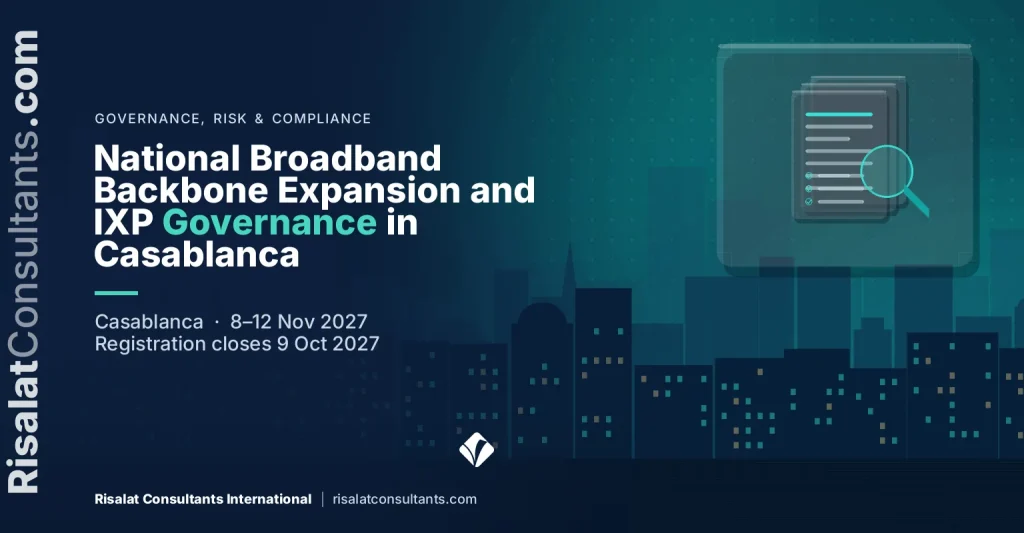
- 8–12 Nov 2027 (5 days)
- Lieu
- Casablanca, Maroc
- Frais par participant
- 3 000 £ (GBP)
- Paiement
- Sur facture et par virement bancaire
- Clôture des inscriptions
- 9 oct. 2027
- Certificat
- Certificat de participation
- Option intra
- Organisez-le pour votre équipe, à vos dates
Sur cette page 14 sections
Présentation du programme
National digital transformation requires resilient, high-capacity transmission networks alongside efficient domestic traffic exchange. This five-day executive training programme delivers rigorous technical and regulatory methodologies for planning, rolling out, and managing national optic fibre backbones and Internet Exchange Points (IXPs). Participants examine civil engineering standards, optic transmission parameters, and carrier-neutral exchange architectures essential for modern wholesale digital connectivity. The curriculum addresses the operational complexities faced by public telecom authorities, infrastructure agencies, and sector regulators seeking to eliminate international transit dependencies and lower domestic bandwidth expenses.
Delivered in Casablanca, Morocco, the course combines field-tested engineering frameworks with international wholesale telecommunications governance practices. Attendees review optic fibre duct deployment, dark fibre commercialisation models, and non-discriminatory infrastructure sharing mandates. The programme explores ITU-T recommendations for optical transport networks, alongside best practices from the Internet Society and Euro-IX regarding IXP operational governance. Through hands-on design exercises and technical policy reviews, public officials evaluate practical approaches to managing open-access broadband infrastructure, cross-border network interconnections, and national peering ecosystems.
The sessions also address governance, concession agreements, and legal structuring for state-owned digital assets. Participants establish compliance criteria, wholesale pricing benchmarks, and service level agreements (SLAs) that satisfy international standards and multilateral development bank procurement criteria. By linking physical layer deployment oversight with IXP route server management and wholesale regulatory design, the programme equips technical managers and regulatory specialists with the tools needed to supervise large-scale telecommunications capital projects and deliver competitive, high-speed national connectivity.
Public digital connectivity drives socio-economic modernization, yet fragmented fibre deployments and routing domestic traffic through overseas switches continue to drain public resources and constrain broadband uptake. This training aligns with the major digital infrastructure, backbone rollout, and network deployment objectives supported by sovereign borrowing, including the US$150m Senegal Digital Economy Acceleration Project funded by the World Bank. Government authorities, infrastructure operating agencies, and regulatory bodies require immediate technical capacity to oversee extensive civil duct works, enforce infrastructure sharing regulations, and govern sustainable, neutral Internet Exchange Points to retain digital traffic locally.
Delivered by Risalat Consultants International in Casablanca, Morocco, it combines expert-led sessions, real cases and group work, so that participants can apply what they learn in their own institution.
The Programme Strengthens Institutional Capability
- Terrestrial optical transmission fundamentals, link budget calculation, and ITU-T G.652/G.654 fibre standards
- Civil engineering works: trenching methodologies, duct installation, micro-trenching, and duct occupancy verification
- Quality assurance and route surveying: optical time-domain reflectometer (OTDR) testing and chromatic dispersion management
- Civil works contractor supervision, environmental and social risk mitigation, and right-of-way (RoW) acquisition
- Procurement and FIDIC contract management for national backbone rollouts under international financing rules
- Open-access principles: structural separation, accounting separation, and non-discriminatory access rules
- Commercialisation of state-owned optical fibres: dark fibre, indefeasible rights of use (IRU), and wavelength leasing
- Public-private partnership (PPP) operational models: Build-Own-Operate-Transfer (BOOT) versus concession licences
- Planification et priorisation des infrastructures
- Évaluation ex ante des projets et études de rentabilité
- Options de financement et partenariats public-privé
- Passation des marchés et contrats de travaux
It is designed for telecom and civil engineers overseeing national optic fibre deployments, digital infrastructure directors from public sector communication agencies, communications regulatory authority officers and wholesale market analysts and others who want practical, current skills in infrastructure, urban development and partnerships.
The Growing Importance of National Broadband Backbone Expansion and IXP Governance in Casablanca
Les infrastructures et les services urbains façonnent la croissance, la santé et les perspectives. Les projets sont vastes, complexes et durables, et les faiblesses de planification, de financement ou de réalisation coûtent cher à corriger par la suite.
Les gouvernements combinent de plus en plus investissement public, partenariats avec le secteur privé et nouvelles technologies. Les équipes capables de planifier, d'évaluer, d'acheter et de gérer ces investissements obtiennent de meilleurs actifs et services.
Les organisations ont de plus en plus besoin de professionnels capables de :
- Planifier et prioriser les investissements d'infrastructure
- Évaluer les projets et préparer des études de rentabilité
- Choisir les modèles de financement et de réalisation
- Superviser les travaux en matière de délais, de coûts et de qualité
- Gérer les actifs tout au long de leur cycle de vie
Des systèmes solides en matière d'infrastructures, de développement urbain et de partenariats aident les organisations à :
- Choisir les bons investissements
- Livrer les projets dans les délais et le budget
- Attirer des financements et des partenaires
- Prolonger la durée de service des actifs
This National Broadband Backbone Expansion and IXP Governance in Casablanca programme brings these elements together in a practical format, so that participants understand not only what good practice looks like but also how to introduce it in their own setting, with the people and resources they have.
Who Should Attend This National Broadband Backbone Expansion and IXP Governance in Casablanca Training?
Ce programme s'adresse à :
- Telecom and civil engineers overseeing national optic fibre deployments
- Digital infrastructure directors from public sector communication agencies
- Communications regulatory authority officers and wholesale market analysts
- Project coordinators from donor-funded digital transformation units
- National transmission network managers and system architects
- Public-private partnership (PPP) telecom contract and concession officers
- Universal service fund managers dedicated to broadband expansion
- Internet Exchange Point technical directors and peering coordinators
- Cross-border interconnection managers within ministries of digital economy
- Planificateurs d'infrastructures et urbanistes
- Ingénieurs et responsables techniques
- Gestionnaires de projets et de programmes
Le programme convient aussi bien aux professionnels expérimentés qu’à ceux qui prennent de nouvelles responsabilités. Les groupes réunissant plusieurs institutions et pays sont encouragés, car les participants apprennent beaucoup de l’expérience des autres.
Cochez ce que votre équipe doit être capable de faire.
National Broadband Backbone Expansion and IXP Governance in Casablanca Training Objectives
Upon successful completion of this National Broadband Backbone Expansion and IXP Governance in Casablanca Training, participants will be able to:
- Assess civil works specifications and duct deployment oversight for national optic fibre backbone networks
- Structure carrier-neutral Internet Exchange Point (IXP) technical architectures, switching fabrics, and multi-lateral peering policies
- Evaluate international wholesale telecommunications regulations and reference interconnect offers (RIOs)
- Formulate open-access infrastructure sharing models to optimize public utility rights-of-way and dark fibre assets
- Draft comprehensive Service Level Agreements (SLAs) for wholesale transit, co-location, and high-speed terrestrial backhaul
- Apply ITU-T and Euro-IX technical standards to digital infrastructure procurement and project monitoring
- Design institutional governance frameworks that balance sovereign asset management with private-sector broadband service provision
- Expliquer comment les infrastructures sont planifiées et priorisées
- Évaluer des projets et préparer une étude de rentabilité
- Comparer les modèles de financement et de réalisation, y compris les partenariats
Chaque objectif est mis en pratique pendant le programme à travers des exercices, des études de cas ou des travaux de groupe, afin que les participants repartent capables de le faire, et pas seulement de le décrire.
Contenu et structure du programme
- Terrestrial optical transmission fundamentals, link budget calculation, and ITU-T G.652/G.654 fibre standards
- Civil engineering works: trenching methodologies, duct installation, micro-trenching, and duct occupancy verification
- Quality assurance and route surveying: optical time-domain reflectometer (OTDR) testing and chromatic dispersion management
- Civil works contractor supervision, environmental and social risk mitigation, and right-of-way (RoW) acquisition
- Procurement and FIDIC contract management for national backbone rollouts under international financing rules
- Open-access principles: structural separation, accounting separation, and non-discriminatory access rules
- Commercialisation of state-owned optical fibres: dark fibre, indefeasible rights of use (IRU), and wavelength leasing
- Public-private partnership (PPP) operational models: Build-Own-Operate-Transfer (BOOT) versus concession licences
- Co-deployment synergies: cross-sector coordination with electricity transmission, road networks, and rail corridors
- Wholesale pricing models: cost-oriented access pricing, LRIC methodology, and universal service fund interventions
- Domestic peering mechanics: transit versus peering, latency reduction, and international bandwidth conservation
- Carrier-neutral data centre requirements, colocation specifications, dual-feed power, and physical security standards
- Switch fabric architecture, route servers, Bird/OpenBGPD deployment, and automated prefix filtering via RPKI
- MANRS (Mutually Agreed Norms for Routing Security) implementation for secure national routing ecosystems
- Domain Name System (DNS) root and country-code top-level domain (ccTLD) anycast instances hosting at IXPs
- IXP organisational structuring: non-profit associations, technical community management, and neutral public entities
- Membership charters, peering agreements, and terms of service (ToS) formulation
- Financial cost-recovery models: port charges, colocation fees, and operational sustainability planning
- Inter-IXP connections, regional peering corridors, and cross-border telecommunications policy harmonization
- Key performance indicators: tracking exchange traffic volumes, local content caching, and peering member growth
- Reference Interconnect Offers (RIO) and Reference Unbundling Offers (RUO) regulatory supervision
- Wholesale dispute resolution mechanisms: handling anti-competitive behaviour, refusal to deal, and margin squeeze
- Formulating commercial Service Level Agreements (SLAs): Mean Time to Repair (MTTR), latency, and availability metrics
- Supervision of donor-financed telecommunications projects: disbursement monitoring, audits, and compliance checks
- Capstone exercise: structuring a national backbone expansion and IXP governance action plan
Contenu détaillé jour par jour
Le programme se déroule sur 5 jours. Chaque journée associe apports d'experts, travail pratique et un atelier ou une étude de cas de clôture :
- First Day: National Fibre Backbone Design and Civil Engineering Supervision
- Second Day: Open-Access Infrastructure Sharing and Public-Private Concessions
- Third Day: Internet Exchange Point Architecture and Operational Engineering
- Fourth Day: IXP Governance, Multi-Stakeholder Models, and Sustainability
- Fifth Day: Wholesale Telecom Regulation, Quality of Service, and SLA Design
Contenu détaillé jour par jour
First Day | National Fibre Backbone Design and Civil Engineering Supervision
- Terrestrial optical transmission fundamentals, link budget calculation, and ITU-T G.652/G.654 fibre standards
- Civil engineering works: trenching methodologies, duct installation, micro-trenching, and duct occupancy verification
- Quality assurance and route surveying: optical time-domain reflectometer (OTDR) testing and chromatic dispersion management
- Civil works contractor supervision, environmental and social risk mitigation, and right-of-way (RoW) acquisition
- Procurement and FIDIC contract management for national backbone rollouts under international financing rules
Workshop: National Fibre Backbone Design and Civil Engineering Supervision: Applying It to Your Institution
En petits groupes, les participants appliquent les méthodes du jour à des exemples tirés de leurs institutions et conviennent d'étapes concrètes pour la suite.
Second Day | Open-Access Infrastructure Sharing and Public-Private Concessions
- Open-access principles: structural separation, accounting separation, and non-discriminatory access rules
- Commercialisation of state-owned optical fibres: dark fibre, indefeasible rights of use (IRU), and wavelength leasing
- Public-private partnership (PPP) operational models: Build-Own-Operate-Transfer (BOOT) versus concession licences
- Co-deployment synergies: cross-sector coordination with electricity transmission, road networks, and rail corridors
- Wholesale pricing models: cost-oriented access pricing, LRIC methodology, and universal service fund interventions
Workshop: Open-Access Infrastructure Sharing and Public-Private Concessions: Applying It to Your Institution
En petits groupes, les participants appliquent les méthodes du jour à des exemples tirés de leurs institutions et conviennent d'étapes concrètes pour la suite.
Third Day | Internet Exchange Point Architecture and Operational Engineering
- Domestic peering mechanics: transit versus peering, latency reduction, and international bandwidth conservation
- Carrier-neutral data centre requirements, colocation specifications, dual-feed power, and physical security standards
- Switch fabric architecture, route servers, Bird/OpenBGPD deployment, and automated prefix filtering via RPKI
- MANRS (Mutually Agreed Norms for Routing Security) implementation for secure national routing ecosystems
- Domain Name System (DNS) root and country-code top-level domain (ccTLD) anycast instances hosting at IXPs
Case Study: Internet Exchange Point Architecture and Operational Engineering in Practice
Les participants analysent un cas réaliste, comparent les choix effectués aux bonnes pratiques et en tirent des enseignements applicables à leur propre contexte.
Fourth Day | IXP Governance, Multi-Stakeholder Models, and Sustainability
- IXP organisational structuring: non-profit associations, technical community management, and neutral public entities
- Membership charters, peering agreements, and terms of service (ToS) formulation
- Financial cost-recovery models: port charges, colocation fees, and operational sustainability planning
- Inter-IXP connections, regional peering corridors, and cross-border telecommunications policy harmonization
- Key performance indicators: tracking exchange traffic volumes, local content caching, and peering member growth
Workshop: IXP Governance, Multi-Stakeholder Models, and Sustainability: Applying It to Your Institution
En petits groupes, les participants appliquent les méthodes du jour à des exemples tirés de leurs institutions et conviennent d'étapes concrètes pour la suite.
Fifth Day | Wholesale Telecom Regulation, Quality of Service, and SLA Design
- Reference Interconnect Offers (RIO) and Reference Unbundling Offers (RUO) regulatory supervision
- Wholesale dispute resolution mechanisms: handling anti-competitive behaviour, refusal to deal, and margin squeeze
- Formulating commercial Service Level Agreements (SLAs): Mean Time to Repair (MTTR), latency, and availability metrics
- Supervision of donor-financed telecommunications projects: disbursement monitoring, audits, and compliance checks
- Capstone exercise: structuring a national backbone expansion and IXP governance action plan
Capstone Exercise: National Broadband Backbone Expansion and IXP Governance in Casablanca Action Plan for Your Institution
Les participants synthétisent la semaine dans un plan d'action pour leur institution, avec des priorités, des responsables et des premières étapes, puis le présentent à leurs pairs et aux animateurs pour recueillir leurs retours.
National Broadband Backbone Expansion and IXP Governance in Casablanca Training Methodology
The course utilizes adult-learning methodologies targeted at technical and regulatory professionals. Instruction blends technical lectures, real-world case analysis from emerging market network deployments, and group-based exercises on wholesale telecommunications policy. Participants review authentic technical specifications, inspect duct construction inspection logs, and evaluate BGP peering configurations. Moderated group discussions encourage cross-border peer exchange, culminating in a hands-on action planning workshop where delegates draft infrastructure-sharing protocols and IXP operational models applicable to their home institutions.
Le programme associe :
- Sessions animées par des experts sur les pratiques actuelles
- Études de cas régionales et internationales
- Travaux de groupe et exercices pratiques
- Simulations et jeux de rôle le cas échéant
- Discussion des défis rencontrés par les participants dans l'exercice de leurs fonctions
- Apprentissage entre pairs, d'institutions et de pays différents
- Des outils et modèles pratiques à réutiliser au travail
- Réflexion quotidienne et plan d'action
Avant le programme, une courte pré-évaluation aide les animateurs à comprendre le rôle et les priorités de chaque participant, afin d’adapter les exemples et les exercices au groupe. Chaque journée se termine par une brève réflexion au cours de laquelle les participants notent ce qu’ils appliqueront dans leur travail.
Résultats attendus
Upon completion of this National Broadband Backbone Expansion and IXP Governance in Casablanca Training, participants will be able to:
- Direct engineering and quality control procedures for national optic fibre civil deployments in compliance with ITU-T standards
- Formulate robust open-access regulatory instruments, reference interconnect offers, and infrastructure-sharing terms
- Deploy secure, reliable Internet Exchange Point architectures adhering to MANRS and international routing standards
- Establish transparent, sustainable multi-stakeholder governance models for domestic IXP administration
- Construct enforceable Service Level Agreements and technical compliance protocols for public dark fibre and capacity leases
- Oversee telecommunications infrastructure components of donor-funded capital programmes according to international guidelines
- Planifier et prioriser les investissements d'infrastructure
- Évaluer les projets et préparer des études de rentabilité
Les participants repartent avec un plan d'action personnel et des outils pratiques utilisables dans leur institution dès la première semaine de retour. Les institutions qui envoient plusieurs participants peuvent s'appuyer sur le programme pour convenir de méthodes et de modèles communs entre équipes, ce qui facilite la pérennité des améliorations.
3 000 £ par participant · facture et virement bancaire · remise pour les groupes de 5 personnes ou plus
Cinq personnes ou plus d'une même organisation : demandez le tarif de groupe lors de votre demande de facture.
À partir de dix participants, une version intra pour votre institution peut revenir moins cher par personne. Demander un devis intra.
Registration closes in 330 days (9 Oct 2027)
Institutional Application of National Broadband Backbone Expansion and IXP Governance in Casablanca Training
Ce programme aide les organisations à renforcer :
- Planification des investissements
- Évaluation ex ante des projets
- Gestion des partenariats
- Supervision des travaux
- Gestion des actifs
Les participants repartent avec des outils pratiques pour améliorer :
- Études de rentabilité
- Répartition des risques
- Gestion des contrats
- Planification de la maintenance
- Suivi des services
Le programme est conçu pour que l'apprentissage passe de la salle de formation à l'institution. Les participants travaillent, dans la mesure du possible, sur leurs propres processus et documents, et repartent avec un plan d'action que leurs responsables peuvent examiner et soutenir.
Pertinence régionale & mise en application
Europe
Les institutions européennes mettent en œuvre les infrastructures, le développement urbain et les partenariats dans des cadres réglementaires détaillés et des programmes de réforme. Les participants venus d'Europe peuvent comparer leurs pratiques avec celles de collègues d'autres régions et vérifier comment des méthodes éprouvées fonctionnent dans d'autres conditions.
Afrique
Partout en Afrique, les ministères, les agences et les équipes de projet qui travaillent dans les infrastructures, le développement urbain et les partenariats opèrent de plus en plus aux côtés de programmes financés par les bailleurs, qui exigent des systèmes clairs et des éléments probants. Le programme aide les participants à adapter les bonnes pratiques aux institutions et aux ressources avec lesquelles ils travaillent.
Moyen-Orient
Au Moyen-Orient, les stratégies nationales de développement et les plans de diversification imposent des exigences croissantes en matière d'infrastructures, de développement urbain et de partenariats. Les participants examinent comment bâtir, au sein des organismes publics et des entreprises, les capacités dont ces plans ont besoin.
Asie
Les institutions asiatiques conjuguent croissance rapide et programmes de modernisation ambitieux. Les participants venus d'Asie peuvent partager leur expérience du déploiement rapide de systèmes à grande échelle et découvrir les approches adoptées ailleurs.
Pacifique
Les petits États insulaires et du Pacifique sont confrontés à des contraintes particulières de taille, d'éloignement et de capacités. Le programme met en avant des approches pratiques et proportionnées des infrastructures, du développement urbain et des partenariats, adaptées aux institutions de plus petite taille.
Holding the programme in Casablanca, Morocco brings participants together away from their daily pressures, so they can compare how infrastructure, urban development and partnerships is handled in different settings. The same programme can also be delivered in-house for one institution, in its own country or online, with cases taken from its current work.
Profil du pays d'accueil : Maroc
Training programmes and study tours in Casablanca suit government officials, project teams and professionals focusing on international trade, maritime transport, banking and regional economic development.
Se former hors de son pays permet aux participants de se concentrer, de porter un regard neuf sur leur propre institution et de constituer un réseau avec des collègues d'autres pays.
National Broadband Backbone Expansion and IXP Governance in Casablanca Training Deliverables
Les participants sont accompagnés avant, pendant et après le programme, afin que la préparation, l'apprentissage et le suivi forment une expérience continue.
Avant le programme
- Pré-évaluation des participants
- National Broadband Backbone Expansion and IXP Governance in Casablanca Readiness Assessment
- National Broadband Backbone Expansion and IXP Governance in Casablanca Resource Pack
- Lectures préparatoires
- Aide et conseils gratuits pour le visa
Pendant le programme
- Accueil à l'aéroport & assistance à l'arrivée
- Hébergement avec petit-déjeuner
- Dîner de bienvenue et de réseautage
- Kit de formation Risalat (sac, gourde, mug, t-shirt, casquette, protège-passeport, stylos, carnet, magnet & porte-clés)
- Comprehensive National Broadband Backbone Expansion and IXP Governance in Casablanca Training Manual
- Modèle d'évaluation ex ante de projet
- Matrice de répartition des risques en PPP
- Liste de contrôle de la supervision des travaux
- Modèle de plan de gestion des actifs
- Ateliers pratiques & simulations
- Discussions de groupe & apprentissage entre pairs
- Déjeuner et pauses-café quotidiens
- Accès complet aux installations du lieu de formation
- Mini tablette avec supports pédagogiques numériques
- Visite de terrain (le cas échéant)
- Visite récréative de la ville
Après le programme
- Certificat de participation
- Distinction Risalat de participation au programme
- Documents de référence après la formation
- Liste de contrôle pour la revue des études de rentabilité
- Modèle de plan de maintenance
- Accompagnement après la formation & conseils de suivi
- Rapport du programme
Les institutions peuvent aussi demander une version intra sur mesure de ce programme, dispensée dans leurs locaux ou en ligne. Demander une proposition.
Common Challenges in National Broadband Backbone Expansion and IXP Governance in Casablanca, And How This Training Helps
Comment les institutions peuvent-elles planifier et hiérarchiser leurs investissements d'infrastructure ?
The programme addresses this directly on the first day (National Fibre Backbone Design and Civil Engineering Supervision), where participants practise the methods involved and adapt them to their own institution, then build it into their action plan.
Comment les institutions peuvent-elles évaluer des projets et préparer des dossiers d'investissement ?
The programme addresses this directly on the second day (Open-Access Infrastructure Sharing and Public-Private Concessions), where participants practise the methods involved and adapt them to their own institution, then build it into their action plan.
Comment les institutions peuvent-elles choisir leurs modèles de financement et d'exécution ?
The programme addresses this directly on the third day (Internet Exchange Point Architecture and Operational Engineering), where participants practise the methods involved and adapt them to their own institution, then build it into their action plan.
Comment les institutions peuvent-elles superviser les travaux en matière de délais, de coûts et de qualité ?
The programme addresses this directly on the fourth day (IXP Governance, Multi-Stakeholder Models, and Sustainability), where participants practise the methods involved and adapt them to their own institution, then build it into their action plan.
Comment les institutions peuvent-elles gérer leurs actifs tout au long de leur cycle de vie ?
The programme addresses this directly on the fifth day (Wholesale Telecom Regulation, Quality of Service, and SLA Design), where participants practise the methods involved and adapt them to their own institution, then build it into their action plan.
Questions fréquentes
When and where does the National Broadband Backbone Expansion and IXP Governance in Casablanca programme take place?
It runs from 8 Nov 2027 to 12 Nov 2027, in Casablanca, Morocco. The registration deadline is shown at the top of this page.
Qui devrait participer ?
The programme is designed for telecom and civil engineers overseeing national optic fibre deployments, digital infrastructure directors from public sector communication agencies, communications regulatory authority officers and wholesale market analysts, project coordinators from donor-funded digital transformation units, and others who want practical skills in infrastructure, urban development and partnerships.
Recevrai-je un certificat ?
Oui. Les participants qui terminent le programme reçoivent un certificat de participation délivré par Risalat Consultants International.
Ce programme peut-il être dispensé pour notre seule institution ?
Oui. Nous pouvons proposer une version intra sur mesure dans vos locaux, dans une autre ville ou en ligne, construite autour de vos propres cas. Utilisez la demande de proposition sur cette page.
Faut-il une expérience préalable en infrastructures, développement urbain et partenariats ?
Aucune formation spécialisée n'est requise au-delà d'une expérience dans une fonction similaire. Une courte pré-évaluation aide les animateurs à adapter les sessions au groupe.
Who Will Deliver This Programme
Each date is delivered by a team assigned from Risalat's expert network for this subject. For this programme we assign:
How we choose them: Experience in the region of the participants or comparable settings; Command of the financier rules that apply (World Bank, ADB, AfDB, EU, UN) where relevant; Delivery in English; other languages on request for in-house groups; No conflict of interest with participants' institutions.
Names and short CVs of the assigned experts are shared with registered participants and sponsoring organisations before the programme, on request. Are you an expert in this subject? Join our expert network.
Training courses in CasablancaTechnology training courses
Why Casablanca for this programme
Casablanca links French- and Arabic-speaking Africa with Europe.
The National Broadband Backbone Expansion and IXP Governance in Casablanca programme in November 2027 brings together officials and professionals from across the Africa region and beyond. Sessions combine short inputs, case studies and group work on participants' own files, and the city's institutions can be added as a study visit on request.
Getting there: Mohammed V (CMN).
Vérifiez si vous avez besoin d'un visa avec le vérificateur de visa gratuit, et demandez une lettre d'invitation une fois inscrit.
Other programmes in Casablanca
- Urban Stormwater Infrastructure and Flood Protection Civil Works in Casablanca
- Solar Photovoltaic Operations, Inverter Safety and O&M Standards in Casablanca
- Artisanal Mining Formalisation and Environmental Rehabilitation in Casablanca
- Agri-Enterprise Outgrower Contracting and Commercial Matching Grants in Casablanca
- Public Sector Fiber Backbone Contracting and Open Access Regulation in Casablanca
- Open Contracting Partnership Open Contracting Partnership
- OCDE (Organisation de coopération et de développement économiques) OCDE
- Programme des Nations Unies pour le développement PNUD
For teams and institutions
Bring your team
Teams that learn together apply more at work. Tell us how many people and how you would like to take part: we reply with a group quote within two working days.
Other dates and cities for this subject: Governance, Risk and Anti-Corruption training courses (91 upcoming dates).
Plus de formations au Maroc · Tous les programmes en Afrique · Calendrier complet des formations
Plan this programme in a roadmap: why it matters, why to approve it, the dates to plan and the career it builds.