Points clés
- Dates
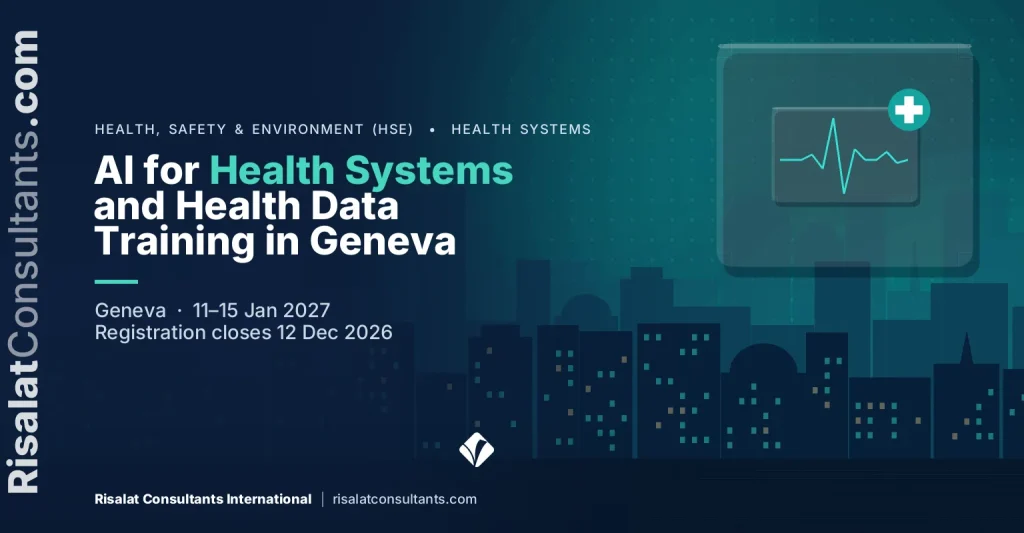
- 11–15 janv. 2027 (5 jours)
- Lieu
- Genève, Suisse
- Frais par participant
- 3 850 £ (GBP)
- Paiement
- Sur facture et par virement bancaire
- Clôture des inscriptions
- 12 déc. 2026
- Certificat
- Certificat de participation
- Option intra
- Organisez-le pour votre équipe, à vos dates
Sur cette page 16 sections
Présentation du programme
Health ministries, public health institutes, and tertiary hospitals face growing pressure to modernise digital health infrastructure using artificial intelligence. This five-day course in Geneva provides leaders and technical specialists with the knowledge required to deploy AI solutions effectively. Participants study how automated systems support diagnostics, strengthen national disease surveillance, and integrate with routine health information systems, ensuring that investments align with institutional priorities and modern public health standards.
Free self-check: the digital readiness assessment gives how ready your institution is for digital services, data and AI, in about 10 minutes.
The curriculum addresses the critical regulatory, ethical, and governance challenges associated with deploying digital tools in clinical and public health environments. Drawing directly on the World Health Organization guidance on the ethics and governance of artificial intelligence for health, the programme examines patient data protection, algorithmic bias, model transparency, and accountability frameworks. Sessions explore how to maintain strict clinical safety and patient privacy while managing complex digital transformations across health services.
Delivered through practical case exercises and policy reviews, the course equips managers to evaluate commercial and open-source AI applications systematically. Health leaders gain the technical fluency needed to direct multidisciplinary teams, assess vendor proposals, and integrate safe predictive models into health programmes. By linking international policy benchmarks to everyday health operations, this training ensures that public institutions adopt technologies that improve patient outcomes, safeguard confidentiality, and deliver long-term health system resilience.
Governments and donor-financed health operations supported by development partners such as the World Bank, Asian Development Bank, African Development Bank, European Union, and United Nations agencies are accelerating the adoption of digital technologies. As public health initiatives incorporate machine learning, institutions must align their operations with international benchmarks including the OECD AI Principles, the UNESCO Recommendation on the Ethics of Artificial Intelligence, and the European Union AI Act. Public bodies now urgently require capable personnel who understand how to deploy AI applications safely, manage sensitive health records responsibly, and integrate algorithmic systems into everyday clinical and administrative workflows.
Proposé par Risalat Consultants International à Genève (Suisse), il associe sessions animées par des experts, cas réels et travaux de groupe, afin que les participants puissent appliquer leurs acquis dans leur propre institution.
The Programme Strengthens Institutional Capability
- Core concepts of machine learning, deep learning, and natural language processing in health
- Mapping AI applications across primary care, secondary care, and community public health
- Interoperability standards for AI integration, including HL7 FHIR and openEHR structures
- Assessing technical readiness of routine health management information systems for AI adoption
- Institutional roles and responsibilities in governing public health computing infrastructure
- Deep dive into the WHO Guidance on Ethics and Governance of AI for Health
- Implementing the OECD AI Principles and UNESCO Recommendation on the Ethics of AI in health
- Examining the implications of the European Union AI Act for high-risk clinical software
- Stratégie numérique et planification de la transformation
- Gouvernance et qualité des données
- Analyse et visualisation des données
- Notions de base en cybersécurité et gestion des risques
It is designed for health ministry officials and policy advisors, national health information system managers, public health surveillance coordinators and others who want practical, current skills in digital government, data and technology.
- Collecter
- Nettoyer
- Stocker
- Analyser
- Décider
The Growing Importance of AI for Health Systems and Health Data
Les services numériques, les données et les nouvelles technologies transforment le fonctionnement des institutions et le service rendu aux citoyens. Bien utilisés, ils rendent les services plus rapides, moins coûteux et plus transparents ; mal utilisés, ils gaspillent de l'argent et exposent les données à des risques.
Les institutions ont besoin de personnes capables de planifier le changement numérique, de gérer les données de manière responsable, de protéger les systèmes et d'utiliser les données probantes dans leurs décisions. Ces compétences sont désormais attendues dans toutes les fonctions, et pas seulement dans l'informatique.
Les organisations ont de plus en plus besoin de professionnels capables de :
- Planifier des initiatives numériques qui résolvent de vrais problèmes
- Gérer la qualité, la protection et le partage des données
- Analyser les données et les présenter clairement
- Gérer les risques cyber et technologiques
- Accompagner les équipes dans le changement numérique
Des systèmes solides d'administration numérique, de données et de technologies aident les organisations à :
- Fournir des services plus rapides et plus accessibles
- Mieux utiliser les données dans les décisions
- Protéger les systèmes et les données personnelles
- Tirer parti des investissements technologiques
This AI for Health Systems and Health Data programme brings these elements together in a practical format, so that participants understand not only what good practice looks like but also how to introduce it in their own setting, with the people and resources they have.
Who Should Attend This AI for Health Systems and Health Data Training?
Ce programme s'adresse à :
- Health ministry officials and policy advisors
- National health information system managers
- Public health surveillance coordinators
- Hospital directors and medical administrators
- Health data governance and privacy officers
- Digital health programme managers on donor-funded projects
- Epidemiologists and biostatisticians managing health datasets
- Clinical informatics leads and health technology assessment officers
- Project officers from international development agencies focused on digital health
- Responsables et chargés des TIC
- Responsables de la transformation numérique
- Analystes de données et statisticiens
Le programme convient aussi bien aux professionnels expérimentés qu’à ceux qui prennent de nouvelles responsabilités. Les groupes réunissant plusieurs institutions et pays sont encouragés, car les participants apprennent beaucoup de l’expérience des autres.
Cochez ce que votre équipe doit être capable de faire.
AI for Health Systems and Health Data Training Objectives
Upon successful completion of this AI for Health Systems and Health Data Training, participants will be able to:
- Analyse the role of machine learning in diagnostics support, clinical workflows, and automated triage
- Apply World Health Organization guidance on the ethics and governance of artificial intelligence for health to national health policies
- Design disease surveillance models that integrate predictive analytics and automated early warning signals
- Establish robust health data governance protocols that comply with international data protection and patient privacy standards
- Evaluate commercial and open-source health AI software using standardised technical and clinical assessment criteria
- Integrate machine learning components into national health management information systems and electronic health records
- Formulate institutional risk management and accountability plans for artificial intelligence deployment in public healthcare
- Expliquer les grandes tendances de l'administration numérique et de l'utilisation des données
- Planifier une initiative numérique liée aux objectifs de service
- Appliquer les principes de gouvernance et de qualité des données
Chaque objectif est mis en pratique pendant le programme à travers des exercices, des études de cas ou des travaux de groupe, afin que les participants repartent capables de le faire, et pas seulement de le décrire.
Contenu et structure du programme
- Core concepts of machine learning, deep learning, and natural language processing in health
- Mapping AI applications across primary care, secondary care, and community public health
- Interoperability standards for AI integration, including HL7 FHIR and openEHR structures
- Assessing technical readiness of routine health management information systems for AI adoption
- Institutional roles and responsibilities in governing public health computing infrastructure
- Deep dive into the WHO Guidance on Ethics and Governance of AI for Health
- Implementing the OECD AI Principles and UNESCO Recommendation on the Ethics of AI in health
- Examining the implications of the European Union AI Act for high-risk clinical software
- Mitigating algorithmic bias, historical health disparities, and dataset representation gaps
- Accountability, explainability, and liability protocols for AI-driven clinical decisions
- Computer vision applications in medical imaging, radiology, pathology, and screening
- Clinical decision support systems for non-communicable diseases and triage management
- AI for bed management, operational scheduling, and hospital resource optimisation
- Validation, clinical efficacy assessment, and regulatory approval pathways for diagnostic software
- Change management strategies for clinical staff adoption and safe workflow integration
- Automated epidemiological surveillance and early warning systems for outbreak detection
- Predictive modelling for infectious disease transmission and resource allocation
- Integrating geospatial data, weather metrics, and mobility patterns into disease tracking
- Natural language processing for processing community reports and public health alerts
- Quality assurance, data pipeline validation, and model drift in dynamic environments
- Health data sovereignty, security safeguards, and cross-border health data transfers
- Developing structured terms of reference and evaluation criteria for AI vendor procurement
- Conducting data protection impact assessments and algorithmic audits on health software
- Monitoring and post-deployment evaluation frameworks for AI in health programmes
- Action planning: Designing a road map for safe AI integration in public institutions
Contenu détaillé jour par jour
Le programme se déroule sur 5 jours. Chaque journée associe apports d'experts, travail pratique et un atelier ou une étude de cas de clôture :
- First Day: Foundations of AI in Healthcare and Digital Health Architecture
- Second Day: Ethics, Governance, and International Regulatory Frameworks
- Third Day: Clinical Diagnostics Support and Hospital Operational Efficiency
- Fourth Day: Disease Surveillance, Predictive Analytics, and Population Health
- Fifth Day: Data Protection, Procurement, and Institutional Implementation
Contenu détaillé jour par jour
First Day | Foundations of AI in Healthcare and Digital Health Architecture
- Core concepts of machine learning, deep learning, and natural language processing in health
- Mapping AI applications across primary care, secondary care, and community public health
- Interoperability standards for AI integration, including HL7 FHIR and openEHR structures
- Assessing technical readiness of routine health management information systems for AI adoption
- Institutional roles and responsibilities in governing public health computing infrastructure
Workshop: Foundations of AI in Healthcare and Digital Health Architecture: Applying It to Your Institution
En petits groupes, les participants appliquent les méthodes du jour à des exemples tirés de leurs institutions et conviennent d'étapes concrètes pour la suite.
Second Day | Ethics, Governance, and International Regulatory Frameworks
- Deep dive into the WHO Guidance on Ethics and Governance of AI for Health
- Implementing the OECD AI Principles and UNESCO Recommendation on the Ethics of AI in health
- Examining the implications of the European Union AI Act for high-risk clinical software
- Mitigating algorithmic bias, historical health disparities, and dataset representation gaps
- Accountability, explainability, and liability protocols for AI-driven clinical decisions
Workshop: Ethics, Governance, and International Regulatory Frameworks: Applying It to Your Institution
En petits groupes, les participants appliquent les méthodes du jour à des exemples tirés de leurs institutions et conviennent d'étapes concrètes pour la suite.
Third Day | Clinical Diagnostics Support and Hospital Operational Efficiency
- Computer vision applications in medical imaging, radiology, pathology, and screening
- Clinical decision support systems for non-communicable diseases and triage management
- AI for bed management, operational scheduling, and hospital resource optimisation
- Validation, clinical efficacy assessment, and regulatory approval pathways for diagnostic software
- Change management strategies for clinical staff adoption and safe workflow integration
Case Study: Clinical Diagnostics Support and Hospital Operational Efficiency in Practice
Les participants analysent un cas réaliste, comparent les choix effectués aux bonnes pratiques et en tirent des enseignements applicables à leur propre contexte.
Fourth Day | Disease Surveillance, Predictive Analytics, and Population Health
- Automated epidemiological surveillance and early warning systems for outbreak detection
- Predictive modelling for infectious disease transmission and resource allocation
- Integrating geospatial data, weather metrics, and mobility patterns into disease tracking
- Natural language processing for processing community reports and public health alerts
- Quality assurance, data pipeline validation, and model drift in dynamic environments
Workshop: Disease Surveillance, Predictive Analytics, and Population Health: Applying It to Your Institution
En petits groupes, les participants appliquent les méthodes du jour à des exemples tirés de leurs institutions et conviennent d'étapes concrètes pour la suite.
Fifth Day | Data Protection, Procurement, and Institutional Implementation
- Health data sovereignty, security safeguards, and cross-border health data transfers
- Developing structured terms of reference and evaluation criteria for AI vendor procurement
- Conducting data protection impact assessments and algorithmic audits on health software
- Monitoring and post-deployment evaluation frameworks for AI in health programmes
- Action planning: Designing a road map for safe AI integration in public institutions
Capstone Exercise: AI for Health Systems and Health Data Action Plan for Your Institution
Les participants synthétisent la semaine dans un plan d'action pour leur institution, avec des priorités, des responsables et des premières étapes, puis le présentent à leurs pairs et aux animateurs pour recueillir leurs retours.
AI for Health Systems and Health Data Training Methodology
The training is conducted through instructor-led technical briefings, structured policy analyses, and collaborative working groups. Participants work through realistic scenarios based on digital health modernisation projects, using genuine international frameworks to assess tools and governance models. Daily sessions combine lecture material with group appraisal of real-world health data workflows, software procurement documents, and regulatory compliance checklists, ensuring practical skills transfer for immediate institutional application.
Le programme associe :
- Sessions animées par des experts sur les pratiques actuelles
- Études de cas régionales et internationales
- Travaux de groupe et exercices pratiques
- Simulations et jeux de rôle le cas échéant
- Discussion des défis rencontrés par les participants dans l'exercice de leurs fonctions
- Apprentissage entre pairs, d'institutions et de pays différents
- Des outils et modèles pratiques à réutiliser au travail
- Réflexion quotidienne et plan d'action
Avant le programme, une courte pré-évaluation aide les animateurs à comprendre le rôle et les priorités de chaque participant, afin d’adapter les exemples et les exercices au groupe. Chaque journée se termine par une brève réflexion au cours de laquelle les participants notent ce qu’ils appliqueront dans leur travail.
Résultats attendus
Upon completion of this AI for Health Systems and Health Data Training, participants will be able to:
- Confidence to lead the strategic adoption of AI tools across health systems and public programmes
- Ability to align health data initiatives with WHO, OECD, and European regulatory standards
- Competence in auditing health algorithms for fairness, data privacy, and clinical safety
- Practical skill in drafting institutional procurement requirements for digital health applications
- Capacity to integrate predictive analytics safely into national disease surveillance workflows
- Establishment of institutional frameworks for continuous monitoring of algorithmic performance
- Planifier des initiatives numériques liées aux objectifs de service
- Appliquer les principes de gouvernance et de qualité des données
Les participants repartent avec un plan d'action personnel et des outils pratiques utilisables dans leur institution dès la première semaine de retour. Les institutions qui envoient plusieurs participants peuvent s'appuyer sur le programme pour convenir de méthodes et de modèles communs entre équipes, ce qui facilite la pérennité des améliorations.
3 850 £ par participant · facture et virement bancaire · réduction pour les groupes de 5 personnes ou plus
Cinq personnes ou plus d'une même organisation : demandez le tarif de groupe lors de votre demande de facture.
Ten or more: an in-house version for your institution may cost less per person. Ask for an in-house quote.
Registration closes in 24 days (12 Dec 2026)
Institutional Application of AI for Health Systems and Health Data Training
Ce programme aide les organisations à renforcer :
- Stratégie numérique
- Gouvernance des données
- Décisions fondées sur les données
- Cybersécurité
- Gestion des technologies
Les participants repartent avec des outils pratiques pour améliorer :
- Inventaires des données
- Tableaux de bord
- Registres des risques
- Achats de technologies
- Plans de changement
Le programme est conçu pour que l'apprentissage passe de la salle de formation à l'institution. Les participants travaillent, dans la mesure du possible, sur leurs propres processus et documents, et repartent avec un plan d'action que leurs responsables peuvent examiner et soutenir.
Pertinence régionale & mise en application
Europe
Les institutions européennes pratiquent l'administration numérique, la gestion des données et des technologies dans le cadre de réglementations détaillées et de programmes de réforme. Les participants venus d'Europe peuvent comparer leurs pratiques avec celles de collègues d'autres régions et vérifier comment des méthodes éprouvées fonctionnent dans d'autres conditions.
Afrique
En Afrique, les ministères, agences et équipes de projet œuvrant dans l'administration numérique, les données et les technologies travaillent de plus en plus aux côtés de programmes financés par les bailleurs qui exigent des systèmes clairs et des données probantes. Le programme aide les participants à adapter les bonnes pratiques aux institutions et aux ressources avec lesquelles ils travaillent.
Moyen-Orient
Au Moyen-Orient, les stratégies nationales de développement et les plans de diversification sollicitent de plus en plus l'administration numérique, les données et les technologies. Les participants examinent comment bâtir, au sein des organismes publics et des entreprises, les capacités dont ces plans ont besoin.
Asie
Les institutions asiatiques conjuguent croissance rapide et programmes de modernisation ambitieux. Les participants venus d'Asie peuvent partager leur expérience du déploiement rapide de systèmes à grande échelle et découvrir les approches adoptées ailleurs.
Pacifique
Les petits États insulaires et du Pacifique font face à des contraintes particulières de taille, de distance et de capacités. Le programme met en avant des approches pratiques et proportionnées de l'administration numérique, des données et des technologies, adaptées aux institutions de petite taille.
Holding the programme in Geneva, Switzerland brings participants together away from their daily pressures, so they can compare how digital government, data and technology is handled in different settings. The same programme can also be delivered in-house for one institution, in its own country or online, with cases taken from its current work.
Profil du pays d'accueil – Suisse
Programmes, ateliers, visites et formations à Genève, en Suisse, par Risalat Consultants International
Se former hors de son pays permet aux participants de se concentrer, de porter un regard neuf sur leur propre institution et de constituer un réseau avec des collègues d'autres pays.
AI for Health Systems and Health Data Training Deliverables
Les participants sont accompagnés avant, pendant et après le programme, afin que la préparation, l'apprentissage et le suivi forment une expérience continue.
Avant le programme
- Pré-évaluation des participants
- AI for Health Systems and Health Data Readiness Assessment
- AI for Health Systems and Health Data Resource Pack
- Lectures préparatoires
- Aide et conseils gratuits pour le visa
Pendant le programme
- Accueil à l'aéroport & assistance à l'arrivée
- Accommodation with breakfast: 6 nights, check-in Sunday 10 January 2027, check-out Saturday 16 January 2027 (one night before and one night after the programme)
- Dîner de bienvenue et de réseautage
- Kit de formation Risalat (sac, gourde, mug, t-shirt, casquette, protège-passeport, stylos, carnet, magnet & porte-clés)
- Comprehensive AI for Health Systems and Health Data Training Manual
- Liste de contrôle de la maturité numérique
- Modèle d'inventaire des données
- Modèle de planification de tableau de bord
- Registre des risques technologiques
- Ateliers pratiques & simulations
- Discussions de groupe & apprentissage entre pairs
- Déjeuner et pauses-café quotidiens
- Accès complet aux installations du lieu de formation
- Mini tablette avec supports pédagogiques numériques
- Visite de terrain (le cas échéant)
- Visite récréative de la ville
Après le programme
- Certificat de participation
- Distinction Risalat de participation au programme
- Documents de référence après la formation
- Autoévaluation de la gouvernance des données
- Liste de contrôle d'examen des projets numériques
- Accompagnement après la formation & conseils de suivi
- Rapport du programme
Institutions can also request a tailored in-house version of this programme, delivered at their premises or online. Request a proposal.
Common Challenges in AI for Health Systems and Health Data, And How This Training Helps
Comment les institutions peuvent-elles planifier des initiatives numériques qui résolvent de vrais problèmes ?
The programme addresses this directly on the first day (Foundations of AI in Healthcare and Digital Health Architecture), where participants practise the methods involved and adapt them to their own institution, then build it into their action plan.
Comment les institutions peuvent-elles gérer la qualité, la protection et le partage des données ?
The programme addresses this directly on the second day (Ethics, Governance, and International Regulatory Frameworks), where participants practise the methods involved and adapt them to their own institution, then build it into their action plan.
Comment les institutions peuvent-elles analyser les données et les présenter clairement ?
The programme addresses this directly on the third day (Clinical Diagnostics Support and Hospital Operational Efficiency), where participants practise the methods involved and adapt them to their own institution, then build it into their action plan.
Comment les institutions peuvent-elles gérer les risques cyber et technologiques ?
The programme addresses this directly on the fourth day (Disease Surveillance, Predictive Analytics, and Population Health), where participants practise the methods involved and adapt them to their own institution, then build it into their action plan.
Comment les institutions peuvent-elles accompagner les équipes dans le changement numérique ?
The programme addresses this directly on the fifth day (Data Protection, Procurement, and Institutional Implementation), where participants practise the methods involved and adapt them to their own institution, then build it into their action plan.
Questions fréquentes
When and where does the AI for Health Systems and Health Data programme take place?
It runs from 11 Jan 2027 to 15 Jan 2027, in Geneva, Switzerland. The registration deadline is shown at the top of this page.
Qui devrait participer ?
The programme is designed for health ministry officials and policy advisors, national health information system managers, public health surveillance coordinators, hospital directors and medical administrators, and others who want practical skills in digital government, data and technology.
Recevrai-je un certificat ?
Oui. Les participants qui terminent le programme reçoivent un certificat de participation délivré par Risalat Consultants International.
Ce programme peut-il être dispensé pour notre seule institution ?
Oui. Nous pouvons proposer une version intra sur mesure dans vos locaux, dans une autre ville ou en ligne, construite autour de vos propres cas. Utilisez la demande de proposition sur cette page.
Faut-il une expérience préalable en administration numérique, données et technologies ?
Aucune formation spécialisée n'est requise au-delà d'une expérience dans une fonction similaire. Une courte pré-évaluation aide les animateurs à adapter les sessions au groupe.
Who Will Deliver This Programme
Each date is delivered by a team assigned from Risalat's expert network for this subject. For this programme we assign:
How we choose them: Experience in the region of the participants or comparable settings; Command of the financier rules that apply (World Bank, ADB, AfDB, EU, UN) where relevant; Delivery in English; other languages on request for in-house groups; No conflict of interest with participants' institutions.
Names and short CVs of the assigned experts are shared with registered participants and sponsoring organisations before the programme, on request. Are you an expert in this subject? Join our expert network.
Training courses in GenevaHealthcare training courses
Pourquoi Genève pour ce programme
Genève accueille des agences de l'ONU et des fonds internationaux, ce qui en fait un lieu naturel pour les thèmes de financement du développement et d'action humanitaire.
The AI for Health Systems and Health Data Training in Geneva programme in January 2027 brings together officials and professionals from across Europe, Africa, the Middle East and Asia. Sessions combine short inputs, case studies and group work on participants' own files, and the city's institutions can be added as a study visit on request.
Accès : aéroport de Genève (GVA).
Vérifiez si vous avez besoin d'un visa avec le vérificateur de visa gratuit, et demandez une lettre d'invitation une fois inscrit.
Le même thème dans d'autres villes
- AI for Agriculture and Food Security Training in Accra (Accra)
- AI for Climate Action, Disaster Risk and Early Warning Training in Copenhagen (Copenhagen)
- Prompt Engineering and AI Tools for Professionals Training in Bangkok (Bangkok)
- AI Strategy and Governance for Ministries Training in London (London)
- Artificial Intelligence for Public Sector Leaders Training in Dubai (Dubai)
- AI Governance, Ethics and Risk in Istanbul (Istanbul)
Autres programmes à Genève
- Practical AI Tools for Project Teams and Analysts in Geneva
- HSE Management Systems and ISO 45001 for Public Agencies in Geneva
- Adaptive Cash Transfer Programme Enrolment and Payment Architecture in Geneva
- Urban Bulk Water Treatment and Wellfield Asset Reliability in Geneva
- Civil Service Performance Contracts and Service Delivery Audits in Geneva
Voir aussi : Gouvernance de l'IA pour les institutions publiques · outil gratuit de préparation à la gouvernance de l'IA · tous les programmes
- OCDE (Organisation de coopération et de développement économiques) OCDE
- Open Contracting Partnership Open Contracting Partnership
- Programme des Nations Unies pour le développement PNUD
For teams and institutions
Bring your team
Teams that learn together apply more at work. Tell us how many people and how you would like to take part: we reply with a group quote within two working days.
Other dates and cities for this subject: Health Systems and Health Project Management training courses (111 upcoming dates).
Plus de formations en Suisse · Tous les programmes en Europe · Calendrier complet des formations
Plan this programme in a roadmap: why it matters, why to approve it, the dates to plan and the career it builds.