Key facts
- Dates
- 8–11 Feb 2027 (4 days)
- Where
- Dubai, United Arab Emirates
- Fee per participant
- £3,050 (GBP)
- Payment
- By invoice and bank transfer
- Registration closes
- 30 Dec 2026
- Format
- 4-day short course: a practical capacity-building programme for government, NGO and project teams in Dubai
- Groups
- Teams of 3 or more qualify for a group discount, offered case by case: ask for a group quote.
- In-house option
- Run it for your team, on your dates
On this page 9 sections
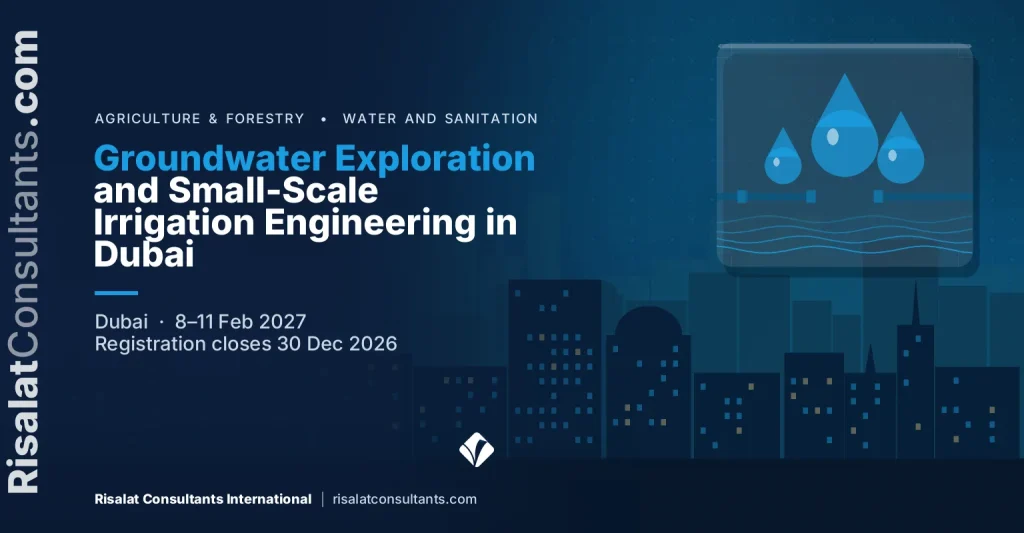
Groundwater Exploration and Small-Scale Irrigation Engineering in Dubai
Programme Overview
Groundwater resources represent a vital lifeline for agricultural resilience across arid and semi-arid regions. This professional programme delivers advanced engineering practices required to identify, extract, and distribute subsurface water for small-scale irrigation. Participants examine modern geophysical surveying methods alongside rigorous hydrogeological assessment techniques. By addressing both the subterranean dynamics and surface distribution demands, the curriculum bridges the gap between raw hydrological exploration and practical, communal civil infrastructure.
Engineers and technical specialists explore deep borehole siting, production well drilling oversight, and sustainable aquifer yield testing. The course focuses extensively on solar photovoltaic pumping system architecture, sizing generation capacity against hydraulic head and crop water requirements. Participants review international technical guidelines, including FAO irrigation criteria and standard civil specifications for distribution systems. Every module emphasises robust engineering calculations, material durability, and operational longevity in remote agricultural environments.
Instruction extends to field-level distribution networks, contrasting pressurised drip lines, micro-sprinklers, and lined communal canals. Attendees evaluate water-use efficiency frameworks to minimise conveyance losses and prevent secondary soil salinisation. Delivered by Risalat Consultants International in Dubai, United Arab Emirates, it combines expert-led sessions, real cases, and group work, so that participants can apply what they learn in their own institution.
The programme strengthens institutional capability in:
- Principles of aquifer characterisation and groundwater potential mapping in fractured and alluvial systems
- Geophysical exploration methods focusing on vertical electrical sounding and 2D electrical resistivity tomography
- Data interpretation for borehole siting, fault detection, and boundary condition evaluation
- Hydrochemical assessment of groundwater quality for agricultural use and soil salinity risks
- Groundwater vulnerability mapping and recharge estimation methods for sustainable abstraction
- Well design fundamentals: casing selection, screen slot sizing, and artificial gravel pack grading
- Drilling rig technology selection, mud circulation control, and lithological logging supervision
- Borehole development methods, plumbness testing, and well alignment quality assurance
- Climate and environmental risk assessment
- Adaptation and mitigation planning
- Sector strategies for energy, water, and land
- Project design for climate and environmental goals
- Funds
- Entity
- Project
- Results
- MRV
Why this matters now
Organisations increasingly require professionals capable of:
- Assess climate and environmental risks to their services and assets
- Design projects that meet climate and environmental goals
- Prepare proposals that financiers can approve
- Measure and report results credibly
- Work with communities and partners across sectors
Strong climate, environment and natural resources systems help organisations:
- Protect services and infrastructure from climate risks
- Access climate and environmental finance
- Meet national and international commitments
- Use natural resources sustainably
Who Should Attend
This programme is designed for:
- Irrigation and drainage engineers working on donor-financed agricultural projects
- Hydrogeologists and groundwater exploration officers from water resources ministries
- Civil engineers responsible for communal irrigation schemes and infrastructure tenders
- Agricultural engineers managing scheme design, pressurised networks, and on-farm works
- Project management unit engineering specialists overseeing World Bank, AfDB, and UN portfolios
- Regional water bureau technical directors and zonal infrastructure coordinators
- Procurement and technical evaluation specialists handling borehole and irrigation civil works
- Infrastructure supervisors monitoring drilling quality, pump installation, and testing contracts
- Soil and water conservation specialists focusing on irrigated catchment resilience
- Climate change and environment officers
- Energy, water, and agriculture sector staff
- Planning and policy officers
Tick what your team needs to be able to do.
Programme Objectives
By the end of this programme participants will be able to:
- Interpret electrical resistivity and geophysical survey datasets to accurately locate productive agricultural boreholes
- Execute standard aquifer pumping test analyses using Theis and Cooper-Jacob methods to determine sustainable abstraction yields
- Design production well casings, gravel packs, and screen intervals in compliance with international hydrogeological engineering standards
- Calculate crop water requirements and irrigation scheduling utilising the FAO-56 Penman-Monteith methodology
- Engineer off-grid solar photovoltaic water pumping configurations matched to total dynamic head and daily delivery demands
- Formulate detailed civil design packages for small-scale pressurised and gravity-fed distribution networks
- Draft comprehensive operation, maintenance, and groundwater monitoring plans to preserve communal scheme longevity
- Explain the main climate and environmental challenges for their sector
- Assess climate and environmental risks to services and assets
- Plan adaptation and mitigation measures
Training Structure & Contents
- Principles of aquifer characterisation and groundwater potential mapping in fractured and alluvial systems
- Geophysical exploration methods focusing on vertical electrical sounding and 2D electrical resistivity tomography
- Data interpretation for borehole siting, fault detection, and boundary condition evaluation
- Hydrochemical assessment of groundwater quality for agricultural use and soil salinity risks
- Groundwater vulnerability mapping and recharge estimation methods for sustainable abstraction
- Workshop: Groundwater Exploration, Geophysics, and Hydrogeological Assessment: Applying It to Your Institution
- Well design fundamentals: casing selection, screen slot sizing, and artificial gravel pack grading
- Drilling rig technology selection, mud circulation control, and lithological logging supervision
- Borehole development methods, plumbness testing, and well alignment quality assurance
- Pumping test design: step-drawdown, constant-rate, and recovery testing protocols
- Pumping test analytical solutions applying Cooper-Jacob, Theis, and recovery curves for transmissivity
- Workshop: Production Borehole Engineering, Drilling Supervision, and Aquifer Testing: Applying It to Your Institution
- Calculation of crop evapotranspiration and net irrigation requirements using FAO-56 guidelines
- System hydraulics: total dynamic head determination, pipe friction losses, and fitting calculations
- Solar photovoltaic array sizing, module tilt angle, and daily solar irradiance matching
- Solar surface and submersible pump selection, inverter control, and variable frequency drive integration
- Storage tank siting, balance reservoir capacity sizing, and water conveyance pipeline design
- Case Study: Solar-Powered Pumping Architecture and Head Hydraulic Calculations in Practice
- Pressurised network engineering: drip, micro-sprinkler, and manifold layout hydraulics
- Gravity-fed canals and low-pressure pipe systems: lining materials, gradient control, and structures
- Field water application efficiency, distribution uniformity, and irrigation scheduling regimes
- Preparation of technical specifications, bills of quantities, and employer requirements for tenders
- Post-construction groundwater monitoring, wellfield monitoring networks, and scheme handover frameworks
- Capstone Exercise: Groundwater Exploration and Small-Scale Irrigation Engineering in Dubai Action Plan for Your Institution
- Integration of climate and environmental risk assessments into small-scale irrigation designs
- Formulation of sector-specific adaptation and mitigation strategies across energy, water, and land
- Alignment of engineering works with donor and multilateral financing institution standards
- Synthesis of hydrogeological data into complete technical dossiers and bills of quantities
- Institutional frameworks for community water governance and long-term asset management
- Final technical review, peer feedback, and operational roadmap presentation
Full day-by-day contents
First Day | Groundwater Exploration, Geophysics, and Hydrogeological Assessment
- Principles of aquifer characterisation and groundwater potential mapping in fractured and alluvial systems
- Geophysical exploration methods focusing on vertical electrical sounding and 2D electrical resistivity tomography
- Data interpretation for borehole siting, fault detection, and boundary condition evaluation
- Hydrochemical assessment of groundwater quality for agricultural use and soil salinity risks
- Groundwater vulnerability mapping and recharge estimation methods for sustainable abstraction
- Workshop: Groundwater Exploration, Geophysics, and Hydrogeological Assessment: Applying It to Your Institution
Second Day | Production Borehole Engineering, Drilling Supervision, and Aquifer Testing
- Well design fundamentals: casing selection, screen slot sizing, and artificial gravel pack grading
- Drilling rig technology selection, mud circulation control, and lithological logging supervision
- Borehole development methods, plumbness testing, and well alignment quality assurance
- Pumping test design: step-drawdown, constant-rate, and recovery testing protocols
- Pumping test analytical solutions applying Cooper-Jacob, Theis, and recovery curves for transmissivity
- Workshop: Production Borehole Engineering, Drilling Supervision, and Aquifer Testing: Applying It to Your Institution
Third Day | Solar-Powered Pumping Architecture and Head Hydraulic Calculations
- Calculation of crop evapotranspiration and net irrigation requirements using FAO-56 guidelines
- System hydraulics: total dynamic head determination, pipe friction losses, and fitting calculations
- Solar photovoltaic array sizing, module tilt angle, and daily solar irradiance matching
- Solar surface and submersible pump selection, inverter control, and variable frequency drive integration
- Storage tank siting, balance reservoir capacity sizing, and water conveyance pipeline design
- Case Study: Solar-Powered Pumping Architecture and Head Hydraulic Calculations in Practice
Fourth Day | Small-Scale Distribution Engineering, Efficiency Plans, and Operation Management
- Pressurised network engineering: drip, micro-sprinkler, and manifold layout hydraulics
- Gravity-fed canals and low-pressure pipe systems: lining materials, gradient control, and structures
- Field water application efficiency, distribution uniformity, and irrigation scheduling regimes
- Preparation of technical specifications, bills of quantities, and employer requirements for tenders
- Post-construction groundwater monitoring, wellfield monitoring networks, and scheme handover frameworks
- Capstone Exercise: Groundwater Exploration and Small-Scale Irrigation Engineering in Dubai Action Plan for Your Institution
Fifth Day | Climate Resilience, Project Integration, and Technical Consolidation
- Integration of climate and environmental risk assessments into small-scale irrigation designs
- Formulation of sector-specific adaptation and mitigation strategies across energy, water, and land
- Alignment of engineering works with donor and multilateral financing institution standards
- Synthesis of hydrogeological data into complete technical dossiers and bills of quantities
- Institutional frameworks for community water governance and long-term asset management
- Final technical review, peer feedback, and operational roadmap presentation
Training Methodology
The programme combines expert-led technical instruction, real cases, and group work to ensure participants can apply methods directly in their own organisations. Practical exercises and analytical work are embedded throughout each module.
- Interactive technical presentations covering engineering standards and calculation methods
- Hands-on analysis of authentic hydrogeological datasets and geophysical survey profiles
- Practical exercises using pumping test analytical methods and crop water requirement equations
- Small group workshops addressing institutional design problems and operational challenges
- Real-world case evaluation focusing on infrastructure choices, good practice, and lessons learned
- Development of an institutional action plan with defined priorities and next steps
Expected Outcomes
- Accurate identification and siting of productive agricultural boreholes using geophysical data
- Production well designs that conform to international hydrogeological engineering specifications
- Valid pumping test interpretations that establish sustainable abstraction limits and prevent over-abstraction
- Calculated crop water requirements and robust irrigation scheduling using FAO criteria
- Sized solar photovoltaic pumping systems aligned with total dynamic head and daily demands
- Civil design packages for pressurised and gravity-fed communal distribution networks
- Operational monitoring and maintenance frameworks to protect groundwater and infrastructure longevity
£3,050 per participant · invoice and bank transfer · groups of 5 or more receive a discount
Five or more from one organisation: ask for the group rate on the invoice request.
Ten or more: an in-house version for your institution may cost less per person. Ask for an in-house quote.
Registration closes in 31 days (30 Dec 2026)
Who Will Deliver This Programme
Each date is delivered by a team assigned from Risalat's expert network for this subject. For this programme we assign:
How we choose them: Experience in the region of the participants or comparable settings; Command of the financier rules that apply (World Bank, ADB, AfDB, EU, UN) where relevant; Delivery in English; other languages on request for in-house groups; No conflict of interest with participants' institutions.
Training courses in DubaiAgriculture & Forestry training courses
Why Dubai for this programme
Dubai is a one-flight hub for Africa, Asia and Europe, with simple visas for many nationalities and modern training venues.
The Groundwater Exploration and Small-Scale Irrigation Engineering in Dubai programme in February 2027 brings together officials and professionals from across the Middle East region and beyond. Sessions combine short inputs, case studies and group work on participants' own files, and the city's institutions can be added as a study visit on request.
Getting there: Dubai International (DXB).
Check whether you need a visa with the free Visa Checker, and ask for an invitation letter once you are registered.
Other programmes in Dubai
- Mini Degree in Internal Audit and Risk Management in Dubai
- Refugee and Host Community Programme Management in Dubai
- Performance Audit for Supreme Audit Institutions in Dubai
- Artificial Intelligence for Public Sector Leaders Training in Dubai
- Records and Archives Management for Public Institutions in Dubai
Questions before you nominate your team? Book a 30-minute call with us, or ask for this programme in-house.
Teams often travel here from Maldives, Sri Lanka, Bangladesh, Nepal, Pakistan, Kazakhstan, Uzbekistan, Kyrgyzstan. Funding, visa letters and group rates are explained on each country page.
Is there water and sanitation training for government officials in Dubai in February 2027?
Can "Groundwater Exploration and Small-Scale Irrigation Engineering in Dubai" be delivered in-house for one organisation?
Which other water and sanitation programmes does Risalat run?
How do organisations register and pay?
For teams and institutions
Bring your team
Teams that learn together apply more at work. Tell us how many people and how you would like to take part: we reply with a group quote within two working days.
Watch: this programme in short

Other dates and cities for this subject: Water Supply and Sanitation Management training courses (96 upcoming dates).
More training courses in the United Arab Emirates · All programmes in Middle East · Full training calendar
Plan this programme in a roadmap: why it matters, why to approve it, the dates to plan and the career it builds.