Key facts
- Dates
- 9–12 Aug 2027 (4 days)
- Where
- Kuala Lumpur, Malaysia
- Fee per participant
- £2,350 (GBP)
- Payment
- By invoice and bank transfer
- Registration closes
- 30 Jun 2027
- Format
- 4-day short course: a practical capacity-building programme for government, NGO and project teams in Kuala Lumpur
- In-house option
- Run it for your team, on your dates
On this page 10 sections
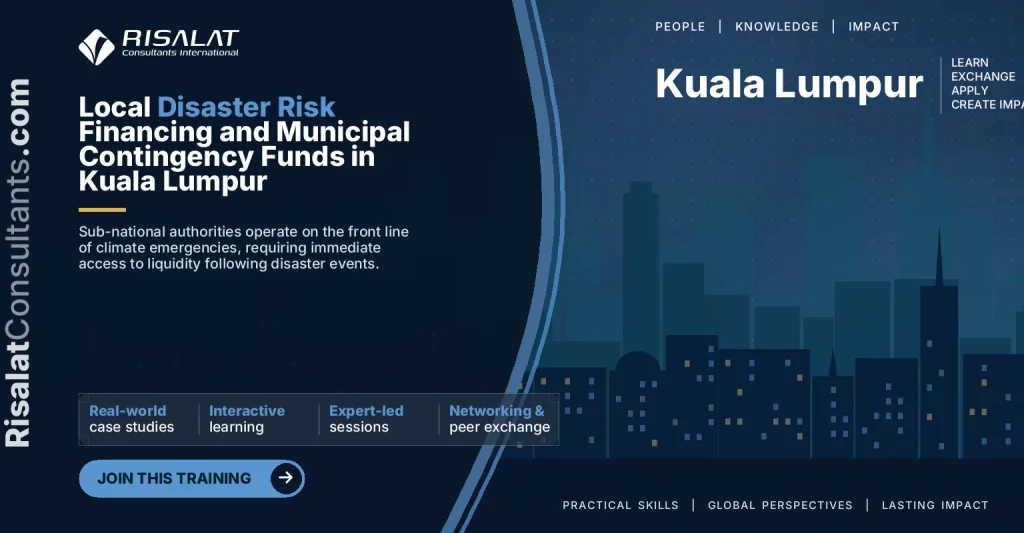
Local Disaster Risk Financing and Municipal Contingency Funds in Kuala Lumpur
Programme Overview
Sub-national authorities operate on the front line of climate emergencies, requiring immediate access to liquidity following disaster events. This intensive professional course in Kuala Lumpur addresses the structural, legal, and operational arrangements needed to establish robust municipal disaster risk financing systems. Participants review core public financial management practices alongside disaster management legislation, exploring how decentralised entities can balance statutory local disaster risk reduction and management funds with innovative ex-ante fiscal protection instruments.
Free self-check: the governance self-audit gives a quick check of governance, controls and accountability, in about 10 minutes.
The curriculum examines the end-to-end architecture of municipal emergency reserves, multi-year contingency lines, and parametric insurance mechanisms. Delegates examine how to integrate physical risk assessments into multi-year budget frameworks, build legally compliant municipal contingency funds, and configure rapid-disbursement triggers. The sessions analyse local sovereign risk layering, ensuring municipal authorities avoid post-disaster budget diversions from baseline capital investments while observing statutory public procurement regulations and internal control standards.
Watch: a short video on this subject
Municipal Grant Auditing: Auditing Local Capital Projects
One minute, practical, made for ministries and project teams.
Through applied analytical exercises, participants master resource mobilisation, cash planning, and expenditure tracking for local relief and reconstruction. The course outlines transparent accounting processes for intergovernmental disaster transfers, municipal risk pools, and local trust accounts. Delivered by Risalat Consultants International in Kuala Lumpur, Malaysia, the programme combines expert-led sessions, real cases, and group work, ensuring participants can apply what they learn in their own institutions.
The programme strengthens institutional capability in:
- Principles of sub-national disaster risk financing and risk layering concepts
- Public financial management constraints in municipal emergency liquidity mobilisation
- Statutory reserve requirements and local disaster risk reduction fund mandates
- Assessing sub-national historical loss data to inform municipal cash-flow planning
- Aligning municipal contingency financing with medium-term expenditure frameworks
- Designing municipal emergency fund architecture and special trust accounts
- Defining objective triggers, operational rules, and fund governance mechanisms
- Budget execution rules, expedited approvals, and emergency procurement procedures
- Climate and environmental risk assessment
- Adaptation and mitigation planning
- Sector strategies for energy, water, and land
- Project design for climate and environmental goals
Why this matters now
Organisations increasingly require professionals capable of:
- Assess climate and environmental risks to their services and assets
- Design projects that meet climate and environmental goals
- Prepare proposals that financiers can approve
- Measure and report results credibly
- Work with communities and partners across sectors
Strong climate, environment and natural resources systems help organisations:
- Protect services and infrastructure from climate risks
- Access climate and environmental finance
- Meet national and international commitments
- Use natural resources sustainably
Who Should Attend
This programme is designed for:
- Provincial budget officers and local finance committee members
- Department of the Interior and Local Government (DILG) disaster focal persons
- Municipal disaster risk reduction and management officers (MDRRMOs)
- City treasurers and sub-national financial planning directors
- Provincial and municipal planning and development coordinators
- Internal auditors and municipal disaster risk finance compliance officers
- Technical specialists in sub-national public financial management
- Local government disaster risk management project coordinators
- National disaster management agency sub-national liaison officers
- Climate change and environment officers
- Energy, water, and agriculture sector staff
- Planning and policy officers
Tick what your team needs to be able to do.
Programme Objectives
By the end of this programme participants will be able to:
- Formulate local disaster risk financing strategies utilising risk layering frameworks
- Design municipal contingency fund structures compliant with statutory expenditure rules
- Appraise local parametric insurance options and index-based risk transfer mechanisms
- Establish clear protocols and triggers for the rapid disbursement of emergency liquidity
- Structure tracking frameworks to monitor and audit post-disaster recovery expenditures
- Integrate catastrophe contingent financing and emergency credit into municipal medium-term plans
- Draft operational standard operating procedures for local risk finance execution
- Explain the main climate and environmental challenges for their sector
- Assess climate and environmental risks to services and assets
- Plan adaptation and mitigation measures
Training Structure & Contents
- Principles of sub-national disaster risk financing and risk layering concepts
- Public financial management constraints in municipal emergency liquidity mobilisation
- Statutory reserve requirements and local disaster risk reduction fund mandates
- Assessing sub-national historical loss data to inform municipal cash-flow planning
- Aligning municipal contingency financing with medium-term expenditure frameworks
- Workshop on applying sub-national disaster risk layering and PFM foundations to participant institutions
- Designing municipal emergency fund architecture and special trust accounts
- Defining objective triggers, operational rules, and fund governance mechanisms
- Budget execution rules, expedited approvals, and emergency procurement procedures
- Cash preservation, reprioritisation, and emergency virement protocols
- Practical exercise on drafting a municipal contingency fund operational manual
- Workshop on applying municipal contingency funds and rapid release protocols to participant institutions
- Introduction to sub-national parametric insurance and index-based risk mechanisms
- Designing collective municipal asset protection schemes and aggregate pools
- Intergovernmental transfer dynamics and counterpart funding mechanisms
- Catastrophe contingent credit lines and integrating Cat-DDO modalities at local level
- Evaluating premium affordability, cost efficiency, and basis risk for municipalities
- Case study analysis on sub-national parametric insurance and catastrophe instruments in practice
- Post-disaster recovery expenditure tracking frameworks and accounting codes
- Audit compliance, documentation standards, and anti-leakage control measures
- Transparency, citizen monitoring, and public reporting of emergency spending
- Inter-agency coordination linking budget offices, DILG, and DRM managers
- Simulation and final presentation on municipal disaster risk financing strategy design
- Capstone exercise on local disaster risk financing and municipal contingency funds action planning
- Integration of physical risk assessments into sub-national development frameworks
- Operationalising pre-arranged financing instruments for frontline crisis response
- Sector strategies for resilient energy, water, and land infrastructure planning
- Aligning auditable recovery tracking with disaster risk management policy loans
- Establishing institutional operational standard operating procedures for municipal risk finance execution
Full day-by-day contents
First Day | Sub-National Disaster Risk Layering and PFM Foundations
- Principles of sub-national disaster risk financing and risk layering concepts
- Public financial management constraints in municipal emergency liquidity mobilisation
- Statutory reserve requirements and local disaster risk reduction fund mandates
- Assessing sub-national historical loss data to inform municipal cash-flow planning
- Aligning municipal contingency financing with medium-term expenditure frameworks
- Workshop on applying sub-national disaster risk layering and PFM foundations to participant institutions
Second Day | Municipal Contingency Funds and Rapid Release Protocols
- Designing municipal emergency fund architecture and special trust accounts
- Defining objective triggers, operational rules, and fund governance mechanisms
- Budget execution rules, expedited approvals, and emergency procurement procedures
- Cash preservation, reprioritisation, and emergency virement protocols
- Practical exercise on drafting a municipal contingency fund operational manual
- Workshop on applying municipal contingency funds and rapid release protocols to participant institutions
Third Day | Sub-National Parametric Insurance and Catastrophe Instruments
- Introduction to sub-national parametric insurance and index-based risk mechanisms
- Designing collective municipal asset protection schemes and aggregate pools
- Intergovernmental transfer dynamics and counterpart funding mechanisms
- Catastrophe contingent credit lines and integrating Cat-DDO modalities at local level
- Evaluating premium affordability, cost efficiency, and basis risk for municipalities
- Case study analysis on sub-national parametric insurance and catastrophe instruments in practice
Fourth Day | Tracking, Accountability, and Action Planning
- Post-disaster recovery expenditure tracking frameworks and accounting codes
- Audit compliance, documentation standards, and anti-leakage control measures
- Transparency, citizen monitoring, and public reporting of emergency spending
- Inter-agency coordination linking budget offices, DILG, and DRM managers
- Simulation and final presentation on municipal disaster risk financing strategy design
- Capstone exercise on local disaster risk financing and municipal contingency funds action planning
Fifth Day | Sectoral Integration and Resilience Planning
- Integration of physical risk assessments into sub-national development frameworks
- Operationalising pre-arranged financing instruments for frontline crisis response
- Sector strategies for resilient energy, water, and land infrastructure planning
- Aligning auditable recovery tracking with disaster risk management policy loans
- Establishing institutional operational standard operating procedures for municipal risk finance execution
Training Methodology
The course employs an applied adult learning methodology combining structured technical presentations with practical design workshops. Participants evaluate diagnostic tools, review sub-national policy templates, and analyse comparative case studies of municipal emergency budgeting. Interactive group sessions require delegates to draft operational fund triggers, map expenditure pathways, and structure local recovery balance sheets for simulated crisis events. Before the programme, a short pre-assessment helps the facilitators understand each participant’s role and priorities, so that examples and exercises can be adjusted to the group. Each day ends with a short reflection in which participants note what they will apply at work.
- Expert-led sessions on current practice
- Regional and international case studies
- Group work and practical exercises
- Simulations and role plays where relevant
- Discussion of participants’ own challenges
- Peer learning across institutions and countries
- Practical tools and templates to take back to work
- Daily reflection and action planning
- Transaction
- Record
- Control
- Evidence
- Opinion
Expected Outcomes
- Formulation of comprehensive local disaster risk financing strategies incorporating multi-layered fiscal tools
- Operational design of legally compliant municipal contingency funds and rapid-release mechanisms
- Application of index-based and parametric risk transfer instruments to protect municipal assets
- Integration of contingent credit facilities and Cat-DDO modalities into local medium-term expenditure frameworks
- Implementation of robust post-disaster expenditure tracking, audit compliance, and transparent reporting systems
- Creation of tailored institutional action plans to enhance municipal fiscal resilience against disaster shocks
£2,350 per participant · invoice and bank transfer · groups of 5 or more receive a discount
Five or more from one organisation: ask for the group rate on the invoice request.
Ten or more: an in-house version for your institution may cost less per person. Ask for an in-house quote.
Registration closes in 213 days (30 Jun 2027)
Who Will Deliver This Programme
Each date is delivered by a team assigned from Risalat's expert network for this subject. For this programme we assign:
How we choose them: Experience in the region of the participants or comparable settings; Command of the financier rules that apply (World Bank, ADB, AfDB, EU, UN) where relevant; Delivery in English; other languages on request for in-house groups; No conflict of interest with participants' institutions.
Training courses in Kuala LumpurAccounting & Finance training courses
Why Kuala Lumpur for this programme
Kuala Lumpur combines good value, easy visas for many countries and examples of public sector delivery units.
The Local Disaster Risk Financing and Municipal Contingency Funds in Kuala Lumpur programme in August 2027 brings together officials and professionals from across the Asia region and beyond. Sessions combine short inputs, case studies and group work on participants' own files, and the city's institutions can be added as a study visit on request.
Getting there: Kuala Lumpur International (KUL).
Check whether you need a visa with the free Visa Checker, and ask for an invitation letter once you are registered.
The same topic in other cities
- Disaster Risk Management and Early Warning Systems in Sapporo (Sapporo)
- Disaster Risk Management and Early Warning Systems in Hiroshima (Hiroshima)
- Refugee and Host Community Programme Management in Dubai (Dubai)
- Sustainable Tourism Development and Destination Management Training in Opatija (Opatija)
- Sustainable Tourism Development and Destination Management Training in Dubrovnik (Dubrovnik)
- Decentralised Community Infrastructure and Participatory Budgeting in Kigali (Kigali)
Other programmes in Kuala Lumpur
- Women in Leadership for the Public Sector in Kuala Lumpur
- Public Administration Reform and Civil Service Management in Kuala Lumpur
- Occupational Health and Safety Management on Public Works Contracts in Kuala Lumpur
- Carbon Accounting and Net-Zero Planning for Institutions in Kuala Lumpur
- AI for Public Financial Management and Audit Training in Kuala Lumpur
Questions before you nominate your team? Book a 30-minute call with us, or ask for this programme in-house.
Teams often travel here from Timor-Leste, Maldives, Sri Lanka, Bangladesh, Nepal, Bhutan, Pakistan, Myanmar. Funding, visa letters and group rates are explained on each country page.
Free roadmap: Disaster Insurance on the Lookout of Modern Disaster Risk Management: a 12-month plan for your team
Is there disaster risk management training for government officials in Kuala Lumpur in August 2027?
Can "Local Disaster Risk Financing and Municipal Contingency Funds in Kuala Lumpur" be delivered in-house for one organisation?
Which other disaster risk management programmes does Risalat run?
How do organisations register and pay?
For teams and institutions
Bring your team
Teams that learn together apply more at work. Tell us how many people and how you would like to take part: we reply with a group quote within two working days.
Watch: this programme in short


Other dates and cities for this subject: Climate Resilience and Adaptation training courses (108 upcoming dates).
More training courses in Malaysia · All programmes in Asia · Full training calendar
Plan this programme in a roadmap: why it matters, why to approve it, the dates to plan and the career it builds.