Key facts
- Dates
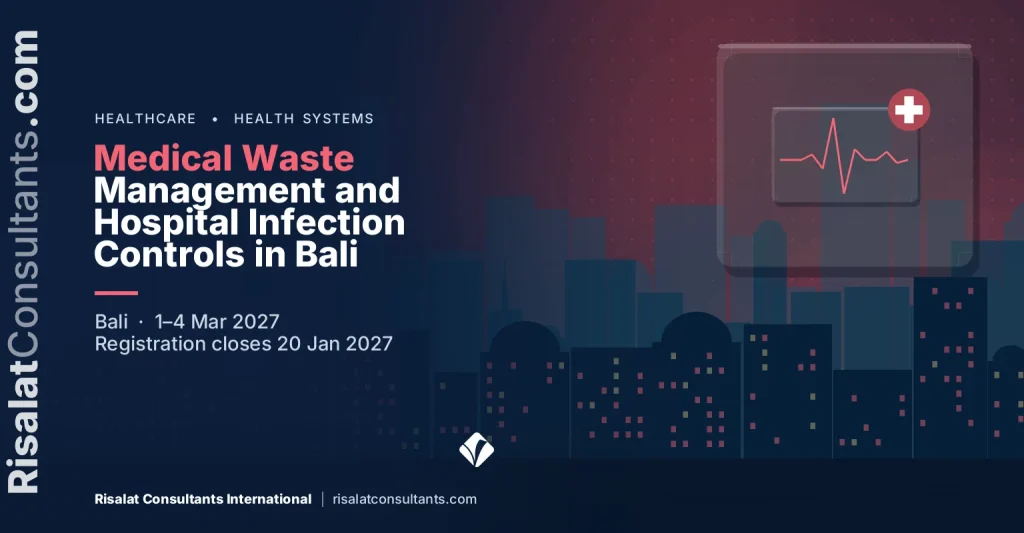
- 1–4 Mar 2027 (4 days)
- Where
- Bali, Indonesia
- Fee per participant
- £2,800 (GBP)
- Payment
- By invoice and bank transfer
- Registration closes
- 20 Jan 2027
- Format
- 4-day short course: a practical capacity-building programme for government, NGO and project teams in Bali
- In-house option
- Run it for your team, on your dates
On this page 10 sections
Medical Waste Management and Hospital Infection Controls in Bali
Programme Overview
Healthcare facilities generate considerable quantities of hazardous biomedical residues that pose severe environmental and public health hazards if mishandled. This four-day intensive programme in Bali delivers structured technical competence in medical waste management and hospital infection prevention and control. Delivered in alignment with World Health Organization guidelines and international environmental safeguards, the course equips practitioners with operational frameworks required to audit facility waste streams, establish rigorous point-of-generation segregation, and maintain safe storage, transport, and final treatment systems.
Participants explore practical controls that mitigate healthcare-associated infections and environmental contamination within complex operational settings. The curriculum examines engineering controls, airborne and bloodborne pathogen containment, personal protective equipment regimens, and wastewater management in healthcare contexts. Practical sessions instruct delegates on evaluating primary treatment modalities, including autoclaving, chemical disinfection, and high-temperature incineration, ensuring strict adherence to environmental emission limits and occupational health mandates established by international development institutions.
Through technical presentations, comparative case analyses, and practical planning exercises, attendees develop actionable compliance mechanisms for their home institutions. The training directly addresses administrative responsibilities, regulatory reporting, and standard operating procedure design for clinical waste handlers and infection control teams. Delivered by Risalat Consultants International in Bali, Indonesia, it combines expert-led sessions, real cases, and group work, strengthening healthcare waste systems and bio-containment infrastructure for health authorities and project implementers operating under multilateral financing frameworks, such as interventions supported by the Additional Financing to Myanmar COVID-19 Emergency Response Project.
The programme strengthens institutional capability in:
- Typologies of healthcare waste: infectious, pathological, sharps, pharmaceutical, genotoxic, and non-hazardous general streams
- International standards and conventions: WHO guidelines, Stockholm Convention, and Basel Convention provisions
- Point-of-generation segregation techniques, standard colour-coding schemes, labelling, and primary containment specifications
- Occupational health and safety measures, immunisation requirements, and ergonomic handling for clinical waste personnel
- Quantification methodologies, baseline waste audits, and facility waste tracking documentation
- Epidemiology of healthcare-associated infections and standard versus transmission-based precaution protocols
- Administrative, environmental, and engineering controls for airborne and bloodborne pathogen containment
- Hand hygiene infrastructure, personal protective equipment selection, donning, doffing, and stock management
- Service planning and management
- Quality improvement and standards
- Human resources and workforce planning
- Financing and budgeting for services
- Transaction
- Record
- Control
- Evidence
- Opinion
Why this matters now
Organisations increasingly require professionals capable of:
- Plan and manage services to meet demand
- Improve quality against standards
- Manage staff and resources effectively
- Use data to guide decisions
- Work with communities and partners
Strong health, education and social services systems help organisations:
- Deliver better services to more people
- Use budgets and staff efficiently
- Meet quality standards
- Show results to government and partners
Who Should Attend
This programme is designed for:
- Hospital administrators and medical superintendents
- Clinical waste management supervisors and officers
- Hospital infection prevention and control committee members
- Public health environmental officers and municipal regulators
- Environmental and social safeguards specialists on donor-funded projects
- Chief nursing officers and infection control link nurses
- Laboratory managers and biosafety officers
- Operations, facility maintenance, and procurement managers in health facilities
- Health, safety, and environment coordinators in the health sector
- Service managers and administrators
- Directors and senior officials
- Planning and policy officers
Tick what your team needs to be able to do.
Programme Objectives
By the end of this programme participants will be able to:
- Classify healthcare waste streams using World Health Organization and international safeguard definitions
- Evaluate point-of-generation segregation, containment, colour-coding, and internal collection practices
- Design facility-level infection prevention and control procedures to prevent nosocomial pathogen transmission
- Assess operational parameters and compliance requirements for autoclaving, microwaving, chemical disinfection, and incineration
- Formulate institutional contingency plans for hazardous chemical spills, sharps injuries, and biohazard containment failures
- Conduct comprehensive environmental and biosafety audits across clinical wards, laboratories, and waste storage depots
- Draft facility-specific medical waste management and infection control plans aligned with international project safeguards
- Explain the main challenges facing their sector
- Plan services that match demand and resources
- Apply quality improvement methods
Training Structure & Contents
- Typologies of healthcare waste: infectious, pathological, sharps, pharmaceutical, genotoxic, and non-hazardous general streams
- International standards and conventions: WHO guidelines, Stockholm Convention, and Basel Convention provisions
- Point-of-generation segregation techniques, standard colour-coding schemes, labelling, and primary containment specifications
- Occupational health and safety measures, immunisation requirements, and ergonomic handling for clinical waste personnel
- Quantification methodologies, baseline waste audits, and facility waste tracking documentation
- Workshop: Healthcare Waste Stream Classification, Characterisation, and Regulatory Baselines: Applying It to Your Institution
- Epidemiology of healthcare-associated infections and standard versus transmission-based precaution protocols
- Administrative, environmental, and engineering controls for airborne and bloodborne pathogen containment
- Hand hygiene infrastructure, personal protective equipment selection, donning, doffing, and stock management
- Decontamination, cleaning, and high-level disinfection protocols for clinical environments and medical equipment
- Isolation ward design, ventilation requirements, and containment protocols for emerging infectious diseases
- Workshop: Infection Prevention and Control Frameworks and Bio-Risk Containment: Applying It to Your Institution
- Internal transport routes, schedule optimisation, and central intermediate storage depot design standards
- Non-burn treatment technologies: operational parameters and validation for autoclaving and chemical shredding systems
- High-temperature incineration: operational criteria, emission monitoring, and residue management
- Hospital wastewater and effluent treatment plants: liquid bio-waste disinfection and environmental discharge standards
- Contractor management, chain-of-custody documentation, and off-site transportation regulatory compliance
- Case Study: Treatment Technologies, Storage, Transport, and Facility Wastewater Controls in Practice
- Establishing functional facility infection prevention and control and waste management committees
- Developing standard operating procedures, staff training curricula, and institutional awareness programmes
- Emergency response protocols for hazardous spills, sharps exposures, and breach of physical containment
- Designing institutional monitoring frameworks, compliance checklists, and biosafety audit tools
- Action planning workshop: drafting facility-level implementation plans aligned with international safeguard standards
- Capstone Exercise: Medical Waste Management and Hospital Infection Controls in Bali Action Plan for Your Institution
- Review of international safeguard standards and environmental and social management plans
- Integration of quality improvement methods into institutional infection control protocols
- Financing and budgeting for medical waste management and bio-containment infrastructure
- Human resources and workforce planning for clinical waste handlers and infection control teams
- Final review of participant action plans and institutional next steps
Full day-by-day contents
First Day | Healthcare Waste Stream Classification, Characterisation, and Regulatory Baselines
- Typologies of healthcare waste: infectious, pathological, sharps, pharmaceutical, genotoxic, and non-hazardous general streams
- International standards and conventions: WHO guidelines, Stockholm Convention, and Basel Convention provisions
- Point-of-generation segregation techniques, standard colour-coding schemes, labelling, and primary containment specifications
- Occupational health and safety measures, immunisation requirements, and ergonomic handling for clinical waste personnel
- Quantification methodologies, baseline waste audits, and facility waste tracking documentation
- Workshop: Healthcare Waste Stream Classification, Characterisation, and Regulatory Baselines: Applying It to Your Institution
Second Day | Infection Prevention and Control Frameworks and Bio-Risk Containment
- Epidemiology of healthcare-associated infections and standard versus transmission-based precaution protocols
- Administrative, environmental, and engineering controls for airborne and bloodborne pathogen containment
- Hand hygiene infrastructure, personal protective equipment selection, donning, doffing, and stock management
- Decontamination, cleaning, and high-level disinfection protocols for clinical environments and medical equipment
- Isolation ward design, ventilation requirements, and containment protocols for emerging infectious diseases
- Workshop: Infection Prevention and Control Frameworks and Bio-Risk Containment: Applying It to Your Institution
Third Day | Treatment Technologies, Storage, Transport, and Facility Wastewater Controls
- Internal transport routes, schedule optimisation, and central intermediate storage depot design standards
- Non-burn treatment technologies: operational parameters and validation for autoclaving and chemical shredding systems
- High-temperature incineration: operational criteria, emission monitoring, and residue management
- Hospital wastewater and effluent treatment plants: liquid bio-waste disinfection and environmental discharge standards
- Contractor management, chain-of-custody documentation, and off-site transportation regulatory compliance
- Case Study: Treatment Technologies, Storage, Transport, and Facility Wastewater Controls in Practice
Fourth Day | Biosafety Auditing, Institutional Governance, and Action Plan Formulation
- Establishing functional facility infection prevention and control and waste management committees
- Developing standard operating procedures, staff training curricula, and institutional awareness programmes
- Emergency response protocols for hazardous spills, sharps exposures, and breach of physical containment
- Designing institutional monitoring frameworks, compliance checklists, and biosafety audit tools
- Action planning workshop: drafting facility-level implementation plans aligned with international safeguard standards
- Capstone Exercise: Medical Waste Management and Hospital Infection Controls in Bali Action Plan for Your Institution
Fifth Day | Institutional Compliance, Quality Improvement, and Review
- Review of international safeguard standards and environmental and social management plans
- Integration of quality improvement methods into institutional infection control protocols
- Financing and budgeting for medical waste management and bio-containment infrastructure
- Human resources and workforce planning for clinical waste handlers and infection control teams
- Final review of participant action plans and institutional next steps
Training Methodology
The course employs an applied, evidence-based methodology tailored for public sector and project professionals. Each day combines expert input, practical work, and a closing workshop or case study, allowing participants to apply what they learn directly to their own institutions.
- Expert-led presentations and technical inputs
- Practical planning exercises and working in small groups
- Comparative case studies analysing realistic scenarios against good practice
- Interactive workshops to agree practical next steps for home institutions
- Capstone action planning exercise with peer and facilitator feedback
Expected Outcomes
- Participants leave able to perform, rather than merely describe, core infection control and waste management procedures
- Establishment of actionable compliance mechanisms and standard operating procedures for home facilities
- Enhanced institutional capacity to systematically reduce nosocomial risks across health facilities and laboratories
- Formulation of a facility-level action plan with clear priorities, owners, and first steps
- Preparedness to oversee contractor compliance and adhere to international safeguard frameworks
£2,800 per participant · invoice and bank transfer · groups of 5 or more receive a discount
Five or more from one organisation: ask for the group rate on the invoice request.
Ten or more: an in-house version for your institution may cost less per person. Ask for an in-house quote.
Registration closes in 53 days (20 Jan 2027)
Who Will Deliver This Programme
Each date is delivered by a team assigned from Risalat's expert network for this subject. For this programme we assign:
How we choose them: Experience in the region of the participants or comparable settings; Command of the financier rules that apply (World Bank, ADB, AfDB, EU, UN) where relevant; Delivery in English; other languages on request for in-house groups; No conflict of interest with participants' institutions.
Training courses in BaliHealthcare training courses
Why Bali for this programme
Bali offers a retreat setting for leadership and team programmes, with links to tourism and community development.
The Medical Waste Management and Hospital Infection Controls in Bali programme in March 2027 brings together officials and professionals from across the Asia region and beyond. Sessions combine short inputs, case studies and group work on participants' own files, and the city's institutions can be added as a study visit on request.
Getting there: Ngurah Rai (DPS).
Check whether you need a visa with the free Visa Checker, and ask for an invitation letter once you are registered.
The same topic in other cities
- District Health Infrastructure Commissioning and Clinical Works in Casablanca (Casablanca)
- Hospital Emergency Triage and Clinical Infection Containment in Bangkok (Bangkok)
- Medical Waste and Biohazard Disposal Operations in Kigali (Kigali)
- Hospital Civil Works Supervision and Commissioning in Cape Town (Cape Town)
- Infection Prevention and Control in Clinical Facilities in Johannesburg (Johannesburg)
- Health Facility Infrastructure Upgrading & Operational Planning in Accra (Accra)
Other programmes in Bali
- Mangrove Ecosystem Restoration & Blue Carbon Coastal Habitat Management in Bali
- Outer-Island Small Enterprise Tourism Value Chain Development in Bali
- Export Agribusiness Incubation & Smallholder Market Linkages in Bali
- Sub-National Ward Development & Community Infrastructure Planning in Bali
- Coastal Fisheries Co-Management and Marine Protected Area Operations in Bali
Questions before you nominate your team? Book a 30-minute call with us, or ask for this programme in-house.
Teams often travel here from Timor-Leste, Nepal, Myanmar, Vietnam, Philippines, Indonesia, Papua New Guinea, Fiji. Funding, visa letters and group rates are explained on each country page.
- World Health Organization World Health Organization
- Environmental and Social Framework (ESF) World Bank
Is there health systems training for government officials in Bali in March 2027?
Can "Medical Waste Management and Hospital Infection Controls in Bali" be delivered in-house for one organisation?
Which other health systems programmes does Risalat run?
How do organisations register and pay?
For teams and institutions
Bring your team
Teams that learn together apply more at work. Tell us how many people and how you would like to take part: we reply with a group quote within two working days.
Watch: this programme in short



Other dates and cities for this subject: Health Systems and Health Project Management training courses (112 upcoming dates).
More training courses in Indonesia · All programmes in Asia · Full training calendar
Plan this programme in a roadmap: why it matters, why to approve it, the dates to plan and the career it builds.