Key facts
- Dates
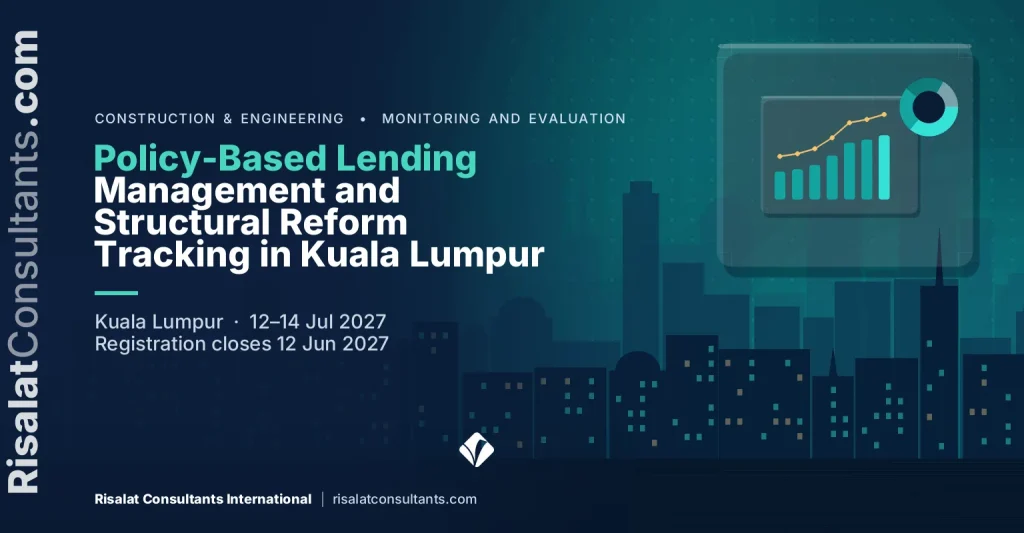
- 12–14 Jul 2027 (3 days)
- Where
- Kuala Lumpur, Malaysia
- Fee per participant
- £1,950 (GBP)
- Payment
- By invoice and bank transfer
- Registration closes
- 12 Jun 2027
- Who it is for
- Officials from the Ministry of Economy and Finance; Macro-fiscal policy directors and technical analysts; Development policy financing task team me…
- Certificate
- Certificate of completion
- In-house option
- Run it for your team, on your dates
On this page 12 sections
Programme Overview
Policy-based lending operations require robust administrative machinery to ensure structural reform commitments translate into tangible policy achievements and timely loan disbursements. This three-day intensive programme equips public sector officials with the technical methodologies required to design, coordinate, and track macro-fiscal reforms. Delivered in Kuala Lumpur, the course examines the end-to-end management of development policy operations, covering the formulation of clear policy matrices, inter-agency tracking protocols, and the evidential standards demanded by international financiers.
Delegates will examine the operational mechanics of policy-based lending, focusing on the structural linkages between policy actions, result indicators, and macro-fiscal stability frameworks. The curriculum addresses the practical complexities of coordinating multiple line ministries to fulfil agreed prior actions. Through detailed analytical sessions, participants will assess institutional bottlenecks, verify reform milestones against international standards, and establish reliable monitoring arrangements that satisfy both domestic accountability requirements and international financing conditions.
The training emphasizes direct operational application, moving from high-level policy dialogue to granular implementation tools. Participants review practical methodologies for fiscal risk reporting, economic resilience diagnostics, and compliance reporting mechanisms. By reviewing real-world reform matrices and verification protocols, the course builds institutional capacity to navigate development policy financing cycles smoothly, manage stakeholder relationships during sensitive reforms, and maintain consistent momentum across multi-year national reform agendas.
Governments face the dual challenge of navigating fiscal consolidation whilst driving structural transformations to enhance medium-term economic resilience. Development policy operations, such as the Second Cambodia Growth and Resilience Development Policy Financing, tie vital sovereign budget support directly to complex institutional and regulatory reforms. Navigating these operations requires executing agencies to establish rigorous monitoring mechanisms, assemble clear documentary proof for prior actions, and coordinate disparate line ministries efficiently. Strengthening internal tracking capabilities is essential now to prevent disbursement delays, ensure uninterrupted budget support, and successfully deliver foundational structural reforms.
Delivered by Risalat Consultants International in Kuala Lumpur, Malaysia, it combines expert-led sessions, real cases and group work, so that participants can apply what they learn in their own institution.
The Programme Strengthens Institutional Capability
- Core mechanics of development policy operations: triggers, prior actions, and tranche releases
- Structuring robust policy matrices: establishing direct lines of sight between actions and outcomes
- Setting qualitative and quantitative baselines and targets for regulatory and policy changes
- Fiduciary, macro-fiscal, and debt sustainability pre-conditions for development policy financing
- Exercise: Reviewing draft prior action formulations to identify operational ambiguities and compliance risks
- Institutional mechanisms for cross-government coordination across technical line ministries
- Documentary standards and evidential requirements for validating completed prior actions
- Managing execution timelines and identifying early warning indicators of policy drift
- Strategic thinking and direction setting
- Leading and developing teams
- Decision making and problem solving
- Communication and influence
It is designed for officials from the Ministry of Economy and Finance, macro-fiscal policy directors and technical analysts, development policy financing task team members and others who want practical, current skills in leadership, management and communication.
The Growing Importance of Policy-Based Lending Management and Structural Reform Tracking in Kuala Lumpur
Institutions change faster than ever: new policies, technologies and expectations from citizens and partners. Leaders and managers who can set direction, build teams and manage change make the difference between plans and results.
Strong leadership is a set of practical skills: deciding, communicating, negotiating, developing people and leading change. These skills can be learnt and improved with practice and feedback.
Organisations increasingly require professionals capable of:
- Set clear direction and priorities
- Lead and motivate teams through change
- Communicate and negotiate effectively
- Manage performance fairly
- Make sound decisions under pressure
Strong leadership, management and communication systems help organisations:
- Turn strategies into results
- Build motivated, capable teams
- Manage change with less resistance
- Improve relations with partners and stakeholders
This Policy-Based Lending Management and Structural Reform Tracking in Kuala Lumpur programme brings these elements together in a practical format, so that participants understand not only what good practice looks like but also how to introduce it in their own setting, with the people and resources they have.
Who Should Attend This Policy-Based Lending Management and Structural Reform Tracking in Kuala Lumpur Training?
This programme is designed for:
- Officials from the Ministry of Economy and Finance
- Macro-fiscal policy directors and technical analysts
- Development policy financing task team members
- National reform council coordinators and secretariats
- Line ministry planning and policy department heads
- Public financial management modernisation working groups
- Aid management and external debt coordination specialists
- Central bank economic research and policy officers
- Directors and senior managers
- Heads of department and unit
- Middle managers and team leaders
- Project and programme managers
The programme suits experienced professionals as well as those moving into new responsibilities. Groups that mix institutions and countries are encouraged, because participants learn a great deal from each other’s experience.
Tick what your team needs to be able to do.
Policy-Based Lending Management and Structural Reform Tracking in Kuala Lumpur Training Objectives
Upon successful completion of this Policy-Based Lending Management and Structural Reform Tracking in Kuala Lumpur Training, participants will be able to:
- Analyse the architecture and disbursement requirements of development policy operations
- Evaluate policy matrices and structural benchmarks for institutional viability and evaluability
- Establish rigorous documentary verification protocols for agreed prior actions
- Monitor macro-fiscal sustainability indicators in alignment with international guidelines
- Coordinate inter-ministerial reform working groups to prevent implementation bottlenecks
- Formulate institutional risk mitigation strategies for complex policy conditions
- Produce comprehensive progress reports for external development financiers and sovereign decision-makers
- Explain current approaches to leadership in public and private institutions
- Set direction and priorities for their team
- Lead, motivate and develop people
Each objective is practised during the programme through exercises, cases or group work, so that participants leave able to do it, not only to describe it.
Programme Contents and Structure
- Core mechanics of development policy operations: triggers, prior actions, and tranche releases
- Structuring robust policy matrices: establishing direct lines of sight between actions and outcomes
- Setting qualitative and quantitative baselines and targets for regulatory and policy changes
- Fiduciary, macro-fiscal, and debt sustainability pre-conditions for development policy financing
- Exercise: Reviewing draft prior action formulations to identify operational ambiguities and compliance risks
- Institutional mechanisms for cross-government coordination across technical line ministries
- Documentary standards and evidential requirements for validating completed prior actions
- Managing execution timelines and identifying early warning indicators of policy drift
- Stakeholder consultation processes and political economy mapping during reform implementation
- Practical workshop: Developing formal verification packs for legislative and administrative prior actions
- Tracking macroeconomic framework adequacy during multi-year policy reform cycles
- Designing and monitoring indicators for domestic resource mobilisation and economic resilience
- Public financial management diagnostics and their integration into policy-based triggers
- Managing the transition between programmatic tranches and subsequent financing series
- Simulation: Conducting a tranche release review meeting and addressing implementation deficits
Full day-by-day contents
The programme runs over 3 days. Each day combines expert input, practical work and a closing workshop or case study:
- First Day: Policy-Based Lending Architecture and Prior Action Formulation
- Second Day: Inter-Ministerial Coordination, Execution, and Verification
- Third Day: Macro-Fiscal Monitoring, Resilience Indicators, and Institutional Reporting
Full day-by-day contents
First Day | Policy-Based Lending Architecture and Prior Action Formulation
- Core mechanics of development policy operations: triggers, prior actions, and tranche releases
- Structuring robust policy matrices: establishing direct lines of sight between actions and outcomes
- Setting qualitative and quantitative baselines and targets for regulatory and policy changes
- Fiduciary, macro-fiscal, and debt sustainability pre-conditions for development policy financing
- Exercise: Reviewing draft prior action formulations to identify operational ambiguities and compliance risks
Workshop: Policy-Based Lending Architecture and Prior Action Formulation: Applying It to Your Institution
Working in small groups, participants apply the day's methods to examples from their own institutions and agree practical next steps.
Second Day | Inter-Ministerial Coordination, Execution, and Verification
- Institutional mechanisms for cross-government coordination across technical line ministries
- Documentary standards and evidential requirements for validating completed prior actions
- Managing execution timelines and identifying early warning indicators of policy drift
- Stakeholder consultation processes and political economy mapping during reform implementation
- Practical workshop: Developing formal verification packs for legislative and administrative prior actions
Workshop: Inter-Ministerial Coordination, Execution, and Verification: Applying It to Your Institution
Working in small groups, participants apply the day's methods to examples from their own institutions and agree practical next steps.
Third Day | Macro-Fiscal Monitoring, Resilience Indicators, and Institutional Reporting
- Tracking macroeconomic framework adequacy during multi-year policy reform cycles
- Designing and monitoring indicators for domestic resource mobilisation and economic resilience
- Public financial management diagnostics and their integration into policy-based triggers
- Managing the transition between programmatic tranches and subsequent financing series
- Simulation: Conducting a tranche release review meeting and addressing implementation deficits
Capstone Exercise: Policy-Based Lending Management and Structural Reform Tracking in Kuala Lumpur Action Plan for Your Institution
Participants bring the week together in an action plan for their own institution, with priorities, owners and first steps, and present it for feedback from peers and facilitators.
Policy-Based Lending Management and Structural Reform Tracking in Kuala Lumpur Training Methodology
The training employs a participatory, adult-learning methodology centred on practical public sector casework. Modules combine concise technical briefings with hands-on working groups, document review exercises, and simulated policy dialogue sessions. Participants evaluate structural reform matrices, draft prior action verification documentation, and resolve institutional coordination problems using real-world scenarios. Facilitators guide peer-to-peer exchanges to share comparative experiences from the Southeast Asian region, ensuring that theoretical concepts are translated into operational tools directly applicable to sovereign policy management.
The programme combines:
- Expert-led sessions on current practice
- Regional and international case studies
- Group work and practical exercises
- Simulations and role plays where relevant
- Discussion of participants' own challenges
- Peer learning across institutions and countries
- Practical tools and templates to take back to work
- Daily reflection and action planning
Before the programme, a short pre-assessment helps the facilitators understand each participant’s role and priorities, so that examples and exercises can be adjusted to the group. Each day ends with a short reflection in which participants note what they will apply at work.
- Inputs
- Activities
- Outputs
- Outcomes
- Impact
Expected Outcomes
Upon completion of this Policy-Based Lending Management and Structural Reform Tracking in Kuala Lumpur Training, participants will be able to:
- Ability to review development policy financing matrices and identify operational design risks
- Proficiency in assembling legally sound, auditable verification files for reform prior actions
- Enhanced capacity to lead inter-institutional technical secretariats for structural reform programmes
- Competence in linking sectoral policy milestones with overall macro-fiscal monitoring frameworks
- Practical understanding of multilateral financier appraisal, supervision, and tranche release processes
- Preparedness to manage implementation schedules for multi-year budget support programmes
- Set clear direction and priorities
- Lead and develop teams
Participants leave with a personal action plan and practical tools they can use in their institution from the first week back. Institutions that send several participants can use the programme to agree shared methods and templates across teams, which makes improvements easier to sustain.
£1,950 per participant · invoice and bank transfer · groups of 5 or more receive a discount
Five or more from one organisation: ask for the group rate on the invoice request.
Ten or more: an in-house version for your institution may cost less per person. Ask for an in-house quote.
Registration closes in 216 days (12 Jun 2027)
Institutional Application of Policy-Based Lending Management and Structural Reform Tracking in Kuala Lumpur Training
This programme supports organisations in strengthening:
- Leadership and management
- Team development
- Change management
- Communication
- Performance management
Participants return with practical tools to improve:
- Team plans
- Coaching
- Change plans
- Stakeholder communication
- Performance reviews
The programme is built so that learning moves from the classroom into the institution. Participants work on their own processes and documents where possible, and leave with an action plan that their managers can review and support.
Regional Relevance & Application
Europe
European institutions apply leadership, management and communication within detailed regulatory frameworks and reform agendas. Participants from Europe can compare their practice with colleagues from other regions and test how established methods work under different conditions.
Africa
Across Africa, ministries, agencies and project teams working in leadership, management and communication increasingly operate alongside donor-financed programmes that expect clear systems and evidence. The programme helps participants adapt good practice to the institutions and resources they work with.
Middle East
In the Middle East, national development strategies and diversification plans place growing demands on leadership, management and communication. Participants explore how to build the capability these plans need inside public bodies and companies.
Asia
Institutions across Asia combine rapid growth with ambitious modernisation programmes. Participants from Asia can share their experience of scaling systems quickly and learn from approaches used elsewhere.
Pacific
Small island and Pacific states face particular constraints of size, distance and capacity. The programme highlights practical, proportionate approaches to leadership, management and communication that suit smaller institutions.
Holding the programme in Kuala Lumpur, Malaysia brings participants together away from their daily pressures, so they can compare how leadership, management and communication is handled in different settings. The same programme can also be delivered in-house for one institution, in its own country or online, with cases taken from its current work.
Host Country Profile – Malaysia
Programmes, Workshops, Exposures, Training Courses in Kuala Lumpur, Malaysia by Risalat Consultants International
Studying away from their own country gives participants time to focus, a fresh view of their own institution and the chance to build a network with colleagues from other countries.
Policy-Based Lending Management and Structural Reform Tracking in Kuala Lumpur Training Deliverables
Participants receive support before, during and after the programme, so that preparation, learning and follow-up form one continuous experience.
Before the Programme
- Participant Pre-Assessment
- Policy-Based Lending Management and Structural Reform Tracking in Kuala Lumpur Readiness Assessment
- Policy-Based Lending Management and Structural Reform Tracking in Kuala Lumpur Resource Pack
- Preparatory Reading Materials
- Complimentary Visa Support & Advisory
During the Programme
- Airport Pickup & Welcome Assistance
- Accommodation with Breakfast
- Welcome Networking Dinner
- Risalat Training Kit (Bag, Bottle, Mug, T-Shirt, Cap, Passport Cover, Pens, Notebook, Magnet & Keychain)
- Comprehensive Policy-Based Lending Management and Structural Reform Tracking in Kuala Lumpur Training Manual
- Leadership Self-Assessment
- Team Development Plan Template
- Change Plan Template
- Negotiation Preparation Sheet
- Practical Workshops & Simulations
- Group Discussions & Peer Learning
- Daily Lunch and Refreshments
- Full Access to Training Venue Facilities
- Mini Pad / Tablet with Digital Learning Materials
- Field Visit (where applicable)
- Entertaining City Tour
After the Programme
- Certificate of Completion
- Risalat Programme Participation Recognition Award
- Post-Training Reference Materials
- Personal Development Plan Template
- Coaching Conversation Guide
- Post-Training Support & Follow-Up Guidance
- Programme Report
Institutions can also request a tailored in-house version of this programme, delivered at their premises or online. Request a proposal.
Common Challenges in Policy-Based Lending Management and Structural Reform Tracking in Kuala Lumpur, And How This Training Helps
How can institutions set clear direction and priorities?
The programme addresses this directly on the first day (Policy-Based Lending Architecture and Prior Action Formulation), where participants practise the methods involved and adapt them to their own institution, then build it into their action plan.
How can institutions lead and motivate teams through change?
The programme addresses this directly on the second day (Inter-Ministerial Coordination, Execution, and Verification), where participants practise the methods involved and adapt them to their own institution, then build it into their action plan.
How can institutions communicate and negotiate effectively?
The programme addresses this directly on the third day (Macro-Fiscal Monitoring, Resilience Indicators, and Institutional Reporting), where participants practise the methods involved and adapt them to their own institution, then build it into their action plan.
How can institutions manage performance fairly?
The programme addresses this directly on the first day (Policy-Based Lending Architecture and Prior Action Formulation), where participants practise the methods involved and adapt them to their own institution, then build it into their action plan.
How can institutions make sound decisions under pressure?
The programme addresses this directly on the second day (Inter-Ministerial Coordination, Execution, and Verification), where participants practise the methods involved and adapt them to their own institution, then build it into their action plan.
Frequently Asked Questions
When and where does the Policy-Based Lending Management and Structural Reform Tracking in Kuala Lumpur programme take place?
It runs from 12 Jul 2027 to 14 Jul 2027, in Kuala Lumpur, Malaysia. The registration deadline is shown at the top of this page.
Who should attend?
The programme is designed for officials from the Ministry of Economy and Finance, macro-fiscal policy directors and technical analysts, development policy financing task team members, national reform council coordinators and secretariats, and others who want practical skills in leadership, management and communication.
Will I receive a certificate?
Yes. Participants who complete the programme receive a Certificate of Completion from Risalat Consultants International.
Can this programme be delivered for our institution only?
Yes. We can deliver a tailored in-house version at your premises, in another city or online, built around your own cases. Use the proposal request on this page.
Do I need prior experience in leadership, management and communication?
No specialist background is required beyond experience in a related role. A short pre-assessment helps the facilitators adapt the sessions to the group.
Training courses in Kuala LumpurConstruction & Engineering training courses
Why Kuala Lumpur for this programme
Kuala Lumpur combines good value, easy visas for many countries and examples of public sector delivery units.
The Policy-Based Lending Management and Structural Reform Tracking in Kuala Lumpur programme in July 2027 brings together officials and professionals from across the Asia region and beyond. Sessions combine short inputs, case studies and group work on participants' own files, and the city's institutions can be added as a study visit on request.
Getting there: Kuala Lumpur International (KUL).
Check whether you need a visa with the free Visa Checker, and ask for an invitation letter once you are registered.
The same topic in other cities
- Green Transition Policy Matrix and Decarbonisation Frameworks in Brussels (Brussels)
- Capital Market Deepening and Sovereign Debt Instrument Structuring in Dubai (Dubai)
- Small Island State Development Policy Financing Operations in Singapore (Singapore)
- Financial Sector Stability and Inclusive Growth Policy Oversight in Dubai (Dubai)
Other programmes in Kuala Lumpur
- Tuna Fishery Traceability, Catch Documentation and Quota Enforcement in Kuala Lumpur
- Competency-Based Technical Apprenticeships & Youth Skills Certification in Kuala Lumpur
- Rural Road Maintenance Systems and Community Access Planning in Kuala Lumpur
- Primary Healthcare Facility Quality and Essential Drug Supply Chains in Kuala Lumpur
- Urban Transit Interchange Design and Bus Transit Modernisation in Kuala Lumpur
More training courses in Malaysia · All programmes in Asia · Full training calendar
Plan this programme in a roadmap: why it matters, why to approve it, the dates to plan and the career it builds.