Key facts
- Dates
- 8–11 Nov 2027 (4 days)
- Where
- Casablanca, Morocco
- Fee per participant
- £2,350 (GBP)
- Payment
- By invoice and bank transfer
- Registration closes
- 29 Sep 2027
- Format
- 4-day short course: a practical capacity-building programme for government, NGO and project teams in Casablanca
- In-house option
- Run it for your team, on your dates
On this page 10 sections
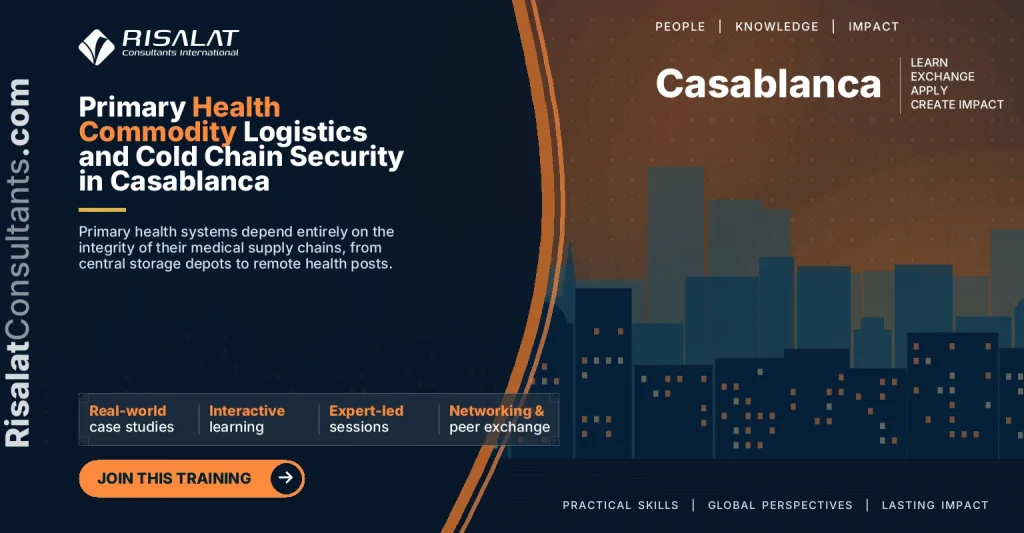
Primary Health Commodity Logistics and Cold Chain Security in Casablanca
Programme Overview
Primary health systems depend entirely on the integrity of their medical supply chains, from central storage depots to remote health posts. This professional development course in Casablanca provides healthcare logisticians with practical methodologies to secure pharmaceutical inventories and maintain stringent cold chain standards. Participants examine internationally recognised procedures to prevent commodity stockouts, eliminate product spoilage, and resolve transport bottlenecks that undermine primary care delivery, focusing on fragile logistics networks and remote clinic distribution channels.
Free self-check: the procurement maturity assessment gives 30 questions on planning, tendering, contract management, integrity and e-procurement, with a score per area, in about 10 minutes.
Delegates analyse core disciplines within public health commodity distribution, including consumption-based forecasting, warehouse quality assurance, and automated cold chain temperature surveillance. The curriculum incorporates guidelines from the World Health Organisation and international development institutions to align national practice with global standards. By reviewing risk mitigation frameworks and distribution planning models, practitioners learn how to protect temperature-sensitive vaccines, essential medicines, and diagnostic consumables across complex, multi-tiered public health infrastructures.
Through operational scenario planning and standard operating procedure design, participants develop responsive distribution mechanisms tailored to challenging operating environments. The course prioritises real-time stock monitoring, route rationalisation, and last-mile accountability. Health logistics professionals gain the technical capabilities required to modernise inventory controls, improve storage safety, and ensure that vital medical supplies reach rural clinics without compromising efficacy, traceability, or public health resources.
The programme strengthens institutional capability in:
- Application of WHO Good Storage Practices and Good Distribution Practices in public depots
- Warehouse layout optimisation, security zoning, and quarantine management for pharmaceuticals
- Stock rotation protocols implementing First Expired, First Out and First In, First Out rules
- Physical inventory verification, discrepancy reconciliation, and loss prevention procedures
- Hazardous pharmaceutical waste segregation, documentation, and safe disposal compliance
- Standards for WHO prequalified cold chain equipment, solar direct drive units, and passive cool boxes
- Temperature mapping, sensor placement, and validation of stationary cold rooms and refrigerators
- Continuous electronic temperature surveillance, data logging, and automated alert systems
- Procurement planning and market analysis
- Choosing procurement methods and approaches
- Writing specifications and terms of reference
- Bidding documents and evaluation criteria
- Transaction
- Record
- Control
- Evidence
- Opinion
Why this matters now
Organisations increasingly require professionals capable of:
- Plan procurement that matches project needs and timelines
- Prepare clear specifications and evaluation criteria
- Evaluate bids consistently and defend the decision
- Manage contracts, variations and performance
- Keep complete records for audit and review
Strong procurement and contract management systems help organisations:
- Reduce procurement delays and failed tenders
- Achieve value for money
- Lower the risk of complaints and audit findings
- Deliver contracts on time and to quality
Who Should Attend
This programme is designed for:
- Health logistics officers managing primary healthcare distribution networks
- Central medical store managers and regional warehouse supervisors
- Supply chain directors within national ministries of health
- Public health pharmacists overseeing essential drug supplies
- Cold chain technicians and biomedical logistics specialists
- Project procurement and supply management specialists on donor-funded projects
- Monitoring and evaluation officers tracking health commodity availability
- District health management team members responsible for clinic resupply
- Non-governmental organisation logistics managers delivering primary care
- Procurement officers and managers
- Contract managers and administrators
- Project and programme managers
Tick what your team needs to be able to do.
Programme Objectives
By the end of this programme participants will be able to:
- Evaluate pharmaceutical warehouse operations using World Health Organisation Good Storage and Distribution Practices
- Design continuous cold chain temperature monitoring systems for stationary and mobile refrigeration units
- Calculate inventory reorder levels, safety stock thresholds, and buffer requirements using consumption-based data
- Establish standard operating procedures for last-mile distribution across rural and hard-to-reach primary health clinics
- Implement quality assurance protocols to manage cold chain excursions, product recalls, and expired medical inventory
- Formulate rationalised distribution routes and transport contingencies for temperature-sensitive health commodities
- Construct verified reporting tools for stock balance tracking, physical inventory audits, and logistics management information systems
- Explain the procurement cycle and the rules that apply to it
- Prepare a procurement plan linked to project timelines
- Choose a suitable method and approach to the market
Training Structure & Contents
- Application of WHO Good Storage Practices and Good Distribution Practices in public depots
- Warehouse layout optimisation, security zoning, and quarantine management for pharmaceuticals
- Stock rotation protocols implementing First Expired, First Out and First In, First Out rules
- Physical inventory verification, discrepancy reconciliation, and loss prevention procedures
- Hazardous pharmaceutical waste segregation, documentation, and safe disposal compliance
- Workshop on applying central storage methods and practical steps to participant institutions
- Standards for WHO prequalified cold chain equipment, solar direct drive units, and passive cool boxes
- Temperature mapping, sensor placement, and validation of stationary cold rooms and refrigerators
- Continuous electronic temperature surveillance, data logging, and automated alert systems
- Protocol development for temperature excursions, equipment breakdown, and power contingency plans
- Preventive maintenance schedules, spare parts management, and routine servicing of cooling assets
- Workshop on applying cold chain methods to home institutions and agreeing next steps
- Transport route planning, fleet capacity assessment, and fuel monitoring in secondary distribution
- Conditioning, packing, and validation of transport cool boxes and freeze-preventative carriers
- Push versus pull resupply models tailored to rural clinics and variable consumption patterns
- Overcoming seasonal distribution barriers, infrastructure deficits, and remote terrain challenges
- Traceability, chain-of-custody transfer, and proof-of-delivery documentation at clinic level
- Case study analysis on last-mile transport logistics and rural clinic resupply in practice
- Logistics Management Information System data capture, reporting compliance, and accuracy checks
- Design and implementation of Standard Operating Procedures for clinic-level inventory control
- Key performance indicators for health supply chains including order fill rate and stockout frequency
- Audit preparation, donor compliance frameworks, and supply chain governance under funded projects
- Action planning and formulating operational supply chain improvement plans
- Capstone exercise to develop an institutional action plan with priorities and first steps
- Procurement cycle principles and governing public health procurement rules
- Procurement planning aligned with project needs and operational timelines
- Market analysis, choosing procurement methods, and commercial approach selection
- Developing technical specifications and terms of reference for health commodities
- Formulating bidding documents, evaluation criteria, and contract management procedures
- Final review of audit readiness, contract administration, and institutional implementation
Full day-by-day contents
First Day | Central Storage Management and Good Distribution Practices
- Application of WHO Good Storage Practices and Good Distribution Practices in public depots
- Warehouse layout optimisation, security zoning, and quarantine management for pharmaceuticals
- Stock rotation protocols implementing First Expired, First Out and First In, First Out rules
- Physical inventory verification, discrepancy reconciliation, and loss prevention procedures
- Hazardous pharmaceutical waste segregation, documentation, and safe disposal compliance
- Workshop on applying central storage methods and practical steps to participant institutions
Second Day | Cold Chain Infrastructure and Temperature Surveillance
- Standards for WHO prequalified cold chain equipment, solar direct drive units, and passive cool boxes
- Temperature mapping, sensor placement, and validation of stationary cold rooms and refrigerators
- Continuous electronic temperature surveillance, data logging, and automated alert systems
- Protocol development for temperature excursions, equipment breakdown, and power contingency plans
- Preventive maintenance schedules, spare parts management, and routine servicing of cooling assets
- Workshop on applying cold chain methods to home institutions and agreeing next steps
Third Day | Last-Mile Transport Logistics and Rural Clinic Resupply
- Transport route planning, fleet capacity assessment, and fuel monitoring in secondary distribution
- Conditioning, packing, and validation of transport cool boxes and freeze-preventative carriers
- Push versus pull resupply models tailored to rural clinics and variable consumption patterns
- Overcoming seasonal distribution barriers, infrastructure deficits, and remote terrain challenges
- Traceability, chain-of-custody transfer, and proof-of-delivery documentation at clinic level
- Case study analysis on last-mile transport logistics and rural clinic resupply in practice
Fourth Day | Logistics Information Systems, Standard Operating Procedures, and Quality Oversight
- Logistics Management Information System data capture, reporting compliance, and accuracy checks
- Design and implementation of Standard Operating Procedures for clinic-level inventory control
- Key performance indicators for health supply chains including order fill rate and stockout frequency
- Audit preparation, donor compliance frameworks, and supply chain governance under funded projects
- Action planning and formulating operational supply chain improvement plans
- Capstone exercise to develop an institutional action plan with priorities and first steps
Fifth Day | Procurement Integration, Market Engagement, and Review
- Procurement cycle principles and governing public health procurement rules
- Procurement planning aligned with project needs and operational timelines
- Market analysis, choosing procurement methods, and commercial approach selection
- Developing technical specifications and terms of reference for health commodities
- Formulating bidding documents, evaluation criteria, and contract management procedures
- Final review of audit readiness, contract administration, and institutional implementation
Training Methodology
The training is delivered through practical, instructor-led technical sessions, hands-on cold chain equipment simulations, and group analytical exercises. Participants evaluate real-world public health operational scenarios, dissect supply chain failure points, and draft institutional standard operating procedures directly applicable to their home institutions.
- Instructor-led technical presentations
- Hands-on cold chain equipment simulations
- Group analytical exercises and operational scenario evaluations
- Dissection of supply chain failure points
- Drafting of institutional standard operating procedures
- Structured peer exchange focused on last-mile distribution bottlenecks
Expected Outcomes
- Modernised pharmaceutical inventory controls and storage safety in participant facilities
- Established standard operating procedures for last-mile delivery and rural clinic distribution
- Reliable implementation of continuous temperature surveillance and cold chain validation
- Reduced commodity stockouts and elimination of pharmaceutical spoilage
- Application of WHO Good Storage and Good Distribution Practices across public depots
- Enhanced capabilities in procurement planning, specification writing, and contract oversight
- Operational action plans tailored for institutional adoption and audit readiness
£2,350 per participant · invoice and bank transfer · groups of 5 or more receive a discount
Five or more from one organisation: ask for the group rate on the invoice request.
Ten or more: an in-house version for your institution may cost less per person. Ask for an in-house quote.
Registration closes in 304 days (29 Sep 2027)
Who Will Deliver This Programme
Each date is delivered by a team assigned from Risalat's expert network for this subject. For this programme we assign:
How we choose them: Experience in the region of the participants or comparable settings; Command of the financier rules that apply (World Bank, ADB, AfDB, EU, UN) where relevant; Delivery in English; other languages on request for in-house groups; No conflict of interest with participants' institutions.
Training courses in CasablancaProcurement, Supply Chain & Logistics training courses
Why Casablanca for this programme
Casablanca links French- and Arabic-speaking Africa with Europe.
The Primary Health Commodity Logistics and Cold Chain Security in Casablanca programme in November 2027 brings together officials and professionals from across the Africa region and beyond. Sessions combine short inputs, case studies and group work on participants' own files, and the city's institutions can be added as a study visit on request.
Getting there: Mohammed V (CMN).
Check whether you need a visa with the free Visa Checker, and ask for an invitation letter once you are registered.
The same topic in other cities
- Emergency Nutrition Surveillance and Malnutrition Treatment Auditing in Cairo (Cairo)
- Emergency Medical Supply Warehousing and Last-Mile Distribution in Penang (Penang)
- Early Childhood Nutrition Interventions and Stunting Prevention Delivery in Geneva (Geneva)
- Primary Health Facility Upgrading and Service Quality Audits in Kigali (Kigali)
- National Health Logistics and Essential Drug Supply Chain Management in Dubai (Dubai)
- Primary Healthcare Facility Quality and Essential Drug Supply Chains in Kuala Lumpur (Kuala Lumpur)
Other programmes in Casablanca
- Urban Stormwater Infrastructure and Flood Protection Civil Works in Casablanca
- Public Sector Fiber Backbone Contracting and Open Access Regulation in Casablanca
- Agri-Enterprise Outgrower Contracting and Commercial Matching Grants in Casablanca
- Solar Photovoltaic Operations, Inverter Safety and O&M Standards in Casablanca
- Artisanal Mining Formalisation and Environmental Rehabilitation in Casablanca
Questions before you nominate your team? Book a 30-minute call with us, or ask for this programme in-house.
Teams often travel here from Senegal, Côte d'Ivoire, Cameroon, Madagascar, Comoros, Burundi, Djibouti, Benin. Funding, visa letters and group rates are explained on each country page.
- World Health Organization World Health Organization
- Procurement Framework and Regulations for Projects World Bank
Is there health systems training for government officials in Casablanca in November 2027?
Can "Primary Health Commodity Logistics and Cold Chain Security in Casablanca" be delivered in-house for one organisation?
Which other health systems programmes does Risalat run?
How do organisations register and pay?
For teams and institutions
Bring your team
Teams that learn together apply more at work. Tell us how many people and how you would like to take part: we reply with a group quote within two working days.
Watch: this programme in short


Other dates and cities for this subject: Health Systems and Health Project Management training courses (112 upcoming dates).
More training courses in Morocco · All programmes in Africa · Full training calendar
Plan this programme in a roadmap: why it matters, why to approve it, the dates to plan and the career it builds.