Factos essenciais
- Datas
- 8–12 fev. 2027 (5 dias)
- Local
- A definir, Genebra, Suíça
- Preço por participante
- £4.350 (GBP)
- Pagamento
- Por fatura e transferência bancária
- Encerramento das inscrições
- 30 dez. 2026
- Formato
- 5-day short course: a practical capacity-building programme for government, NGO and project teams in Geneva
- Certificado
- Certificado de conclusão
- Opção interna
- Realize-o para a sua equipa, nas datas que preferir
Nesta página 12 secções
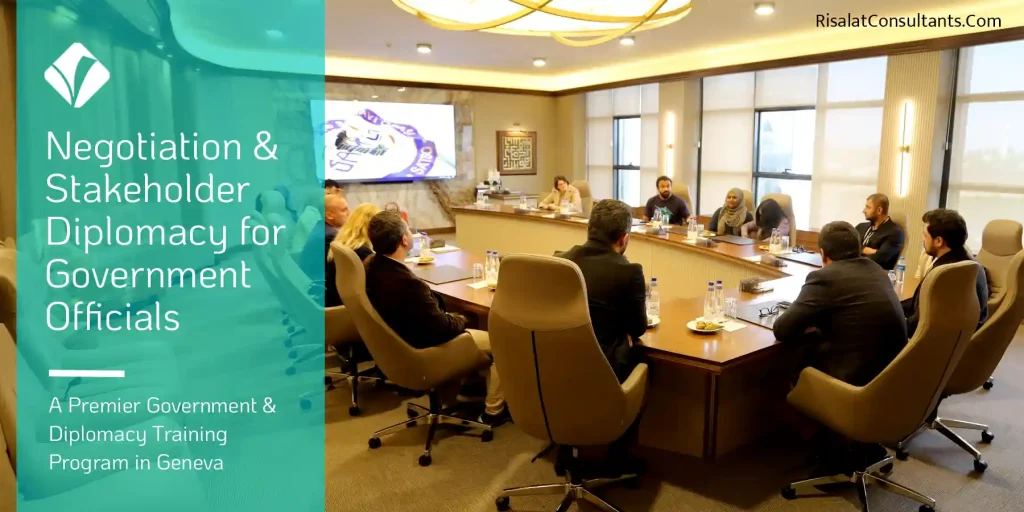
Negociação e Diplomacia com Partes Interessadas para Funcionários Públicos
Visão geral do programa
Government officials today operate in an increasingly complex landscape, balancing national interests, donor expectations, private sector demands, and community concerns. Effective negotiation and stakeholder diplomacy are essential for advancing reforms, securing resources, resolving conflicts, and building trust across diverse partners.
Free self-check: the governance self-audit gives a quick check of governance, controls and accountability, in about 10 minutes.
This specialised 5-day programme equips government leaders, PIU teams, and public-sector professionals with the diplomatic negotiation capabilities required to navigate high-stakes discussions, manage multi-stakeholder environments, and represent their institutions with authority and cultural intelligence. Delivered by Risalat Consultants International in Geneva, Switzerland, it combines expert-led sessions, real cases and group work, so that participants can apply what they learn in their own institution.
Delivered in Geneva, one of the world’s most respected diplomatic capitals, participants gain exposure to international negotiation practices and learn frameworks rooted in statecraft, diplomacy, and development cooperation.
O programa reforça a capacidade institucional em:
- Principles of negotiation for public officials
- Harvard Model, BATNA, ZOPA, interest vs. position
- Public-sector negotiation constraints and ethics
- Exercise: Internal negotiation within government structures
- Stakeholder mapping and influence analysis
- Tools for building diplomatic relationships
- Strategies for maintaining political neutrality
- Workshop: Stakeholder engagement plan for a real project
- Triagem de riscos ambientais e sociais
- Instrumentos de avaliação e planos de gestão
- Planeamento do envolvimento das partes interessadas
- Mecanismos de reclamação que funcionam
Why this matters now
As organizações precisam cada vez mais de profissionais capazes de:
- Fazer a triagem e classificar os riscos ambientais e sociais
- Preparar e executar planos de gestão
- Envolver as partes interessadas de forma significativa ao longo de todo o projeto
- Gerir mecanismos de reclamação que resolvem problemas
- Monitorizar e reportar os compromissos assumidos perante os financiadores
Sistemas sólidos de gestão ambiental, social e das partes interessadas ajudam as organizações a:
- Evitar atrasos e suspensões de desembolsos
- Proteger as comunidades e os trabalhadores
- Cumprir as normas e os compromissos dos financiadores
- Criar confiança junto das pessoas afetadas e do público
Quem deve participar
Este programa destina-se a:
- Funcionários públicos e decisores políticos
- PIU staff in donor-funded projects
- Diretores/gestores de ministérios e agências
- Public affairs officers
- Representatives engaged in international cooperation
- Regulatory authorities
- Local government officials working with communities and private firms
- Professionals seeking to apply modern negotiation frameworks tailored for government and public-sector realities
- Officials needing to engage donors, contractors, communities, and international partners with diplomacy
- Personnel managing conflict, competing agendas, and sensitive political dynamics
- Leaders looking to build consensus across multi-stakeholder groups
- Individuals who conduct negotiations with cultural intelligence, confidence, and strategic clarity
Assinale o que a sua equipa precisa de ser capaz de fazer.
Objetivos do programa
No final deste programa, os participantes serão capazes de:
- Explicar as normas ambientais e sociais aplicáveis aos seus projetos
- Fazer a triagem e classificar riscos e impactos
- Preparar os principais instrumentos e planos de gestão
- Planear e realizar um envolvimento significativo das partes interessadas
- Criar e gerir um mecanismo de reclamação
- Aplicar os requisitos laborais e de segurança e saúde
- Abordar as questões de terra, meios de subsistência e grupos vulneráveis
- Monitorizar e reportar os compromissos ambientais e sociais
- Preparar um plano de ação para o seu projeto
Training Structure & Contents
- Principles of negotiation for public officials
- Harvard Model, BATNA, ZOPA, interest vs. position
- Public-sector negotiation constraints and ethics
- Exercise: Internal negotiation within government structures
- Workshop: Foundations of Government Negotiation: Applying It to Your Institution
- Stakeholder mapping and influence analysis
- Tools for building diplomatic relationships
- Strategies for maintaining political neutrality
- Workshop: Stakeholder engagement plan for a real project
- Workshop: Stakeholder Diplomacy & Power Dynamics: Applying It to Your Institution
- How WB, ADB, EBRD negotiate with governments
- Balancing national priorities with donor requirements
- Negotiating scope, timelines, cost variations and claims
- Simulation: Government, donor, contractor negotiation
- Case Study: Negotiating with Donors, Contractors & International Partners in Practice
- Cultural intelligence (CQ) for international negotiations
- High-context vs low-context negotiation styles
- Conflict de-escalation and mediation techniques
- Encenação de papéis: Resolução de conflitos com parceiros externos
- Workshop: Cross-Cultural Diplomacy & Conflict Resolution: Applying It to Your Institution
- Facilitating agreement among diverse stakeholders
- Communicating decisions with clarity and authority
- Managing high-pressure or politicized negotiations
- Final negotiation: Multi-stakeholder diplomatic scenario
- Capstone Exercise: Negotiation & Stakeholder Diplomacy for Government Officials Action Plan for Your Institution
Conteúdo completo, dia a dia
First Day | Foundations of Government Negotiation & Stakeholder Diplomacy for Government Officials
- Principles of negotiation for public officials
- Harvard Model, BATNA, ZOPA, interest vs. position
- Public-sector negotiation constraints and ethics
- Exercise: Internal negotiation within government structures
- Workshop: Foundations of Government Negotiation: Applying It to Your Institution
Second Day | Stakeholder Diplomacy & Power Dynamics
- Stakeholder mapping and influence analysis
- Tools for building diplomatic relationships
- Strategies for maintaining political neutrality
- Workshop: Stakeholder engagement plan for a real project
- Workshop: Stakeholder Diplomacy & Power Dynamics: Applying It to Your Institution
Third Day | Negotiating with Donors, Contractors & International Partners
- How WB, ADB, EBRD negotiate with governments
- Balancing national priorities with donor requirements
- Negotiating scope, timelines, cost variations and claims
- Simulation: Government, donor, contractor negotiation
- Case Study: Negotiating with Donors, Contractors & International Partners in Practice
Fourth Day | Cross-Cultural Diplomacy & Conflict Resolution
- Cultural intelligence (CQ) for international negotiations
- High-context vs low-context negotiation styles
- Conflict de-escalation and mediation techniques
- Encenação de papéis: Resolução de conflitos com parceiros externos
- Workshop: Cross-Cultural Diplomacy & Conflict Resolution: Applying It to Your Institution
Fifth Day | Consensus Building, Strategic Communication & Final Simulation
- Facilitating agreement among diverse stakeholders
- Communicating decisions with clarity and authority
- Managing high-pressure or politicized negotiations
- Final negotiation: Multi-stakeholder diplomatic scenario
- Capstone Exercise: Negotiation & Stakeholder Diplomacy for Government Officials Action Plan for Your Institution
Metodologia de formação
The programme is practical and participatory. Expert facilitators introduce concepts and current practice, and participants apply them straight away through discussion, exercises and work on real cases. Before the programme, a short pre-assessment helps the facilitators understand each participant’s role and priorities, so that examples and exercises can be adjusted to the group. Each day ends with a short reflection in which participants note what they will apply at work.
- Facilitated strategic dialogues based on international negotiation practice
- Análise diplomática baseada em casos utilizando cenários reais de governos e doadores
- Structured negotiation simulations replicating high-level engagements
- Collaborative roundtable exercises for peer learning and inter-agency insight
- Guided reflection sessions to refine personal negotiation style
- Laboratórios de negociação aplicados que abordam desafios realistas baseados em cenários
- Sessões conduzidas por especialistas sobre as práticas atuais
- Estudos de caso regionais e internacionais
- Trabalho de grupo e exercícios práticos
- Simulações e dramatizações, quando relevante
Resultados esperados
- Os participantes elaboram um plano de gestão da mudança prático e alinhado com os doadores
- Melhor liderança e comunicação durante a implementação das reformas
- Menor resistência e adoção mais fluida das reformas introduzidas pelos doadores
- Maior preparação institucional para a sustentabilidade e a transição
- Melhor alinhamento entre as prioridades dos doadores e a apropriação pelo governo
- Fazer a triagem e classificar os riscos ambientais e sociais
- Preparar e aplicar planos de gestão
- Envolver as partes interessadas de forma significativa
- Participants leave with a personal action plan and practical tools they can use in their institution from the first week back
£4.350 por participante · fatura e transferência bancária · desconto para grupos de 5 ou mais pessoas
Cinco ou mais participantes da mesma organização: peça a tarifa de grupo no pedido de fatura.
Dez ou mais: uma versão interna para a sua instituição pode custar menos por pessoa. Pedir um orçamento interno.
As inscrições encerram em 38 dias (30 dez 2026)
Perfil do país anfitrião
Geneva stands as one of the world’s foremost centers for diplomacy, negotiation, and multilateral cooperation. Home to the United Nations, WTO, WHO, ILO, UNHCR, and more than 40 international organizations, it provides an unparalleled environment for government officials seeking to elevate their negotiation capabilities. The city’s culture of neutrality, discretion, and international engagement makes it the ideal location for a programme focused on high-level diplomacy, donor relations, and stakeholder management.
Relevância regional e aplicação
Europe: European institutions apply environmental, social and stakeholder management within detailed regulatory frameworks and reform agendas. Participants from Europe can compare their practice with colleagues from other regions and test how established methods work under different conditions.
Africa: Across Africa, ministries, agencies and project teams working in environmental, social and stakeholder management increasingly operate alongside donor-financed programmes that expect clear systems and evidence. The programme helps participants adapt good practice.
Who Will Deliver This Programme
Each date is delivered by a team assigned from Risalat's expert network for this subject. For this programme we assign:
How we choose them: Experience in the region of the participants or comparable settings; Command of the financier rules that apply (World Bank, ADB, AfDB, EU, UN) where relevant; Delivery in English; other languages on request for in-house groups; No conflict of interest with participants' institutions.
Training courses in GenevaManagement & Leadership training courses
Porquê Genebra para este programa
Genebra acolhe agências da ONU e fundos internacionais, o que a torna um local natural para temas de financiamento do desenvolvimento e ação humanitária.
The Negotiation & Stakeholder Diplomacy for Government Officials programme in February 2027 brings together officials and professionals from across Europe, Africa, the Middle East and Asia. Sessions combine short inputs, case studies and group work on participants' own files, and the city's institutions can be added as a study visit on request.
Como chegar: Aeroporto de Genebra (GVA).
Verifique se precisa de visto com o Verificador de Vistos gratuito e peça uma carta-convite depois de se inscrever.
O mesmo tema noutras cidades
- Comunicação Intercultural em Projetos Internacionais (Barcelona)
- Formação em Diálogo, Paz e Mediação – Certificado Avançado (Doha)
- Formação em Gestão de Conflitos e Consolidação da Paz em Istambul (Istambul)
- Formação em Negociação Humanitária e Tomada de Decisão (Roterdão)
- Humanitarian Cooperation and Diplomacy Training in Brussels (Brussels)
- Training on Human Rights and International Humanitarian Law in Armed Conflicts in Geneva (Geneva)
Outros programas em Genebra
- Practical AI Tools for Project Teams and Analysts in Geneva
- AI for Health Systems and Health Data Training in Geneva
- HSE Management Systems and ISO 45001 for Public Agencies in Geneva
- Arquitetura de Inscrição e Pagamento do Programa de Transferência de Renda Adaptativa em Genebra
- Urban Bulk Water Treatment and Wellfield Asset Reliability in Geneva
Is there negotiation and communication training for government officials in Geneva in February 2027?
Can "Negotiation & Stakeholder Diplomacy for Government Officials" be delivered in-house for one organisation?
Which other negotiation and communication programmes does Risalat run?
Como se inscrevem e pagam as organizações?
For teams and institutions
Bring your team
Teams that learn together apply more at work. Tell us how many people and how you would like to take part: we reply with a group quote within two working days.
Watch: this programme in short
Other dates and cities for this subject: Stakeholder Engagement and Grievance Redress training courses (19 upcoming dates).
Mais cursos de formação na Suíça · Todos os programas na Europa · Calendário de formação completo
Planear este programa num roteiro: porque importa, porque o aprovar, as datas a planear e a carreira que constrói.