Points clés
- Dates
- 8–12 févr. 2027 (5 jours)
- Lieu
- À confirmer, Genève, Suisse
- Frais par participant
- 4 350 £ (GBP)
- Paiement
- Sur facture et par virement bancaire
- Clôture des inscriptions
- 30 déc. 2026
- Format
- 5-day short course: a practical capacity-building programme for government, NGO and project teams in Geneva
- Certificat
- Certificat de participation
- Option intra
- Organisez-le pour votre équipe, à vos dates
Sur cette page 12 sections
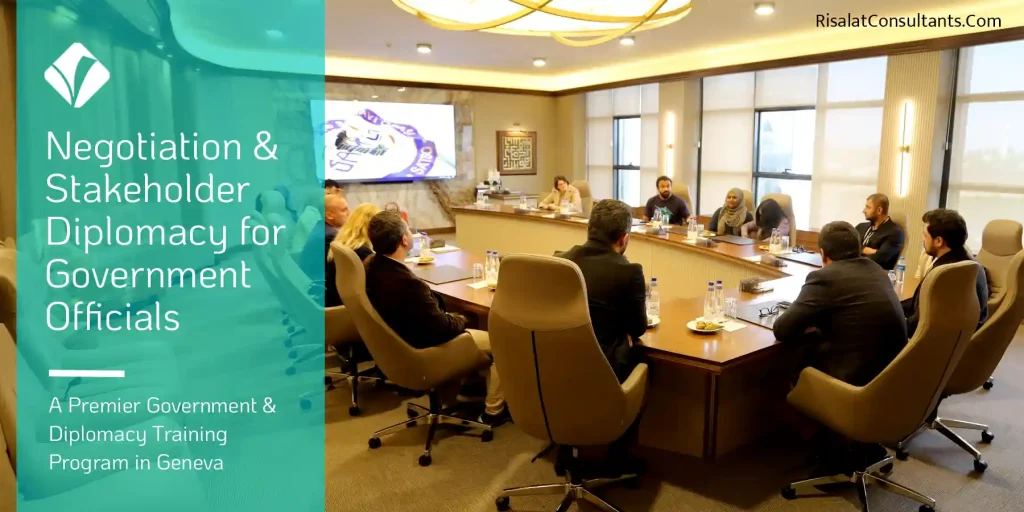
Négociation & diplomatie avec les parties prenantes pour les fonctionnaires
Présentation du programme
Government officials today operate in an increasingly complex landscape, balancing national interests, donor expectations, private sector demands, and community concerns. Effective negotiation and stakeholder diplomacy are essential for advancing reforms, securing resources, resolving conflicts, and building trust across diverse partners.
Free self-check: the governance self-audit gives a quick check of governance, controls and accountability, in about 10 minutes.
This specialised 5-day programme equips government leaders, PIU teams, and public-sector professionals with the diplomatic negotiation capabilities required to navigate high-stakes discussions, manage multi-stakeholder environments, and represent their institutions with authority and cultural intelligence. Delivered by Risalat Consultants International in Geneva, Switzerland, it combines expert-led sessions, real cases and group work, so that participants can apply what they learn in their own institution.
Delivered in Geneva, one of the world’s most respected diplomatic capitals, participants gain exposure to international negotiation practices and learn frameworks rooted in statecraft, diplomacy, and development cooperation.
Le programme renforce les capacités institutionnelles en matière de :
- Principles of negotiation for public officials
- Harvard Model, BATNA, ZOPA, interest vs. position
- Public-sector negotiation constraints and ethics
- Exercise: Internal negotiation within government structures
- Stakeholder mapping and influence analysis
- Tools for building diplomatic relationships
- Strategies for maintaining political neutrality
- Workshop: Stakeholder engagement plan for a real project
- Tri préliminaire des risques environnementaux et sociaux
- Instruments d'évaluation et plans de gestion
- Planification de la mobilisation des parties prenantes
- Des mécanismes de gestion des plaintes qui fonctionnent
Why this matters now
Les organisations ont de plus en plus besoin de professionnels capables de :
- Trier et classer les risques environnementaux et sociaux
- Préparer et mettre en œuvre les plans de gestion
- Mobiliser les parties prenantes de manière constructive tout au long du projet
- Gérer des mécanismes de plainte qui résolvent les problèmes
- Suivre les engagements pris envers les bailleurs de fonds et en rendre compte
Des systèmes solides de gestion environnementale, sociale et des parties prenantes aident les organisations à :
- Éviter les retards et les suspensions de décaissements
- Protéger les communautés et les travailleurs
- Respecter les normes et engagements des bailleurs de fonds
- Instaurer la confiance avec les personnes concernées et le public
Public concerné
Ce programme s'adresse à :
- Fonctionnaires et décideurs politiques
- PIU staff in donor-funded projects
- Ministry and agency directors/managers
- Public affairs officers
- Representatives engaged in international cooperation
- Regulatory authorities
- Local government officials working with communities and private firms
- Professionals seeking to apply modern negotiation frameworks tailored for government and public-sector realities
- Officials needing to engage donors, contractors, communities, and international partners with diplomacy
- Personnel managing conflict, competing agendas, and sensitive political dynamics
- Leaders looking to build consensus across multi-stakeholder groups
- Individuals who conduct negotiations with cultural intelligence, confidence, and strategic clarity
Cochez ce que votre équipe doit être capable de faire.
Objectifs du programme
À l'issue de ce programme, les participants seront en mesure de :
- Expliquer les normes environnementales et sociales applicables à leurs projets
- Trier et classer les risques et les impacts
- Préparer les principaux instruments et plans de gestion
- Planifier et mener une mobilisation des parties prenantes constructive
- Mettre en place et gérer un mécanisme de gestion des plaintes
- Appliquer les exigences en matière de travail, de santé et de sécurité
- Traiter les questions foncières, de moyens de subsistance et de groupes vulnérables
- Suivre les engagements environnementaux et sociaux et en rendre compte
- Préparer un plan d'action pour leur projet
Training Structure & Contents
- Principles of negotiation for public officials
- Harvard Model, BATNA, ZOPA, interest vs. position
- Public-sector negotiation constraints and ethics
- Exercise: Internal negotiation within government structures
- Workshop: Foundations of Government Negotiation: Applying It to Your Institution
- Stakeholder mapping and influence analysis
- Tools for building diplomatic relationships
- Strategies for maintaining political neutrality
- Workshop: Stakeholder engagement plan for a real project
- Workshop: Stakeholder Diplomacy & Power Dynamics: Applying It to Your Institution
- How WB, ADB, EBRD negotiate with governments
- Balancing national priorities with donor requirements
- Negotiating scope, timelines, cost variations and claims
- Simulation: Government, donor, contractor negotiation
- Case Study: Negotiating with Donors, Contractors & International Partners in Practice
- Cultural intelligence (CQ) for international negotiations
- High-context vs low-context negotiation styles
- Conflict de-escalation and mediation techniques
- Role-play: Resolving conflict with external partners
- Workshop: Cross-Cultural Diplomacy & Conflict Resolution: Applying It to Your Institution
- Facilitating agreement among diverse stakeholders
- Communicating decisions with clarity and authority
- Managing high-pressure or politicized negotiations
- Final negotiation: Multi-stakeholder diplomatic scenario
- Capstone Exercise: Negotiation & Stakeholder Diplomacy for Government Officials Action Plan for Your Institution
Contenu détaillé jour par jour
First Day | Foundations of Government Negotiation & Stakeholder Diplomacy for Government Officials
- Principles of negotiation for public officials
- Harvard Model, BATNA, ZOPA, interest vs. position
- Public-sector negotiation constraints and ethics
- Exercise: Internal negotiation within government structures
- Workshop: Foundations of Government Negotiation: Applying It to Your Institution
Second Day | Stakeholder Diplomacy & Power Dynamics
- Stakeholder mapping and influence analysis
- Tools for building diplomatic relationships
- Strategies for maintaining political neutrality
- Workshop: Stakeholder engagement plan for a real project
- Workshop: Stakeholder Diplomacy & Power Dynamics: Applying It to Your Institution
Third Day | Negotiating with Donors, Contractors & International Partners
- How WB, ADB, EBRD negotiate with governments
- Balancing national priorities with donor requirements
- Negotiating scope, timelines, cost variations and claims
- Simulation: Government, donor, contractor negotiation
- Case Study: Negotiating with Donors, Contractors & International Partners in Practice
Fourth Day | Cross-Cultural Diplomacy & Conflict Resolution
- Cultural intelligence (CQ) for international negotiations
- High-context vs low-context negotiation styles
- Conflict de-escalation and mediation techniques
- Role-play: Resolving conflict with external partners
- Workshop: Cross-Cultural Diplomacy & Conflict Resolution: Applying It to Your Institution
Fifth Day | Consensus Building, Strategic Communication & Final Simulation
- Facilitating agreement among diverse stakeholders
- Communicating decisions with clarity and authority
- Managing high-pressure or politicized negotiations
- Final negotiation: Multi-stakeholder diplomatic scenario
- Capstone Exercise: Negotiation & Stakeholder Diplomacy for Government Officials Action Plan for Your Institution
Méthodologie de formation
The programme is practical and participatory. Expert facilitators introduce concepts and current practice, and participants apply them straight away through discussion, exercises and work on real cases. Before the programme, a short pre-assessment helps the facilitators understand each participant’s role and priorities, so that examples and exercises can be adjusted to the group. Each day ends with a short reflection in which participants note what they will apply at work.
- Facilitated strategic dialogues based on international negotiation practice
- Analyse diplomatique basée sur des cas utilisant des scénarios réels de gouvernements et de donateurs
- Structured negotiation simulations replicating high-level engagements
- Collaborative roundtable exercises for peer learning and inter-agency insight
- Guided reflection sessions to refine personal negotiation style
- Laboratoires de négociation appliquée abordant des défis réalistes basés sur des scénarios
- Sessions animées par des experts sur les pratiques actuelles
- Études de cas régionales et internationales
- Travaux de groupe et exercices pratiques
- Simulations et jeux de rôle le cas échéant
Résultats attendus
- Les participants élaborent un plan de gestion du changement pratique et aligné sur les exigences des bailleurs
- Leadership et communication renforcés lors du déploiement des réformes
- Moins de résistances et une adoption plus fluide des réformes introduites par les bailleurs
- Institutions mieux préparées à la pérennisation et à la transition
- Meilleure articulation entre les priorités des bailleurs et l'appropriation par l'État
- Trier et classer les risques environnementaux et sociaux
- Préparer et appliquer les plans de gestion
- Mobiliser les parties prenantes de manière constructive
- Participants leave with a personal action plan and practical tools they can use in their institution from the first week back
4 350 £ par participant · facture et virement bancaire · remise pour les groupes de 5 personnes ou plus
Cinq personnes ou plus d'une même organisation : demandez le tarif de groupe lors de votre demande de facture.
Dix personnes ou plus : une version interne pour votre institution peut coûter moins cher par personne. Demander un devis pour une formation interne.
Registration closes in 38 days (30 Dec 2026)
Profil du pays d'accueil
Geneva stands as one of the world’s foremost centers for diplomacy, negotiation, and multilateral cooperation. Home to the United Nations, WTO, WHO, ILO, UNHCR, and more than 40 international organizations, it provides an unparalleled environment for government officials seeking to elevate their negotiation capabilities. The city’s culture of neutrality, discretion, and international engagement makes it the ideal location for a programme focused on high-level diplomacy, donor relations, and stakeholder management.
Pertinence régionale & mise en application
Europe: European institutions apply environmental, social and stakeholder management within detailed regulatory frameworks and reform agendas. Participants from Europe can compare their practice with colleagues from other regions and test how established methods work under different conditions.
Africa: Across Africa, ministries, agencies and project teams working in environmental, social and stakeholder management increasingly operate alongside donor-financed programmes that expect clear systems and evidence. The programme helps participants adapt good practice.
Who Will Deliver This Programme
Each date is delivered by a team assigned from Risalat's expert network for this subject. For this programme we assign:
How we choose them: Experience in the region of the participants or comparable settings; Command of the financier rules that apply (World Bank, ADB, AfDB, EU, UN) where relevant; Delivery in English; other languages on request for in-house groups; No conflict of interest with participants' institutions.
Cours de formation à GenèveManagement & Leadership training courses
Pourquoi Genève pour ce programme
Genève accueille des agences de l'ONU et des fonds internationaux, ce qui en fait un lieu naturel pour les thèmes de financement du développement et d'action humanitaire.
The Negotiation & Stakeholder Diplomacy for Government Officials programme in February 2027 brings together officials and professionals from across Europe, Africa, the Middle East and Asia. Sessions combine short inputs, case studies and group work on participants' own files, and the city's institutions can be added as a study visit on request.
Accès : aéroport de Genève (GVA).
Vérifiez si vous avez besoin d'un visa avec le vérificateur de visa gratuit, et demandez une lettre d'invitation une fois inscrit.
Le même thème dans d'autres villes
- Communication interculturelle dans les projets internationaux (Barcelone)
- Formation au dialogue, à la paix et à la médiation – Certificat avancé (Doha)
- Formation à la gestion des conflits & à la consolidation de la paix à Istanbul (Istanbul)
- Formation aux négociations et à la prise de décision humanitaires (Rotterdam)
- Humanitarian Cooperation and Diplomacy Training in Brussels (Brussels)
- Training on Human Rights and International Humanitarian Law in Armed Conflicts in Geneva (Geneva)
Autres programmes à Genève
- Practical AI Tools for Project Teams and Analysts in Geneva
- AI for Health Systems and Health Data Training in Geneva
- HSE Management Systems and ISO 45001 for Public Agencies in Geneva
- Adaptive Cash Transfer Programme Enrolment and Payment Architecture in Geneva
- Urban Bulk Water Treatment and Wellfield Asset Reliability in Geneva
Is there negotiation and communication training for government officials in Geneva in February 2027?
Can "Negotiation & Stakeholder Diplomacy for Government Officials" be delivered in-house for one organisation?
Which other negotiation and communication programmes does Risalat run?
Comment les organisations s'inscrivent-elles et paient-elles ?
Pour les équipes et les institutions
Bring your team
Teams that learn together apply more at work. Tell us how many people and how you would like to take part: we reply with a group quote within two working days.
Watch: this programme in short
Other dates and cities for this subject: Stakeholder Engagement and Grievance Redress training courses (19 upcoming dates).
Plus de formations en Suisse · Tous les programmes en Europe · Calendrier complet des formations
Plan this programme in a roadmap: why it matters, why to approve it, the dates to plan and the career it builds.