Key facts
- Dates
- 8–12 Feb 2027 (5 days)
- Where
- TBD, Geneva, Switzerland
- Fee per participant
- £4,350 (GBP)
- Payment
- By invoice and bank transfer
- Registration closes
- 30 Dec 2026
- Format
- 5-day short course: a practical capacity-building programme for government, NGO and project teams in Geneva
- Certificate
- Certificate of completion
- In-house option
- Run it for your team, on your dates
On this page 12 sections
Negotiation & Stakeholder Diplomacy for Government Officials
Programme Overview
Government officials today operate in an increasingly complex landscape, balancing national interests, donor expectations, private sector demands, and community concerns. Effective negotiation and stakeholder diplomacy are essential for advancing reforms, securing resources, resolving conflicts, and building trust across diverse partners.
Free self-check: the governance self-audit gives a quick check of governance, controls and accountability, in about 10 minutes.
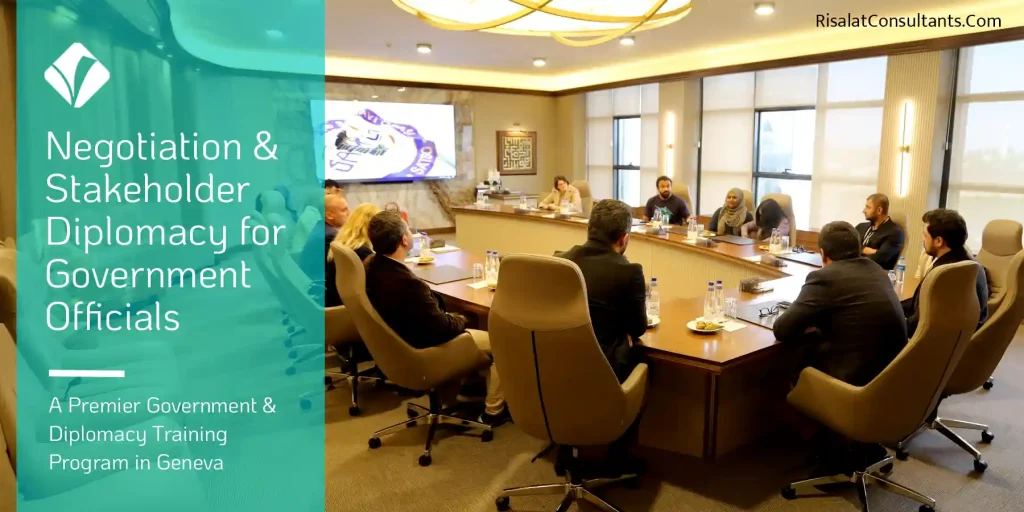
This specialised 5-day programme equips government leaders, PIU teams, and public-sector professionals with the diplomatic negotiation capabilities required to navigate high-stakes discussions, manage multi-stakeholder environments, and represent their institutions with authority and cultural intelligence. Delivered by Risalat Consultants International in Geneva, Switzerland, it combines expert-led sessions, real cases and group work, so that participants can apply what they learn in their own institution.
Delivered in Geneva, one of the world’s most respected diplomatic capitals, participants gain exposure to international negotiation practices and learn frameworks rooted in statecraft, diplomacy, and development cooperation.
The programme strengthens institutional capability in:
- Principles of negotiation for public officials
- Harvard Model, BATNA, ZOPA, interest vs. position
- Public-sector negotiation constraints and ethics
- Exercise: Internal negotiation within government structures
- Stakeholder mapping and influence analysis
- Tools for building diplomatic relationships
- Strategies for maintaining political neutrality
- Workshop: Stakeholder engagement plan for a real project
- Environmental and social risk screening
- Assessment instruments and management plans
- Stakeholder engagement planning
- Grievance mechanisms that work
Why this matters now
Organisations increasingly require professionals capable of:
- Screen and classify environmental and social risks
- Prepare and implement management plans
- Engage stakeholders meaningfully throughout the project
- Run grievance mechanisms that resolve issues
- Monitor and report on commitments to financiers
Strong environmental, social and stakeholder management systems help organisations:
- Avoid delays and suspended disbursements
- Protect communities and workers
- Meet financier standards and commitments
- Build trust with affected people and the public
Who Should Attend
This programme is designed for:
- Government officials and policymakers
- PIU staff in donor-funded projects
- Ministry and agency directors/managers
- Public affairs officers
- Representatives engaged in international cooperation
- Regulatory authorities
- Local government officials working with communities and private firms
- Professionals seeking to apply modern negotiation frameworks tailored for government and public-sector realities
- Officials needing to engage donors, contractors, communities, and international partners with diplomacy
- Personnel managing conflict, competing agendas, and sensitive political dynamics
- Leaders looking to build consensus across multi-stakeholder groups
- Individuals who conduct negotiations with cultural intelligence, confidence, and strategic clarity
Tick what your team needs to be able to do.
Programme Objectives
By the end of this programme participants will be able to:
- Explain the environmental and social standards that apply to their projects
- Screen and classify risks and impacts
- Prepare the key instruments and management plans
- Plan and carry out meaningful stakeholder engagement
- Set up and run a grievance mechanism
- Apply labour, health and safety requirements
- Address land, livelihoods and vulnerable groups
- Monitor and report on environmental and social commitments
- Prepare an action plan for their project
Training Structure & Contents
- Principles of negotiation for public officials
- Harvard Model, BATNA, ZOPA, interest vs. position
- Public-sector negotiation constraints and ethics
- Exercise: Internal negotiation within government structures
- Workshop: Foundations of Government Negotiation: Applying It to Your Institution
- Stakeholder mapping and influence analysis
- Tools for building diplomatic relationships
- Strategies for maintaining political neutrality
- Workshop: Stakeholder engagement plan for a real project
- Workshop: Stakeholder Diplomacy & Power Dynamics: Applying It to Your Institution
- How WB, ADB, EBRD negotiate with governments
- Balancing national priorities with donor requirements
- Negotiating scope, timelines, cost variations and claims
- Simulation: Government, donor, contractor negotiation
- Case Study: Negotiating with Donors, Contractors & International Partners in Practice
- Cultural intelligence (CQ) for international negotiations
- High-context vs low-context negotiation styles
- Conflict de-escalation and mediation techniques
- Role-play: Resolving conflict with external partners
- Workshop: Cross-Cultural Diplomacy & Conflict Resolution: Applying It to Your Institution
- Facilitating agreement among diverse stakeholders
- Communicating decisions with clarity and authority
- Managing high-pressure or politicized negotiations
- Final negotiation: Multi-stakeholder diplomatic scenario
- Capstone Exercise: Negotiation & Stakeholder Diplomacy for Government Officials Action Plan for Your Institution
Full day-by-day contents
First Day | Foundations of Government Negotiation & Stakeholder Diplomacy for Government Officials
- Principles of negotiation for public officials
- Harvard Model, BATNA, ZOPA, interest vs. position
- Public-sector negotiation constraints and ethics
- Exercise: Internal negotiation within government structures
- Workshop: Foundations of Government Negotiation: Applying It to Your Institution
Second Day | Stakeholder Diplomacy & Power Dynamics
- Stakeholder mapping and influence analysis
- Tools for building diplomatic relationships
- Strategies for maintaining political neutrality
- Workshop: Stakeholder engagement plan for a real project
- Workshop: Stakeholder Diplomacy & Power Dynamics: Applying It to Your Institution
Third Day | Negotiating with Donors, Contractors & International Partners
- How WB, ADB, EBRD negotiate with governments
- Balancing national priorities with donor requirements
- Negotiating scope, timelines, cost variations and claims
- Simulation: Government, donor, contractor negotiation
- Case Study: Negotiating with Donors, Contractors & International Partners in Practice
Fourth Day | Cross-Cultural Diplomacy & Conflict Resolution
- Cultural intelligence (CQ) for international negotiations
- High-context vs low-context negotiation styles
- Conflict de-escalation and mediation techniques
- Role-play: Resolving conflict with external partners
- Workshop: Cross-Cultural Diplomacy & Conflict Resolution: Applying It to Your Institution
Fifth Day | Consensus Building, Strategic Communication & Final Simulation
- Facilitating agreement among diverse stakeholders
- Communicating decisions with clarity and authority
- Managing high-pressure or politicized negotiations
- Final negotiation: Multi-stakeholder diplomatic scenario
- Capstone Exercise: Negotiation & Stakeholder Diplomacy for Government Officials Action Plan for Your Institution
Training Methodology
The programme is practical and participatory. Expert facilitators introduce concepts and current practice, and participants apply them straight away through discussion, exercises and work on real cases. Before the programme, a short pre-assessment helps the facilitators understand each participant’s role and priorities, so that examples and exercises can be adjusted to the group. Each day ends with a short reflection in which participants note what they will apply at work.
- Facilitated strategic dialogues based on international negotiation practice
- Case-based diplomatic analysis using real government and donor scenarios
- Structured negotiation simulations replicating high-level engagements
- Collaborative roundtable exercises for peer learning and inter-agency insight
- Guided reflection sessions to refine personal negotiation style
- Applied negotiation laboratories addressing realistic, scenario-driven challenges
- Expert-led sessions on current practice
- Regional and international case studies
- Group work and practical exercises
- Simulations and role plays where relevant
Expected Outcomes
- Participants develop a practical, donor-aligned Change Management Plan
- Improved leadership and communication during reform rollouts
- Reduced resistance and smoother adoption of donor-introduced reforms
- Strengthened institutional readiness for sustainability and transition
- Enhanced alignment between donor priorities and government ownership
- Screen and classify environmental and social risks
- Prepare and apply management plans
- Engage stakeholders meaningfully
- Participants leave with a personal action plan and practical tools they can use in their institution from the first week back
£4,350 per participant · invoice and bank transfer · groups of 5 or more receive a discount
Five or more from one organisation: ask for the group rate on the invoice request.
Ten or more: an in-house version for your institution may cost less per person. Ask for an in-house quote.
Registration closes in 32 days (30 Dec 2026)
Host Country Profile
Geneva stands as one of the world’s foremost centers for diplomacy, negotiation, and multilateral cooperation. Home to the United Nations, WTO, WHO, ILO, UNHCR, and more than 40 international organizations, it provides an unparalleled environment for government officials seeking to elevate their negotiation capabilities. The city’s culture of neutrality, discretion, and international engagement makes it the ideal location for a programme focused on high-level diplomacy, donor relations, and stakeholder management.
Regional Relevance & Application
Europe: European institutions apply environmental, social and stakeholder management within detailed regulatory frameworks and reform agendas. Participants from Europe can compare their practice with colleagues from other regions and test how established methods work under different conditions.
Africa: Across Africa, ministries, agencies and project teams working in environmental, social and stakeholder management increasingly operate alongside donor-financed programmes that expect clear systems and evidence. The programme helps participants adapt good practice.
Who Will Deliver This Programme
Each date is delivered by a team assigned from Risalat's expert network for this subject. For this programme we assign:
How we choose them: Experience in the region of the participants or comparable settings; Command of the financier rules that apply (World Bank, ADB, AfDB, EU, UN) where relevant; Delivery in English; other languages on request for in-house groups; No conflict of interest with participants' institutions.
Training courses in GenevaManagement & Leadership training courses
Why Geneva for this programme
Geneva is home to UN agencies and international funds, making it a natural venue for development finance and humanitarian topics.
The Negotiation & Stakeholder Diplomacy for Government Officials programme in February 2027 brings together officials and professionals from across Europe, Africa, the Middle East and Asia. Sessions combine short inputs, case studies and group work on participants' own files, and the city's institutions can be added as a study visit on request.
Getting there: Geneva Airport (GVA).
Check whether you need a visa with the free Visa Checker, and ask for an invitation letter once you are registered.
The same topic in other cities
- Cross-Cultural Communication in International Projects (Barcelona)
- Dialogue, Peace, and Mediation Training – Advanced Certificate (Doha)
- Conflict Management & Peacebuilding Training in Istanbul (Istanbul)
- Training on Humanitarian Negotiations and Decision-Making (Rotterdam)
- Humanitarian Cooperation and Diplomacy Training in Brussels (Brussels)
- Training on Human Rights and International Humanitarian Law in Armed Conflicts in Geneva (Geneva)
Other programmes in Geneva
- Practical AI Tools for Project Teams and Analysts in Geneva
- HSE Management Systems and ISO 45001 for Public Agencies in Geneva
- AI for Health Systems and Health Data Training in Geneva
- National Fibre Optic Backbone Contracting and Telecom PPPs in Geneva
- Contingent Disaster Financing Operations and Cat DDO Drawdown Trigger Audits in Geneva
Questions before you nominate your team? Book a 30-minute call with us, or ask for this programme in-house.
Is there negotiation and communication training for government officials in Geneva in February 2027?
Can "Negotiation & Stakeholder Diplomacy for Government Officials" be delivered in-house for one organisation?
Which other negotiation and communication programmes does Risalat run?
How do organisations register and pay?
For teams and institutions
Bring your team
Teams that learn together apply more at work. Tell us how many people and how you would like to take part: we reply with a group quote within two working days.
Watch: this programme in short


Other dates and cities for this subject: Stakeholder Engagement and Grievance Redress training courses (19 upcoming dates).
More training courses in Switzerland · All programmes in Europe · Full training calendar
Plan this programme in a roadmap: why it matters, why to approve it, the dates to plan and the career it builds.