Key facts
- Dates
- 12–15 Jul 2027 (4 days)
- Where
- Almaty, Kazakhstan
- Fee per participant
- £2,550 (GBP)
- Payment
- By invoice and bank transfer
- Registration closes
- 2 Jun 2027
- Format
- 4-day short course: a practical capacity-building programme for government, NGO and project teams in Almaty
- Groups
- Teams of 3 or more qualify for a group discount, offered case by case: ask for a group quote.
- In-house option
- Run it for your team, on your dates
On this page 10 sections
Programme Overview
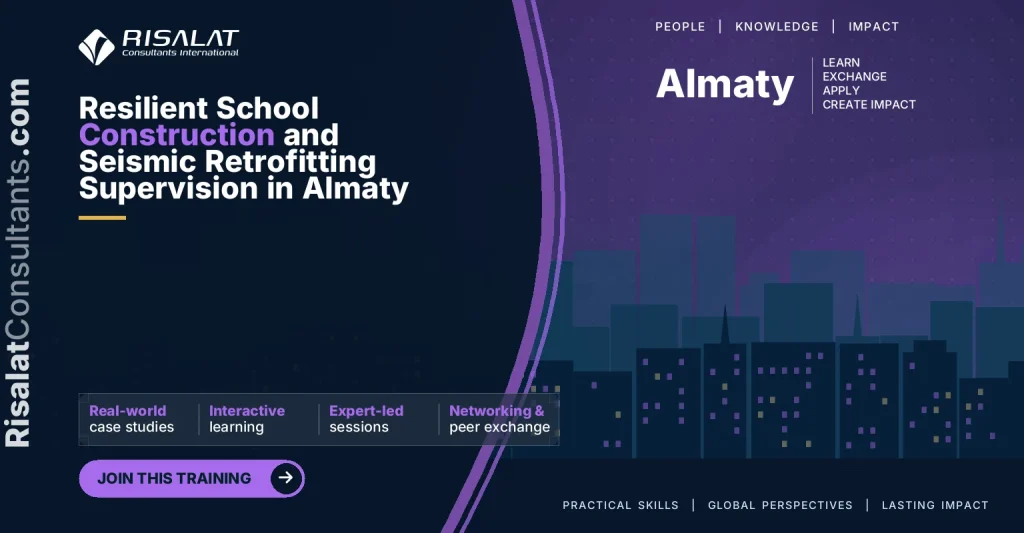
Public education authorities across Central Asia face substantial engineering challenges in bringing ageing school infrastructure into alignment with modern safety requirements. This four-day professional course in Almaty provides structured instruction on structural diagnostics, earthquake resilience, and site supervision methodologies. Participants examine contemporary regional building codes, SNiP standards, and Eurocode 8 adaptations. The curriculum concentrates on practical engineering and project administration techniques required to supervise civil works, evaluate load-bearing masonry, and reinforce existing reinforced concrete frame facilities across regional education estates.
Engineers and procurement officers will review structural retrofitting solutions tailored specifically to rural and peri-urban basic education facilities. Instruction addresses seismic vulnerability assessments, non-destructive testing on site, jacketing techniques, and foundation underpinning. Crucially, the training links structural resilience with universal design principles, demonstrating how to integrate barrier-free access, ramps, and compliant sanitary facilities during major rehabilitation works. Through real technical scenarios, delegates evaluate contractor methodologies, quality assurance frameworks, and material testing regimes to ensure full design compliance.
Organised by Risalat Consultants International, the programme prepares technical teams to oversee complex civil works contracts financed by multilateral development institutions. Participants study contract execution standards, including FIDIC Pink and Red Book conditions, environmental and social risk mitigation, and construction milestone tracking. By the conclusion of the programme, public sector managers and technical specialists will possess the tools to audit site-level contractor performance, verify laboratory testing data, and enforce structural safety standards across public education assets.
The programme strengthens institutional capability in:
- Regional seismicity profiles, geological faults, and school infrastructure exposure in Central Asia
- Analysis of legacy building typologies: unreinforced masonry, adobe, and Soviet-era precast concrete panel schools
- Comparative review of regional seismic building codes, SNiP standards, and Eurocode 8 structural requirements
- Rapid visual screening methodologies and structural vulnerability assessment protocols for rural education assets
- Geotechnical site investigations, soil classification, and foundation risk factors in peri-urban environments
- Reinforced concrete jacketing, steel bracing, and carbon-fibre-reinforced polymer application techniques
- Masonry reinforcement: ring beams, vertical ties, structural repointing, and shotcrete application
- Roof diaphragm strengthening, gable-wall tying, and light-gauge steel structural conversions
- Climate and environmental risk assessment
- Adaptation and mitigation planning
- Sector strategies for energy, water and land
- Project design for climate and environmental goals
- Transaction
- Record
- Control
- Evidence
- Opinion
Why this matters now
Organisations increasingly require professionals capable of:
- Assess climate and environmental risks to their services and assets
- Design projects that meet climate and environmental goals
- Prepare proposals that financiers can approve
- Measure and report results credibly
- Work with communities and partners across sectors
Strong climate, environment and natural resources systems help organisations:
- Protect services and infrastructure from climate risks
- Access climate and environmental finance
- Meet national and international commitments
- Use natural resources sustainably
Who Should Attend
This programme is designed for:
- Civil engineers managing public school modernisation portfolios
- School infrastructure procurement specialists from regional ministries
- Ministry of Education and Science project managers, particularly from Tajikistan
- Project Implementation Unit (PIU) infrastructure directors
- Site supervision engineers and resident technical inspectors
- Municipal education board infrastructure planning officers
- Contract management officers handling donor-funded civil works
- Quality assurance and material testing laboratory coordinators
- Donor agency education infrastructure oversight specialists
- Climate change and environment officers
- Energy, water and agriculture sector staff
- Planning and policy officers
Tick what your team needs to be able to do.
Programme Objectives
By the end of this programme participants will be able to:
- Apply national seismic codes and Eurocode 8 criteria to evaluate school building vulnerabilities
- Select appropriate structural retrofitting methods for unreinforced masonry and concrete school blocks
- Supervise civil works quality control regimes and laboratory testing protocols on site
- Integrate barrier-free accessibility standards and universal design parameters into rehabilitation works
- Audit contractor execution against donor environmental, health, and safety management plans
- Manage site instructions, variation orders, and quality non-conformance reports under FIDIC conditions
- Evaluate structural testing reports to verify concrete strength, rebar placement, and joint integrity
- Explain the main climate and environmental challenges for their sector
- Assess climate and environmental risks to services and assets
- Plan adaptation and mitigation measures
Training Structure & Contents
- Regional seismicity profiles, geological faults, and school infrastructure exposure in Central Asia
- Analysis of legacy building typologies: unreinforced masonry, adobe, and Soviet-era precast concrete panel schools
- Comparative review of regional seismic building codes, SNiP standards, and Eurocode 8 structural requirements
- Rapid visual screening methodologies and structural vulnerability assessment protocols for rural education assets
- Geotechnical site investigations, soil classification, and foundation risk factors in peri-urban environments
- Practical small-group workshop applying assessment methods and agreeing next steps
- Reinforced concrete jacketing, steel bracing, and carbon-fibre-reinforced polymer application techniques
- Masonry reinforcement: ring beams, vertical ties, structural repointing, and shotcrete application
- Roof diaphragm strengthening, gable-wall tying, and light-gauge steel structural conversions
- Incorporating universal design principles: accessible ramps, wider circulation paths, and inclusive sanitary facilities
- Non-structural mitigation: securing ceilings, lighting fixtures, mechanical equipment, and school furniture
- Institutional retrofitting workshop focused on practical application of engineering methods
- Inspection of concrete batching, slump testing, compressive strength sampling, and curing protocols
- Supervision of rebar placement, concrete cover inspection, welding quality, and anchorage testing
- Non-destructive testing methods on site: Schmidt rebound hammer, ultrasonic pulse velocity, and core drilling
- Quality assurance oversight for bricks, mortar mixes, tie-plates, and structural steel sections
- Identification and rectification of material defects, honeycombing, and substandard construction practices
- Real-world case study analysing field choices against quality assurance standards
- Supervising contractor performance under FIDIC conditions of contract for donor-financed projects
- Managing site records, work logs, non-conformance notices, and contractor variation requests
- Site safety governance: occupational health, worker accommodation, and child protection safeguarding on active sites
- Substantial completion assessments, snag list compilation, structural defect audits, and testing verification
- Final handover procedures, structural maintenance manual requirements, and post-occupancy safety reviews
- Capstone exercise producing an institutional action plan with priorities and responsibilities
- Climate and environmental risk assessment for education assets
- Sector strategies and mitigation planning for water, land, and energy resources
- Environmental and social risk mitigation under multilateral finance frameworks
- Alignment of infrastructure plans with national and international environmental commitments
- Review of contractor environmental, health, and safety management performance
- Finalisation of cross-institutional action plans and peer review feedback
Full day-by-day contents
First Day | Seismic Risk Assessment and Regional Building Standards for Schools
- Regional seismicity profiles, geological faults, and school infrastructure exposure in Central Asia
- Analysis of legacy building typologies: unreinforced masonry, adobe, and Soviet-era precast concrete panel schools
- Comparative review of regional seismic building codes, SNiP standards, and Eurocode 8 structural requirements
- Rapid visual screening methodologies and structural vulnerability assessment protocols for rural education assets
- Geotechnical site investigations, soil classification, and foundation risk factors in peri-urban environments
- Practical small-group workshop applying assessment methods and agreeing next steps
Second Day | Structural Retrofitting Engineering and Universal Design Integration
- Reinforced concrete jacketing, steel bracing, and carbon-fibre-reinforced polymer application techniques
- Masonry reinforcement: ring beams, vertical ties, structural repointing, and shotcrete application
- Roof diaphragm strengthening, gable-wall tying, and light-gauge steel structural conversions
- Incorporating universal design principles: accessible ramps, wider circulation paths, and inclusive sanitary facilities
- Non-structural mitigation: securing ceilings, lighting fixtures, mechanical equipment, and school furniture
- Institutional retrofitting workshop focused on practical application of engineering methods
Third Day | Site-Level Civil Works Quality Control and Testing Supervision
- Inspection of concrete batching, slump testing, compressive strength sampling, and curing protocols
- Supervision of rebar placement, concrete cover inspection, welding quality, and anchorage testing
- Non-destructive testing methods on site: Schmidt rebound hammer, ultrasonic pulse velocity, and core drilling
- Quality assurance oversight for bricks, mortar mixes, tie-plates, and structural steel sections
- Identification and rectification of material defects, honeycombing, and substandard construction practices
- Real-world case study analysing field choices against quality assurance standards
Fourth Day | Supervisory Management, Contract Administration, and Commissioning
- Supervising contractor performance under FIDIC conditions of contract for donor-financed projects
- Managing site records, work logs, non-conformance notices, and contractor variation requests
- Site safety governance: occupational health, worker accommodation, and child protection safeguarding on active sites
- Substantial completion assessments, snag list compilation, structural defect audits, and testing verification
- Final handover procedures, structural maintenance manual requirements, and post-occupancy safety reviews
- Capstone exercise producing an institutional action plan with priorities and responsibilities
Fifth Day | Climate Risk Integration, Environmental Safeguards, and Final Action Planning
- Climate and environmental risk assessment for education assets
- Sector strategies and mitigation planning for water, land, and energy resources
- Environmental and social risk mitigation under multilateral finance frameworks
- Alignment of infrastructure plans with national and international environmental commitments
- Review of contractor environmental, health, and safety management performance
- Finalisation of cross-institutional action plans and peer review feedback
Training Methodology
Delivered by Risalat Consultants International in Almaty, Kazakhstan, the programme combines expert-led input, practical work, real cases, and group discussions so that participants can apply core methods directly within their organisations.
- Expert-led instructional modules
- Practical group exercises and institutional workshops
- Real-world engineering and supervision case studies
- Small-group technical discussions
- Action plan development and peer presentation sessions
Expected Outcomes
- Proficiency in applying seismic codes, SNiP standards, and Eurocode 8 to public school infrastructure
- Capability to design and supervise structural retrofitting interventions across masonry and concrete buildings
- Competence in executing on-site non-destructive testing, laboratory verification, and civil works quality assurance
- Ability to incorporate universal design and barrier-free access into structural rehabilitation projects
- Rigorous site-level contract administration and compliance monitoring under FIDIC contract conditions
- Formulation of an operational institutional action plan to mitigate structural, climate, and environmental risks
£2,550 per participant · invoice and bank transfer · groups of 5 or more receive a discount
Five or more from one organisation: ask for the group rate on the invoice request.
Ten or more: an in-house version for your institution may cost less per person. Ask for an in-house quote.
Registration closes in 185 days (2 Jun 2027)
Who Will Deliver This Programme
Each date is delivered by a team assigned from Risalat's expert network for this subject. For this programme we assign:
How we choose them: Experience in the region of the participants or comparable settings; Command of the financier rules that apply (World Bank, ADB, AfDB, EU, UN) where relevant; Delivery in English; other languages on request for in-house groups; No conflict of interest with participants' institutions.
Training courses in AlmatyConstruction & Engineering training courses
Why Almaty for this programme
Almaty is a convenient hub for Central Asian delegations with good venues and value.
The Resilient School Construction and Seismic Retrofitting Supervision in Almaty programme in July 2027 brings together officials and professionals from across the Central Asia region and beyond. Sessions combine short inputs, case studies and group work on participants' own files, and the city's institutions can be added as a study visit on request.
Getting there: Almaty International (ALA).
Check whether you need a visa with the free Visa Checker, and ask for an invitation letter once you are registered.
The same topic in other cities
- School Infrastructure Standards, Seismic Retrofitting and Green Building in Tbilisi (Tbilisi)
- Safe School Retrofitting and Resilient Educational Infrastructure in Nadi (Nadi)
- Seismic and Typhoon Retrofitting for Educational Facilities in Kyoto (Kyoto)
- School Infrastructure Seismic Retrofitting and Disaster Resilience in Almaty (Almaty)
Other programmes in Almaty
- Sustainable Livestock Value Chains and Veterinary Disease Control in Almaty
- Small Hydropower Engineering, Grid Interconnection & Feasibility in Almaty
- Modern Pedagogy, Teacher Professional Development and Learning Assessment in Almaty
- Agribusiness Value Chain Aggregation and Post-Harvest Logistics in Almaty
- Power Transmission Asset Reliability and SCADA Modernisation in Almaty
Questions before you nominate your team? Book a 30-minute call with us, or ask for this programme in-house.
Teams often travel here from Afghanistan, Mongolia, Kazakhstan, Uzbekistan, Kyrgyzstan, Tajikistan, Turkmenistan. Funding, visa letters and group rates are explained on each country page.
Is there education and skills training for government officials in Almaty in July 2027?
Can "Resilient School Construction and Seismic Retrofitting Supervision in Almaty" be delivered in-house for one organisation?
Which other education and skills programmes does Risalat run?
How do organisations register and pay?
For teams and institutions
Bring your team
Teams that learn together apply more at work. Tell us how many people and how you would like to take part: we reply with a group quote within two working days.
Watch: this programme in short


Other dates and cities for this subject: Construction and Works Supervision training courses (69 upcoming dates).
More training courses in Kazakhstan · All programmes in Asia · Full training calendar
Plan this programme in a roadmap: why it matters, why to approve it, the dates to plan and the career it builds.