关键信息
- 日期
- 2027年2月8–17日(10天)
- 地点
- Novotel Dubai Al Barsha, Al Barsha (proposed), Dubai, United Arab Emirates
- 每位学员费用
- £5,940(英镑)
- 付款
- 通过发票和银行转账付款
- 报名截止
- 2026年12月30日
- 形式
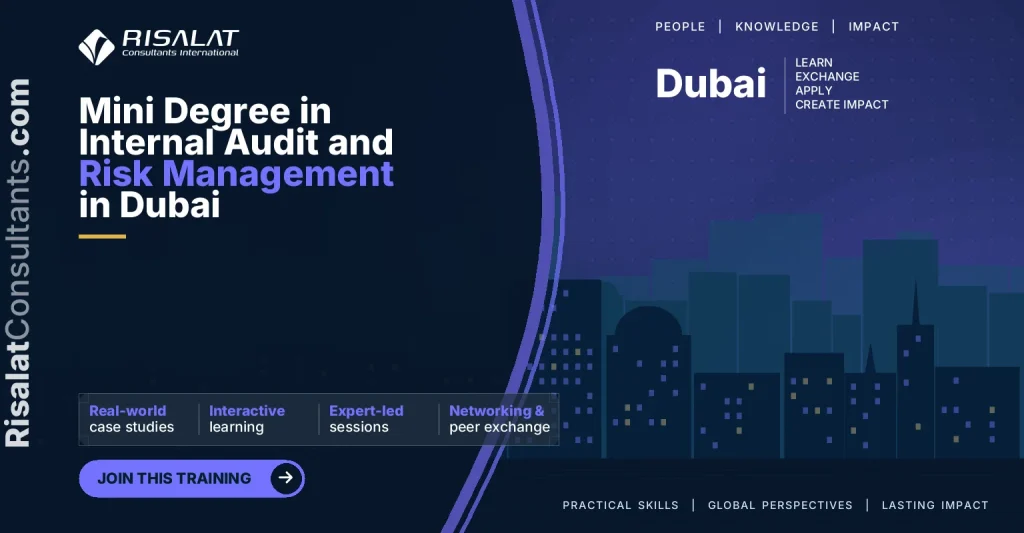
- 10天密集项目(迷你学位):为迪拜的政府、非政府组织和项目团队提供的实用能力建设培训项目
- 证书
- 结业证书
- Groups
- Teams of 3 or more qualify for a group discount, offered case by case: ask for a group quote.
- 内训选项
- 按您的日期,为您的团队专场举办
本页内容17个部分
关于此微学位:这是一个为期十天的密集项目,将两个相关的短期课程结合为一个完整的学习轨道,包含更多实践和综合项目。学员将获得Risalat结业证书;微学位是一个职业项目,而非学术学位。
免费自我检查:治理自我审计可在约10分钟内对治理、控制和问责制进行快速检查。
培训项目概述
The Mini Degree in Internal Audit and Risk Management in Dubai brings together two essential disciplines into an integrated ten-day executive programme. Public sector institutions, state-owned enterprises and development bodies require robust systems of governance, control and assurance. This course provides practitioners with end-to-end coverage of enterprise risk management, the updated Global Internal Audit Standards issued by the Institute of Internal Auditors, and the COSO Internal Control Integrated Framework, establishing structured working practices across complex operations.
观看:关于此主题的短视频
Delivered over ten consecutive days in Dubai, the curriculum addresses the operational demands of government ministries, supreme audit institutions and donor-funded project implementation units. Participants move methodically from fundamental risk identification and control design to advanced risk-based audit planning, fieldwork testing, fraud risk assessment and executive reporting. The structured progression ensures that theoretical concepts translate directly into defensible audit files, systematic risk registers and practical control improvement initiatives across all operational areas.
This intensive programme combines rigorous classroom instruction with extensive practical case work, an institutional study visit, an applied workshop and an integrated capstone exercise. Participants conclude the course by developing and defending a comprehensive action plan for their organisations. Upon successful completion, attendees receive a professional Certificate of Completion from Risalat Consultants International, confirming their mastery of modern audit and risk frameworks. Please note this executive credential is a professional training certificate, not an academic degree qualification.
Public sector entities, line ministries, execution agencies and donor-financed project teams funded by institutions such as the World Bank, Asian Development Bank, African Development Bank, European Union and United Nations face intense scrutiny regarding governance, accountability and fiscal discipline. Rather than sending staff to isolated, fragmented workshops that separate risk assessment from audit execution, organisations now require personnel who understand the entire assurance and oversight lifecycle. A single comprehensive programme enables teams to master international standards, address enterprise and fraud risks systematically, harmonise compliance mechanisms and return with an operational action plan ready for immediate implementation.
由 Risalat Consultants International 在阿拉伯联合酋长国迪拜举办,结合了专家主导的课程、真实案例和小组工作,以便参与者能够将所学应用于他们自己的机构。
该项目增强了机构能力
- The evolving governance landscape in public sector entities and international development projects
- The IIA Global Internal Audit Standards: ethics, independence, objectivity and mandate
- The Three Lines Model: distinguishing management control, risk oversight and independent assurance
- COSO Internal Control Integrated Framework: the five components and seventeen principles
- Assessing the control environment: tone at the top, organisational structures and fiduciary accountability
- COSO Enterprise Risk Management Framework: aligning risk with strategy and performance
- Establishing the organisational context, risk governance structures and risk management policies
- Techniques for comprehensive risk identification across operations, finance, compliance and reporting
- 舞弊风险评估与舞弊风险登记册
- 内部控制的设计与测试
- 三道防线模型与监督的作用
- 审计规划、证据与文档记录
It is designed for internal auditors and audit managers in ministries, departments and public agencies, project directors, finance managers and compliance officers in donor-financed projects, risk management officers and enterprise risk coordinators across public sector bodies and others who want practical, current skills in fraud, audit and internal control.
The Growing Importance of Mini Degree in Internal Audit and Risk Management in Dubai
公共机构和捐助方资助项目须证明资金按预定用途使用。审计师、监督机构和出资方越来越多地透过财务报表,审视其背后的控制、记录和行为。
舞弊和控制缺陷很少源于单一失误。它们往往滋生于职责不清、记录不全以及预警信号未被跟进的地方。了解舞弊如何发生以及控制如何加以阻止的团队,既能保护本机构,也能保护其所服务的民众。
各机构日益需要具备以下能力的专业人员:
- 识别并评估本机构流程中的舞弊与控制风险
- 设计适度且可测试的控制措施
- 收集并记录可靠的审计证据
- 及早识别危险信号并正确上报
- 将审计发现转化为切实可行、各方认可的行动
健全的反欺诈、审计和内部控制体系可帮助组织:
- 减少损失和不合规支出
- 以更少的审计发现通过外部审计
- 增强出资方和公民的信任
- 以公平且有据可查的方式回应指控
This Mini Degree in Internal Audit and Risk Management in Dubai programme brings these elements together in a practical format, so that participants understand not only what good practice looks like but also how to introduce it in their own setting, with the people and resources they have.
Who Should Attend This Mini Degree in Internal Audit and Risk Management in Dubai Training?
本培训项目适合:
- Internal auditors and audit managers in ministries, departments and public agencies
- Project directors, finance managers and compliance officers in donor-financed projects
- Risk management officers and enterprise risk coordinators across public sector bodies
- Staff of Supreme Audit Institutions conducting compliance and performance audits
- Inspectors, internal controllers and integrity officers in state-owned enterprises
- Financial controllers and accountants transitioning into operational or performance assurance
- Audit committee members and board secretariat staff seeking technical oversight skills
- Governance, risk and compliance professionals in development bodies and international organisations
- Monitoring and evaluation specialists responsible for fiduciary oversight and risk mitigation
- 内部审计人员与审计经理
- 财务经理与会计人员
- 合规与风险官员
本培训项目既适合经验丰富的专业人员,也适合刚承担新职责的人员。我们鼓励来自不同机构和国家的学员组成混合小组,因为学员能从彼此的经验中获益良多。
勾选您的团队需要具备的能力。
Mini Degree in Internal Audit and Risk Management in Dubai Training Objectives
Upon successful completion of this Mini Degree in Internal Audit and Risk Management in Dubai Training, participants will be able to:
- Apply the IIA Global Internal Audit Standards and COSO Internal Control Framework to institutional operations
- Establish comprehensive enterprise risk management frameworks aligned with operational and strategic objectives
- Conduct thorough fraud risk assessments to protect public and project procurement and financial transactions
- Develop multi-year and annual risk-based internal audit plans prioritising high-risk institutional activities
- Execute structured internal audit engagements from opening meetings to fieldwork testing and evidence gathering
- Formulate impactful, root-cause audit findings and clear recommendations for executive leadership and audit committees
- Design an institutional audit and risk management action plan for immediate post-training implementation
- 运用公认的舞弊风险模型,阐述舞弊如何发生以及为何发生
- 针对一个真实流程开展舞弊与控制风险评估
- 运用三道防线模型将控制与风险相对应
每项目标都会在培训期间通过练习、案例或小组作业加以实践,使学员结业时不仅能够描述,更能够实际运用。
培训项目内容与结构
- The evolving governance landscape in public sector entities and international development projects
- The IIA Global Internal Audit Standards: ethics, independence, objectivity and mandate
- The Three Lines Model: distinguishing management control, risk oversight and independent assurance
- COSO Internal Control Integrated Framework: the five components and seventeen principles
- Assessing the control environment: tone at the top, organisational structures and fiduciary accountability
- COSO Enterprise Risk Management Framework: aligning risk with strategy and performance
- Establishing the organisational context, risk governance structures and risk management policies
- Techniques for comprehensive risk identification across operations, finance, compliance and reporting
- Risk taxonomy and categorization: strategic, operational, fiduciary, legal and reputational risks
- Hands-on workshop: conducting departmental risk identification workshops using structured tools
- Qualitative, semi-quantitative and quantitative risk analysis methodologies
- Evaluating likelihood and impact: developing institutional scoring matrices and criteria
- Determining inherent risk, control effectiveness and residual risk levels
- Defining risk appetite and risk tolerance boundaries for public expenditure and projects
- Formulating risk response strategies: avoidance, reduction, sharing, transfer and acceptance
- The fraud triangle, fraud diamond and indicators of institutional vulnerability
- Conducting targeted fraud risk assessments in donor-funded programmes and public procurement
- Recognising red flags in procurement bidding, tender evaluation, contract award and contract management
- Preventive, detective and corrective controls against payroll fraud, asset diversion and false invoicing
- Establishing whistleblowing mechanisms, fraud response plans and initial investigation protocols
- Developing the annual risk-based audit plan: linking audit priorities to the enterprise risk register
- Allocating audit resources, defining audit cycles and securing audit committee approval
- Initial engagement planning: establishing scope, timing, team assignments and engagement objectives
- Designing the Engagement Risk Assessment and preliminary information requests
- Drafting the audit engagement announcement letter and convening effective entrance conferences
- Field briefing: governance, internal control and compliance architecture in leading Dubai institutions
- Site visit to an operational entity: observing enterprise risk reporting and control monitoring systems
- Benchmarking review: examining practical document workflows, approvals and internal oversight mechanisms
- Facilitated group reflection on field observations versus established international standards
- Consolidation session: mapping observed regional practices to home institution operational contexts
- Refresher clinic: addressing technical questions and challenges from week one topics
- Standardising audit working papers: indexing, cross-referencing and audit trail integrity
- Practical laboratory: designing structured audit programmes and substantive testing templates
- Applying analytical review procedures and sampling methods on transactional data extracts
- Peer review exercise: evaluating mock working papers against professional documentation standards
- Executing audit tests of controls: walkthroughs, inquiry, observation and re-performance
- Substantive testing of financial transactions, project disbursements and asset management
- Evaluating audit evidence: sufficiency, reliability, relevance and institutional validity
- Identifying and documenting control deficiencies: condition, criteria, cause, effect and recommendation
- Managing contentious engagement issues, scope limitations and client communication during fieldwork
- Drafting clear, concise and compelling audit reports tailored to executive decision-makers
- Structuring root-cause analysis to support practical and cost-effective recommendations
- Conducting the audit exit conference: presenting findings and managing auditee responses
- Audit committee reporting: dash-boarding, tracking outstanding issues and periodic assurance summaries
- Establishing systematic tracking mechanisms to verify management implementation of agreed actions
- Capstone briefing: briefing on integrated institutional scenario covering risk, fraud and internal audit
- Syndicate working session: developing a multi-year audit and risk improvement action plan
- Team presentations: pitching the audit strategy, risk register and remediation plan to a panel
- Panel evaluation, individual feedback and benchmarking against international best practices
- Programme synthesis, individual learning commitments and presentation of certificates of completion
完整的每日课程内容
本培训项目为期10天,每天都包括专家讲解、实践练习,并以研讨或案例研究收尾:
- First Day: Day 1: Modern Internal Governance, Professional Standards and Control Architecture
- Second Day: Day 2: Enterprise Risk Management Architecture and Risk Identification
- Third Day: Day 3: Risk Assessment, Scoring, Appetite and Mitigation Design
- Fourth Day: Day 4: Fraud Risk Management and Fiduciary Integrity in Procurement and Projects
- Fifth Day: Day 5: Risk-Based Internal Audit Planning and Engagement Scoping
- Sixth Day: Day 6: Study Visit and Institutional Field Observation
- Seventh Day: Day 7: Applied Workshop on Audit Working Papers and Analytical Procedures
- Eighth Day: Day 8: Fieldwork Execution, Evidence Gathering and Audit Testing
- Ninth Day: Day 9: Audit Reporting, Executive Communication and Follow-up Systems
- 第十天:技术考察、国际实践与机构行动规划
完整的每日课程内容
First Day | Day 1: Modern Internal Governance, Professional Standards and Control Architecture
- The evolving governance landscape in public sector entities and international development projects
- The IIA Global Internal Audit Standards: ethics, independence, objectivity and mandate
- The Three Lines Model: distinguishing management control, risk oversight and independent assurance
- COSO Internal Control Integrated Framework: the five components and seventeen principles
- Assessing the control environment: tone at the top, organisational structures and fiduciary accountability
Workshop: Day 1: Modern Internal Governance, Professional Standards and Control Architecture: Applying It to Your Institution
学员分成小组,将当天所学方法应用于本机构的实例,并商定切实可行的后续步骤。
Second Day | Day 2: Enterprise Risk Management Architecture and Risk Identification
- COSO Enterprise Risk Management Framework: aligning risk with strategy and performance
- Establishing the organisational context, risk governance structures and risk management policies
- Techniques for comprehensive risk identification across operations, finance, compliance and reporting
- Risk taxonomy and categorization: strategic, operational, fiduciary, legal and reputational risks
- Hands-on workshop: conducting departmental risk identification workshops using structured tools
Workshop: Day 2: Enterprise Risk Management Architecture and Risk Identification: Applying It to Your Institution
学员分成小组,将当天所学方法应用于本机构的实例,并商定切实可行的后续步骤。
Third Day | Day 3: Risk Assessment, Scoring, Appetite and Mitigation Design
- Qualitative, semi-quantitative and quantitative risk analysis methodologies
- Evaluating likelihood and impact: developing institutional scoring matrices and criteria
- Determining inherent risk, control effectiveness and residual risk levels
- Defining risk appetite and risk tolerance boundaries for public expenditure and projects
- Formulating risk response strategies: avoidance, reduction, sharing, transfer and acceptance
Case Study: Day 3: Risk Assessment, Scoring, Appetite and Mitigation Design in Practice
学员分析真实案例,将案例中的决策与良好实践进行比较,并总结出可在自身环境中运用的经验。
Fourth Day | Day 4: Fraud Risk Management and Fiduciary Integrity in Procurement and Projects
- The fraud triangle, fraud diamond and indicators of institutional vulnerability
- Conducting targeted fraud risk assessments in donor-funded programmes and public procurement
- Recognising red flags in procurement bidding, tender evaluation, contract award and contract management
- Preventive, detective and corrective controls against payroll fraud, asset diversion and false invoicing
- Establishing whistleblowing mechanisms, fraud response plans and initial investigation protocols
Workshop: Day 4: Fraud Risk Management and Fiduciary Integrity in Procurement and Projects: Applying It to Your Institution
学员分成小组,将当天所学方法应用于本机构的实例,并商定切实可行的后续步骤。
Fifth Day | Day 5: Risk-Based Internal Audit Planning and Engagement Scoping
- Developing the annual risk-based audit plan: linking audit priorities to the enterprise risk register
- Allocating audit resources, defining audit cycles and securing audit committee approval
- Initial engagement planning: establishing scope, timing, team assignments and engagement objectives
- Designing the Engagement Risk Assessment and preliminary information requests
- Drafting the audit engagement announcement letter and convening effective entrance conferences
Workshop: Day 5: Risk-Based Internal Audit Planning and Engagement Scoping: Applying It to Your Institution
学员分成小组,将当天所学方法应用于本机构的实例,并商定切实可行的后续步骤。
Sixth Day | Day 6: Study Visit and Institutional Field Observation
- Field briefing: governance, internal control and compliance architecture in leading Dubai institutions
- Site visit to an operational entity: observing enterprise risk reporting and control monitoring systems
- Benchmarking review: examining practical document workflows, approvals and internal oversight mechanisms
- Facilitated group reflection on field observations versus established international standards
- Consolidation session: mapping observed regional practices to home institution operational contexts
Case Study: Day 6: Study Visit and Institutional Field Observation in Practice
学员分析真实案例,将案例中的决策与良好实践进行比较,并总结出可在自身环境中运用的经验。
Seventh Day | Day 7: Applied Workshop on Audit Working Papers and Analytical Procedures
- Refresher clinic: addressing technical questions and challenges from week one topics
- Standardising audit working papers: indexing, cross-referencing and audit trail integrity
- Practical laboratory: designing structured audit programmes and substantive testing templates
- Applying analytical review procedures and sampling methods on transactional data extracts
- Peer review exercise: evaluating mock working papers against professional documentation standards
Workshop: Day 7: Applied Workshop on Audit Working Papers and Analytical Procedures: Applying It to Your Institution
学员分成小组,将当天所学方法应用于本机构的实例,并商定切实可行的后续步骤。
Eighth Day | Day 8: Fieldwork Execution, Evidence Gathering and Audit Testing
- Executing audit tests of controls: walkthroughs, inquiry, observation and re-performance
- Substantive testing of financial transactions, project disbursements and asset management
- Evaluating audit evidence: sufficiency, reliability, relevance and institutional validity
- Identifying and documenting control deficiencies: condition, criteria, cause, effect and recommendation
- Managing contentious engagement issues, scope limitations and client communication during fieldwork
Workshop: Day 8: Fieldwork Execution, Evidence Gathering and Audit Testing: Applying It to Your Institution
学员分成小组,将当天所学方法应用于本机构的实例,并商定切实可行的后续步骤。
Ninth Day | Day 9: Audit Reporting, Executive Communication and Follow-up Systems
- Drafting clear, concise and compelling audit reports tailored to executive decision-makers
- Structuring root-cause analysis to support practical and cost-effective recommendations
- Conducting the audit exit conference: presenting findings and managing auditee responses
- Audit committee reporting: dash-boarding, tracking outstanding issues and periodic assurance summaries
- Establishing systematic tracking mechanisms to verify management implementation of agreed actions
Case Study: Day 9: Audit Reporting, Executive Communication and Follow-up Systems in Practice
学员分析真实案例,将案例中的决策与良好实践进行比较,并总结出可在自身环境中运用的经验。
第十天 | 技术考察、国际实践与机构行动规划
- Capstone briefing: briefing on integrated institutional scenario covering risk, fraud and internal audit
- Syndicate working session: developing a multi-year audit and risk improvement action plan
- Team presentations: pitching the audit strategy, risk register and remediation plan to a panel
- Panel evaluation, individual feedback and benchmarking against international best practices
- Programme synthesis, individual learning commitments and presentation of certificates of completion
Capstone Exercise: Mini Degree in Internal Audit and Risk Management in Dubai Action Plan for Your Institution
学员将一周所学整合为本机构的行动计划,明确优先事项、负责人和初步行动,并进行展示,听取同伴和讲师的反馈。
Mini Degree in Internal Audit and Risk Management in Dubai Training Methodology
The programme employs an adult-learning methodology designed specifically for experienced practitioners in governance, risk and assurance functions. Interactive lectures outline core frameworks, which are immediately reinforced through group discussions, procurement and financial case studies, and practical exercises. Day six provides field-based perspective through an institutional study visit in Dubai, followed by an applied documentation workshop on day seven. Throughout the ten days, participants work in syndicates on real-world scenarios, culminating on day ten in a comprehensive capstone exercise where each team defends a fully developed audit and risk action plan.
本培训项目融合了:
- 专家主讲当前实践
- 区域及国际案例研究
- 小组作业与实践练习
- 视情况安排模拟演练与角色扮演
- 探讨学员自身面临的挑战
- 跨机构、跨国家的同伴学习
- 对机构和现场的技术参观
- 每日反思与行动规划
培训开始前,简短的课前评估可帮助讲师了解每位学员的岗位职责和重点关注事项,以便根据学员群体调整案例和练习。每天结束时安排简短的反思环节,学员记录下将在工作中应用的内容。
- 交易
- 记录
- 控制
- 证据
- 意见
技术参观与现场考察安排
该项目包括参观迪拜市内及周边的机构、项目或现场,让参与者亲身体验当前的做法并会见负责的专业人员。参观活动在项目开始前与接待组织进行确认,可能会因运营原因而有所调整。
- 东道机构介绍其做法与成果
- 有引导的现场参观,并留有提问时间
- 每次参观的结构化观察记录
- 小组复盘,将所见所闻与学员所在机构相联系
预期成果
Upon completion of this Mini Degree in Internal Audit and Risk Management in Dubai Training, participants will be able to:
- Establish or update institutional internal audit charters, policies and standard operating procedures
- Construct and maintain an operational enterprise risk register with structured mitigation plans
- Formulate an annual risk-based internal audit plan aligned with organisational priorities and donor mandates
- Design and execute thorough fraud risk assessments across vulnerable procurement and financial cycles
- Produce high-quality audit working papers, clear deficiency findings and actionable audit reports
- Implement an effective remediation tracking system to ensure auditee accountability and timely closure
- 评估本机构流程中的舞弊与控制风险
- 设计并测试适度的控制措施
学员结业时将获得个人行动计划和实用工具,回到工作岗位的第一周即可在机构中应用。派出多名学员的机构可借助本培训项目,在各团队之间统一方法和模板,使改进成果更易持续。
每位学员£5,940 · 通过发票和银行转账付款 · 5人及以上团体报名可享优惠
同一机构五人及以上:请在申请发票时索取团体价。
Ten or more: an in-house version for your institution may cost less per person. Ask for an in-house quote.
注册截止时间为 30天后(2026年12月30日)
Institutional Application of Mini Degree in Internal Audit and Risk Management in Dubai Training
本培训项目帮助机构加强:
- 舞弊与腐败风险管理
- 内部控制框架
- 审计与监督安排
- 审计发现的跟进
- 廉洁与举报渠道
学员将带着实用工具回到工作岗位,以提升:
- 风险登记册与控制图
- 审计规划与测试
- 证据与文档记录
- 向管理层和董事会报告
- 预防不合规支出
本培训项目的设计旨在让学习成果从课堂延伸至机构。学员尽可能围绕自身的流程和文件开展练习,并在结业时带走一份可供其主管审阅和支持的行动计划。
区域相关性与应用
欧洲
欧洲机构在详尽的监管框架和改革议程下开展反欺诈、审计和内部控制工作。来自欧洲的学员可以与其他地区的同行比较实践,并检验成熟方法在不同条件下的效果。
非洲
在非洲各地,反欺诈、审计和内部控制领域的部委、机构和项目团队日益与捐助方资助的项目并行运作,而这些项目要求有清晰的体系和证据。本培训项目帮助学员根据所在机构及其资源条件,灵活运用良好做法。
中东
在中东地区,国家发展战略和经济多元化计划对反欺诈、审计和内部控制提出了日益增长的要求。学员将探讨如何在公共机构和企业内部培养这些计划所需的能力。
亚洲
亚洲各国的机构在快速发展的同时,推进着雄心勃勃的现代化计划。来自亚洲的学员可以分享快速扩展系统的经验,并借鉴其他地区的做法。
太平洋地区
小岛屿国家和太平洋国家在规模、距离和能力方面面临特殊制约。本培训项目重点介绍适合小型机构、务实且相称的反欺诈、审计和内部控制方法。
在阿拉伯联合酋长国迪拜举办该项目,使参与者能够摆脱日常压力,从而能够比较在不同环境下如何处理欺诈、审计和内部控制。同一个项目也可以为某个机构在其本国或在线内部交付,案例取自其当前的工作。
东道国概况:阿联酋
Risalat Consultants International在阿联酋迪拜举办的培训项目、研讨会、实地见习与培训课程
在本国以外学习,可让学员专心投入,以全新视角审视本机构,并有机会与其他国家的同行建立人脉网络。
Mini Degree in Internal Audit and Risk Management in Dubai Training Deliverables
学员在培训前、培训中及培训后均可获得支持,使准备、学习与跟进形成连贯完整的体验。
培训开始前
- 学员课前评估
- Mini Degree in Internal Audit and Risk Management in Dubai Readiness Assessment
- Mini Degree in Internal Audit and Risk Management in Dubai Resource Pack
- 课前阅读资料
- 免费签证支持与咨询
培训期间
- 机场接机与欢迎协助
- 含早餐住宿:11晚,2027年2月7日星期日入住,2027年2月18日星期四退房(项目开始前一晚和结束后一晚)
- 欢迎交流晚宴
- Risalat培训礼包(背包、水瓶、马克杯、T恤、帽子、护照套、笔、笔记本、冰箱贴及钥匙扣)
- Comprehensive Mini Degree in Internal Audit and Risk Management in Dubai Training Manual
- 舞弊风险登记册模板
- 控制映射矩阵
- 审计证据检查清单
- 审计发现与跟进追踪表
- 实践研讨与模拟演练
- 小组讨论与同伴学习
- 每日午餐与茶歇
- 全面使用培训场地设施
- 装有数字学习资料的迷你平板电脑
- 实地考察(如适用)
- 城市休闲观光
培训结束后
- 结业证书
- Risalat培训项目参与表彰奖
- 培训后参考资料
- 舞弊风险自我评估指南
- 控制测试检查清单
- 培训后支持与跟进指导
- 培训项目报告
Institutions can also request a tailored in-house version of this programme, delivered at their premises or online. Request a proposal.
Common Challenges in Mini Degree in Internal Audit and Risk Management in Dubai, And How This Training Helps
机构如何识别和评定自身流程中的欺诈与控制风险?
The programme addresses this directly on the first day (Day 1: Modern Internal Governance, Professional Standards and Control Architecture), where participants practise the methods involved and adapt them to their own institution, then build it into their action plan.
机构如何设计相称且可检验的控制措施?
The programme addresses this directly on the second day (Day 2: Enterprise Risk Management Architecture and Risk Identification), where participants practise the methods involved and adapt them to their own institution, then build it into their action plan.
机构如何收集并记录可靠的审计证据?
The programme addresses this directly on the third day (Day 3: Risk Assessment, Scoring, Appetite and Mitigation Design), where participants practise the methods involved and adapt them to their own institution, then build it into their action plan.
机构如何及早识别危险信号并正确上报?
The programme addresses this directly on the fourth day (Day 4: Fraud Risk Management and Fiduciary Integrity in Procurement and Projects), where participants practise the methods involved and adapt them to their own institution, then build it into their action plan.
机构如何将发现转化为切实可行、各方认同的行动?
The programme addresses this directly on the fifth day (Day 5: Risk-Based Internal Audit Planning and Engagement Scoping), where participants practise the methods involved and adapt them to their own institution, then build it into their action plan.
常见问题
When and where does the Mini Degree in Internal Audit and Risk Management in Dubai programme take place?
该项目将于2027年2月8日至2027年2月17日在阿拉伯联合酋长国迪拜举行。注册截止日期见本页顶部。
谁应参加?
The programme is designed for internal auditors and audit managers in ministries, departments and public agencies, project directors, finance managers and compliance officers in donor-financed projects, risk management officers and enterprise risk coordinators across public sector bodies, staff of Supreme Audit Institutions conducting compliance and performance audits, and others who want practical skills in fraud, audit and internal control.
我能获得证书吗?
能。完成本培训项目的学员将获得Risalat Consultants International颁发的结业证书。
本培训项目能否仅为我们机构单独举办?
可以。我们可以在贵机构所在地、其他城市或在线提供量身定制的内训版本,并围绕贵机构自身的案例设计内容。请使用本页面的方案建议书申请表。
我是否需要具备舞弊、审计和内部控制方面的经验?
除具备相关岗位经验外,无需其他专业背景。简短的课前评估可帮助讲师根据学员群体调整课程。
谁将讲授本课程
每个日期均由从Risalat专家网络中为此主题指派的团队进行授课。对于此项目,我们指派:
我们如何选择他们:在学员所在地区或类似环境中拥有经验;熟悉适用的供资方规则(如适用,包括世界银行、亚洲开发银行、非洲开发银行、欧盟、联合国);用英语授课;内部培训小组可应要求提供其他语言;与学员所在机构无利益冲突。
为何选择在迪拜举办本培训项目
迪拜是通往非洲、亚洲和欧洲的一站直达枢纽,对许多国家的公民提供简便的签证政策,并拥有现代化的培训场地。
The Mini Degree in Internal Audit and Risk Management in Dubai programme in February 2027 brings together officials and professionals from across the Middle East region and beyond. Sessions combine short inputs, case studies and group work on participants' own files, and the city's institutions can be added as a study visit on request.
交通:迪拜国际机场(DXB)。
使用免费的签证查询工具确认您是否需要签证,完成报名后即可申请邀请函。
其他城市的同主题培训
- 新加坡PPP与基础设施融资迷你学位(新加坡)
- 伊斯坦布尔环境与社会保障微学位(伊斯坦布尔)
- 伦敦领导力与公共政策迷你学位(伦敦)
- 塔林数字政府与人工智能迷你学位(塔林)
- 哥本哈根气候金融与韧性迷你学位(哥本哈根)
- 迪拜资助项目管理迷你学位(迪拜)
迪拜的其他培训项目
在提名您的团队之前还有疑问?与我们预约30分钟的通话,或咨询该项目的内部定制培训。
Teams often travel here from Maldives, Sri Lanka, Bangladesh, Nepal, Pakistan, Kazakhstan, Uzbekistan, Kyrgyzstan. Funding, visa letters and group rates are explained on each country page.
Local participant, or arranging your own stay?
The fee without accommodation is £4,940 per participant instead of £5,940 (£100 less for each of the 10 days). Everything else in the package stays the same: training, materials, lunches, the kit, the city tour and the certificate.
Register without accommodation →Venue: Novotel Dubai Al Barsha, Al Barsha. Proposed venue, or a similar hotel with a training room; it may change with circumstances, and participants are told at once of any change.
- 开放合同伙伴关系(Open Contracting Partnership) 开放合同伙伴关系(Open Contracting Partnership)
- 国际内部审计师协会(IIA) IIA
面向团队与机构
携团队同行
一起学习的团队在工作应用更多。告诉我们人数以及您希望如何参加:我们将在两个工作日内回复团购报价。
观看:项目简介
该主题的其他日期和城市:捐赠方资助项目的财务管理培训课程(67 个即将举行的日期)。
阿拉伯联合酋长国更多培训课程 · 中东所有培训项目 · 完整培训日历
在路线图中规划此项目:为什么重要、为什么要批准它、要计划的日期以及它所构建的职业生涯。