要点总结
- Open Contracting Implementation Guide: From Paper Policy to Digital…. Governments around the world spend about US$9.5 trillion on public contracts each year – that’s 15% of global GDP.
- Understanding the Foundations of Open Contracting. Public procurement processes face corruption risks worldwide.
- Designing a Digital-First Procurement Strategy. Digital procurement systems are a crucial step to implement effective open contracting.
- Implementing the Open Contracting Data Standard (OCDS). Example OCDS architecture connecting procurement systems through a centralized data hub
- Institutionalizing Open Contracting Across Government. Open contracting needs more than just technical tools to succeed.
In short: Open contracting guide for public sector reform, digital procurement, OCDS adoption, and stronger transparency.
Free self-check: the governance self-audit gives a quick check of governance, controls and accountability, in about 10 minutes.
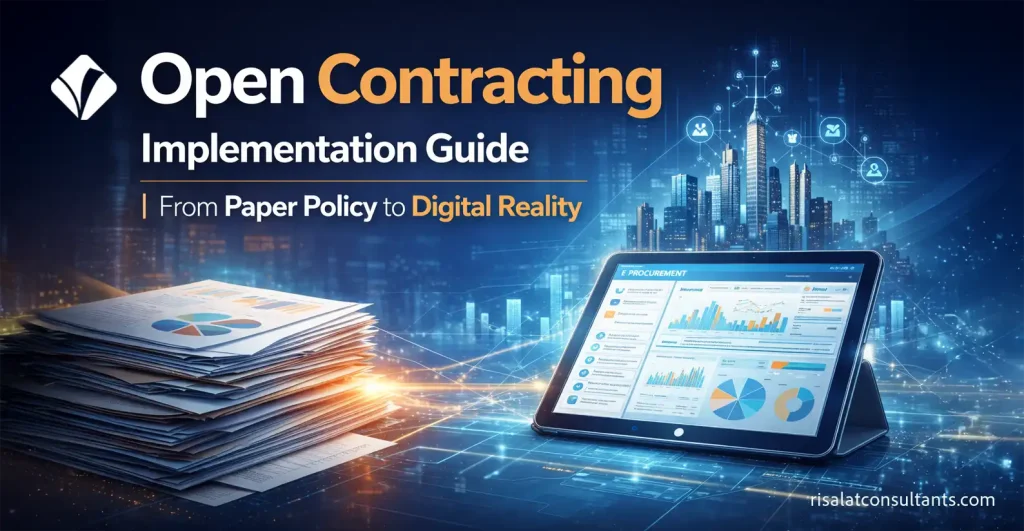
Open Contracting Implementation Guide: From Paper Policy to Digital Reality
Governments around the world spend about US$9.5 trillion on public contracts each year – that’s 15% of global GDP. One in every three dollars goes through contracts with limited oversight. Public data shows less than three percent of the billions spent on procurement. This lack of transparency creates perfect conditions for corruption. The OECD Anti-Bribery Convention’s records show that 57% of foreign bribery cases involved bribes to get public contracts. Open contracting provides a systematic way to tackle these challenges by improving procurement transparency and accountability.
The numbers tell a compelling story – studies show that 10-20% of procurement budgets are wasted through inefficiency and corruption. South Korea’s transparent e-procurement system KONEPS showed what’s possible by saving the public sector US$1.4 billion in costs. Only 46% of public entities in some areas share information on procurement. The good news is that open contracting data standards make shared contract monitoring possible throughout the procurement process.
By March 2019, 70 Open Government Partnership members made 189 open contracting commitments. These numbers show a growing awareness of its role in curbing corruption, which costs the European Union about €120 billion yearly. This piece shows how governments can turn paper-based procurement policies into working digital systems. These systems are the foundations of transparency that boost competition and get better value from public money.
Understanding the Foundations of Open Contracting
Public procurement processes face corruption risks worldwide. Studies show that governments lose 30% of public infrastructure investment due to various inefficiencies. Open contracting tackles this problem through data transparency, public participation, and making institutions accountable.
These pillars directly reinforce procurement integrity by reducing discretionary decision-making and strengthening oversight across the procurement lifecycle.
Open contracting meaning in anti-corruption strategies
开放式政府采购通过三个紧密相连的要素提供了一种打击腐败的完整方法。第一要素要求政府在整个采购周期中共享开放数据。第二要素允许利益相关者监督采购活动。第三要素确保政府机构对反馈作出回应。这种方法已获得广泛认可。联合国反腐败公约缔约国会议2023年通过了第一项专门针对公共采购的决议。这确立了开放式采购作为全球180多个政府认可的全球标准。
Open contracting’s value in fighting corruption comes from its coverage of the entire procurement chain – from planning and tender to award, contract, and implementation. A well-implemented open contracting system can automate monitoring using more than 72 “red flags”. These indicators help spot potential fraud, waste, and abuse throughout the procurement cycle.
Core principles: transparency, participation, accountability
Open contracting builds on three principles that create accountability in public procurement systems. These principles appear in the Open Contracting Global Principles, which collect best practices for sharing information and participation.
Transparency gives citizens the right to access information about all public contracting stages. Governments must regularly publish contracts, licenses, concessions, pre-studies, bid documents, performance evaluations, and audit reports. These documents should be open, structured, and machine-readable. Research shows that more procurement information leads to fewer single-bid contracts. Single-bid contracts typically cost 7-10% more than competitive ones.
Participation gives the public the right to oversee the contracting process. Governments should create an environment that supports public consultation and monitoring from start to finish. This public oversight helps check data quality, boost competition, and validate processes.
Accountability requires oversight bodies to review disclosed information and respond to citizen feedback. These bodies should help communication between contracting parties and civil society. Strong accountability systems must allow investigations and penalties for violations.
How open contracting aligns with Article 227 and public finance laws
Open contracting supports the laws that govern public finance management. Kenya’s system shows this alignment. Open contracting matches Article 35’s requirements for information access and Chapter 12’s public finance management rules. It specifically supports Article 227, which demands fair, equal, transparent, competitive, and economical public procurement.
This alignment extends beyond national borders. The UNCITRAL Model Law on Public Procurement lists six best practices that match open contracting’s goals. These include economic efficiency, broad supplier participation, maximum competition, fair treatment, integrity, and transparency.
The Open Contracting Data Standard (OCDS) provides technical guidelines to help governments publish procurement data in useful formats. This standardization helps governments meet legal requirements while making the data practical for oversight.
Designing a Digital-First Procurement Strategy
Digital procurement systems are a crucial step to implement effective open contracting. Modern economies now see that e-procurement can bring amazing returns. Studies show that lower middle-income economies can achieve a benefit-cost ratio from 142 to 473 .
Digitization roadmap: from paper to e-procurement
A successful digital shift needs more than just turning paper into digital files. Organizations need a clear vision for digital procurement with goals they can measure. The COVID-19 pandemic showed us how paper-based systems fall short, making the switch to digital more urgent now.
数字化路线图包含以下关键阶段:
- Assessment and planning: We look at current procurement workflows to spot inefficiencies and set baseline metrics
- Technology selection: We pick platforms that work together well and avoid getting stuck with one vendor
- 实施:解决方案一步步推出,从随时间增长的基本功能开始
- 能力建设: Teams learn to use digital tools through proper training
避免供应商锁定和ERP系统故障
Vendor lock-in happens when organizations depend too much on one supplier’s technology. This creates a big risk in procurement digitization. About 87% of procurement leaders say they’ve faced vendor lock-in, which hurts their flexibility and costs. Watch out for contracts that renew by themselves, missing break clauses, and data you can’t easily move.
ERP systems often fail because they focus too much on financial recording instead of early procurement stages. This creates problems in purchasing and accounts payable workflows. These areas handle high volumes with many handoffs and need good tracking. Organizations should keep ERP systems focused on what they do best – controls, data integrity, and financial posting. They can then link operational workflows through special procurement tools.
采购系统的开放式设计架构
开放设计架构为采购系统带来了全新方法。它专注于协同工作、遵循数据标准并以用户为首要任务的系统。这种方法在保持免受专有技术限制的同时,创造了签约的透明度。
OpenProcurement toolkit shows this approach well. It offers an open source e-procurement solution that handles data storage and reverse auctions. The system uses a Central Database (CDB) and API that lets different platforms work together. This creates healthy competition while keeping the system secure.
The best open-by-design systems use machine-readable data formats and follow the Open Contracting Data Standard (OCDS). They also need clear governance rules. Governments now build or commission open procurement platforms more often. This way, they own their code and data, which helps them stay flexible and sustainable.
Implementing the Open Contracting Data Standard (OCDS)

Example OCDS architecture connecting procurement systems through a centralized data hub
The Open Contracting Data Standard (OCDS) acts as the technical foundation to implement transparent procurement. Organizations need to grasp the standard’s structure, share data in usable formats, and set up systems that ensure quality and timely data.
OCDS(开放契约数据标准)模式:规划、招标、授标、合同、执行
The OCDS schema organizes procurement data into five main stages of the contracting lifecycle:
- Planning – Contains background information including budgets, project plans, needs assessments, and feasibility studies
- Tender – Covers announcement details, bidding documents, technical specifications, and evaluation criteria
- Award – Documents decisions on contract recipients and evaluation reports
- Contract – Has signed agreements, schedules, milestones, and contract amendments
- Implementation – Shows physical progress reports, financial information, and completion certificates
This organized approach lets stakeholders track procurement from start to finish. Each contracting process gets a unique identifier (OCID) that connects all related documents and data. You can monitor changes throughout the procurement lifecycle. The schema offers standard fields, structures, data types, and validation rules to ensure consistency in procurement systems.
Publishing contract data in machine-readable formats
Machine-readable formats are essential to make open contracting work well. These formats allow automated processing, comparison, and monitoring, unlike paper documents or PDFs that limit analysis. OCDS data comes in JSON format by default, but CSV and Excel formats should be available to help users with different needs.
Organizations using OCDS share data through:
- Bulk downloads of OCDS releases and records in JSON, CSV, or Excel formats
- API access to query and integrate with monitoring tools
- Structured web portals that show procurement information
Ensuring data completeness and real-time updates
A systematic approach ensures data quality, completeness, accuracy, and timeliness. The OCDS model combines regular data releases and documents with snapshot records of full contracting processes. Publishers create new releases whenever information changes to show all modifications over time.
Organizations need automated integration with procurement systems for up-to-the-minute updates, usually through daily data syncs. This gives stakeholders current information while keeping a history of all changes. Quality checks should validate against the OCDS schema to maintain compliance and consistency.
Successful implementation depends on using OCDS as a tool for transparency and accountability throughout procurement, not just a technical exercise.
Institutionalizing Open Contracting Across Government
Open contracting needs more than just technical tools to succeed. It needs steady political support and organizational structures that make transparency natural across government operations. Leaders at the top must clearly support open contracting to keep reforms going through political changes.
除了数字系统外,各机构还必须加强各部委和机构的实际合同管理能力,以确保改革转化为现实成果。
Executive branch leadership and inter-agency coordination
The executive leadership must set clear mandates for open contracting to work. They should give authority, allocate budgets, and pick capable team members to lead reforms. Ukraine’s success story shows this well. Their Deputy Minister for Economic Development championed ProZorro, the country’s transparent e-procurement platform. He saw a vital chance to change the system.
Open contracting shapes and responds to broader open government practices. Success stories show that countries need reliable data management systems. These systems help procurement information flow naturally between departments. Open contracting has become a vital tool that changes how governments handle public finances.
In practice, successful adoption also depends on structured change management for donor-funded reform programs, helping institutions align leadership, processes, and staff around new digital procurement systems.
Legislative oversight and budget transparency linkages
Lawmakers play a key role in making open contracting permanent through oversight and legal frameworks. Special committees with clear authority often monitor contract performance effectively. Idaho shows a great example. They created a bipartisan oversight committee with equal party membership, no matter which party controls the chamber. This ensures both sides get heard.
Budget transparency and procurement oversight go hand in hand. Most governments spend more than half their discretionary funds through procurement. So, when legislative audit committees share performance reports with both budget and jurisdiction committees, they create strong accountability.
Subnational implementation: lessons from Makueni and Elgeyo Marakwet
Local governments often lead the way in open contracting innovation. Kenya’s Makueni County stands out. They combined strong political leadership with community involvement. The county worked closely with civil society through project design meetings. They also created Project Monitoring Committees (PMCs) where citizens oversee infrastructure projects.
Makueni County’s efforts paid off. They saved 45 million shillings (US$407,000) in road construction projects. Their platform now shows over 140 contracts that follow the Open Contracting Data Standard.
Similar results have been observed in Uganda, where improved budget execution at the local level demonstrated how transparent procurement and financial tracking directly translate into better service delivery.
Build the institutional capacity needed to make open contracting work in practice. Explore Risalat’s training and advisory programs on procurement reform, data transparency, and contract monitoring.
Elgeyo Marakwet County focused on making procurement more inclusive. They worked to remove barriers that women, youth, and persons with disabilities face when seeking procurement opportunities. Their work shows how open contracting can boost both social inclusion and transparency.
Evaluating Impact and Sustaining Reform
Organizations need robust monitoring mechanisms and informed improvement cycles to review open contracting initiatives well. Research from many implementations shows that systematic assessment creates more competitive and optimized procurement systems.
Contract monitoring using open contracting data
Open data helps track procurement activities, particularly given the massive scale of public contracting transactions. The Open Contracting Data Standard (OCDS) lets stakeholders track procurement processes from planning through implementation with unique identifiers. This tracking proves vital to spot potential problems in contract execution.
This approach becomes even more powerful when combined with performance-based contracting models that link payments to verified service delivery outcomes, strengthening accountability during contract implementation.
Trust and understanding grow between parties when stakeholders take part in multi-stakeholder monitoring systems. Civil society organizations act as public watchdogs and monitor procurement processes. Their participation helps ensure parties meet contractual obligations and employ public resources properly.
Participatory monitoring helps ensure proper revenue collection while protecting environmental and community rights. Citizens learn valuable information about how governments spend tax revenues on service delivery through open contracting data.
Tracking competition, pricing, and bidder diversity
Procurement market health needs key performance indicators for review. Essential metrics include open tenders proportion, single-bid contracts, average bidder numbers, market concentration, and supplier diversity. Ukraine’s ProZorro platform saw a 15% rise in average bids per tender and 45% more unique suppliers after implementing OCDS.
Unit price analysis spots overpricing in procurement systems effectively. Tools like OpenTender.KZ, OpenMoney, and Ukraine’s Market Research Tool let users compare unit prices across contracts. Each additional procurement audit relates to an 18.647% drop in price variance, which shows oversight’s crucial role in controlling costs.
Research confirms that transparency creates greater competition. Studies reveal that adding five information items could cut single bidding by 2-3.5% and save €3.6-6.3 billion across the EU. Colombia saw 50% of contractors winning government bids who had never worked in public contracting before the open contracting reforms.
扩大供应商参与也有助于包容性增长和经济成功,因为透明的采购为中小企业和首次竞标者开拓了机遇。
Using feedback to iterate and improve procurement systems
Procurement improvement needs structured feedback loops and data analytics. Organizations should create ways for stakeholders to give feedback on contract implementation. Kenya’s procurement authority plans to enable public feedback through its e-GP system and act on this information.
Simple feedback systems work best. Online feedback forms or collaborative development platforms make engagement easier without adding complexity. Ukraine saw trust in its procurement system improve substantially after open contracting reforms, with corruption perceptions falling from 54% to 29%.
Regular evaluation helps organizations spot inefficiencies and make quick changes. This method typically combines advanced analytics and reporting tools that boost data visibility. These tools give procurement professionals informed views of spending patterns, supplier performance, and market trends.
观看


- 开放合同伙伴关系(Open Contracting Partnership) 开放合同伙伴关系(Open Contracting Partnership)
- 项目采购框架与条例 世界银行
Know people who should read this? Become an Ambassador or write with Risalat.
自2011年以来始终是项目成功的合作伙伴,为政府部委、公共机构和项目团队提供诊断评估、咨询支持与应用型学习。