Key facts
- Dates
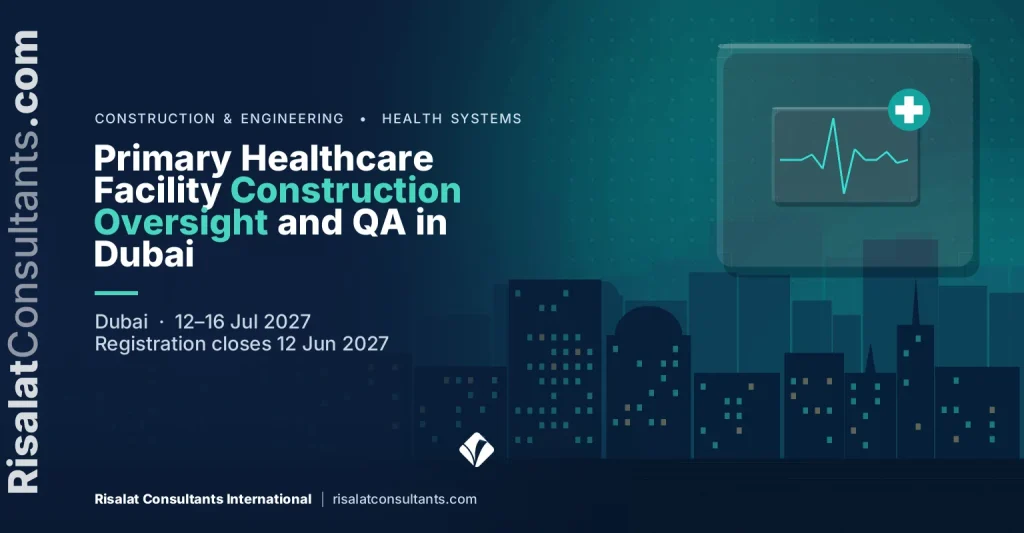
- 12–16 Jul 2027 (5 days)
- Where
- Dubai, United Arab Emirates
- Fee per participant
- £3,850 (GBP)
- Payment
- By invoice and bank transfer
- Registration closes
- 12 Jun 2027
- Certificate
- Certificate of completion
- In-house option
- Run it for your team, on your dates
On this page 13 sections
Programme Overview
Primary healthcare infrastructure requires robust engineering oversight to guarantee structural integrity, occupant safety, and functional clinical performance. Public institutions and donor-funded delivery units operating in fragile environments frequently face logistical constraints, uneven workmanship, and non-compliant building materials. This five-day course equips technical specialists with practical supervisory methodologies, contract management protocols, and international engineering benchmarks. Participants examine complete project lifecycles, ensuring rural and urban health facilities satisfy structural requirements, operational demands, and rigorous multilateral development bank standards.
The curriculum centres on field-level quality assurance, covering structural concrete testing, seismic resilience, building envelope integrity, and architectural layouts tailored to infection prevention and control. Technical officers learn to evaluate contractor submissions, implement multi-stage site inspection regimens, and verify adherence to design specifications. Through structured analyses of healthcare building systems, attendees address electrical reliability, clean water distribution, drainage networks, and specialized hazardous waste containment units, ensuring full alignment with international technical guidance from organisations such as the World Health Organisation.
Delivered in Dubai, this intensive programme provides infrastructure practitioners with the tools needed to manage contractor non-compliance, mitigate procurement risks, and conduct systematic verification under donor financing frameworks. Participants review FIDIC contract administration principles, quality control documentation, and environmental and social management plans. By mastering proactive oversight strategies, technical delivery teams protect public capital investments, enforce statutory building codes, and ensure delivered primary care facilities provide safe, durable, and dignified treatment environments for vulnerable communities.
Delivery units are currently modernising clinic networks and physical infrastructure funded by major multilateral initiatives, including the Afghanistan Health Emergency Response (HER) Project. Expanding primary care access in remote and underserved regions requires rapid yet compliant infrastructure implementation. Without rigorous site oversight, accelerated civil works risk poor structural quality, inadequate infection control measures, and premature facility deterioration, making advanced technical supervision vital for project engineers right now.
Delivered by Risalat Consultants International in Dubai, United Arab Emirates, it combines expert-led sessions, real cases and group work, so that participants can apply what they learn in their own institution.
The Programme Strengthens Institutional Capability
- Primary healthcare facility typologies: spatial planning, clinical workflows, and zoning
- Applicable international building codes and seismic design considerations for health posts
- Reviewing contractor mobilisation, technical submittals, and site-specific QA/QC plans
- Geotechnical verification, foundation excavation oversight, and soil compaction testing
- Establishing baseline inspection and test plans (ITP) for civil and structural works
- Concrete batching, slump testing, compressive strength sampling, and curing verification
- Reinforcing steel inspection: grade verification, placement, concrete cover, and tying standards
- Masonry unit compliance, mortar mix ratios, damp-proof courses, and tie-beam integrity
- Infrastructure planning and prioritisation
- Project appraisal and business cases
- Financing options and public-private partnerships
- Procurement and contracting for works
It is designed for civil and structural engineers managing health facility construction, site supervision engineers and resident technical officers, procurement specialists managing civil works tenders and contracts and others who want practical, current skills in infrastructure, urban development and partnerships.
- Transaction
- Record
- Control
- Evidence
- Opinion
The Growing Importance of Primary Healthcare Facility Construction Oversight and QA in Dubai
Infrastructure and urban services shape growth, health and opportunity. Projects are large, complex and long-lived, and weaknesses in planning, financing or delivery are costly to fix later.
Governments increasingly combine public investment, partnerships with the private sector and new technologies. Teams who can plan, appraise, procure and manage these investments deliver better assets and services.
Organisations increasingly require professionals capable of:
- Plan and prioritise infrastructure investments
- Appraise projects and prepare business cases
- Choose financing and delivery models
- Supervise works for time, cost and quality
- Manage assets over their life
Strong infrastructure, urban development and partnerships systems help organisations:
- Select the right investments
- Deliver projects on time and on budget
- Attract financing and partners
- Keep assets working for longer
This Primary Healthcare Facility Construction Oversight and QA in Dubai programme brings these elements together in a practical format, so that participants understand not only what good practice looks like but also how to introduce it in their own setting, with the people and resources they have.
Who Should Attend This Primary Healthcare Facility Construction Oversight and QA in Dubai Training?
This programme is designed for:
- Civil and structural engineers managing health facility construction
- Site supervision engineers and resident technical officers
- Procurement specialists managing civil works tenders and contracts
- Infrastructure project managers within health sector delivery units
- Technical specialists from ministries of public health and public works
- Engineers supporting donor-financed rural health rehabilitation projects
- Quality assurance and quality control (QA/QC) inspectors
- Environmental, social, health, and safety (ESHS) site compliance officers
- Technical advisors supervising remote primary care clinic builds
- Infrastructure and urban planners
- Engineers and technical managers
- Project and programme managers
The programme suits experienced professionals as well as those moving into new responsibilities. Groups that mix institutions and countries are encouraged, because participants learn a great deal from each other’s experience.
Tick what your team needs to be able to do.
Primary Healthcare Facility Construction Oversight and QA in Dubai Training Objectives
Upon successful completion of this Primary Healthcare Facility Construction Oversight and QA in Dubai Training, participants will be able to:
- Execute systematic quality assurance and quality control protocols for primary healthcare civil works
- Verify contractor compliance with international structural codes, seismic guidelines, and material standards
- Inspect clinical infrastructure to ensure adherence to WHO infection prevention and control design parameters
- Evaluate engineering plans for medical waste management facilities, including safe sharps handling and incinerator siting
- Administer FIDIC construction contracts effectively to manage variations, site delays, and material non-conformance
- Audit occupational health, safety, and environmental safeguards on remote and challenging construction sites
- Conduct thorough pre-commissioning inspections and manage defect liability documentation prior to facility handover
- Explain how infrastructure is planned and prioritised
- Appraise projects and prepare a business case
- Compare financing and delivery models, including partnerships
Each objective is practised during the programme through exercises, cases or group work, so that participants leave able to do it, not only to describe it.
Programme Contents and Structure
- Primary healthcare facility typologies: spatial planning, clinical workflows, and zoning
- Applicable international building codes and seismic design considerations for health posts
- Reviewing contractor mobilisation, technical submittals, and site-specific QA/QC plans
- Geotechnical verification, foundation excavation oversight, and soil compaction testing
- Establishing baseline inspection and test plans (ITP) for civil and structural works
- Concrete batching, slump testing, compressive strength sampling, and curing verification
- Reinforcing steel inspection: grade verification, placement, concrete cover, and tying standards
- Masonry unit compliance, mortar mix ratios, damp-proof courses, and tie-beam integrity
- Roof structure oversight: timber and steel trusses, tie-downs, insulation, and storm resistance
- Building envelope quality: waterproofing, external rendering, and weather-resistant finishes
- Infection prevention and control (IPC) engineering: ventilation rates, isolation rooms, and clean zones
- Healthcare plumbing standards: potable water storage, pressure testing, and backflow prevention
- Clinical wastewater conveyance, septic system design, and soak-away pit engineering
- Electrical supply reliability: primary grid connection, solar-diesel hybrid systems, and earthing
- Internal finish verification: non-porous floorings, anti-microbial coatings, and hygienic coving
- Civil infrastructure for healthcare waste: placenta pits, ash pits, and sharps disposal units
- Medical waste compound layout, fencing requirements, and dual-chamber incinerator civil bases
- World Bank Environmental and Social Framework (ESF) compliance on active construction sites
- Occupational health and safety (OHS) audits: scaffolding safety, PPE enforcement, and trench shoring
- Managing remote site logistics, material supply disruptions, and security protocols
- Managing contractor non-conformance: notices to correct, rectification plans, and payment withholding
- FIDIC contract administration for health civil works: variation verification and claims evaluation
- Pre-commissioning procedures: snag list preparation, MEP systems testing, and functional trials
- Environmental handover: clean-up, hazardous material clearance, and site reinstatement
- Final handover protocols, as-built drawing review, and defects liability management
Full day-by-day contents
The programme runs over 5 days. Each day combines expert input, practical work and a closing workshop or case study:
- First Day: Day 1: Structural Standards, Healthcare Architecture, and Site Mobilisation
- Second Day: Day 2: Structural Quality Assurance, Materials Testing, and Enclosure Systems
- Third Day: Day 3: Building Services, IPC Engineering, and Clinical WASH Integration
- Fourth Day: Day 4: Healthcare Waste Facilities, ESHS, and Remote Site Safety
- Fifth Day: Day 5: Contractor Management, Snagging, Commissioning, and Handover
Full day-by-day contents
First Day | Day 1: Structural Standards, Healthcare Architecture, and Site Mobilisation
- Primary healthcare facility typologies: spatial planning, clinical workflows, and zoning
- Applicable international building codes and seismic design considerations for health posts
- Reviewing contractor mobilisation, technical submittals, and site-specific QA/QC plans
- Geotechnical verification, foundation excavation oversight, and soil compaction testing
- Establishing baseline inspection and test plans (ITP) for civil and structural works
Workshop: Day 1: Structural Standards, Healthcare Architecture, and Site Mobilisation: Applying It to Your Institution
Working in small groups, participants apply the day's methods to examples from their own institutions and agree practical next steps.
Second Day | Day 2: Structural Quality Assurance, Materials Testing, and Enclosure Systems
- Concrete batching, slump testing, compressive strength sampling, and curing verification
- Reinforcing steel inspection: grade verification, placement, concrete cover, and tying standards
- Masonry unit compliance, mortar mix ratios, damp-proof courses, and tie-beam integrity
- Roof structure oversight: timber and steel trusses, tie-downs, insulation, and storm resistance
- Building envelope quality: waterproofing, external rendering, and weather-resistant finishes
Workshop: Day 2: Structural Quality Assurance, Materials Testing, and Enclosure Systems: Applying It to Your Institution
Working in small groups, participants apply the day's methods to examples from their own institutions and agree practical next steps.
Third Day | Day 3: Building Services, IPC Engineering, and Clinical WASH Integration
- Infection prevention and control (IPC) engineering: ventilation rates, isolation rooms, and clean zones
- Healthcare plumbing standards: potable water storage, pressure testing, and backflow prevention
- Clinical wastewater conveyance, septic system design, and soak-away pit engineering
- Electrical supply reliability: primary grid connection, solar-diesel hybrid systems, and earthing
- Internal finish verification: non-porous floorings, anti-microbial coatings, and hygienic coving
Case Study: Day 3: Building Services, IPC Engineering, and Clinical WASH Integration in Practice
Participants analyse a realistic case, compare the choices made with good practice and draw lessons they can use in their own setting.
Fourth Day | Day 4: Healthcare Waste Facilities, ESHS, and Remote Site Safety
- Civil infrastructure for healthcare waste: placenta pits, ash pits, and sharps disposal units
- Medical waste compound layout, fencing requirements, and dual-chamber incinerator civil bases
- World Bank Environmental and Social Framework (ESF) compliance on active construction sites
- Occupational health and safety (OHS) audits: scaffolding safety, PPE enforcement, and trench shoring
- Managing remote site logistics, material supply disruptions, and security protocols
Workshop: Day 4: Healthcare Waste Facilities, ESHS, and Remote Site Safety: Applying It to Your Institution
Working in small groups, participants apply the day's methods to examples from their own institutions and agree practical next steps.
Fifth Day | Day 5: Contractor Management, Snagging, Commissioning, and Handover
- Managing contractor non-conformance: notices to correct, rectification plans, and payment withholding
- FIDIC contract administration for health civil works: variation verification and claims evaluation
- Pre-commissioning procedures: snag list preparation, MEP systems testing, and functional trials
- Environmental handover: clean-up, hazardous material clearance, and site reinstatement
- Final handover protocols, as-built drawing review, and defects liability management
Capstone Exercise: Primary Healthcare Facility Construction Oversight and QA in Dubai Action Plan for Your Institution
Participants bring the week together in an action plan for their own institution, with priorities, owners and first steps, and present it for feedback from peers and facilitators.
Primary Healthcare Facility Construction Oversight and QA in Dubai Training Methodology
The training is delivered through practical, technical modules tailored to engineers and technical managers. Sessions combine instructor-led technical presentations with engineering case studies, drawing reviews, and simulated site inspection exercises. Participants analyse photographic evidence from live construction sites, critique contractor method statements, and evaluate material laboratory test certificates. Working in small peer groups, attendees resolve real-world quality failures, prepare actionable non-conformance reports, and draft inspection and test plans aligned with donor standards.
The programme combines:
- Expert-led sessions on current practice
- Regional and international case studies
- Group work and practical exercises
- Simulations and role plays where relevant
- Discussion of participants' own challenges
- Peer learning across institutions and countries
- Practical tools and templates to take back to work
- Daily reflection and action planning
Before the programme, a short pre-assessment helps the facilitators understand each participant’s role and priorities, so that examples and exercises can be adjusted to the group. Each day ends with a short reflection in which participants note what they will apply at work.
Expected Outcomes
Upon completion of this Primary Healthcare Facility Construction Oversight and QA in Dubai Training, participants will be able to:
- Apply comprehensive inspection and test plans across all civil works phases of clinic construction
- Identify and resolve non-compliant building materials and deficient contractor execution on site
- Integrate clinical infection prevention and control principles directly into facility infrastructure audits
- Oversee the correct engineering installation of specialized clinical waste and sanitary disposal units
- Enforce occupational health, safety, and environmental safeguards in line with multilateral project rules
- Lead formal pre-commissioning inspections and produce definitive snagging lists for final handover
- Plan and prioritise infrastructure investments
- Appraise projects and prepare business cases
Participants leave with a personal action plan and practical tools they can use in their institution from the first week back. Institutions that send several participants can use the programme to agree shared methods and templates across teams, which makes improvements easier to sustain.
£3,850 per participant · invoice and bank transfer · groups of 5 or more receive a discount
Five or more from one organisation: ask for the group rate on the invoice request.
Ten or more: an in-house version for your institution may cost less per person. Ask for an in-house quote.
Registration closes in 217 days (12 Jun 2027)
Institutional Application of Primary Healthcare Facility Construction Oversight and QA in Dubai Training
This programme supports organisations in strengthening:
- Investment planning
- Project appraisal
- Partnership management
- Works supervision
- Asset management
Participants return with practical tools to improve:
- Business cases
- Risk allocation
- Contract management
- Maintenance planning
- Service monitoring
The programme is built so that learning moves from the classroom into the institution. Participants work on their own processes and documents where possible, and leave with an action plan that their managers can review and support.
Regional Relevance & Application
Europe
European institutions apply infrastructure, urban development and partnerships within detailed regulatory frameworks and reform agendas. Participants from Europe can compare their practice with colleagues from other regions and test how established methods work under different conditions.
Africa
Across Africa, ministries, agencies and project teams working in infrastructure, urban development and partnerships increasingly operate alongside donor-financed programmes that expect clear systems and evidence. The programme helps participants adapt good practice to the institutions and resources they work with.
Middle East
In the Middle East, national development strategies and diversification plans place growing demands on infrastructure, urban development and partnerships. Participants explore how to build the capability these plans need inside public bodies and companies.
Asia
Institutions across Asia combine rapid growth with ambitious modernisation programmes. Participants from Asia can share their experience of scaling systems quickly and learn from approaches used elsewhere.
Pacific
Small island and Pacific states face particular constraints of size, distance and capacity. The programme highlights practical, proportionate approaches to infrastructure, urban development and partnerships that suit smaller institutions.
Holding the programme in Dubai, United Arab Emirates brings participants together away from their daily pressures, so they can compare how infrastructure, urban development and partnerships is handled in different settings. The same programme can also be delivered in-house for one institution, in its own country or online, with cases taken from its current work.
Host Country Profile – United Arab Emirates
Programmes, Workshops, Exposures, Training Courses in Dubai, UAE by Risalat Consultants International
Studying away from their own country gives participants time to focus, a fresh view of their own institution and the chance to build a network with colleagues from other countries.
Primary Healthcare Facility Construction Oversight and QA in Dubai Training Deliverables
Participants receive support before, during and after the programme, so that preparation, learning and follow-up form one continuous experience.
Before the Programme
- Participant Pre-Assessment
- Primary Healthcare Facility Construction Oversight and QA in Dubai Readiness Assessment
- Primary Healthcare Facility Construction Oversight and QA in Dubai Resource Pack
- Preparatory Reading Materials
- Complimentary Visa Support & Advisory
During the Programme
- Airport Pickup & Welcome Assistance
- Accommodation with Breakfast
- Welcome Networking Dinner
- Risalat Training Kit (Bag, Bottle, Mug, T-Shirt, Cap, Passport Cover, Pens, Notebook, Magnet & Keychain)
- Comprehensive Primary Healthcare Facility Construction Oversight and QA in Dubai Training Manual
- Project Appraisal Template
- PPP Risk Allocation Matrix
- Works Supervision Checklist
- Asset Management Plan Template
- Practical Workshops & Simulations
- Group Discussions & Peer Learning
- Daily Lunch and Refreshments
- Full Access to Training Venue Facilities
- Mini Pad / Tablet with Digital Learning Materials
- Field Visit (where applicable)
- Entertaining City Tour
After the Programme
- Certificate of Completion
- Risalat Programme Participation Recognition Award
- Post-Training Reference Materials
- Business Case Review Checklist
- Maintenance Planning Template
- Post-Training Support & Follow-Up Guidance
- Programme Report
Institutions can also request a tailored in-house version of this programme, delivered at their premises or online. Request a proposal.
Common Challenges in Primary Healthcare Facility Construction Oversight and QA in Dubai, And How This Training Helps
How can institutions plan and prioritise infrastructure investments?
The programme addresses this directly on the first day (Day 1: Structural Standards, Healthcare Architecture, and Site Mobilisation), where participants practise the methods involved and adapt them to their own institution, then build it into their action plan.
How can institutions appraise projects and prepare business cases?
The programme addresses this directly on the second day (Day 2: Structural Quality Assurance, Materials Testing, and Enclosure Systems), where participants practise the methods involved and adapt them to their own institution, then build it into their action plan.
How can institutions choose financing and delivery models?
The programme addresses this directly on the third day (Day 3: Building Services, IPC Engineering, and Clinical WASH Integration), where participants practise the methods involved and adapt them to their own institution, then build it into their action plan.
How can institutions supervise works for time, cost and quality?
The programme addresses this directly on the fourth day (Day 4: Healthcare Waste Facilities, ESHS, and Remote Site Safety), where participants practise the methods involved and adapt them to their own institution, then build it into their action plan.
How can institutions manage assets over their life?
The programme addresses this directly on the fifth day (Day 5: Contractor Management, Snagging, Commissioning, and Handover), where participants practise the methods involved and adapt them to their own institution, then build it into their action plan.
Frequently Asked Questions
When and where does the Primary Healthcare Facility Construction Oversight and QA in Dubai programme take place?
It runs from 12 Jul 2027 to 16 Jul 2027, in Dubai, United Arab Emirates. The registration deadline is shown at the top of this page.
Who should attend?
The programme is designed for civil and structural engineers managing health facility construction, site supervision engineers and resident technical officers, procurement specialists managing civil works tenders and contracts, infrastructure project managers within health sector delivery units, and others who want practical skills in infrastructure, urban development and partnerships.
Will I receive a certificate?
Yes. Participants who complete the programme receive a Certificate of Completion from Risalat Consultants International.
Can this programme be delivered for our institution only?
Yes. We can deliver a tailored in-house version at your premises, in another city or online, built around your own cases. Use the proposal request on this page.
Do I need prior experience in infrastructure, urban development and partnerships?
No specialist background is required beyond experience in a related role. A short pre-assessment helps the facilitators adapt the sessions to the group.
Training courses in DubaiConstruction & Engineering training courses
Why Dubai for this programme
Dubai is a one-flight hub for Africa, Asia and Europe, with simple visas for many nationalities and modern training venues.
The Primary Healthcare Facility Construction Oversight and QA in Dubai programme in July 2027 brings together officials and professionals from across the Middle East region and beyond. Sessions combine short inputs, case studies and group work on participants' own files, and the city's institutions can be added as a study visit on request.
Getting there: Dubai International (DXB).
Check whether you need a visa with the free Visa Checker, and ask for an invitation letter once you are registered.
Other programmes in Dubai
- Incubator Management, Seed Financing and Tech Startup Ecosystems in Dubai
- High-Voltage Transmission Network Strengthening and Substation Safety in Dubai
- Urban Livelihoods and Micro-Enterprise Support Programming in Dubai
- Labor-Intensive Public Works and Community Cash Operations in Dubai
- AI in Classroom Pedagogy and Multimedia Educational Design in Dubai
- Procurement Framework and Regulations for Projects World Bank
- MAPS: Methodology for Assessing Procurement Systems MAPS Initiative
- Open Contracting Partnership Open Contracting Partnership
More training courses in United Arab Emirates · All programmes in Middle East · Full training calendar